(Updated Dec. 27, 2024)
In August 2001, the Cardinals began a transformation from underachievers to postseason qualifiers when they acquired pitcher Woody Williams from the Padres for outfielder Ray Lankford.
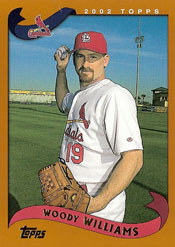 After winning the National League Central championship in 2000, the Cardinals were expected to contend in 2001, but they entered August in third place at 53-51 _ 8.5 games behind the first-place Cubs and four behind the Astros.
With the emergence of rookie Albert Pujols, the Cardinals had a surplus of outfielders, including Jim Edmonds, J.D. Drew and Lankford. Complaining about a lack of respect, Lankford, 34, was falling out of favor with team management. It didn’t help that he was hitting .235 with 105 strikeouts in 264 at-bats. Lankford had missed on 36 percent of his swings.
On Aug. 2, 2001, the Cardinals sent Lankford (who agreed to waive his no-trade clause) and more than $2.8 million to the Padres for Williams. Andy Benes was struggling (7.06 ERA entering August) and the Cardinals needed a fifth starter to join a rotation of Matt Morris, Darryl Kile, Dustin Hermanson and Bud Smith.
“We’re extremely happy,” Cardinals general manager Walt Jocketty said to the St. Louis Post-Dispatch. “Woody Williams is a quality pitcher and a quality person.”
Williams, who would turn 35 Aug. 19, didn’t appear to be the obvious solution. He was 8-8 with a 4.97 ERA for the Padres, yielding 170 hits in 145 innings.
“I’m going to use this as a steppingstone that will allow me to get back to where I want to be,” Williams said.
Relying on a change of speeds and sharp location, Williams made his first Cardinals start on Aug. 4, 2001, against the Marlins at St. Louis and pitched six shutout innings. He left the game to a standing ovation from the crowd of 42,312. Luther Hackman and Gene Stechschulte combined to pitch three shutout innings in relief, preserving the win for Williams in a 3-0 victory. Boxscore
Starting with that game, the Cardinals went 38-16 the remainder of the season, finishing in a tie for first place with the Astros at 93-69 and qualifying for the playoffs for a second consecutive season.
The Cardinals couldn’t have done it without Williams, who was 7-1 with a 2.28 ERA for them, limiting batters to 54 hits in 75 innings.
Looking back on his Cardinals days, Williams told Stan McNeal of Cardinals Magazine in 2024, “When I got to St. Louis, I’d had a problem with giving up the long ball in my career … In St. Louis, my mentality became, ‘I’m going to attack the zone and keep the ball in the ballpark.’ I’ll be doggone if those guys behind me didn’t support me like crazy and make me look like a much better pitcher.”
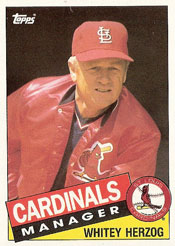 On July 22, 1986, a scuffle involving the Cardinals and Giants in St. Louis was sparked by a war of words between Herzog and Craig.
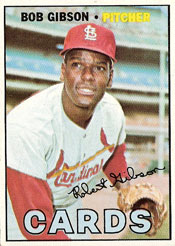 Gibson posted records against the Mets of 4-1 in 1964, 5-0 in 1965 and 3-0 in 1966.
 Taylor, acquired by the Cardinals from the Pirates in October 1969 for pitcher Dave Giusti and catcher Dave Ricketts, was expected to compete for the starting right field position in 1970. Instead, the job went to Leron Lee and Taylor primarily was used as a pinch-hitter.
 Matched against
 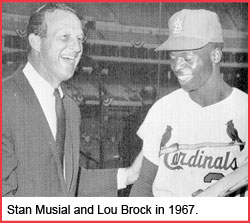 Stan Musial (3,630), Lou Brock (2,713), Rogers Hornsby (2,110) and Enos Slaughter (2,064) also achieved 2,000 hits as Cardinals. Of those four, only Musial played his entire big-league career with St. Louis. The career hit totals of the others: Brock (3,023), Hornsby (2,930) and Slaughter (2,383). Pujols achieved his 3,000th career hit on May 4, 2018.
 RetroSimba