(Updated Aug. 11, 2024)
On Dec. 9, 1980, in a trade that successfully altered the course of the franchise, the Cardinals acquired closer Bruce Sutter from the Cubs for first baseman Leon Durham, third baseman Ken Reitz and utility player Ty Waller.
 Sutter gave the Cardinals the reliable closer they had been lacking. With Sutter as the anchor, manager Whitey Herzog built a deep bullpen that handcuffed the opposition and took pressure off the starting staff.
Sutter, who would be elected to the National Baseball Hall of Fame, was a key to turning the Cardinals from underachievers throughout the 1970s to World Series champions in 1982.
In his first year with St. Louis, the strike-hampered 1981 season, Sutter had a National League-leading 25 saves. In 1982, he led the NL in saves again, with 36.
In the five years before Sutter’s arrival, no Cardinals reliever had recorded more than 13 saves in a season.
In his book, “White Rat: A Life in Baseball,” Herzog said, “Relief pitchers like Bruce Sutter are worth their weight in gold.”
Wheeling and dealing
At the 1980 baseball winter meetings in Dallas, Herzog, who had the dual role of general manager and manager, completed a multiplayer deal in which he acquired closer Rollie Fingers from the Padres. He still wanted Sutter, who had won the 1979 National League Cy Young Award. Herzog viewed Fingers as insurance in case a deal with the Cubs couldn’t be completed.
Herzog called Fingers “the great relief pitcher I needed, but not the one I really wanted. The guy I was really after was Bruce Sutter.”
The Cubs were willing to deal Sutter because he had been awarded a $700,000 yearly salary, about twice as much as the club wanted to pay, in an arbitration ruling the year before.
When Herzog first approached the Cubs about Sutter, their general manager, Bob Kennedy, wanted Durham, Waller and second baseman Tom Herr, Herzog said.
Regarding Durham, Herzog told the St. Louis Post-Dispatch, “I hate to give him up. Durham is one of the top five prospects in the game.”
Cardinals scout Fred McAlister told the Chicago Tribune, “Quite frankly, in Durham, the Cubs may be getting another Dave Parker. If this guy ain’t a prospect, then nobody is.”
Herzog said he tried to get the Cubs to accept a package of players excluding Durham and Herr, but Kennedy responded, “No Durham, no Sutter.”
Herzog offered first baseman Keith Hernandez instead of Herr.
“I offered them Hernandez in a package deal,” Herzog said in the book, “You’re Missin’ A Great Game.” “But … Kennedy didn’t want to take on that big salary.”
When the Cardinals countered with an offer of Durham, Reitz and Waller, the Cubs accepted.
Upping the ante
Herzog was ready to part with Reitz, who he deemed “a fine-fielding third baseman but a streak hitter and maybe one of the slowest runners I’ve seen.” He hoped to shift Ken Oberkfell from second to third and put Herr at second.
Reitz, however, had a no-trade clause in his contract and wasn’t eager to approve a move to the Cubs. According to the Post-Dispatch, Reitz finally consented when the Cubs offered to increase his salary and the Cardinals agreed to compensate him for waiving the no-trade clause. Herzog said the Cardinals gave Reitz $50,000 to approve the trade. Newspapers reported the price was $75,000.
Chicago Tribune columnist Bob Verdi wrote, “It would have been nice had Kennedy held out for Ted Simmons, whose average for 81 games in Wrigley Field might have bordered on astronomical.”
Because he had signed free-agent catcher Darrell Porter, Herzog wanted to move Simmons from catcher to first base and put Hernandez in left field.
When Simmons balked at moving to first base, Herzog shipped Simmons, Fingers and pitcher Pete Vuckovich to the Brewers for pitchers Dave LaPoint and Lary Sorensen and oufielders David Green and Sixto Lezcano.
Good as expected
“The Cardinals have a chance to win the pennant with Bruce,” Kennedy told the Chicago Tribune, “but we have to rebuild, and he couldn’t win the pennant for us.”
Sutter said he was glad to leave the Cubs.
“I just don’t see any chance of the Cubs becoming a winner,” Sutter told the Chicago Tribune. “There’s not much in their minor-league system and it’s pretty obvious we didn’t have enough talent up here. It seems like the minute you become good around here, and they have to pay you for being good, they get rid of you because they don’t want to pay you. You just can’t operate that way.”
Sutter added, “The ballclub I’m going to is going to be a winner, and that matters more than anything.”
Using a split-fingered pitch Herzog described as looking “like a rock skipping on water _ tough to pick up, let alone hit,” Sutter was the stopper Herzog desired.
“When I got to St. Louis, I was sure I got myself a top-flight closer,” Herzog said. “…I realized it was smarter to start building my staff at the back, with that one potent guy, and move forward from there. I’d get that guy who could shut the door the last two innings, cut the other guy’s chance from 27 (outs) to 21, and hope my starters were good enough to get me through the sixth (inning).”
Sutter changed the dynamics of the game for the Cardinals. “Sutter might be the most important pitcher I ever had,” Herzog said. “He was sure the best relief pitcher I ever saw.”
Sutter led the league in saves in three of his four seasons with St. Louis. In the 1982 World Series, in which the Cardinals won four of seven games against the Brewers, Sutter had a win and two saves, closing out the decisive Game 7. Video
In an interview for the 2006 Baseball Hall of Fame yearbook, Sutter said, “I had a great time playing there. Whitey Herzog was the best. I learned a lot of baseball from Whitey Herzog.”
Claude Osteen, who pitched and coached in the big leagues, said most hitters couldn’t resist swinging at Sutter’s split-fingered pitch.
“So many times I’ve seen him come in to pitch and not be sharp and the majority of his out pitches are balls,” Osteen told the Philadelphia Daily News in 1985, “but the pitch just looks so appealing to the hitter that they can’t lay off of it. I’ve only seen one of two hitters _ Mike Schmidt is one and Ted Simmons was one of the best _ who were good at laying off of that pitch. Those two hitters constantly have Sutter behind in the count because they don’t swing at that pitch. That’s the secret to it.”
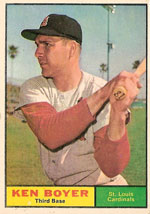 Santo, former Cubs third baseman, was deserving of election, but voters should do the right thing and elect former Cardinals third baseman Ken Boyer, too. To elect one without the other is an injustice.
 The Cardinals
 RetroSimba