Feeds:
Posts
Comments

Archive for May, 2011

Two of the best pitchers in Cardinals history _ Dizzy Dean and Mort Cooper _ each yielded 19 hits in a game, and won.

_ Cardinals 8, Reds 7, May 31, 1936, at St. Louis: Dizzy Dean appeared headed for a loss when Cincinnati took a 7-5 lead into the ninth inning, but the Cardinals scored twice in the ninth and won with a run in the 12th.

Two days after pitching 1.1 innings of relief, Dean went all 12 innings, yielding 19 hits and two walks (he also hit two batters), and improved his record to 9-2. The Reds stranded 13 and had no home runs. Boxscore

_ Cardinals 4, Phillies 3, Sept. 24, 1944, at Philadelphia: In his last regular-season start of the year, Cooper went the route and earned the win when Whitey Kurowski broke a 3-3 tie with a home run off Phillies starter Ken Raffensberger in the 16th inning.

Philadelphia scored single runs in the first, third and fourth before Cooper shut them out over the last 12. Of Philadelphia’s 19 hits, 18 were singles (first baseman Tony Lupien doubled). Boxscore

Cooper’s line: 16 innings, 19 hits, 3 runs, 5 walks, 7 strikeouts.

Raffensberger’s line: 16 innings, 13 hits, 4 runs, 1 walk, 5 strikeouts.

The win improved Cooper’s record to 22-7 _ his third consecutive season with at least 21 wins.

In the 1944 World Series against the Browns, Cooper made two starts and held the American League champions to two runs over 16 innings.

Read Full Post »

(Updated Nov. 24, 2024)

Bill Bergesch, a longtime baseball executive who worked for difficult team owners such as Charlie Finley, George Steinbrenner and Marge Schott, is the man most responsible for Bob Gibson becoming a Cardinal.

Bergesch, a St. Louis native, joined the Cardinals organization in 1947 as a minor-league administrator. He was general manager or business manager of Cardinals farm clubs in Albany, Ga., Winston-Salem, N.C., Columbus, Ga., and Omaha, Neb.

As general manager at Omaha, Bergesch donated used equipment to recreation-center baseball teams organized by Josh Gibson, older brother of Bob Gibson.

“I got to know Bob’s brother Josh well,” Bergesch told Baseball Digest in 1962. “We let his kid teams come to our games. We gave his teams some of our spare equipment and sold them our old uniforms cheap.”

Josh Gibson believed his brother Bob was a professional prospect. Years later, Bob Gibson told The Sporting News he could throw a baseball hard as far back as he could remember.

Bob Gibson had been scouted by big-league organizations, including the Yankees and Dodgers, but the only scout who made an offer after he graduated from high school was Runt Marr of the Cardinals.

Instead, Bob Gibson accepted a scholarship to play basketball at Creighton University. He played baseball when the basketball season ended.

In his autobiography, “Stranger to the Game,” Gibson said, “Baseball was, at best, my second sport, and I really didn’t have a niche in it. At various times in my college career, I played catcher, third base, outfield and occasionally pitcher, demonstrating a no-table wildness in the latter capacity.”

As a favor, Josh Gibson asked Bergesch to watch his brother play for Creighton in the spring of 1957.

David Halberstam, in his book “October 1964,” said Bergesch attended two Creighton games but Gibson didn’t pitch in either. He played outfield in the first and was the catcher in the second. Bergesch could see Gibson was a talented athlete with a powerful arm.

Bergesch told Omaha manager Johnny Keane that Gibson was a prospect and suggested arranging a tryout. When Keane saw Gibson throw, he was impressed.

“At the tryout, Gibson was awesome,” Halberstam wrote. “First, he took batting practice and showed exceptional power … Then Bergesch had him throw to the (Omaha) Cardinals’ regular catcher. Neither Bergesch nor Keane had ever seen a kid throw like that … Years later, Bergesch estimated that he must have thrown at about 95 mph. In addition, his fastball already had movement.”

In his book “From Ghetto to Glory,” Gibson said Bergesch told him, “Nobody’s going to give you a big bonus. If they give you more than $4,000, the rules say they have to carry you on the major-league roster for two seasons and you just don’t have enough experience for any club to take a chance on you like that.”

When basketball’s Harlem Globetrotters offered Gibson a $1,000-a-month contract, Gibson said, “I … called Bill Bergesch. He had impressed me by being so forthright. I told him I was ready to sign with the Cardinals.”

Gibson signed for $4,000, spurning an aggressive offer from the Reds.

“I would sign with the Cardinals for a bonus of a thousand dollars, play out the (1957) season for another $3,000, then join the Globetrotters at $1,000 a month for four months of the baseball off-season,” Gibson said. “The total was $8,000, but the real value of the deal was that it kept me alive in both sports. I still wasn’t ready to pick one.”

In a 2018 interview with Stan McNeal of Cardinals Yearbook, Gibson recalled, “I played for the Globetrotters from November (1957) until early February (1958). I must have played 120 games with them because sometimes we’d play two games in a day … I loved playing basketball, but I don’t think I could have played too long for the Globetrotters. The parts of the games when there wasn’t all the clowning around were fine; the other parts really weren’t my thing.”

Gibson eventually chose baseball. A good hitter as well as a talented pitcher, Gibson was a switch-hitter until his first season at Omaha, The Sporting News reported. His right elbow bothered him, so he began batting exclusively from the right side.

Two years after he accepted Bergesch’s contract offer, Gibson made his big-league debut with the 1959 Cardinals. When Keane replaced Solly Hemus as Cardinals manager in 1961, Gibson blossomed under the care of his former Omaha mentor and built a career that landed him in the Baseball Hall of Fame.

After the 1959 season, the Cardinals dumped Omaha from their farm system, leaving Bergesch out of a job. The Cardinals made him their minor-league field coordinator in 1960. A year later, Finley hired Bergesch to be assistant general manager of the Athletics.

Bergesch went on to become a Yankees executive under Steinbrenner and general manager of the Reds under Schott.

He had many achievements, but his most memorable was signing Bob Gibson.

Read Full Post »

(Updated Feb. 20, 2023)

Harmon Killebrew, long an admirer of Stan Musial, got to know the Cardinals icon best when both represented Major League Baseball on a tour of Vietnam.

Killebrew, the Hall of Fame slugger who hit 573 home runs in a 22-year American League career, played primarily for the Twins and Senators. Though he never played a regular-season or postseason game against the Cardinals, Killebrew did have a connection to and fondness for Musial.
In a radio interview with St. Louis station 1380 AM, Killebrew was asked to share his thoughts about Musial, who was about to receive the Presidential Medal of Freedom.

“I always admired Stan from afar as a youngster,” Killebew told radio host Evan Makovsky. “I’ve known him now for over 40-some years and we’ve been good friends. I’ve always just marveled at the records Stan Musial put up. I always felt he did not get the credit he deserved … He has to rank, in my book, as one of the greatest players who ever lived.”

On Nov. 1, 1966, Musial, Killebrew, the Braves’ Hank Aaron and Joe Torre, the Orioles’ Brooks Robinson and broadcaster Mel Allen embarked on a trip to Vietnam to conduct clinics and boost morale of the U.S. troops.

“I got to know Stan very, very well (on that tour),” Killebrew said. “I got to know the kind of person he was, and it really magnified my feelings about Stan Musial.”

According to a November 1966 story by Lou Hatter of the Baltimore Sun, the tour was co-sponsored by the baseball commissioner’s office and the Department of Defense. The baseball group, which left from San Francisco, stopped in Honolulu, Guam and Manila on the way to Saigon. The return trip included stops in Tokyo and Anchorage before concluding in San Francisco.

In his autobiography, “I Had a Hammer,” Hank Aaron said, “Musial was one of my favorite ballplayers because he treated everybody the same _ black or white, superstar or scrub _ and he genuinely loved the game. When he and I were part of a group of players who toured Vietnam, Musial became the first white man I ever roomed with.”

Aaron added that the Vietnam trip enabled him to “develop a deeper friendship” with Musial, “who, for my money, was the greatest gentleman in the game.”

Brooks Robinson told the newspaper the group met with U.S. military personnel at field hospitals and battle stations. Robinson said the group was in daily earshot of gunfire and once saw a U.S. airstrike from their transport helicopter.

“A couple of our helicopters had taken bullet holes from snipers in the brush, though on the way to pick us up,” Robinson said. “We usually flew at about 3,000 feet to avoid sniper fire and never came in for a landing at a gradual descent. We normally came straight down from that altitude in a kind of screwdriver spiral descent. That was some kind of a thrill.”

In an interview for the 2003 Baseball Hall of Fame yearbook, Robinson recalled, “Stan and I visited one hospital where a kid had just lost both legs and was lying there in bed. Stan went over and said, ‘Hi, I’m Stan Musial with the St. Louis Cardinals.’ The kid actually apologized to Stan for not recognizing him. That tore me up right there. I had tears come to my eyes.”

Jim Lucas, a Pulitzer Prize-winning American war correspondent based in Vietnam for Scripps Howard newspapers, told colleagues the baseball group accomplished its mission.

“Wherever I’ve gone, I’ve heard nothing but raves,” Lucas said. “Stan Musial apparently is quite a guy. He’s the one most often quoted … They did a lot for baseball as an entity with the top brass, from General Westmoreland on down, and they did a lot for the morale of the troops.”

In the book “Musial: From Stash to Stan the Man,” author James N. Giglio wrote, “Musial nearly became a fatality; his quarters were bombed while he was elsewhere in the area eating lunch. He flirted with danger at another outpost and in a helicopter over hostile territory.”

Author George Vecsey, in the book “Stan Musial: An American Life,” reported a different version while making the same point: “This was no meet-and-greet opportunity in a secured camp … In Da Nang, the players had lunch with General William Westmoreland, the commander of the U.S. operation in Vietnam, and dinner with Lieutenant General Lewis Walt, the commanding general of the III Marine Amphibious Force. Shortly after that, the general’s quarters were bombed by the Vietcong. Musial was still talking about that bombing when he got home a few weeks later.”

An editorial in the Nov. 19, 1966, edition of The Sporting News opined, “These men are members of baseball’s elite. All have been well-rewarded for their accomplishments _ in money, prestige, applause and publicity. They have captured no headlines in Vietnam nor will they gain financially. Their trip might not be necessary either, but it surely is worthwhile.”

Read Full Post »

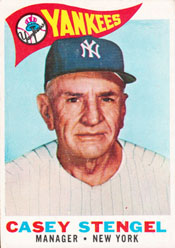
Besides ranking among the most successful managers, Tony La Russa and Casey Stengel have something else in common: Each had to leave his team during a season to receive treatment for a medical condition described as a virus.

At 66, La Russa, the Cardinals manager, sat out a six-game road trip to Chicago and Cincinnati in May 2011 to receive testing and treatment for shingles, a viral infection of the nerve roots.

At 69, Stengel, the Yankees manager who led them to 10 American League pennants and seven World Series titles, missed 12 games in 1960 when he entered a hospital for treatment of a virus condition that settled in his kidneys.

Known as “The Old Professor,” Stengel became ill on May 28, 1960.

When he was released from a New York hospital June 5, The New York Times reported the next day, “Casey Stengel, victorious in his battle with a low-grade virus, yesterday left Lenox Hill Hospital, where he had been confined since last Tuesday … Stengel, who first became ill on May 28, has been advised to rest for at least 24 more hours before resuming his job with the Bombers.”

Yankees coach Ralph Houk was acting manager in Stengel’s absence. The Yankees were 6-6 in the games Houk managed, including two doubleheaders.

Stengel returned to the Yankees on June 7. Dick Young of the New York Daily News described the scene at Yankee Stadium for The Sporting News: “He put on the white flannel uniform, and it felt good. For more than a week, he had worn nothing but silk pajamas or those baggy nightgowns they give you at the hospital, the ones that look shapeless enough to be Dior creations.”

Stengel met with reporters in the dugout before the Yankees faced the White Sox. Here is part of Dick Young’s account:

“You look good,” said a newspaperman, telling a little white lie.

“Well, I’ll tell you something,” said Casey. “They examined all my organs.

“Some of them are quite remarkable, and others are not so good. A lot of museums are bidding for them.”

Everybody laughed, including Stengel.

The Yankees, 22-21 when Stengel returned, beat the White Sox, 5-2, that night, sparking a seven-game winning streak. New York went on to win the American League pennant, finishing 97-57.

Read Full Post »

Cardinals shortstop Garry Templeton experienced a first-half funk during the 1978 season.

Templeton was booed by Cardinals fans for poor shortstop play that contributed to St. Louis’ dismal first three months of the season.

Jim Russo, a Baltimore Orioles scout based in St. Louis, said the Cardinals should demote Templeton to the minors “until he gets his head screwed on.”

Templeton, 22, made eight errors during a stretch in which the Cardinals lost 16 of 17 games from May 12 to May 29. As the Cardinals entered the all-star break on July 10, Templeton had committed 27 errors. He would finish the season with 40, a team record for a shortstop.

Templeton reached rock bottom on July 9 in the Cardinals’ last game before the break.

Playing in St. Louis against the Pirates, the Cardinals took a 1-0 lead into the seventh inning. Pittsburgh loaded the bases with one out against Bob Forsch, who induced Ken Macha to hit a routine grounder to Templeton for what appeared to be an inning-ending double play. Templeton booted the ball for an error and two runs scored, opening the door to a six-run inning for Pittsburgh. The Pirates won, 6-1. Boxscore

“It’s frustrating to get an effort like that from Forsch and then kiss it away,” Cardinals manager Ken Boyer told The Sporting News. “One play turned the whole game around.”

After receiving advice from his father, Templeton improved in the season’s second half, though he still made 13 errors. In early August, Boyer said, “For the last three weeks, (Templeton) has played shortstop better than I’ve seen it played. After making that bad play behind Bob Forsch a few weeks ago, he began to realize he had to play good defense if his pitcher was to win.”

In October, Boyer hired Dal Maxvill, the shortstop on the Cardinals’ pennant winners of 1967 and 1968, to join St. Louis’ coaching staff and instruct Templeton.

“When you’re young, you’re inclined to hurry throws or throw too hard,” Maxvill said. “Often, you’re not concentrating on who’s the batter or who’s coming up next. Garry is bound to become a superstar _ it’s just a matter of experience with him.”

Said Boyer, after the Cardinals finished 69-93 in 1978: “The one thing that will make this a better ballclub is to take Garry Templeton and make him think defense first … I don’t think he’s fully got the impact of how important a shortstop is to a team.”

Though displaying brilliant stretches of play during his six seasons with St. Louis, Templeton remained error-prone, only once making fewer than 20 errors in a season:

YEAR               GAMES AT SHORTSTOP           ERRORS

1976                 53                                                     24

1977                 151                                                   32

1978                 155                                                   40

1979                 151                                                   34

1980                 115                                                   29

1981                 76                                                     18


Read Full Post »

(Updated April 17, 2022)

John Tudor earned wins in each of his first four starts for the 1990 Cardinals.

Tudor, who pitched for the Cardinals from 1985 until an August 1988 trade to the Dodgers, was reacquired by St. Louis as a free agent in December 1989. After having elbow, shoulder and knee surgeries following the 1988 season, Tudor was limited to 14.1 innings in six games for the Dodgers in 1989.

The Athletics, managed by Tony La Russa, were among the teams that expressed interest in signing the free agent, but Tudor chose St. Louis, in part, because “I considered it coming home … This is where I’ve been successful in the past, and this is where I felt I could be successful again,” he told The Sporting News.

Tudor, 36, opened the 1990 season as a starter in a Cardinals rotation with Joe Magrane, Bryn Smith, Jose DeLeon and Greg Mathews.

A look at Tudor’s first four wins:

_ April 13, 1990, Cardinals 11, Phillies 0, at Philadelphia: Using changeups away and fastballs in, Tudor retired the first six in a row and limited the Phillies to three hits over six innings. Bob Tewksbury pitched the final three innings for the save. Boxscore

_ April 18, 1990, Cardinals 3, Pirates 0, at Pittsburgh: Going seven innings, Tudor stretched to 13 his scoreless innings streak to open the season. Barry Bonds, batting leadoff, went 0-for-3 against Tudor. Boxscore

_ April 23, 1990, Cardinals 7, Pirates 4, at St. Louis: Jeff King hit a two-run double in the first inning, but Tudor recovered and held Pittsburgh to three runs and five hits over eight innings. Boxscore

_ April 28, 1990, Cardinals 5, Giants 0, at San Francisco: Tudor limited the Giants to five hits in seven scoreless innings, lowering his ERA to 0.96. Boxscore

“He’s so precise with his pitching,” said Cardinals center fielder Willie McGee. “It’s always just enough on the outside where you can’t get a good piece of it.”

Tudor told Cardinals Magazine, “I was always confident in the fact that I could throw strikes. I could make them put the ball in play, and if I could make them put the ball in play, we had a pretty darn good defense here that really helped out in some tough situations.”

In 25 appearances, Tudor finished 12-4 with a 2.40 ERA for a last-place 1990 Cardinals team.

“Most people figured he had been through too much to come back,” wrote columnist Bob Hertzel, “but Whitey Herzog, the Cardinals’ manager, knew the doctors had operated on Tudor’s knee, shoulder and elbow, not his heart.”

Read Full Post »

« Newer Posts - Older Posts »