Feeds:
Posts
Comments

Archive for 2011

In 1932, the Cardinals’ top slugger also was their most effective bunter.

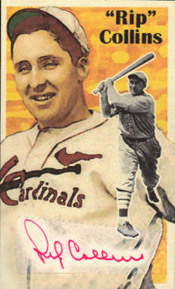
Rip Collins, a first baseman and outfielder, paced the 1932 Cardinals in home runs (21) and tied with pitcher Dizzy Dean for the team lead in sacrifice bunts (eight).

Collins, 28, was in his second big-league season with the Cardinals. A switch-hitter, Collins primarily batted fourth (80 games) or fifth (42 games) in the St. Louis order in 1932.

According to author Robert E. Hood in the book “The Gashouse Gang,” Collins earned his nickname as a youth in Altoona, Pa., “when a line drive from his bat stuck on a nail in the right-field fence.”

Collins was a favorite of Cardinals manager Frankie Frisch because he had a sly, engaging personality that fit well in the Gashouse Gang clubhouse, and he knew how to handle a bat. The latter skill explains why Collins was adept at slugging as well as bunting.

In the book “The St. Louis Cardinals: The 100th Anniversary History,” author Rob Rains wrote, “One (Cardinal) who knew how to play and when to be serious, Frisch’s type of guy, was the versatile Collins.”

In “The Gashouse Gang,” Hood described Collins as “a chunky, powerful man who hit long home runs even though he choked up on the bat.”

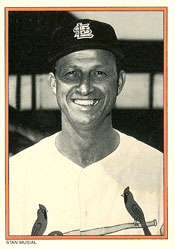
To put Collins’ achievement in perspective, consider that the Cardinals’ career home run leader, Stan Musial, only once had as many as eight sacrifice bunts in a season (10 in 1943) during a 22-year big-league career.

The instigator behind many of teammate Pepper Martin’s legendary pranks, the baby-faced Collins could be as an innovative off the field as he was with a baseball bat in his hand.

In “The Gashouse Gang,” Hood wrote, “Rip Collins was clever. Although he had little formal education, he started out the 1934 season writing daily news stories for the East St. Louis (Ill.) Journal and the Rochester (N.Y.) Times Union. Part way through the season, he suspended his writing career when, after he struck out one day, manager Frisch shouted at him, ‘Next time, swing your typewriter.’ “

Read Full Post »

(Updated May 24, 2025)

Stan Musial of the Cardinals had 500 or more hits against each of six franchises: Braves, Dodgers, Giants, Phillies, Pirates and Reds.

To put that in perspective, consider Pete Rose, the only player with more National League hits (4,256) than Musial (3,630), never got 500 hits against any franchise.

Hank Aaron, who had more total hits (3,771) than Musial, also never achieved 500 hits against any opponent.

The most hits Rose recorded against an opponent were 486 in 1,513 at-bats against the Braves.

Aaron’s career-best hits total against one team: 448 against the Reds in 1,403 at-bats.

Musial was amazingly consistent in a big-league career that stretched from 1941-63. He hit against most teams with equal skill.

Not counting the Mets and Colt .45s (who entered the league in 1962 and against whom he had 79 career at-bats apiece), Musial failed to reach 500 hits against just one franchise _ the Cubs (and he missed by only eight).

Musial used a Louisville Slugger bat with the thinnest handle the company made. Musial’s bat “was 15/16th of an inch at its thinnest point on the handle, and he would shave it even closer to his liking,” according to the 2004 Cardinals Yearbook. Rex Bradley of the Hillerich & Bradsby bat company said to writer Thomas R. Raber, “Musial held the bat way out in his fingers. His grip was a lot like a golfer’s.”

First baseman Bill White, a Cardinals teammate of Musial, told Yankees Magazine, “Stan could beat you any way he wanted to. He hit the ball wherever it was pitched. He had power. He was just the best hitter I’ve ever seen.

“Ted Williams, I understand, was a great hitter, but Ted’s reputation was built on his eyes. If the pitch was that far outside, he wouldn’t swing at it. Stan would have gotten a base hit on that pitch. If you pitched him outside, he could get the bat on it and get a base hit to left. If you pitched him inside, he’d hit it up on the roof. I’ve never seen anybody handle a bat like that.”

Listed in order of most hits, here is how Musial did against NL opponents:

TEAM……..HITS…….AT-BATS…….BATTING AVERAGE

Pirates……526……….1,546……….. .340

Dodgers….522……….1,530……….  .341

Phillies……522……….1,547………  .337

Braves…….515……….1,571………  .328

Giants…….504……….1,494………   .337

Reds………500……….1,574………  .318

Cubs………492……….1,550………  .317

Mets………32…………79…………..  .405

Colt .45s..17………….79…………..  .215

Read Full Post »

(Updated July 30, 2018)

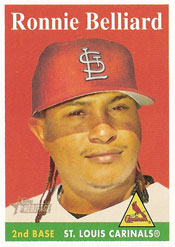
In his two months with the Cardinals during the 2006 regular season, Ronnie Belliard didn’t compile dazzling statistics, but he did play a significant part in Cardinals postseason history.

Belliard’s performance in the 2006 National League Division Series enabled the Cardinals to eliminate the Padres and advance on a postseason path that led them to their first World Series title in 24 years.

On July 30, 2006, the Cardinals acquired Belliard, a second baseman, from the Indians for infielder Hector Luna. The Cardinals rated Belliard a more complete player than either Luna or their incumbent second baseman, Aaron Miles.

In declaring Belliard the everyday second baseman, Cardinals manager Tony La Russa said, “Sometimes you have to seize the moment. This is our chance to win.”

“I’ve seen him rise to the occasion in winning situations,” La Russa told the St. Louis Post-Dispatch. “He doesn’t hide from them. He takes charge of them.”

Belliard gave the Cardinals an infield that had at each position a starter who had been a big-league all-star: Albert Pujols at first, Belliard at second, David Eckstein at short and Scott Rolen at third.

When acquired by St. Louis, Belliard was hitting .291 with eight home runs and 44 RBI for the Indians.

In 54 games with the Cardinals, Belliard batted .237 with five home runs and 23 RBI.

After losing nine of their final 13 regular-season games and barely holding off Houston to win the NL Central championship, the Cardinals stumbled into the first round of the playoffs against San Diego.

That’s when Belliard played his best as a Cardinal.

In Game 1 at San Diego, the Padres trailed by four runs in the seventh inning, but had the bases loaded with two outs and Todd Walker at the plate against reliever Tyler Johnson.

Walker hit a sharp grounder, but Belliard “dived on the outfield grass, knocked the ball down, rolled over and threw out Walker by a step,” Ryan Fagan of The Sporting News reported. “It was the play the locker room was buzzing about.” Video

If the ball had gotten past Belliard, two runs would have scored and the Padres would have had the tying runs on base with Dave Roberts (who was 3-for-3 in the game) up next.

Instead, the Cardinals went on to win, 5-1, setting the tone for the series and restoring their swagger after their wobbly finish to the regular season. Boxscore

“That saved the game for us,” Cardinals outfielder Jim Edmonds said. “If they get two runs in right there, we’re in trouble.”

Added Pujols: “I never thought he was going to get to the ball.”

In the clubhouse, his Cardinals teammates presented Belliard with a game ball.

“I think I got lucky on that one.” Belliard said. “… It was a pretty good play and I know we need that play for the win.”

Belliard also delivered with the bat. In the decisive Game 4 against the Padres, Belliard’s two-run, two-out single in the first tied the score and helped St. Louis regain momentum en route to a 6-2 victory. Boxscore

For the four-game series, Belliard batted .462 (6-for-13).

The Cardinals went on to eliminate the Mets in a classic seven-game League Championship Series and knocked off the Tigers in the World Series.

Belliard’s strong play didn’t last. He was hitless in 12 at-bats in the World Series.

On Oct. 31, 2006, Belliard declared for free agency, sat for five months without an offer, and finally signed with the Nationals on March 24, 2007.

Read Full Post »

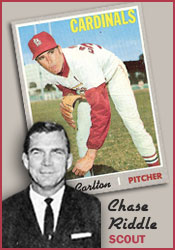
Chase Riddle never played a game for the Cardinals, but he had a major impact on the makeup of their teams.

Riddle was the scout who signed pitcher Steve Carlton for the Cardinals and who opened the talent pipeline for the club in Latin America.

Riddle was a Cardinals minor-league manager from 1955-62 before he became a scout, with responsibilities primarily for the Caribbean region and southeastern United States.

In 1963, John Buik, an American Legion coach in North Miami, Fla., contacted Riddle, tipping him off to a gangly left-handed pitcher on the team named Steve Carlton.

“Chase Riddle was a nice guy,” Buik said in a 1996 interview with Baseball Digest magazine. “He was a good scout and a good worker.”

Riddle liked what he saw of Carlton. Other teams, especially the Pirates, also had been scouting Carlton, so Riddle felt a sense of urgency to act.

“Chase convinced me there would be a good opportunity for advancement with the Cardinals,” Carlton told The Sporting News in June 1972.

Riddle arranged for Carlton to participate in a tryout for Cardinals personnel in St. Louis in September 1963.

“I threw as hard as I could and as well as I could, but I don’t think I threw fast enough for them,” Carlton recalled in a May 1967 interview with The Sporting News. “They were looking mostly for that hummer.”

Besides Riddle, the only other observer that day impressed by Carlton was Cardinals pitching coach Howie Pollet. “I liked Steve’s sneaky fastball and I felt his curve was good enough to make him worth a $5,000 gamble,” Pollet said. “I figured he could improve a lot more with experience than the other kids.”

With Pollet’s significant support, Riddle signed Carlton for $5,000.

By April 1965, Carlton, 20, made his big-league debut with the Cardinals. He helped them to two National League pennants and a World Series title before he got into a contract dispute and was traded to the Phillies before the 1972 season.

Carlton is a member of the National Baseball Hall of Fame, with 329 wins and 4,136 strikeouts in a 24-year big-league career.

Meanwhile, Riddle used his connections in the Caribbean to sign players such as outfielder Jose Cruz for the Cardinals.

In separate articles in February 1970, The Sporting News noted, “George Silvey, (Cardinals) director of player procurement, had just returned from the Caribbean area, which he toured with Chase Riddle, the scout who has had a big hand in the Redbirds’ emphasis on signing Latin Americans in recent years.

“No fewer than 24 Latin Americans grace the rolls of the Cardinals’ organization. Scouts like Chase Riddle, Tony Martinez and (Carlos) Negron have been chiefly responsible for the recent emphasis on signing Latins.”

In 1978, Riddle left the Cardinals to become manager of the Troy University baseball team in Alabama. His Troy teams won NCAA Division II national titles in 1986 and 1987. Riddle remained Troy’s manager until 1990, compiling more than 430 wins.

Read Full Post »

One of the most memorable and hotly debated plays in Cardinals history always will be the two-run triple by Detroit’s Jim Northrup on a drive that sailed over the head of center fielder Curt Flood in Game 7 of the 1968 World Series.

The contentious question remains: Would Flood have caught the ball if he hadn’t stumbled?

In the top of the seventh inning of the scoreless Game 7 on Oct. 10, 1968, at Busch Stadium, Northrup, a left-handed batter, faced Bob Gibson with Norm Cash on second base, Willie Horton on first and two outs. Northrup lined Gibson’s first offering to center field.

Flood initially broke in for the catch. Realizing his mistake, Flood tried to move back and to his right. As he did, his spikes appeared to catch in the turf. (Some say he slipped on a slick spot in the grass.) He briefly stumbled but didn’t fall. Though he recovered quickly, it was too late to catch the ball, which fell behind him, several yards in front of the warning track.

Both runners scored and Northrup raced to third base. The next batter, Bill Freehan, drove in Northrup with a double, giving the Tigers a 3-0 lead. Detroit went on to a 4-1 victory, winning its first World Series title in 23 years and stunning the defending champion Cardinals, who had taken a 3-games-to-1 lead in the best-of-seven series. Boxscore

Flood, a seven-time Gold Glove Award winner, was labeled the goat because many thought he would have caught Northrup’s liner if not for the slip. Others, though, have said Northrup’s shot was so well-struck it would have eluded Flood regardless of his stumble.

film clip of the play on YouTube shows Northrup hit the ball hard, but it landed in a spot where a center fielder (especially one of Flood’s skill) likely would be able to race back and make a catch.

Because a strong case can be made for either side, the argument likely will endure for as long as baseball has fans.

In his report for the Oct. 29, 1968, edition of The Sporting News, Dick Kaegel described this exchange between reporters and Flood, who sat on the edge of a table and sipped from a bottle of champagne that was intended for a Cardinals celebration:

Did you lose the ball in the crowd?

Yes.

Was the ground still soggy out there?

Yes.

Could you have caught the ball if you hadn’t slipped?

I think so. Yes. Look, I don’t want to make alibis. I should have made the play but I didn’t, and that’s all there is to it.

In the visiting team locker room, Northrup was asked whether Flood should have caught the ball.

“The guys on the bench all said he wouldn’t have caught it even if he hadn’t stumbled,” Northrup said in The Sporting News report. “I couldn’t really say myself.”

In the Associated Press accounts of the game, Flood said, “I couldn’t see it against the shirts (in the crowd). The reason I started in, I just didn’t know where the ball was. A ball hit right at me gives me trouble in day games. If I hadn’t slipped, I might have got it.”

Cardinals manager Red Schoendienst told the Associated Press, “I’m sure he could have caught it if he hadn’t charged in on it.”

In a tribute to Northrup after his passing, longtime Detroit sports columnist Jerry Green of FOXSportsDetroit.com reported Northrup had told him, “Flood never could have caught the ball.”

Denny McLain, ace of the 1968 Tigers staff, said in a June 8, 2011, interview with Drew Sharp of the Detroit Free Press, “I never once bought the argument that (Flood) misplayed the ball like everyone says. There was no way he was catching that.”

Yet, in his autobiography “Nobody’s Perfect,” McLain said, “Curt Flood simply blew it. Now, here’s a super outfielder, but he just couldn’t find the ball.”

In his autobiography “The Way It Is,” Flood barely mentions the play. “I attracted unfavorable attention by missing a catch that might have been easy for me if I had not been completely bushed,” Flood said.

Author Stuart L. Weiss, in his book “The Curt Flood Story” asked, “Why he was ‘bushed’ he did not say … That could have affected him after he started running back and to his right for the ball, but it could not have accounted for his initial misjudgment.”

It had rained in St. Louis the day before Game 7. Flood’s teammates have indicated Flood slipped on a spot still wet from the rain.

“As soon as the ball left the bat, I was confident Flood would track it down, as he had done on so many similar occasions over the years,” Bob Gibson said in his autobiography “Stranger to the Game.” “This time, though, Curt’s first step was toward the infield, and when he realized he had underestimated the hit, he turned sharply, and for a split second lost his footing on the wet grass.”

Cardinals catcher Tim McCarver told journalist William Mead, “The playing conditions that day were very bad in the outfield. Curt broke initially to his right and one or two steps in, and then he got stuck in the mud. When he got stuck, his quickness wasn’t there, and Northrup’s ball, which was well-hit, got past him.”

In comments to the Pittsburgh Post-Gazette after the game, Northrup supported that version. He played center field for the Tigers in Game 7, so he knew about the conditions.

“It was muddy out there,” Northrup said. “Most of the field was dry, but it was muddy in center field because of yesterday’s rain. The sun never hit center field. The grass and dirt didn’t get a chance to dry out.”

Often overshadowed is the fact Northrup had a terrific World Series overall. He hit a grand slam off Larry Jaster in Game 6. In the seven games, Northrup had eight RBI, seven hits, two home runs and four runs scored.

Read Full Post »
(Updated April 23, 2026)

In 1948, Stan Musial became the first Cardinals player to hit walkoff home runs in consecutive games.

No Cardinal matched the feat until Albert Pujols did it June 4 and June 5 in 2011 against the Cubs, according to the Elias Sports Bureau.

On Aug. 26, 1948, in the second game of a doubleheader against the Giants at St. Louis, Musial batted in the ninth inning with a runner on first, one out and the score tied at 5-5.

Facing Ken Trinkle, a right-handed reliever, Musial launched a home run, giving the Cardinals a 7-5 walkoff victory. Boxscore

In the next game, Aug. 28 against the Giants at St. Louis, Musial batted in the 12th with one out, the bases empty and the score tied at 4-4. Facing starter Monty Kennedy, a left-hander, Musial cracked a home run, giving the Cardinals a 5-4 victory. Boxscore

In his autobiography, “Stan Musial: The Man’s Own Story,” Musial indicated the Cardinals turned up their intensity when playing the Giants because of the presence of manager Leo Durocher, a relentless antagonist. In July 1948, in a move that shocked the baseball world, Durocher left the Dodgers and became manager of the Giants, replacing Mel Ott.

The 1948 Cardinals were 11-1 against the Giants after Durocher joined them.

“Leo liked to play the game rough, liked to make it a game of intimidation,” Musial said in his autobiography. “His tactics turned us from tabbies into tigers.”

For the book “Voices From Cooperstown,” Musial told author Anthony J. Connor, “Durocher tried to intimidate the other team with this kind of rough stuff, but I think it backfired on him more than not. He was just stirring up a nest of hornets. When Durocher came to town, I was so charged up before the game, man, I could go out there and climb six fences. I wasn’t the only one. Our whole team was up.”

(In the book “Oh, Baby, I Love It,” Cardinals catcher Tim McCarver recalled how mild-mannered Musial got angry when Durocher, then a Dodgers coach, taunted the Cardinals during a game. According to McCarver, Musial went to the top step of the dugout, pointed a finger at Durocher and yelled, “You’re up and strutting now, but just you wait. We’ll get you, you prick.”)

The game-winner on Aug. 28 was Musial’s 33rd home run of the season. Since arriving in the big leagues in 1941, Musial never had hit as many as 20 homers in a season. In 1948, he would finish with a career-best 39. It began a 10-year stretch in which Musial hit 20 or more home runs each season, including six years with 30 or more.

“The power surge felt good, mighty good,” Musial said.

In his book “Musial: From Stash to Stan the Man,” author James N. Giglio wrote of Musial’s home run production: “Always able to smack outside pitches to left field, Musial nevertheless became a smarter and more confident hitter in 1948. His greater sensitivity to the strike zone made him even more dangerous with two strikes. Instead of trying to protect the plate, he bore down harder and took his customary swing.”

Musial won the National League Most Valuable Player Award in 1948. He hit .376 with 131 RBI, 230 hits and 135 runs scored. His slugging percentage (.702) was the first above .700 in the NL since Hack Wilson (.723) of the Cubs in 1930, and his 103 extra-base hits were four shy of the NL record established by Chuck Klein of the Phillies in 1930.

Read Full Post »

« Newer Posts - Older Posts »