Luis Arroyo was the most unlikely of Cardinals pitchers to open a season with wins in each of his first six starts.
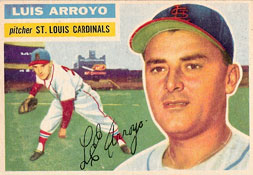 Arroyo, a rookie left-hander who barely made the 1955 Opening Day roster and nearly got knocked out in the first inning of his first start, posted a 6-0 record and 1.56 ERA through eight appearances (including two relief stints) and earned a spot on the National League all-star team.
Arroyo, a native of Puerto Rico, signed a professional contract in 1948 and joined the Cardinals’ organization in 1950. He hurt his left arm and sat out the 1952 and 1953 seasons. He re-emerged in 1954 as a prospect, posting an 8-6 record and 2.49 ERA for Class A Columbus (Ga.) and an 8-3 record and 2.35 ERA for Class AA Houston.
Arroyo, who credited Cardinals scout and retired catcher Gus Mancuso with teaching him an improved curve, pitched a no-hitter for Houston and had strikeout totals of 17 in one game and 15 in another. His combined record for Columbus and Houston in 1954 was 16-9 with a 2.42 ERA.
Invited to join the 1955 Cardinals in spring training, Arroyo pitched poorly, yielding 14 earned runs in 18 innings. However, the Cardinals, managed by Eddie Stanky, were desperate for left-handed pitching and placed Arroyo, 28, on the season-opening roster.
His big-league debut occurred on April 20, 1955, with a start against the Reds at Cincinnati. It almost ended soon after it began.
In the Reds’ half of the first, Johnny Temple led off with a single and advanced to second on a wild pitch. Wally Post walked. When Arroyo ran the count to 3-and-0 against the next batter, Gus Bell, Stanky sent coach Dixie Walker to confer with the pitcher.
Arroyo, reported The Sporting News, “came within one pitch of being yanked and sent to the minors.”
Walker told Arroyo, “You’ve been pitching scared all spring. There’s no use being nervous out there. You either do or you don’t _ that’s all there is to it. Get the ball over and get ’em out.”
Arroyo struck out Bell. On the third strike, Temple was thrown out attempting to steal third base. Ted Kluszewski grounded out to second, ending the inning.
In the third, Arroyo got another break. Temple was on second when Kluszewski singled, but Temple was thrown out trying to score.
Gaining confidence, Arroyo shut out the Reds for 7.2 innings before being relieved. He earned the win in the Cardinals’ 3-0 victory. Boxscore
Unimpressed, Reds manager Birdie Tebbetts told reporters he’d be surprised if Arroyo still was in the major leagues in July.
After two relief appearances, Arroyo returned to the rotation and won each of his next five starts. Two of those wins were against the Pirates, one came against the Phillies and two more were against the Reds.
After Arroyo beat Cincinnati for the third time, Tebbetts said, “He’s looking like one of the league’s better left-handers, who, I am sorry to say, will be around all year, at least.”
Arroyo’s six-game winning streak was snapped on June 6 at Brooklyn. Arroyo took a 4-3 lead into the bottom of the ninth, but Gil Hodges walked and Jackie Robinson followed with a home run for a 5-4 Dodgers victory. Boxscore
Arroyo accounted for eight of the Cardinals’ first 26 victories. After getting the win in the Cardinals’ 5-3 triumph over the Giants at St. Louis on June 25, Arroyo’s record was 9-2 with a 2.02 ERA.
In The Sporting News, Bob Broeg wrote of Arroyo, “He’s got a lively fastball, a pitch that moves away from right-handed hitters, causing them to pop up, and he’s got a good enough curve, change and control, too.”
Selected to the all-star team, Arroyo was the only one of seven NL pitchers not used by manager Leo Durocher in a game Stan Musial decided with a 12th-inning home run off Boston’s Frank Sullivan.
Arroyo’s second half of the 1955 season wasn’t as successful as his first half. He lost his final four decisions, and five of the last six. He finished at 11-8 with a 4.19 ERA in 35 games (24 starts). Arroyo and Harvey Haddix were Cardinals co-leaders in complete games (nine apiece) and only Haddix (12) had more wins for St. Louis.
In 1956, with Fred Hutchinson as manager, the Cardinals restructured their rotation. Arroyo was sent to Class AAA Omaha after spring training. He was 1-0 in five games for Omaha before the Cardinals traded him to the Pirates for pitcher Max Surkont.
Unable to repeat the success of his rookie season, Arroyo bounced from the Pirates to the Reds. He was in the Reds’ minor-league system when the Yankees purchased his contract in July 1960.
The move revived his career. Arroyo helped the 1960 Yankees win the American League pennant, posting a 5-1 record with seven saves and a 2.88 ERA in 29 games. A year later, Arroyo enjoyed his best big-league season. He was named AL Fireman of the Year by The Sporting News, with a 15-5 record, 29 saves and a 2.19 ERA in 65 games for the league-champion Yankees. Arroyo also was the winning pitcher in Game 3 of the 1961 World Series against the Reds.
Arroyo had one other claim to fame. According to Baseball Digest, he was the first major-league reliever to ride to the mound from the bullpen on a motorized cart. The bullpen cart was introduced at a Yankees-Red Sox game shortly before the 1961 All-Star Game at Fenway Park.
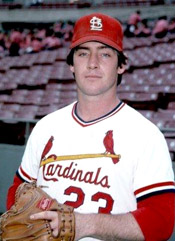 Simmons achieved four hits in a game 19 times as a Cardinal.
 RetroSimba