(Updated Aug. 7, 2018)
Imagine a Cardinals lineup of Willie McGee at shortstop, Ricky Horton in right field and Jose Oquendo on the mound.
Manager Whitey Herzog could.
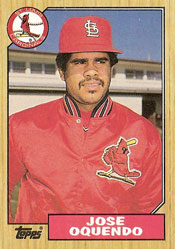 In 1987, during a blowout loss to the Phillies, Herzog made all of those unusual moves. He also batted Oquendo for Jack Clark and used John Tudor as a pinch-hitter with two runners on base.
On Aug. 7, 1987, the Cardinals were in first place in the National League East Division, but on that Friday night at Philadelphia’s Veterans Stadium the Phillies grabbed control early, scoring seven runs in the first two innings off Joe Magrane.
In the fifth inning, with the Phillies ahead 12-1, St. Louis had runners on first and second, two outs, when Herzog lifted Clark, the Cardinals’ slugging first baseman, for Oquendo.
Oquendo struck out against Phillies starter Shane Rawley and stayed in the game, replacing Ozzie Smith at shortstop.
In the eighth, Philadelphia led 12-4 and St. Louis had runners on first and third with one out. Reliever Bill Dawley was due to bat against Kent Tekulve, the Phillies’ sidearm-throwing right-hander. Herzog instead sent another pitcher, Tudor, a left-handed batter, to face Tekulve.
Tudor, a career .154 hitter, grounded into an inning-ending 4-6-3 double play, lost his balance as he tried to beat the relay throw and fell. “He runs down the line like a damn nut,” Herzog said to the St. Louis Post-Dispatch.
Things got even more strange.
Needing a pitcher to replace Dawley for the bottom of the eighth, Herzog turned to his shortstop. Oquendo already had played every position except pitcher and catcher in 1987.
To replace Oquendo in the infield, Herzog moved his center fielder, Willie McGee, to shortstop. The right fielder, John Morris, moved to center. That left the Cardinals without a right fielder. So Herzog put pitcher Ricky Horton in that spot.
It would be the only times in their big-league careers McGee would play shortstop and Horton would appear in the outfield.
Two balls were hit to right field. Both carried over the head of the harried Horton. The first, by Glenn Wilson, was ruled a double and drove in a run. The second was a single by Lance Parrish that scored Wilson.
“Horton played what must be described as periscope outfield,” the Post-Dispatch reported. “He would take two steps and watch from afar as the ball sailed over his head.”
“Some outfielders shy away from the walls,” Horton said to The Sporting News. “I just happened to shy away 30 yards from it.”
After watching the spectacle from the mound, Oquendo said, “I could have got out of the inning. We need better outfielders.”
Said Horton: “I apologized to Jose, but the good thing is I didn’t get anybody hurt, including myself.”
McGee handled his defensive chores at shortstop skillfully. With a runner on first, Milt Thompson grounded to McGee, who fielded the ball and threw to second for the forceout. Later in the inning, with Parrish at first, Steve Jeltz grounded to first baseman Jim Lindeman, who threw to McGee covering second for the forceout.
Oquendo surrendered three runs on four hits and a walk in his inning of relief work. He also hit a batter, his friend and fellow Puerto Rican Luis Aguayo.
“The best pitch he threw was when he hit the guy,” umpire Joe West said to the Post-Dispatch.
Before facing his first batter, Oquendo told catcher Steve Lake he could throw six different types of pitches. After his outing, Oquendo quipped, “He called the wrong pitches.”
Lake good-naturedly replied, “He says he’s got six pitches. I call fastball and he says, ‘Yeah.’ I call another fastball. ‘Yeah.’ Then I call something else. He says, ‘No.’ ”
(Oquendo would pitch for the Cardinals in two more games, one in 1988 and the other in 1991. He went four innings in 1988 against the Braves and took the loss in a 19-inning game won by Atlanta, 7-5.)
After the debacle in Philadelphia, a 15-5 Phillies win that broke a six-game losing streak, Herzog told the Associated Press, “In 162 games, you’ll have one like this.” Boxscore
Previously: How Andy Van Slyke amazed Jose Oquendo

 RetroSimba
Leave a comment