Ted Wilks was a right-handed pitcher who suffered from ulcers and had trouble controling his weight.
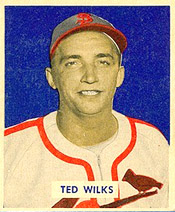 He also had an amazing knack for winning games for the Cardinals.
When Kyle Lohse built a 14-2 record for the 2012 Cardinals, he established the second-best mark in team history to begin a season. Only Wilks did better, according to the Cardinals.
A 28-year-old rookie, Wilks was 14-1 and eventually 15-2 in 1944. He split his final four decisions, finishing the regular season at 17-4 with a 2.64 ERA.
Manager Billy Southworth used Wilks, 5 feet 9 and 180 pounds, as a spot starter and reliever for the first part of the 1944 season. When George Munger went into the Army after posting an 11-3 record and 1.34 ERA, Wilks replaced him in the Cardinals’ rotation as the season entered July.
From July 2 through Aug. 29, Wilks won 11 consecutive decisions. During that stretch, he survived getting struck in the head by a line drive hit so hard that Southworth feared for Wilks’ life. The smash by Reds third baseman Steve Mesner during an Aug. 6 game at Cincinnati bounced high off Wilks’ skull and knocked out the pitcher. Boxscore
“Ted got out of that quite luckily,” Southworth told The Sporting News. “In my long experience in baseball, I’ve never seen anything quite like it.”
After striking Wilks, Southworth said, “the ball went about 40 feet into the air before (Whitey) Kurowski caught it at his regular third-base position. Wilks was knocked out and I’ll admit we were all pretty scared … Hit an inch lower, that drive could have been fatal.”
Said Wilks: “That ball came at me so fast I didn’t have time to duck.”
He recovered to pitch complete-game three-hitters in consecutive starts _ a 2-1 victory over the Cubs on Aug. 24 Boxscore and a 3-0 victory over the Reds on Aug. 29 that boosted Wilks’ record to 14-1. Boxscore
The son of a Polish immigrant who changed the family named from Wilzcek to Wilks when naturalized, Ted Wilks was born in Fulton, N.Y., about 20 miles from Syracuse. He joined the Cardinals’ organization as an amateur free agent in 1938 and spent six seasons in their minor-league system.
Because of ulcers, Wilks was classified 4-F and didn’t serve in the military during World War II. He was prone to gain weight, and headline writers poked fun at his waistline even while praising his pitching. Some examples from The Sporting News:
_ “Wilks Fills Out as Cardinals’ Fill-In”
_ “Chunky Ted Proves Winner”
_ “Chubby Righthander Rates Best of Majors’ Rookie Crop”
Frederick G. Lieb, a veteran baseball reporter, wrote: Ted is a husky young gent and needs to exercise to keep down to his best pitching weight of 175 pounds.
Regardless, Wilks was an effective pitcher. In 36 games (21 starts) for the 1944 Cardinals, Wilks had 16 complete games and four shutouts, helping them win the National League pennant.
In the 1944 World Series, Wilks started Game 3 but yielded four runs in 2.2 innings and got the loss in the Browns’ 6-2 victory. It was suspected that ulcers hampered Wilks in that start. Boxscore
Three games later, Wilks got another chance _ and delivered one of the greatest relief stints in Cardinals history.
In Game 6, Wilks relieved starter Max Lanier with one out and two on in the sixth. He retired all 11 batters he faced and preserved the Cardinals’ Series-clinching 3-1 victory. Boxscore
Converted to a reliever in 1946, Wilks thrived. He was 8-0 for the pennant-winning 1946 Cardinals, 4-0 for the 1947 Cardinals and 2-0 for the 1950 Cardinals.
In a 10-year major-league career with the Cardinals, Pirates and Indians, Wilks was 59-30.
Previously: Cardinals were victims of historic homers by Gil Hodges

 RetroSimba
Leave a comment