(Updated Nov. 16, 2024)
Tracy Stallard had a reputation for being a victim. The Cardinals gave him a chance to be a victor. The right-handed pitcher took advantage of the opportunity.
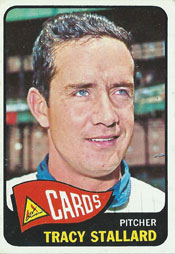 On Dec. 8, 1964, in one of Bob Howsam’s first deals as Cardinals general manager, St. Louis traded outfielder Johnny Lewis and pitcher Gordon Richardson to the Mets for Stallard and shortstop Elio Chacon.
The trade energized Stallard, who went from the last-place club in the National League to the newly crowned World Series champions. Stallard rewarded the Cardinals by producing the best season of his big-league career in 1965.
Until then, Stallard largely had been associated with setbacks. Most notable:
_ Roger Maris broke Babe Ruth’s single-season record when he hit his 61st home run in the 1961 season finale against Stallard at Yankee Stadium. It accounted for the lone run in a 1-0 Yankees triumph over the Red Sox. Maris accomplished one of the most memorable baseball feats. Stallard became the answer to a trivia question. Boxscore
“The pitch was a fastball and over the plate,” Maris said to the New York Times. “I appreciate the fact that he was man enough to pitch to me to try and get me out.”
Stallard told the newspaper, “I’d rather he hit the homer off me than I walk him.”
Years later, asked whether he grooved the 2-and-0 pitch to Maris to give him a shot at the record, Stallard replied to Dan Shaughnessy of the Boston Globe, “God, no … I don’t know how anybody could help anybody hit a home run … The fastball was probably all I had.”
_ Stallard had a 6-17 record for the 1963 Mets. He followed that with a 10-20 mark for the 1964 Mets and led the major leagues in losses that season. He was the starting and losing pitcher when the Phillies’ Jim Bunning achieved a perfect game against the Mets in 1964. Boxscore
“Tracy Stallard is a good pitcher,” New York Daily News columnist Dick Young wrote. “You have to be good to lose 20 games for the Mets. (Manager) Casey Stengel wouldn’t tolerate you that long if you aren’t good.”
Change of scenery
Stallard was born and raised in Coeburn, Va., a coal-mining town in the southwestern corner of the state. His father was a coal miner. “I hate the mines,” Stallard said to George Vecsey of Newsday. “Never wanted to go down there.”
Baseball gave Stallard a career path. He grew to 6-foot-5, became a standout high school pitcher and was signed at 18 by the Red Sox in 1956.
Stallard was 2-7 as a rookie for the Red Sox in 1961. On the day he gave up the home run to Maris, the Boston Patriots were playing the New York Titans in a pro football game at the Polo Grounds. According to Jerry Nason of the Globe, in the club car on the train back to Boston, a young man announced to his fellow passengers that drinks were on him. One of the Patriots players asked, “What’s this all about?” Stallard replied, “Today I became famous. Roger Maris hit his 61st homer off me.”
According to the Globe, Stallard enjoyed the good life and was known as a “real swingin’ kid” and a “member of the Red Sox jet set.” That “zest for living,” as the Globe described it, apparently hampered his pitching and he was sent back to the minors in 1962. After the season, Stallard was traded to the Mets.
According to Newsday’s Joe Donnelly, at spring training in 1964, Casey Stengel chose Stallard to manage one of the teams in an intrasquad game “because Tracy has the largest hat size (7 5/8) of any Met. Casey thinks a large head houses a large brain.”
Stallard was intelligent enough to change his pitching style in 1964, working smarter and harder to make better pitches.
“This year, he’s always thinking,” Mets catcher Jesse Gonder told Newsday in 1964. “He knows what he wants to do. He’d pitch to spots on every hitter. He wouldn’t throw the ball over the middle. He’d work on the corners. He’d always have an idea. Last year (in 1963), he was a thrower. This year, he’s a pitcher.”
Seeking a starter
Though Stallard was 1-3 against the 1964 Cardinals, he yielded just 20 hits (and no home runs) to them in 22 innings and had a 3.27 ERA.
Uncertain whether Ray Washburn would recover from a shoulder injury, Howsam sought a starter to join a rotation of Bob Gibson, Ray Sadecki and Curt Simmons.
The Mets were seeking an outfielder. Lewis, a rookie, began the 1964 season as one of the Cardinals’ regulars. He started 28 games in right field, but batted .234 with two home runs and seven RBI. In June, slowed by an ankle injury, the Cardinals sent Lewis to Class AAA Jacksonville.
Mike Shannon became the Cardinals’ right fielder and Lou Brock, acquired by the Cardinals in June 1964 from the Cubs, became the left fielder.
Bing Devine, the Cardinals general manager who engineered the deal for Brock before being fired in August 1964, had joined the Mets as an assistant to team president George Weiss. Devine recommended Lewis, 25, to the Mets. Weiss and his vice president, Johnny Murphy, negotiated with Howsam on the trade. “Devine stayed out of the picture,” The Sporting News reported.
Devine told the New York Daily News, “I’d say the only difference between Lewis and Shannon is confidence. Lewis has all the assets of Shannon, but Shannon was always confident beyond his record. Lewis never had the confidence that others felt in him.”
Stallard, who shared a midtown Manhattan apartment with Yankees infielder Phil Linz, had become “quite the young man about (town),” according to the Daily News. “He could run a charm school,” Casey Stengel told Bob Broeg of the St. Louis Post-Dispatch.
Yet, when asked his reaction to joining the Cardinals, Stallard told the newspaper, “It’s wonderful. Imagine going from a 10th-place club to a World Series winner.”
Stallard said to Newsday, “This is like going into daylight from darkness.”
Cardinals contributor
In a story headlined “Tracy Ticketed For Starter Job On Cards Staff,” St. Louis manager Red Schoendienst told The Sporting News, “Stallard is a tough competitor and he ought to do a lot better for us because our club can score some runs for him. His best pitches are a slider and a fastball.”
Said Howsam: “We wanted a fourth starter and we think we’ve got him.”
A week later, though, Howsam acquired another starting pitcher, Bob Purkey, from the Reds for outfielder Charlie James and pitcher Roger Craig.
Stallard, 27, began the 1965 season in the Cardinals’ bullpen. He lost his first start April 24 to the Reds, then won his next three decisions as a starter, beating the Pirates twice and the Dodgers. After a win over the Phillies July 18, Stallard was 7-3 with a 2.80 ERA.
His best game for the 1965 Cardinals came on Sept. 1, a day after his 28th birthday, when Stallard pitched a three-hit shutout in a 9-0 victory over the Cubs at Chicago. Stallard struck out eight and yielded only a double by Don Kessinger and singles by Joe Amalfitano and Ernie Banks. Boxscore
Stallard finished second on the 1965 Cardinals in wins (11) and third in innings pitched (194.1). His 3.38 ERA was better than the team average of 3.77. His 11-8 record represented his lone winning season in the majors.
In 1966, Stallard was 1-5 for the Cardinals, who demoted him to the minor leagues. He never returned to the majors, and thus missed a chance to be a teammate of Maris, who was acquired by the Cardinals in December 1966.
Asked about Maris, Stallard told Pat Calabria of Newsday in 1986, “I talked to him a few times after the home run. I’d see him at spring training, or someplace, and we’d talk, but we never talked about the home run … He didn’t bring it up, not once, and neither did I.”
Stallard’s big-league career totals: 30-57 record, 3.91 ERA.

 RetroSimba
Leave a comment