(Updated March 2, 2019)
Willie Crawford was acquired by the Cardinals from the Dodgers to strengthen the bench, but he exceeded expectations and became their starting right fielder, giving a good performance for a bad team.
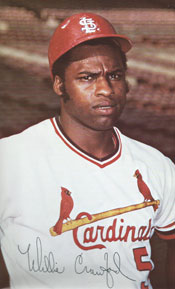 On March 2, 1976, the Cardinals traded second baseman Ted Sizemore for Crawford. The deal accommodated Sizemore, who was being displaced as the starting second baseman and wanted to play close to his home in California.
Crawford, who spent 12 seasons as a role player with the Dodgers, wanted to play regularly, but with Lou Brock in left, Bake McBride in center and Reggie Smith in right the 1976 Cardinals were set with starting outfielders.
Platoon player
In 1964, Crawford, a high school standout in Los Angeles, was signed by Dodgers scout Tommy Lasorda, the future Hall of Fame manager.
A left-handed batter, Crawford played in two World Series (1965 and 1974) for the Dodgers. He and Sizemore were teammates for two years. Sizemore won the National League Rookie of the Year Award in 1969, but was dealt to the Cardinals for slugger Dick Allen after the 1970 season.
No. 2 man
Sizemore was the Cardinals’ starting second baseman from 1971-75. Batting primarily in the No. 2 spot, he led the National League in sacrifice bunts (25) in 1973 and was second (with 21) in 1975.
In 1974, when Lou Brock had 118 stolen bases, he said, “You have to have the right man batting behind you. I do: Ted Sizemore.”
Sizemore said to the Los Angeles Times, “To bat behind a base stealer, you have to be patient, willing to take pitches and sacrifice your average, be able to make contact with two strikes, be adept in the subtle ways of hindering a catcher, and be satisfied that by helping to get that man to second base, you are doing what your team must do to win.”
By 1976, Sizemore was expendable because the Cardinals planned to shift Mike Tyson from shortstop to second base and play Don Kessinger at shortstop until Garry Templeton was ready to take over the position.
Anatomy of a deal
Sizemore told Cardinals general manager Bing Devine he intended to go to spring training in 1976 and beat out Tyson for the starting second base spot, but then changed his mind, “expressing his desire to be traded to Los Angeles if such a deal could be made,” Devine told United Press International.
Devine said he approached Dodgers executive Al Campanis and proposed a trade of Sizemore for Crawford. Because the Dodgers had Davey Lopes at second base and Bill Russell at shortstop, they projected Sizemore, 30, as a utility player.
The Cardinals and Dodgers also discussed a deal of Reggie Smith for Bill Russell, Campanis confirmed to the Los Angeles Times. The newspaper noted such a swap would give Crawford a chance to claim the Cardinals’ right field job and enable the Dodgers to move Davey Lopes to shortstop, opening up second base for Sizemore.
However, Campanis said the Cardinals opted “to stand pat (with Smith) until later in the spring,” the Los Angeles Times reported. “The Cardinals also expressed the opinion the Dodgers would have to part with more than Russell” for Smith.
(Three months later, in June 1976, the Cardinals sent Reggie Smith to the Dodgers for catcher Joe Ferguson and two minor-leaguers.)
Crawford, 29, told the Los Angeles Times he “never had the type of communications” with Dodgers manager Walter Alston “that I should have, but I don’t leave with ill feelings. I simply feel there was a need for a change of scenery. I was in a rut.”
Times columnist Jim Murray wrote, “Willie’s is a classic case of arrested athletic development. A big-muscled, powerful young man … Willie Crawford … has the body and configuration that must be used every day to stay at peak efficiency.”
Hot hitter
Crawford quickly fit in with the 1976 Cardinals. During spring training, The Sporting News reported, Crawford took over retired pitcher Bob Gibson’s role of “clubhouse and on-field needler.”
Over the first two weeks of the 1976 regular season, Crawford was used exclusively as a pinch-hitter by manager Red Schoendienst. On April 25, Schoendienst moved Reggie Smith to third base, replacing struggling rookie Hector Cruz, and put Crawford in right field. Crawford responded by batting .438 in April and .326 in May. After the Cardinals traded Smith to the Dodgers, Crawford got the most starts in right.
Strong season
Crawford completed the 1976 season with a .304 batting mark and .360 on-base percentage. His batting average against right-handers was .313.
Crawford hit nine home runs and produced 50 RBI, but consistent run production was a weakness. Crawford hit .225 with runners in scoring position, according to baseball-reference.com.
After the 1976 Cardinals finished 72-90, Schoendienst was fired and the club looked to make other changes.
Planning to move Cruz to right field in 1977, the Cardinals traded Crawford, pitcher John Curtis and utility player Vic Harris to the Giants for pitchers Mike Caldwell and John D’Acquisto and catcher Dave Rader in October 1976.

 RetroSimba
Leave a comment