(Updated Jan. 13, 2025)
One of the first issues Walt Jocketty faced as Cardinals general manager in 1994 involved who to keep at second base. The leading candidates were Geronimo Pena and Luis Alicea. Jocketty picked Pena, trading Alicea to the Red Sox.
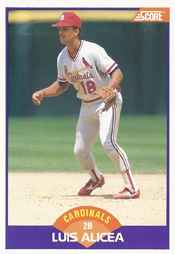 Fifteen months later, Jocketty reacquired Alicea to be the second baseman for the 1996 Cardinals.
On March 17, 1996, the Cardinals signed Alicea, who was waived by the Red Sox, to a one-year contract for $500,000.
The 1996 Cardinals, in their first season with Tony La Russa as manager, tried to attract a free-agent second baseman. They pursued Craig Biggio and Tony Phillips, but couldn’t land either.
They arrived at spring training with Pena, Jose Oquendo, Mike Gallego and David Bell as candidates for the second base job, but their options soon dwindled.
Pena (knee) and Gallego (hamstring) got injured. Oquendo no longer was effective. Bell wasn’t ready to be a starter.
The Cardinals caught a break when Alicea became available.
Turnover in Boston
Alicea started at second base for the 1995 division champion Red Sox. He batted .270, produced a .367 on-base percentage and led American League second basemen in turning the most double plays (103). In the Division Series versus the Indians, Alicea batted .600 (6-for-10).
After the 1995 postseason, the Red Sox acquired Wil Cordero from the Expos and projected him to be their second baseman in 1996.
“I asked to be traded,” Alicea told Rick Hummel of the St. Louis Post-Dispatch, “but it didn’t happen.”
Instead, Alicea went to spring training with the Red Sox in 1996. They determined he was too expensive to keep as a utility player and placed him on waivers.
The Cardinals were grateful.
First time around
Alicea was a first-round draft choice of St. Louis in 1986. Cardinals scouting director Fred McAlister recalled to Cardinals Yearbook in 1988, “I knew we were going to take him the first day I saw him. He can run, throw, fields good and I think he’s going to hit … He’s a smart little player.”
He became the Cardinals’ second baseman in April 1988 after Tommy Herr was traded but Alicea wasn’t ready, hitting .212 in 93 games.
Alicea spent the 1989 and 1990 seasons in the minors and Jose Oquendo took over as the Cardinals’ second baseman from 1989-91.
In 1992 and 1993, Alicea reclaimed the role as the Cardinals’ primary second baseman. He had his best Cardinals season in 1993 when he batted .279 and produced a .362 on-base percentage for manager Joe Torre.
Geronimo Pena (54 starts) and Alicea (48 starts) shared the second base job with the Cardinals in 1994. After that strike-shortened season, Jocketty replaced Dal Maxvill as general manager and asked Cardinals talent evaluators to assess the second base situation.
“At that time, the consensus was that Pena was the better guy,” Jocketty said.
On Dec. 7, 1994, the Cardinals traded Alicea to the Red Sox for pitcher Nate Minchey and outfielder Jeff McNeely.
With Alicea gone, Pena went into the 1995 season as the projected starter at second, but he was a bust. Pena went on the disabled list three times in 1995 and was limited to 25 starts. Oquendo got the most starts at second base for the 1995 Cardinals and batted .204.
Looking for help
Before starting spring training in 1996, the Cardinals signed Mike Gallego, who had become a free agent after playing for Tony La Russa with the Athletics. The Cardinals figured some combination of Pena, Gallego, Oquendo and Bell would be adequate at second base.
However, midway through spring training, Oquendo was released. According to Hummel, Oquendo “saw there was no job for him this year,” so he and the Cardinals “mutually agreed to part ways.”
Pena also was offered his release, but opted to stay with the organization and accept an assignment to Class AAA Louisville.
Said La Russa: “I feel bad for Pena … If he stays healthy, he’s a good player.”
With Gallego headed to the disabled list, the Cardinals were left only with Bell _ until Alicea became available.
Alicea got the most starts (104) at second base for the 1996 Cardinals, who won a division title and advanced to the National League Championship Series.
Alicea had a career-best 26 doubles for the 1996 Cardinals, hitting .258 and producing a .350 on-base percentage, but his 24 errors were the most committed by a NL second baseman that season.
After the season, the Cardinals signed a free agent, Delino DeShields, to be their second baseman in 1997. Alicea became a free agent and joined the Angels.
In two stints over six seasons with the Cardinals, Alicea batted .252.

 RetroSimba
I don’t know if this is worthy of a separate article but Alicea had an unbelievable stretch, homering three consecutive games very late in those games to help secure victories. Keep in mind he only hit five home runs for the season.
On May 29th against Colorado in the bottom of the eighth he hit a three-run home run to put the Cardinals up 6-5 and they hung on to win. The next day was a day off.
On May 31st against the Astros in the bottom of the eighth he hit another three run home run that broke a tie and put the Cardinals up 6-3 and they won that game.
Then on June 1st with the Cardinals trailing 4-2 in the bottom of the 9th, he hit a two-run home run to tie the game and in the 10th inning Tom Pagnozzi hit a walk- off.
I just remember the media going crazy after three consecutive days of home runs by Alicea because it was so out of character and so exciting.
on May 31st against the Astros in the bottom of the eighth he hit another three run home run that broke a tie and put the Cardinals up 6-3 and they won that game.
Thanks for the excellent research, Thom. That was an amazing and unexpected power streak by Luis Alicea. Before that stretch, Alicea had only one home run in his first 49 games for the 1996 Cardinals. As Rick Hummel of the St. Louis Post-Dispatch wrote, “What are the odds of Alicea, averaging one homer every 180 at-bats, hitting a game-winning home run?” During that three-homer stretch, Mike Eisenbath of the Post-Dispatch dubbed Alicea “Longball Lu.” Alicea told the newspaper, “I just wanted to do something positive for the team … It seems like everything bad happens to me.”
Thanks for the follow-up, I’ll have to remember the moniker “longball Lu”!