Harry Glenn was 28 and deep into a professional baseball career that included a stint with the Cardinals when he enlisted in the United States Army Air Forces during World War I. Soon after being assigned to the Aviation Mechanic Training School in St. Paul, Minn., Glenn contracted pneumonia and died, a month before the war ended.
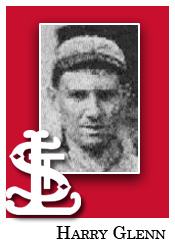 Glenn is one of eight players who appeared in the major leagues and died while serving in the United States armed forces in World War I. He is the only one of the eight who played for the Cardinals.
According to the National Baseball Hall of Fame, the others, in alphabetical order, are Tom Burr, Harry Chapman, Larry Chappell, Eddie Grant, Newt Halliday, Ralph Sharman and Bun Troy.
Three Negro League players died while serving in the United States armed forces in World War I. In alphabetical order, they are Ted Kimbro, Norman Triplett and Pearl Franklyn Webster.
Career path
A native of Shelburn, Ind., near Terre Haute, Harry Glenn was 19 when he began his professional baseball career with the Vincennes (Ind.) Alices in 1910.
A left-handed batter and catcher, Glenn was 6-foot-1, 200 pounds. In 1913, the minor-league Akron Giants sold Glenn’s contract to the Cardinals, but he broke a leg soon after and sat out the season, according to the Louisville Courier-Journal.
The Cardinals sent Glenn to the St. Paul (Minn.) Apostles of the American Association in 1914 and he batted .267 in 104 games.
In 1915, Glenn made the Opening Day roster of the Cardinals as a backup to starting catcher Frank Snyder.
The 1915 Cardinals had intended to start the season with Snyder and Mike Gonzalez as their catchers after agreeing to a deal to acquire Gonzalez from the Reds, but the trade hit a snag and Gonzalez was in roster limbo while details were sorted out. That gave Glenn the opportunity to be the Cardinals’ reserve catcher.
In the lineup
On Opening Day, April 14, 1915, against the Cubs at Chicago, Snyder was hit on the right hand by a foul tip off the bat of Heinie Zimmerman and had to leave the game. Replacing Snyder, Glenn made his big-league debut and got his first hit, a single off starter Hippo Vaughn. The Cubs won, 7-2. Boxscore
With Snyder sidelined and Gonzalez still not cleared to join the Cardinals, Glenn started each of the next four games at catcher.
In his first start, April 15 against the Cubs, Glenn had a single, two walks and scored a run, helping the Cardinals to a 4-2 victory. The Cubs stole a base in their only attempt. Boxscore
The next day, April 16, the Cubs were successful in three stolen base attempts against Glenn and Cardinals pitcher Dan Griner. “The fault was evidently not wholly Glenn’s for (manager Miller) Huggins gave Griner … a calling for allowing the men too big a lead,” the St. Louis Star-Times reported. Glenn got his first RBI, but the Cubs won, 4-2. Boxscore
On April 17, the Cardinals won the finale of the four-game series, 7-4, and Glenn contributed two singles. Boxscore
Reds run wild
The Cardinals’ next game was against the Reds at Cincinnati on April 18 and Glenn again started at catcher.
The Reds won, 6-2, and had seven stolen bases against Glenn and Cardinals ace Bill Doak. Boxscore
“After watching the woeful exhibition of Harry Glenn … the Cardinals are more anxious than ever to obtain (Gonzalez),” the St. Louis Post-Dispatch declared.
The Star-Times asked: “Was it the great base running of (the Reds) or was it the poor catching of Glenn?”
While acknowledging the Reds’ rampage “looks especially bad for Glenn,” the Star-Times added, “The big fellow seems to possess all the qualifications for a good receiver and perhaps the finishing touches will come with a little more experience. His arm is as good as any, but he has not mastered the trick of getting rid of the ball with any great rapidity.”
Brief stay
Snyder returned to the Cardinals’ lineup the next day, April 19, and Glenn was relegated to the bench. The deal for Gonzalez was resolved and he made his Cardinals debut on May 6. Glenn got a pinch-hit appearance on May 12 before being demoted to St. Paul.
Glenn batted .313 (5-for-16) with three walks in six games for the 1915 Cardinals, but base runners were successful on all 11 stolen base attempts against him.
With St. Paul in 1915, Glenn batted .296 in 63 games. He also spent the next three seasons, 1916-18, with St. Paul.
Glenn could have continued playing baseball, but with World War I raging, he enlisted in the mechanical branch of aviation late in the summer of 1918, according to The Indianapolis News.
Deadly disease
In October 1918, Glenn became ill and was admitted to a hospital. A victim of an influenza pandemic, Glenn developed pneumonia.
According to the National Institutes of Health, the majority of deaths during the influenza pandemic of 1918-1919 were caused by bacterial pneumonia following influenza virus infection. The pneumonia developed when bacteria invaded the lungs on a pathway created when the virus destroyed cells that line the bronchial tubes and lungs.
Glenn was in the hospital for a week. His father, Thomas, left Indiana on a Thursday to be at his son’s bedside in Minnesota.
“A telegram was received Friday saying he was better and Saturday morning a telegram was received saying he was dead,” The Indianapolis News reported.
According to Stanford University, the influenza pandemic of 1918-1919 killed between 20 million and 40 million people worldwide. More people died of influenza in a single year than in four years of the Black Death Bubonic Plague of 1347-1351.
Glenn was survived by his parents, two sisters and a brother.
On Nov. 11, 1918, almost a month to the day Glenn died, Germany signed an armistice agreement with the Allies, ending the fighting.
Previously: Mike Gonzalez became 1st Cuban manager in majors

 RetroSimba
Leave a comment