(Updated Jan. 23, 2025)
Chuck Carr, a switch-hitting speedster who appealed to the Cardinals but didn’t fit into their plans, found a home with the expansion Marlins.
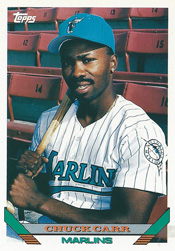 On May 14, 1993, the Cardinals played the Marlins in a regular-season game for the first time. The first batter they faced was Carr, whom the Marlins selected from the Cardinals in the Nov. 17, 1992, National League expansion draft.
Carr developed into a productive player with the 1993 Marlins. He led the National League in stolen bases (58) that season, tied with Jeff Conine for the team lead in runs scored (75) and was second on the club in hits (147).
In a special edition magazine, “Marlins! Top of the First,” Dan Le Batard of the Miami Herald wrote, “If Marlins center fielder Chuck Carr hadn’t been born, Walt Disney would have created him. The cocky Carr, part cartoon and part character, added a flash of fluorescence to a game capable of being as black and white as its box scores.”
For instance, according to Le Batard, after winning a game for the Marlins with a bunt, Carr gave his interviews while staring into a mirror. He also wanted to name a son Sports _ as in, Sports Carr _ but his wife wouldn’t allow it. They settled on Sheldon instead.
The Cardinals would like to have kept Carr, but they had outfielders such as Ray Lankford, Bernard Gilkey and Brian Jordan who rated ahead of him.
Learning to hit
Carr entered pro baseball in 1986 when he was drafted and signed by Reds scout Ed Roebuck, a former big-league pitcher. After a year in the Reds’ system, Carr was released, joined the Mariners, spent two seasons in their organization and got traded to the Mets.
On Dec. 13, 1991, the Cardinals, acting on the advice of player development director Ted Simmons, got Carr from the Mets for minor-league pitcher Clyde Keller. Carr had a reputation for being a good fielder and weak hitter. “We signed him primarily as a defensive player,” Simmons told the St. Louis Post-Dispatch.
The Cardinals assigned Carr to Class AA Arkansas to open the 1992 season and sent minor-league hitting instructor Johnny Lewis to work with him.
“Chuck was just slapping at the ball … I took him aside and showed him ways he could hit the ball harder,” Lewis told the Louisville Courier-Journal.
Said Carr: “Johnny wants me to shorten my swing and put the ball in play more, just like Jose Oquendo and Ozzie Smith. It made sense to me.”
Carr hit .261 at Arkansas and was promoted to Class AAA Louisville on May 12. He batted .308 with 53 stolen bases in 96 games for Louisville.
“Carr is stirring memories of Vince Coleman,” wrote Courier-Journal columnist George Rorrer. “He’s fast enough to steal a base nearly any time he wants.”
Said Louisville manager Jack Krol: “Chuck has done more than we thought he could do … He can make it to the big leagues.”
Building block
Carr was called up to the Cardinals in September 1992 and they gave him a chance to play. He made 15 outfield starts. “His disruptive speed and defensive skills make Carr intriguing,” Dan O’Neill of the Post-Dispatch wrote.
Carr hit .360 in his first 25 at-bats and had five stolen bases. “Initially, he stirred excitement with the Cardinals,” wrote O’Neill. “Then he started hitting fly balls and his average deflated.”
In 22 games for the Cardinals, Carr hit .219 with 10 stolen bases.
After Carr was drafted by the Marlins, Cardinals manager Joe Torre said he “would have benefited us as a player coming off the bench” in 1993. “We were kind of hoping he might sneak through” the draft without being taken, Torre said.
The Marlins saw Carr as a possible cornerstone for building a lineup. “He can steal 50 bases in the major leagues,” said Marlins scout Cookie Rojas.
Run generator
Scott Pose was the Marlins’ starting center fielder and leadoff batter in their first Opening Day, April 5, 1993, but Carr took over the job on April 16 and kept it the remainder of the season.
A couple of more anecdotes from Dan Le Batard about Carr:
_ During 1993 spring training, Carr approached Lou Brock, then an Expos instructor, and asked for tips on how to be a better base stealer. “Listen, son,” Brock said to Carr, “what I’ve done can’t be taught in 15 minutes.” Carr got an autograph instead.
_ In a regular-season game against the Cubs, Carr was called out on a close play at first, taunted umpire Jeff Kellogg by pointing at his eyes and said to him, “If you are blinded by the speed, don’t make the call.”
When the Marlins came to St. Louis for the first time in a regular-season game, their lineup was Chuck Carr in center, Junior Felix in right, Dave Magadan at third, Orestes Destrade at first, Benito Santiago at catcher, Jeff Conine in left, Alex Arias at second, Walt Weiss at short and pitcher Chris Hammond.
The Cardinals’ lineup: left fielder Bernard Gilkey, shortstop Ozzie Smith, center fielder Ray Lankford, first baseman Gregg Jefferies, right fielder Mark Whiten, third baseman Todd Zeile, second baseman Geronimo Pena, catcher Erik Pappas and pitcher Bob Tewksbury.
The Cardinals won, 7-2. Carr contributed to both Marlins runs.
In the fourth, Carr got the Marlins’ first hit, lining a single to center. He swiped second _ “The throw was pretty good,” said Pappas. “He just beat it.” _ advanced to third on a groundout and scored on a single by Magadan.
In the seventh, with the bases loaded and two outs, Carr was grazed on the arm by a Tewskbury pitch, forcing in a run. “The ball was close to being a strike,” said Tewksbury. “He’s just diving into the pitch.” Boxscore
Carr batted .263 with six stolen bases against the Cardinals in 1993. The Cardinals won nine of 13 games against the expansion Marlins.
In eight major-league seasons with the Mets (1990-91), Cardinals (1992), Marlins (1993-95), Brewers (1996-97) and Astros (1997), Carr batted .254 with 144 stolen bases.

 RetroSimba
Leave a comment