(Updated June 15, 2023)
The Cardinals couldn’t figure out Ramon Hernandez when he pitched for them any better than they could when he pitched against them.
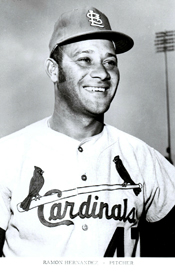 On March 31, 1970, the Cardinals released Hernandez, a left-handed reliever who was on their roster in spring training. The Cardinals came to regret the move.
Hernandez and another ex-Cardinal, Dave Giusti, anchored a dependable bullpen for the Pirates and helped them become the dominant club in the National League East.
The Cardinals, who finished runner-up to the Pirates in 1971 and 1974, consistently were baffled by the effective relief work of Hernandez.
Traveling man
Hernandez was born in Carolina, Puerto Rico, the same hometown as future teammate Roberto Clemente, who was six years older.
Hernandez was 18 when the Pirates signed him as an amateur free agent. In 1960, his second season in their farm system, the Pirates dropped Hernandez from the Class C level to Class D. Miffed by the demotion, he sat out the 1961 season, according to The Pittsburgh Press.
In December 1961, the Pirates sold Hernandez’s contract to the Angels. He played five seasons (1962-66) in the Angels’ farm system and had his best year in 1966 when he posted a 2.16 ERA for an El Paso team managed by Chuck Tanner.
The Braves selected Hernandez in the Rule 5 draft in November 1966 and he made their Opening Day roster in 1967. Hernandez “might turn out to be the surprise hurler of the year,” The Sporting News predicted.
Hernandez made 46 appearances for the 1967 Braves and was 0-2 with five saves and a 4.18 ERA. Unimpressed, the Braves left him off their winter roster. Hernandez was chosen by the Cubs in the November 1967 Rule 5 draft at the request of manager Leo Durocher, who planned for Hernandez and Phil Regan to be the club’s top relievers in 1968. “I didn’t draft Hernandez to send him to Siberia,” Durocher told the Chicago Tribune.
The Cubs’ faith in Hernandez went unrewarded. He appeared in eight games for them and had a 9.00 ERA. Instead of Siberia, they sent him to the Cardinals.
Wrong fit
The Cardinals acquired Hernandez from the Cubs on June 14, 1968, and assigned him to their Class AAA Tulsa farm team.
Warren Spahn, baseball’s career leader in wins (363) by a left-hander, was Tulsa’s manager, but he and Hernandez clashed. “Hernandez admitted he had differences with Warren Spahn,” the St. Louis Post-Dispatch reported.
According to The Pittsburgh Press, Hernandez said Spahn “impeded his return to the majors by sending unfavorable reports back to St. Louis.”
Miserable at Tulsa, Hernandez was 2-5 with a 6.19 ERA. The Cardinals demoted him to Class AA Arkansas for 1969. At 28, his career appeared to be in decline.
On the outs
Playing for Arkansas manager Ray Hathaway, a former pitcher known for his instructional skills, Hernandez improved.
Used primarily as a starter, he was 10-10 with a 2.40 ERA. Among the wins was a no-hitter against El Paso on Aug. 17, 1969. Intrigued, the Cardinals put him on their winter roster and planned to give him a long look in spring training.
Cardinals director of player procurement George Silvey said, “Hernandez throws a screwball and has great control. He’s the kind of guy who maybe has to work every other day (to be effective).”
The good vibes the Cardinals had for Hernandez quickly faded at spring training in 1970 when “there were such problems as reporting late for practice sessions and not going all out in workouts,” the Post-Dispatch reported.
According to The Pittsburgh Press, the Cardinals “didn’t think he was putting out enough in the team running drills.”
Roberto Clemente later said, “Every place he went, they said he had a problem. I guess they didn’t understand him. The first tendency is to say that he is lazy.”
Regarding the decision by Cardinals general manager Bing Devine to release him, Hernandez, 29, told The Sporting News, “He thought I was too old.”
Finding a home
Hernandez signed with the Mexico City Reds of the Mexican League and pitched for them in 1970 before going home to Puerto Rico to play winter baseball. Pirates infielder Jose Pagan saw Hernandez pitch there and was impressed.
At Pagan’s urging, the Pirates acquired Hernandez on Feb. 10, 1971. He was assigned to the minors, but got called up in June for a weekend series versus the Cardinals at St. Louis.
On June 12, 1971, in his first Pirates appearance, Hernandez gave up a scratch single to the first batter he faced, Lou Brock. Boxscore
The Cardinals wouldn’t get another hit against Hernandez the rest of the season.
The next day, Hernandez earned a save against the Cardinals. Boxscore
As planned, he was returned to the minors but got called up again in September. With the Pirates and Cardinals battling for the division title, Hernandez faced the Cardinals twice and got saves both times.
For the season, Hernandez had three saves in four appearances versus the Cardinals and yielded no runs. He faced 19 batters and retired 18.
The Pirates finished seven games ahead of the second-place Cardinals in the East Division, won the pennant against the Giants in the National League Championship Series and prevailed in the World Series versus the Orioles.
Hernandez had seven saves and an 0.73 ERA in 10 appearances for the 1971 Pirates.
Working the angles
Hernandez became one of the National League’s top relievers, helping the Pirates win four division titles in a five-year span, and was especially effective against the Cardinals. In 1972, he was 5-0 with a 1.67 ERA and 14 saves, including four versus the Cardinals. In 1974, he was 2-0 with a 1.88 ERA against them.
Regarding his success with the Pirates, Hernandez told The Pittsburgh Press, “I do it with a bunch of garbage.”
Said Phillies manager Frank Lucchesi: “His motion has a lot to do with it. It’s very deceptive.”
Hernandez threw a variety of pitches from different angles and at varying speeds.
Dave Giusti, his bullpen mate, said of Hernandez, “The best I’ve ever seen at getting out left-handers _ and I mean ever.”
In his book, “Baseball for Brain Surgeons and Other Fans,” catcher Tim McCarver said, “(Outfielder) Rusty Staub and I agree that Ramon Hernandez was the toughest left-hander we faced in our careers. I’d have nightmares about him. He would ride the fastball up and in and then throw the sweeping curveball.”
(For their careers, McCarver hit .091, 1-for-11, versus Hernandez. Staub hit .056, 1-for-18, against him.)
Overall, left-handed batters hit .224 versus Hernandez in the majors. In six seasons (1971-76) with the Pirates, Hernandez was 23-12 with 39 saves and a 2.51 ERA.

 RetroSimba
The 1971 Pittsburgh Pirates had five former Cardinals on their pitching staff. From 1970 to 1972, the Pirates bullpen registered 139 saves. The Cardinals, over the same period, came up with only 55. Shouldn’t come as a surprise that from 1970 to 1975, we won only one season series against the Pirates. I won’t say that Ramon didn’t have any quirks in his personality. But, the truth is, the Cards, as an organization, were no longer innovative and willing to try different things as they did back in the 60’s. By 1970, they were starting to make the mistake of becoming to set in their ways. It’s interesting that this article mentions running drills. Steve Carlton once gave an interview where, as always, he didn’t hesitate to say that he wished that he could have stayed in St. Louis. And yet, he said that he seriously doubts that he would have developed as a pitcher had he remained. He then goes on to say that the Phillies coaches were willing and open to experiment with different training methods instead of just running drills.
Thanks for the fact-based analysis.Those 5 former Cardinals you cited on the 1971 World Series champion Pirates: Nelson Briles (8-4, 1 save, 3.04 ERA), Dave Giusti (5-6, 30 saves, 2.93), Mudcat Grant (5-3, 7 saves, 3.60), Bob Miller (1-2, 3 saves, 1.29) and Ramon Hernandez (0-1, 4 saves, 0.73). I hope the Pirates sent the Cardinals a thank-you note.