A couple of American pitchers finishing out their military service in the Korean War became baseball pioneers of sorts in Japan.
Leo Kiely and Phil Paine were the first to play in the major leagues in the U.S. and in professional baseball in Japan.
Kiely, a left-hander with the 1951 Boston Red Sox, and Paine, a right-hander with the 1951 Boston Braves, played for teams in the Japanese Pacific League in late summer 1953.
Kiely, 23, made his Japanese debut on Aug. 8, 1953, for the Mainichi Orions, according to the Society for American Baseball Research. Paine, 23, made his Japanese debut on Aug. 23, 1953, for the Nishitetsu Lions.
Jersey guy
Born and raised in Hoboken, N.J. (site of the first organized baseball game played in June 1846 between the Knickerbocker Club and New York Nine), Leo Kiely was 5 “when he was run down by an ice truck _ run over twice, in fact, by the same truck,” the Boston Globe reported.
 Both of his legs were broken, just under the knees, and he broke his pelvis, too, according to the Globe.
“That ice truck sure tried to do a job on me,” Kiely told the Boston newspaper. “I was playing in an alley when it backed over me and ran over my legs. Then the guy put on full speed ahead and ran over me again.”
As a teen, Kiely worked for $38 a week as a truck driver’s helper on a Hoboken newspaper, The Jersey Observer. Then he became a press room apprentice at the newspaper, serving the role of flyboy. (The term came about because the job required catching stacks of newspapers as they flew off the presses.) “He had dreams of becoming a printer,” the Globe reported.
Kiely also developed into a standout sandlot baseball player. In August 1947, in the championship game of the Build Better Boys Sandlot Association tournament at Jersey City, Kiely, 17, “looked like Frank Merriwell, Jack Armstrong, and the Rover Boys all rolled into one,” the Bayonne Times reported.
He pitched a four-hitter, striking out nine, and hit a home run as Hoboken ended Bayonne’s four-year hold on the league title. Red Sox scout Bill McCarren signed Kiely to a contract.
Because of his childhood accident, “one leg is still a bit shorter than the other and _ even in his baseball shoes _ he has to wear a slight lift in one shoe,” the Globe reported.
In late June 1951, during his fourth season in the minors, Kiely got called up to the Red Sox. Because he had not been to spring training with the big-league club, “most of the Red Sox had never heard of him when he was brought up,” according to the Globe.
Red Sox manager Steve O’Neill put Kiely, 21, into the starting rotation. He made his big-league debut against the Washington Senators on July 2, 1951, and got the win, pitching a complete game. Boxscore
Kiely finished the 1951 season with a 7-7 record and 3.34 ERA for the Red Sox.
Special delivery
Phil Paine, from Chepachet, Rhode Island, excelled in baseball and hockey as a youth. The Philadelphia Phillies signed him when he was 18 and he pitched two seasons in their farm system. When the Phillies exposed him to the minor-league draft, the Braves claimed him in December 1949.
 At Hartford in 1951, Paine was managed by Tommy Holmes, the former Braves outfielder who twice led the National League in hits. When Braves manager Billy Southworth resigned in June 1951, Holmes replaced him.
A month later, Paine was told there was a telegram for him in the Hartford clubhouse. “I thought it was from the draft board,” Paine told The Sporting News. “I nearly fell over when I read it and found out I’d been called up to the Braves.”
Paine, 21, went 2-0 with a 3.06 ERA in 21 relief appearances for the 1951 Braves.
“This kid has got a lot of stuff,” Holmes told The Sporting News.
Braves pitching coach Bucky Walters said to the Globe, “That boy’s got it. Phil has a perfect disposition for a pitcher, including that touch of meanness that a pitcher needs … I think he’s going to be a great pitcher.”
Soldiering on
After their rookie seasons in the big leagues, Kiely and Paine were inducted into the U.S. Army in the fall of 1951. Even with his leg condition, Kiely passed an Army physical. “The Army decided he was fit for service, although disqualified for combat,” The Sporting News reported.
Both men spent most of the Korean War stationed in Japan and pitched for military base baseball teams.
The signing of an armistice on July 27, 1953, brought an end to the Korean War. Kiely and Paine, both still in military service, then joined the Japanese teams, agreeing to play until they were discharged from the Army. Until then, no one who had played in the major leagues had played for a professional team in Japan.
The arrangement was that Kiely and Paine would pitch on their days off from military duty. Paine was paid $575 a game, The Sporting News reported.
According to baseball-reference.com, Kiely went 6-0 with a 1.80 ERA for the Mainichi Orions, and Paine was 4-3 with a 1.77 ERA for the Nishitetsu Lions.
Both men were discharged from the Army in the fall of 1953 and prepared to return to their major-league teams the following spring.
Much had changed since Kiely and Paine last pitched in the majors. The Braves moved from Boston to Milwaukee and Charlie Grimm was the manager. The Red Sox had a different manager, too _ Lou Boudreau.
San Francisco detour
Kiely was 5-8 for the Red Sox in 1954 (the highlight was a shutout of the Philadelphia Athletics), then got moved to the bullpen in 1955 and was 3-3 with six saves and a 2.80 ERA. In the winter, he worked on the docks in Hoboken, according to the Globe.
After posting a 5.47 ERA for the Red Sox in 1956, Kiely was sent to the minors the following year.
The 1957 season was San Francisco’s last as a minor-league town. Pitching for the San Francisco Seals, Kiely was 21-6 with a 2.22 ERA. Twenty of those wins came in relief.
The Red Sox brought him back in 1958 and Kiely, 28, was 5-2 with 12 saves.
He pitched two more years in the majors _ with the 1959 Red Sox and 1960 Kansas City Athletics. In his final inning, he struck out his former Red Sox teammate, Ted Williams. Boxscore
Cardinals caravan
Paine made 11 relief appearances with the 1954 Braves and 15 with the 1955 team, then spent most of 1956 and 1957 in the minors.
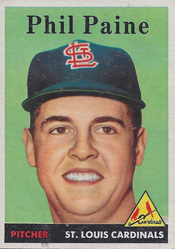
On April 19, 1958, the Cardinals claimed him off waivers and put him in their bullpen. Paine was 5-1 with a save in 46 appearances for the 1958 Cardinals. Combined with his 5-0 mark during his years with the Braves, he had a career record of 10-1 in the majors.
After the season, the Cardinals went on a goodwill tour of Japan and played 16 exhibition games against Japanese all-star teams. Paine was one of eight pitchers the Cardinals brought on the tour.
At Fukuoka, Japan, Paine visited Camp Drake, the military base where he had been stationed, and spoke at a luncheon held in his honor, according to the Society for American Baseball Research. He was the starter and winning pitcher for the Cardinals in the 10th game of the tour at Fukuoka, United Press International reported.
In December 1958, after the Cardinals returned home, they traded Paine and Wally Moon to the Dodgers for Gino Cimoli. The Dodgers made the deal only after the Cardinals agreed to add Paine, the Los Angeles Times reported.
Paine’s former team, the Nishitetsu Lions, offered him a contract to pitch for them in 1959, according to United Press International, but he opted to report to spring training with the Dodgers. They assigned him to the minors and he finished his playing career there.

 RetroSimba
What a fascinating tale. I love that out of war, baseball opportunities bloomed for the two players. Reminds of those times when something I initially perceived as bad produced a few positives like maybe breaking up with someone and all that heart ache, and then on the walk away from her apartment, I stop off at a bar and I like the atmosphere and it becomes a regular spot, maybe like that WC Fields line, something like – It was a women who caused me to drink and I forgot to thank her.
What a feeling that must have been for Paine when he thought it was the draft board and it turned out to be the Braves.
As usual, you respond to the heart of my stories, Steve, and I appreciate that. In researching this piece, it amazed me the goodwill and open-mindedness it took from all sides to have American big-leaguers playing pro ball in Japan just 8 years after WW II. It provides hope for a better world, I think.
“The Dodgers made the deal only after the Cardinals agreed to add Paine”? Moon by himself for Cimoli was already a bad deal for the Cardinals!
Yep, according to the Dec. 5, 1958, Los Angeles Times, the Dodgers and Cardinals first discussed a deal of Wally Moon for Gino Cimoli at the the 1958 World Series. In December, at the baseball winter meetings in Washington, D.C., negotiations resumed between Dodgers general manager Buzzie Bavasi and Cardinals GM Bing Devine, the Times reported. “Not until Devine sweetened the kitty with Phil Paine, however, would the Dodgers general manager OK the deal,” the Times reported. Moon told the newspaper, “I think the Dodgers made a lot better deal than the Cardinals.”
How sad that they both passed away tragically at a young age. With the experiences that they lived they both probably had lots of stories to tell. Incredible that Leo Kiely was able to pitch having one leg shorter than the other. Could it be that one of the reasons for the Dodgers wanting Phil Paine was that he made their hitters look silly? In 16 career appearances against the Dodgers Paine had an era of 1.67 and held them to a batting average of .161 in 109 plate appearances.
Good work on those career statistics for Phil Paine versus the Dodgers, Phillip. I imagine that did have something to do with the Dodgers wanting him.
At Dodgers spring training camp in Vero Beach, Fla., in February 1959, the Los Angeles Times reported, “Paine is on the Spokane roster but is expected to be promoted shortly.”
The Times also reported that Paine needed only about three weeks (one report said 16 days; another, 22 days) on the Dodgers’ regular-season roster in order to qualify for a major-league pension.
“Of the jillion twirlers under contract to L.A. minor-league clubs, there are three who have a good chance to cut it with the Dodgers _ Art Fowler, Phil Paine and Gene Snyder,” the Times reported in March 1959.
On March 22, 1959, in an exhibition game versus the Cardinals at St. Petersburg, Fla., Paine pitched two hitless, scoreless innings for the Dodgers.
However, when the regular season began, Paine was with Spokane. Another pitcher on the Spokane roster was Roger Craig.
The Dodgers had plenty of right-handed relievers on the 1959 team _ Larry Sherry, Clem Labine (who, like Paine, was born and raised in Rhode Island), Art Fowler and Johnny Klippstein. In June 1959, the Dodgers called up Roger Craig from Spokane. Paine never got the call.
The 1959 Dodgers went on to become World Series champions.
Sorry, totally OT but this has to be one of the funniest things ever heard on a baseball broadcast. Cards at Mets 1992, as Junior Noboa steps to the plate 1:08:35.
Good ol’ Ralph Kiner. Met him once. Very nice guy. A true slugger, he played mostly for bad teams, including the 1952 Pirates (42-112). He told Newsday that it was George Weiss, the Mets’ first general manager, who asked him to join Lindsey Nelson and Bob Murphy on the expansion Mets’ first broadcast team. Kiner years later recalled, “I once asked Weiss, ‘Why me?’ He said, ‘You had losing experience.’ “