For a while, in the early part of September 1963, Cardinals pitcher Curt Simmons couldn’t do anything wrong at the ballpark.
 From Sept. 1 to Sept. 13, Simmons won four starts in a row for the 1963 Cardinals and pitched three consecutive shutouts in that stretch.
His hot streak extended beyond the pitching mound. Simmons drove in runs and, in perhaps the most amazing feat of all, stole home.
Base thief
A left-hander who turned 34 in 1963, Simmons was a starter who overcame career-threatening injuries. Part of the big toe on his left foot was sliced off in a lawn motor accident in 1953 and he underwent surgery to remove bone chips in his left elbow in 1959. After the Cardinals signed him in May 1960 following his release by the Phillies, Simmons mixed more changeups and slow curves into his assortment of pitches.
Simmons was part of a 1963 Cardinals starting rotation with Bob Gibson, Ernie Broglio, Ray Sadecki and Lew Burdette.
On Sept. 1, 1963, Simmons started against the Phillies at Connie Mack Stadium in Philadelphia. In the second inning, with Tim McCarver on first and one out, Simmons hit a Chris Short pitch to the base of the scoreboard in center for a triple. McCarver scored, giving the Cardinals a 1-0 lead.
(The triple was the third and last for Simmons in 20 seasons in the majors. The others came in 1953 against Sal Maglie of the Giants and in 1955 versus Hy Cohen of the Cubs.)
With Julian Javier at the plate, the Cardinals called for a squeeze play. Overeager, Simmons broke for home too soon. Short noticed and tried to throw a pitch that Javier would be unable to bunt. In his excitement, Short threw the ball high over the outstretched mitt of catcher Bob Oldis. Simmons scooted safely to the plate and was credited with a steal of home.
Asked by the St. Louis Globe-Democrat whether he could recall his last previous swipe of home, Simmons said, “Maybe in high school. They don’t want to take too many chances with me (attempting to steal).”
(The steal of home versus the Phillies was the second and last stolen base for Simmons in the majors. The first came 10 years earlier when he swiped second base in a 1953 game against the Pirates.)
In the sixth, with Bobby Locke pitching for the Phillies, George Altman tripled and Simmons drove him in with a sacrifice fly for his second RBI of the game.
Simmons pitched a six-hitter for the win, beating the Phillies for the 12th time in 14 decisions since joining the Cardinals. Boxscore
In command
For the next two weeks, Simmons was unbeatable _ and also untouchable when it came to scoring runs against him.
On Sept. 5, he shut out the Mets and contributed a single and a walk in the 9-0 triumph. He thought he had another hit but his liner with the bases loaded was caught against the wall by right fielder Ed Kranepool. “How could they play me so deep?” Simmons said to the St. Louis Post-Dispatch. “They had a first baseman playing right field. If they had a regular outfielder, he wouldn’t have played so deep.” Boxscore
Four days later, Simmons shut out the Cubs on a five-hitter. Cleanup batter Ron Santo, held hitless, told the Post-Dispatch, “That’s the best I’ve seen Simmons.” Boxscore
On Sept. 13, Simmons pitched his third shutout in nine days when he beat the Braves and Warren Spahn.
Hank Aaron, who sometimes was frustrated by Simmons’ soft tosses, struck out twice. So did Eddie Mathews. Simmons held Aaron, Mathews and Joe Torre hitless. “Simmons is like Spahn,” Mathews said to the Post-Dispatch. “He knows what he’s going to do on every pitch.”
Simmons’ RBI-double down the left field line drove in a run and knocked Spahn out of the game in the second inning. Boxscore
Tough foe
The win streak ended for Simmons on Sept. 17 against his season-long nemesis, the Dodgers. Trailing the first-place Dodgers by two games in the National League standings, the Cardinals sent Simmons against Sandy Koufax, but the Dodgers won, 4-0. Boxscore
When the Dodgers completed a sweep of the three-game series the next night, it virtually secured the pennant for them.
In four starts versus the 1963 Dodgers. Simmons was 0-3, even though he had a 2.00 ERA over 36 innings. He lost twice to Koufax and once to Don Drysdale. The Cardinals totaled three runs in those three defeats.
For the 1963 season, Simmons was 15-9 with a 2.48 ERA. He pitched six shutouts and totaled 232.2 innings. (Koufax had 11 shutouts in 1963 and Spahn had seven.) Simmons also fielded flawlessly, committing no errors in 35 chances.
“Curt doesn’t beat himself,” Cardinals manager Johnny Keane remarked to the Post-Dispatch. “He walks few batters, fields his position and gets a base hit now and then.”

 RetroSimba
He started for the Cardinals in the first MLB game I ever attended (6/5/1965). The opposing starter, Larry Dierker, was almost half the age of Simmons.
That was quite an interesting game you witnessed. Larry Dierker, 18, and Curt Simmons, 36, both pitched well. The Cardinals won in the 12th inning when Ken Boyer tripled and scored on a Tim McCarver single against the former Cardinals reliever, Ken MacKenzie. Here is the box score: https://www.retrosheet.org/boxesetc/1965/B06050SLN1965.htm
Just reading about squeeze plays, bunting, a pitcher swinging the bat makes me wish for baseball the way they used to play it. It must have been something special to see Curt Simmons take off for home. In looking at his pitching logs from 1963, both Sandy Koufax and Curt Simmons went into extra innings against each other with both of them getting no decisions. The game is from August 21st, 1963.
I agree with you, Phillip. The ability of a pitcher to get on base added an element of pleasant wonderment to a game.
In that Aug. 21, 1963, game you cited, Curt Simmons pitched 13 innings and Sandy Koufax went 12 without either getting a decision. The Dodgers won in the 16th when Ken McMullen, 21, doubled versus Ron Taylor and scored on a John Roseboro single.
Roseboro had been 0-for-6, mostly strikeouts and pop-ups, in the game before getting his winning hit. Here is a box score: https://www.retrosheet.org/boxesetc/1963/B08210LAN1963.htm
The fact that you can state who the guy hit triples off of is a feat in and of itself! You must have the patience of a saint to do all this amazing research.
Simmons hung around for a long time, and considering his record and how many games he started he was the king of the ND.
I got a special kick from learning that Curt Simmons tripled versus Sal Maglie. Both had the most intimidating 5 o’clock shadows in the game then.
The Sporting News described Simmons as having “a face like a B-picture villain.”
Maglie, who glared and scowled at batters while sporting a dark stubble, “resembles Jack Dempsey stepping into the ring,” Bob Broeg wrote in the St. Louis Post-Dispatch.
Humphrey Bogart could have portrayed either in a motion picture.
Speaking of intimidating 5 o’clock shadows, it’s tough to top Joe Torre’s face on his 1966 Topps baseball card.
In his autobiography, “Chasing the Dream,” Joe Torre recalled that in 1956, the year he turned 16, “I stood 6-foot-1, weighed 240 pounds and had a 40-inch waist. I was just about as wide as I was tall. Opposing teams took one look at me _ this huge kid with a serious 5 o’clock shadow _ and immediately complained to the umpire that I was way too old to be playing in that league.”
Losing his toe and those bone chips in his elbow, what a fighter. Inspiring. Such a long and effective career as a pitcher. I love the span of greatness you describe, his three consecutive shutouts, the triple, and the steal of home. I’m with phillipmezzapelle in wishing pitchers would still bat. It seems strange or ironic or something that at a time when we have probably the best hitting pitcher of all time, pitchers don’t bat anymore. Amazing that the three shutouts happened in September, so late in the season. He must of had not only a strong arm, but a spirit of determination.
Good point, Steve. The face of baseball today, the game’s most marketable player, is Shotei Ohtani, a player who can hit and pitch. So baseball, in its infinite wisdom, bans pitchers from hitting.
As Bob Gibson (another guy who could hit and pitch) said in 1994, “The rancor between the pitcher and the hitter, which characterized the game in my time, has been legislated out in favor of a kinder, gentler game in which there is more cheap offense for the paying customer.”
Curt Simmons transformed from being a power pitcher with the 1950 Whiz Kid Phillies into, as author David Halberstam wrote in his book, October 1964, “a skilled pitcher with a provocative motion who knew how to use hitters’ strengths against them,” with the 1960s Cardinals.
Like 6stn, Simmons started the first game I ever saw live. I was a 10 year old kid in 1963 and Simmons started against the Braves. I believe Warren Spahn was supposed to be the Braves starter, but was being held back as this was still soon after the legendary 16 inning game he and Juan Marichal pitched.
Unfortunately for me, Hank Aaron, who hated hitting against Simmons, got him this time for a three run homer in the top of the first.
Simmons had a real herky-jerky motion then and me and my buddy across the street would do sort of an imitation of his delivery and kind of joke around about it.
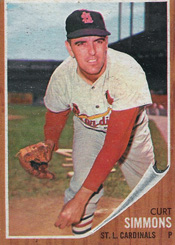
On a slightly different note, I like that ’62 Topps card but my favorite was his 1963 card. Real good pitcher and an 18 game winner with our ’64 champions.
It must have been great fun to try to imitate as a kid the pitching motion of Curt Simmons. In a 1992 interview for the Baseball Hall of Fame Magazine, Stan Musial said, “Curt’s herky-jerky delivery was very hard to time.” In his autobiography, Musial said, “Curt was one of the toughest left-handers I ever faced.” Of course, Stan still batted .359 versus Simmons for his career. Simmons did strike out Stan a lot _ 14 times, according to retrosheet.org, or 13 times, according to baseball-reference.com. Regardless, the only pitchers to whiff Stan Musial more times than Curt Simmons did were Warren Spahn (30 times), Ken Raffensberger (17) and Preacher Roe (15.).
I can relate to what you say about the Curt Simmons 1963 Topps card. The 1963 Topps set is my favorite.
Makes sense that Stan said Simmons would be tough to time. That motion where he kind of had a delay in his delivery and was all twitchy would have been tough to gauge.
Agree on the ’63 Topps. Terrific set with great color and photos. My personal favorite is 1965 as that was my peak year of collecting as a kid, and I had a lot of those. But ’63 was right there as well, and of course has Stan’s last card.