During his National League pitching career, Ken MacKenzie produced one hit. It resulted in his only RBI _ a game-winning single against the Cardinals.
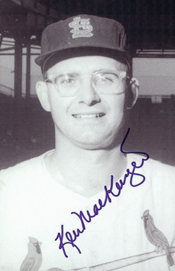 Doing the unexpected came naturally to MacKenzie. A hockey player from a small town on a Canadian island, he went to Yale, graduated and became a big-league pitcher.
A left-handed reliever, MacKenzie was the only pitcher on the original 1962 New York Mets to finish the season with a winning record. In an encore, he also was the only pitcher with a winning record on the 1963 Mets.
Bespectacled and unassuming, MacKenzie was called Mr. Peepers by his Mets teammates, according to Newsday’s George Vecsey.
The Cardinals acquired him for a possible pennant run. After his playing career, MacKenzie coached baseball and hockey at Yale.
Out of the wilderness
MacKenzie was from Gore Bay, a town on Manitoulin Island in Ontario, Canada, at the north end of Lake Huron. His father, John, who ran a hardware store, lost an eye serving in Europe with the Black Watch Royal Highland Regiment of Canada during World War II, according to the Hartford Courant.
Like his father, Ken MacKenzie excelled at hockey. Years later, he recalled to the Atlanta Constitution, “I never played baseball until I was 15 … I started pitching for the town team.”
MacKenzie was so inexperienced at pitching, “I didn’t even know how to wind up until I was 16,” he said to The Sporting News.
He went to Yale for an education (majoring in industrial administration) and to play hockey. After playing for Yale’s freshman hockey team, he made the varsity as a defenseman his sophomore year.
Though he hadn’t played freshman baseball, MacKenzie tried out for the varsity as a sophomore and earned a spot on the pitching staff. He became “one of the best college pitchers I’ve seen,” Hartford Courant columnist Bill Newell observed.
Relying on pinpoint control, MacKenzie was 19-6 with a 1.77 ERA in three varsity baseball seasons. He was 6-0 versus Harvard and 5-1 against Princeton.
(MacKenzie also played three varsity hockey seasons at Yale and was the team’s leading scorer as a junior.)
Beating the odds
Though he was successful in the Ivy League, conventional wisdom was MacKenzie didn’t throw hard enough to pitch in the pros. “Ken, even in his wildest dreams, never pictured himself being a major-league player,” the Hartford Courant noted.
After he graduated in 1956, MacKenzie received one baseball offer _ from the Milwaukee Braves. He signed with them in September 1956 and reported to their Class AA Atlanta Crackers farm club at spring training in 1957.
According to the Atlanta Constitution, MacKenzie “kept his bags packed” because he was uncertain he’d make the team. “Every time I heard a rumor someone was going, I figured it would be me,” he told the Atlanta newspaper.
Instead, he made the team and became a prominent starter, pitching a one-hitter against Mobile and finishing the 1957 season with a 14-6 record.
Progressing through the farm system, MacKenzie got called up to the Braves to fill a relief role in May 1960. His first decision, a loss to the Reds, came when he gave up a walkoff grand slam to Ed Bailey. Boxscore
In October 1961, the Braves sold MacKenzie’s contract to the Mets.
New York, New York
The 1962 Mets (40-120) were a bad team but had some smart pitchers. In addition to MacKenzie (Yale), the college graduates on the staff included Craig Anderson (Lehigh) and Jay Hook (Northwestern). Their manager was the Ol’ Perfessor, Casey Stengel, 72.
In recalling the 1962 Mets, MacKenzie told Dick Young of the New York Daily News, “Grounders went through all the time, and the ones they got to they didn’t pick up. All singles were doubles. I had an earned run average of 5, and maybe half of it was mine. We had to get five and six outs an innings. One day, Frenchy Daviault was pitching and it was brutal. The Old Man (Stengel) came out and said, ‘What’s the matter?’ Frenchy said, ‘What do you expect me to do?’ The Old Man said, ‘Strike somebody out. You know they can’t catch grounders.’ “
According to the New York Times, when MacKenzie came into a game one time in a crucial situation, Stengel handed him the ball and said, “Make like those guys are the Harvards.”
MacKenzie and his wife, Gretchen, a Vassar College graduate, lived in a Greenwich Village apartment during their time with the Mets. “We’d walk around and see all the art shows, drop in the coffee shops, or just watch the people,” MacKenzie told Newsday. “We liked the people down there. Everybody was open-minded. That’s the way we like to operate.”
Timely hitting
On July 28, 1962, at St. Louis, MacKenzie relieved Jay Hook in the fifth inning of a game against the Cardinals. With the Mets ahead, 8-6, in the ninth, MacKenzie, hitless as a big-leaguer, stroked a single against Don Ferrarese, scoring Joe Christopher and increasing the lead to 9-6.
(It was MacKenzie’s only hit and only RBI in 36 at-bats in the majors. MacKenzie told the Hartford Courant that Mets hitting coach Rogers Hornsby said to him, “You know, MacKenzie, you’re not a bad hitter. You put the bat on the ball.”)
The run was important because, in the bottom half of the inning, MacKenzie walked Bill White and gave up a home run to Curt Flood, pulling the Cardinals to within one at 9-8. (Flood hit .700 _ 7 for 10 _ against MacKenzie in his career.) After Willard Hunter relieved and walked Stan Musial, Craig Anderson came in and rescued the Mets, retiring the next three batters and securing the win for MacKenzie. Boxscore
MacKenzie was 5-4 with a save for the 1962 Mets, becoming the first pitcher to complete a season with a winning record for them. His ERA was 4.95. According to the Hartford Courant, when MacKenzie told Casey Stengel that at $10,000 per year he was the lowest paid member of Yale’s class of 1956, Stengel replied, “But you had the highest ERA.”
Cardinals calling
With the 1963 Mets, MacKenzie had a torrid start to the season (2-0, one save, 0.00 ERA in six appearances in April) but hit the skids hard in May. In one stretch of three games, he gave a walkoff home run to the Dodgers’ Frank Howard, a shattering home run to the Cardinals’ Bob Gibson and a game-winning home run to another Cardinal, Charlie James. (For his career, James hit .800 _ 4 for 5 _ versus MacKenzie.) Boxscore, Boxscore, Boxscore
Nonetheless, three months later, on Aug. 5, 1963, the Cardinals traded pitcher Ed Bauta to the Mets for MacKenzie. With a 3-1 record and three saves for the 1963 Mets, MacKenzie again was their only pitcher with a winning record.
(Regarding MacKenzie’s combined record of 8-5 for the 1962-63 Mets, Dick Young wrote, “If they ever decide to hand out medals, Ken MacKenzie belongs in the front line.”)
Manager Johnny Keane, whose Cardinals were five games behind the first-place Dodgers at the time of the trade, said to The Sporting News, “We got MacKenzie to help Bobby Shantz with the left-handed job in the bullpen.”
Though he told Newsday he was pleased to join a pennant contender, MacKenzie also had regrets about leaving the Mets. “I felt I was one of the originals on the club, and that meant something,” he said.
MacKenzie made eight appearances totaling nine innings for the 1963 Cardinals, who finished in second place. After the season, they traded him to the Giants for catcher Jim Coker.
Back to school
After brief stints with the 1964 Giants and 1965 Astros, MacKenzie was done as a player. In October 1965, he was named coach of the freshman baseball and hockey teams at Yale.
Three years later, in June 1968, MacKenzie became head coach of the Yale varsity baseball team, replacing Ethan Allen, who retired.
Among the players on the first varsity team MacKenzie coached were first baseman Steve Greenberg (son of Baseball Hall of Famer Hank Greenberg) and center fielder Brian Dowling (who also was the quarterback on Yale’s football team). Steve Greenberg became deputy commissioner of Major League Baseball, and the character of B.D. in the Doonesbury comic strip was based on Brian Dowling, a classmate of cartoonist Garry Trudeau.
In 1969, MacKenzie made a surprise return to the majors. Montreal Expos general manager John McHale, who had been in the Braves’ front office when MacKenzie first came to the big leagues, put MacKenzie on the Expos’ roster on Sept. 1, 1969, as a favor to add the necessary 26 days for the minimum five years needed for a pension, the Montreal Gazette reported. A grateful MacKenzie spent the month pitching batting practice and didn’t get into a game.
After that adventure, he resumed his coaching duties at Yale. MacKenzie coached varsity baseball for 10 seasons and then worked in the school’s alumni office until he retired.

 RetroSimba
As crazy as it sounds, Ken MacKenzie had the highest winning percentage for a New York Mets pitcher until Tom Seaver came along. Ken MacKenzie by no means had a great career but I can imagine that playing for both the expansion Mets and Astros, as well as briefly being with the expansion Expos, he had some incredible stories to tell. That was a great gesture by GM John McHale. Just as a little tidbit. Ernie Banks, Lou Brock and Roberto Clemente went a combined 2 for 21 against Ken MacKenzie. I hope it’s OK to wish you Mark and your family a happy holiday season. I also express the same to everyone who visits and appreciates RETROSIMBA.
Thanks for your good wishes, Phillip. Your readership and your welcomed contributions to my blog are much appreciated. Here’s hoping 2024 is good to you and your loved ones.
Good insights on those 3 Hall of Famers being a combined 2-for-21 versus Ken MacKenzie. That alone earns him an “A” in my grade book.
Regarding his time with the 1962-63 Mets, MacKenzie said to Newsday, “I’m proud of having been an original Met. If people want to think that I was a clown, that’s all right, but I always remember what the Old Man (Casey Stengel) said after I was traded. As we shook hands, he said, ‘You always tried your best.’ ”
During that one-month stay with the Expos in September 1969, the Montreal Gazette referred to MacKenzie as the club’s “traveling intellect.”
So that means two former Cardinals pitchers have been head coach for Yale. Unless there’s more…
Good point, Paul. Former Cardinals pitcher John Stuper was head coach of the Yale varsity baseball team from 1993 to 2022.
Ethan Allen, who preceded Ken MacKenzie as head coach of the Yale varsity baseball team, had been a big-league outfielder. Allen played for the St. Louis Cardinals in 1933, and for the St. Louis Browns in 1937 and 1938.
One of the few links between the 1962 original Mets and the 1986 World Series champion Mets was provided by Ken MacKenzie and Ron Darling. Both pitched at Yale. In 1983, Darling told the New York Times, “Ken MacKenzie recruited me for Yale. He was the baseball coach, and I asked him if playing baseball at Yale might hurt my chances for a professional career. He assured me that, if I was good enough, it wouldn’t.”
That’s high praise from Rogers Hornsby to say he wasn’t that bad of a hitter! It’s always interesting to hear of players with a hockey background. You’d think most of them hail from Canada, but the first two that come to mind, my mind anyway, are Nyjer Morgan and Tom Glavine. It would have been interesting if Ken MacKenzie would have written a book about his time with the Mets and Casey Stengel.
Mark, thanks for all your great research and writing. I wish you and your family a great and healthy 2024.
Steve, I’m grateful for your readership, encouragement and good wishes. Wishing you happiness and fulfillment in 2024 and beyond.
I always enjoy stories about the Casey Stengel Mets. In researching this piece, I came across one I hadn’t heard before involving Ernie White, a former Cardinals pitcher who was the bullpen coach for the 1963 Mets. White told Pittsburgh sports editor Al Abrams, “Casey calls me Weiss. You know how he butchers names. I’ve always been Weiss to him, and you never really know what he’s going to say when he calls up on the dugout phone to the bullpen. One day, I had Jay Hook and Ken MacKenzie loosening up, just in case, when the ting-a-ling came: ‘Mr. Weiss, who you got warming up?’ I told him Hook and MacKenzie. He said, ‘I don’t need neither one of those gentlemen,’ and he hung up.”
It’s kind of cool that MacKenzie and his wife were cool with the beatnik scene. I’m sure Jack Kerouac and his cronies would have loved to chat it up with him although they hung around Columbia around that time.
Yes, I liked that about Ken MacKenzie, too, that he enjoyed that scene. According to George Vecsey of Newsday, the MacKenzies had an apartment on 10th Street between Fifth and Sixth avenues, and Ken rode the subway from there to the Polo Grounds for Mets games.
MacKenzie told Vecsey about his Greenwich Village days, “Nobody ever bothered me for my autograph or anything … I guess I don’t look that much like a ballplayer.”