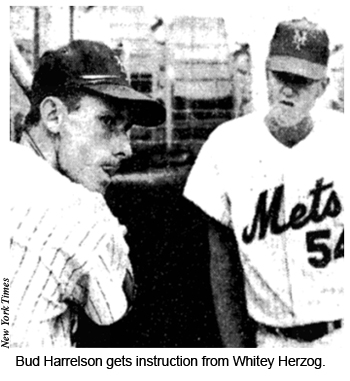
Whitey Herzog helped Bud Harrelson hit well enough to stay in the big leagues. What he likely couldn’t have imagined is that the scrawny shortstop of the Mets would become a terror at the plate against Bob Gibson.
 In 16 big-league seasons, Harrelson hit .236 and had a modest on-base percentage of .327. Against Gibson, he turned into the reincarnation of Ty Cobb. Harrelson batted .333 versus the Cardinals ace and, with 20 hits and 14 walks, had a .459 on-base percentage.
If not for Herzog, a Mets coach who later became Cardinals manager, Harrelson might not have stuck around long enough to do so much damage against Gibson. “Whitey Herzog really taught me what the game is all about here,” Harrelson said to the New York Daily News.
A Gold Glove fielder, Harrelson helped the Mets win two National League pennants and a World Series title.
Making a switch
Signed by the Mets in June 1963, a day after he turned 19, Harrelson got brought up to the majors two years later. His first plate appearance for the 1965 Mets came at St. Louis when he grounded out against the Cardinals’ Ray Washburn. Boxscore
At 155 pounds, Harrelson “looked like a high school shortstop,” the New York Times noted. He fielded like a pro but didn’t hit like one. In 37 at-bats for the 1965 Mets, Harrelson hit .108. Columnist Arthur Daley described him as a “frail little guy” and “a batter of feeble skills.”
Desperate to make himself useful as a hitter, Harrelson, a natural right-hander, took some swings from the left side against a pitching machine at spring training in 1966. Mets director of player personnel Bob Scheffing (a former Cardinals catcher) and minor-league manager Solly Hemus (a former Cardinals player and manager) “noticed his smooth left-handed stroke, and suggested that he continue,” the New York Times reported.
Assigned to Class AAA Jacksonville, managed by Hemus, Harrelson made himself into a switch-hitter, but the results were not immediate. He batted .221 overall, and .210 from the left side, for Jacksonville.
Called up to the Mets in August 1966, Harrelson worked before every game with Herzog, a coach on manager Wes Westrum’s staff, to get better at hitting from both sides. Herzog urged him to “hit that ball like it’s your enemy” and “smash it,” the New York Times reported.
Harrelson told the newspaper, “That half-hour I put into the batting cage is like two hours work for me … but I know I’m knocking on the door. I know I’ve got to make it as a switch-hitter. That’s the way it is.”
Whitey ball
Herzog boosted Harrelson’s confidence and encouraged his scrappy play.
On Sept. 16, 1966, at San Francisco, the score was tied at 3-3 with two outs in the ninth when Harrelson batted from the right side against Giants left-hander Billy Hoeft. A runner, Johnny Lewis (a former Cardinal), was on second.
Harrelson drove the ball over the head of rookie left fielder Frank Johnson, who played shallow, for his second triple of the game, scoring Lewis and giving the Mets a 4-3 lead. “I get to third base, I’m dusting myself off, just happy to be there, and Whitey (Herzog, coaching at third) says, ‘So steal home,’ ” Harrelson told the New York Daily News.
While Harrelson pondered that, the Giants lifted Hoeft and replaced him with Lindy McDaniel, the former Cardinal. On McDaniel’s first pitch to Eddie Bressoud, Harrelson took a normal lead and noticed McDaniel didn’t pay much attention to him. “Herzog told me if McDaniel wasn’t looking at me and I thought I could make it, I should go ahead and try it,” Harrelson said to the San Francisco Examiner.
On McDaniel’s second pitch, Harrelson broke for home as Herzog suggested. McDaniel’s pitch was high and went past catcher Tom Haller to the backstop. Harrelson scored easily with a steal of home, extending the Mets’ lead to 5-3.
The Giants scored a run in the bottom of the ninth, but the Mets prevailed, 5-4, on Harrelson’s dash to the dish. As Newsday noted, “A skinny kid … ran right over the Giants. He just about took their pennant hopes and buried them under home plate with his flashing spikes.” Boxscore
Different strokes
Harrelson became the Mets’ starting shortstop in 1967. “He had to make himself into a ballplayer, and he did it,” Herzog recalled years later to Bernie Miklasz of the St. Louis Post-Dispatch.
Described by Dick Young of the New York Daily News as “a hard-working slap hitter who can fly,” Harrelson took a tip from coach Yogi Berra to use different bats and different grips from each side of the plate.
“Yogi got me to start using a big bat when I hit left-handed,” Harrelson told Dave Anderson of the New York Times. “I use a 36-inch, 35-ounce bat and choke up about four or five inches from the handle. Right-handed, I’m using a light bat that (utility man) Bob Johnson gave to me. It is only 34 inches, 30 ounces. I choke up only about an inch with that one.”
Because batting right-handed was natural to him, resulting in a quicker swing, a lighter bat was sufficient, Harrelson said. From the left side, he became “a sweep contact hitter” who needed the help of a heftier bat, he told Dave Anderson.
“They use a Little League defense against me as a lefty,” Harrelson said to the New York Times. “The outfield plays shallow with the infield in.”
It was as a left-handed batter, his weak side, that Harrelson faced Bob Gibson. All that practicing and experimenting he did paid off.
Bring it on, Bob
The Cardinals won consecutive National League pennants in 1967 and 1968, and were expected to contend again in 1969, but the Mets, who never had experienced a winning season, dethroned them.
On Sept. 23, 1969, the Mets clinched at least a tie for a division title with a 3-2 win versus Gibson and the Cardinals in 11 innings. Batting left-handed, Harrelson had two hits and two walks, and drove in the winning run.
With the score tied at 2-2 in the bottom of the 11th, the Mets had runners on first and second, one out, when Harrelson lined a 1-and-2 pitch from Gibson into center for a single.
“I thought it was gong to be close at the plate,” Mets manager Gil Hodges told Newsday, but Curt Flood’s throw was up the first-base line, enabling Ron Swoboda to score from second. Boxscore
For the 1969 season, Harrelson hit .248 and had an on-base percentage of .341, but against the Cardinals he had a .317 batting mark and reached base in 45.1 percent of his plate appearances. In 17 plate appearances versus Bob Gibson in 1969, Harrelson’s on-base percentage was .625.
In his autobiography, “Stranger to the Game,” Gibson said, “Most of my energy was spent working on and worrying about the guys with the biggest sticks. Although the ping hitters may have put more nicks in me from game to game, I didn’t fear them whatsoever … If I wanted the batter to hit the ball, as I wanted singles hitters to do in most cases, I didn’t see the merit of throwing pitches that weren’t strikes.”
Two years later, on May 7, 1971, Gibson and the Cardinals had a 1-0 lead on Tom Seaver and the Mets at New York’s Shea Stadium when Harrelson led off the bottom of the seventh with a triple to the alley in right-center.
“Maybe he has only four super fastballs in him a game now,” Harrelson said to Newsday of Gibson, “but he’s a great self-analyst. He knows what he’s got and how to use it. He sets you up now instead of blowing you down.”
After Ken Boswell grounded out to first, Dave Marshall batted. “I put down two fingers for a curve and Bob saw only one,” catcher Ted Simmons told Newsday. “That fastball just sailed over my left shoulder.”
The wild pitch enabled Harrelson to scamper home with the tying run.
“That wasn’t Ted’s fault,” Gibson said to Newsday. “I blew the sign.”
The Mets scored twice in the eighth against Gibson and won, 3-1. Boxscore
In 1973, when the Mets edged the Cardinals for the division title, Harrelson hit .258 overall and .325 against St. Louis.
For his career, Harrelson had more hits versus Steve Carlton (23) and Bob Gibson (20) than he did against any other pitchers.

 RetroSimba
Baseball sure is a weird sport.
Yep, it is. I’m glad that, so far, there always has been room for guys like Bud Harrelson, and not just the big guys.
More from the weird side: Bud Harrelson hit just 7 home runs in his 16 seasons in the majors. All were hit right-handed versus left-handed pitchers, including a future Hall of Famer, Jim Kaat, in May 1977 at Philadelphia.
Baseball used to be a game where even the smallest details and modifications were very important. Today’s hit a homerun or strikeout philosophy has changed all that. Even after all these, years you could make the case that from a defensive standpoint, Bud Harrelson is still the best shortstop that’s ever played for the Mets. The work that Whitey Herzog did with Bud Harrelson has to remind us of how Whitey helped Ozzie Smith improve his hitting.
I am glad you mentioned Bud Harrelson’s defense, Phillip. Harrelson is one of two Mets shortstops to win a National League Gold Glove Award. Harrelson won it in 1971. Rey Ordonez was the other Mets shortstop to receive the award. Ordonez won the Gold Glove three times _ 1997, 1998, 1999.
Perhaps Bud Harrelson was similar to the Cardinals’ Dal Maxvill. Like Harrelson, Maxvill won one National League Gold Glove Award (in 1968) for his shortstop play. In the games they played just at shortstop, Maxvill (.973) and Harrelson (.969) had similar career fielding percentages.
In 1978, when Harrelson was playing for the Phillies, Maxvill was a coach on the staff of Mets manager Joe Torre. Tim Foli was the Mets shortstop that season.
Bud was a scrappy ballplayer. I like your comparison to Dal Maxvill. I thought of him the same way.
Bud Harrelson was a perfect utility player for those Phillies clubs in 1978 and 1979. He backed up Larry Bowa at shortstop and Ted Sizemore (1978) and Manny Trillo (1979) at second base.
Jayson Stark of the Philadelphia Inquirer wrote of Harrelson with the Phillies, “He is about as big, physically, as one of Dave Parker’s forearms, but he is a worker, a hustler, an energetic guy who has made himself as good as he can be and who has seemed to make the people around him better through labor and enthusiasm.”
After his season with the Phillies in 1978, Harrelson retired. He was working on Wall Street and playing in a slow-pitch softball beer league in Long Island when Bowa got hurt in May 1979. The Phillies brought back Harrelson then and he spent the rest of the 1979 season with them. In joining the 1979 Phillies, Harrelson became a teammate of Pete Rose, his adversary in the famous 1973 playoff scuffle. Rose was in his first season with the Phillies in 1979.
On June 1, 1979, when Rose played at Cincinnati for the first time since leaving the Reds, Harrelson was in the Phillies starting lineup at shortstop. Rose batted leadoff, pitcher Steve Carlton batted eighth and Harrelson was in the ninth spot in manager Danny Ozark’s batting order.
On June 11, 1979, Harrelson made a Rose-like play to win a game for the Phillies. With the score tied at 2-2 in the seventh against the Astros, Harrelson tried to score from second on a single. Bruce Bochy, then a big catcher for Houston, was blocking the plate. As the Philadelphia Daily News noted, Harrelson weighed about “the same as Bochy’s catching gear,” but Harrelson opted to crash into Bochy rather than slide around him. Bochy couldn’t handle the throw and Harrelson was safe at home with the winning run.
On Aug. 10, 1979, Harrelson delivered a walkoff RBI-single for the Phillies to beat Grant Jackson and the Pirates: https://www.retrosheet.org/boxesetc/1979/B08101PHI1979.htm
Even if he was thought of on the east coast as a light hitter, Harrelson was Alex Rodriguez compared to Hal Lanier.
Bud Harrelson grew up in Hayward, California, and played one season of baseball at San Francisco State. In 1966, when he was with the Mets, he told the San Francisco Examiner, “I’m a big Giants fan. I root for the Giants against everybody but the Mets.”
Like Harrelson, Hal Lanier was helped by Whitey Herzog. Lanier was a coach on Herzog’s Cardinals staff for five years (1981-85) and then became manager of the Astros. Like Lanier, Harrelson also became a big-league coach (with the Mets) and then a big-league manager (also with the Mets).
Kind of off topic, but this post stuck with me including the title “Little Big Man” because it reminded me of the movie with the same name starring Dustin Hoffman, a movie I would very much like to see again.
Regarding the connection between Herzog and Harrelson and the impact Herzog had on Harrelson’s career….that strikes me as what it’s all about, to be young and learn from elders. I’m reminded of Jim Leyland and the praise former players give him.
I hope you will watch “Little Big Man” again soon, Steve. In place of watching sports, I watch a lot of movies on TCM (Turner Classic Movies) and find it a rewarding experience. Some of the movies I re-watch seem better than when I saw them the first time; others do not. It’s also great to discover new “old movies.” It’s fascinating how perspectives change and what I notice now as opposed to before.
I was heartened that Bud Harrelson helped others as Whitey Herzog had done for him. Harrelson’s first managing job was in 1984 with Class A Little Falls (N.Y.). Most of the players were fresh out of high school or college. “They remind me of myself at Salinas of the California League in 1963,” Harrelson told the New York Times. “I remember the anxiety that makes a young player try too hard. I try not to make the pressure worse.”
The Little Falls shortstop was 19-year-old Kevin Elster, who said Harrelson was an excellent mentor. When Harrelson managed the New York Mets in 1990 and 1991, Elster was his shortstop.