Quarterback Norm Snead lost a lot more often than he won in the NFL. Some of it was his fault. Some of it had to do with his supporting casts.
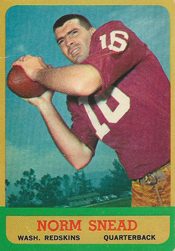 A classic drop-back passer, Snead was 6-foot-4, smart and had a strong arm. Teams traded quarterbacks Sonny Jurgensen and Fran Tarkenton to acquire him.
He was with the Washington Redskins (1961-63), Philadelphia Eagles (1964-70), Minnesota Vikings (1971), New York Giants (1972-74 and 1976) and San Francisco 49ers (1974-75). Most of those were bad teams.
Snead’s clubs had losing records in 13 of his 16 NFL seasons. The exceptions: 1966 Eagles (9-5), 1971 Vikings (11-3) and 1972 Giants (8-6).
In 178 games played (159 as a starter), Snead was 57-114-7 (52-100-7 as a starter). He was 3-12 versus the Cleveland Browns; 3-14-2 against the Redskins.
The St. Louis Cardinals, with their relentless blitzing, also were a tormentor. Snead was 7-12-1 against them. The Cardinals sacked him more times (53) than any other foe, but he also totaled his most passing yards (3,832) against them.
(Cardinals receiver Sonny Randle was a friend, but more on that later.)
Snead threw 196 career touchdown passes _ more than luminaries such as Ken Stabler (194), Bob Griese (192), Sammy Baugh (187), Otto Graham (174), Joe Namath (173), Norm Van Brocklin (165) and Troy Aikman (165).
Sink or swim
In high school at Newport News, Va., Snead excelled in baseball (he struck out 16 in a game) and basketball (he averaged 21 points a game as a senior) as well as football. He went on to play college football at Wake Forest and set multiple Atlantic Coast Conference passing records.
The Washington Redskins, with the second overall pick in the first round of the 1961 NFL draft, chose Snead ahead of quarterbacks Fran Tarkenton of Georgia and Billy Kilmer of UCLA. Then they traded their starter, Ralph Guglielmi, to the Cardinals and gave the job to Snead.
With no running game (the 1961 Redskins ranked last in the NFL in rushing), Snead was put in a tough spot. Opponents, knowing he was going to pass most of the time, teed off on him.
When Snead faced Guglielmi and the Cardinals on Oct. 22, 1961, at Washington, he was sacked seven times, intercepted once and booed by the home crowd before being replaced in the second half. “I felt sorry for him,” Guglielmi told the Associated Press. “I sure was glad it wasn’t me.”
Led by blitzing linebackers Bill Koman, Dale Meinert and Ted Bates, the Cardinals won, 24-0 _ the franchise’s first shutout win since the Chicago Cardinals beat the Detroit Lions, 7-0, in 1942. Game stats
Snead started all 14 games his rookie season but didn’t get a win until the finale against the Dallas Cowboys. Years later, he told the Philadelphia Daily News, “I should have sat on the bench when I first came up instead of starting right away … I’d just go in and throw. I developed some bad habits, like throwing in a crowd, things like that.”
Helping hand
In 1962, Washington became the last NFL team to integrate. Among the black players acquired was future Pro Football Hall of Famer Bobby Mitchell. He and Snead made an immediate connection. Snead threw 22 touchdown passes in 1962. Eleven of those went to Mitchell.
After the season, Snead volunteered with the Peace Corps as a consultant in recruiting college students.
“I had thought about joining the Peace Corps while I was still at Wake Forest,” he said to the Associated Press. “I think all of us have some sort of idealism or patriotism in us that we want to express. This is a fine chance to do it.”
He also told United Press International, “It’s one way to contribute to a fine cause. I believe in what the Peace Corps is doing throughout the world.”
Snead became the first pro football player to work for the Peace Corps, according to the Associated Press.
“I don’t think football builds character,” Snead told Joe Donnelly of the Los Angeles Times-Washington Post Service, “but it is the greatest thing I’ve ever participated or come in contact with at revealing character.”
Not so Sonny
Snead’s fortitude got put to the test during his third season with Washington in 1963. He took a step backwards, getting intercepted 27 times, and became “the victim of unmerciful booing and criticism by Washington fans,” the Associated Press reported.
After the season, Snead and defensive back Claude Crabb were traded to the Eagles for quarterback Sonny Jurgensen and defensive back Jimmy Carr. The deal was unpopular in Philadelphia. As Jack McKinney of the Philadelphia Daily News noted, “Jurgensen, gifted with the best arm in pro football, is an established star. Snead, who has a pretty good pump of his own, is still merely promising.”
Then there was the matter of style. Sonny had swagger; Norm didn’t. Jurgensen “is an irrepressible, flamboyant man who moves through the football world laughing and enjoying himself,” the Philadelphia Inquirer reported. Snead “is a soft-spoken and reserved man who has little to say except in the huddle.”
Or, as the Philadelphia Daily News put it, Jurgensen’s antics off the field were “something less than that of a Boy Scout leader.” Snead was “a non-drinking, non-swearing all-American boy type.”
To be sure, there were successes for Snead with the Eagles. Like the time in 1965 that he picked apart a depleted Cardinals secondary (safeties Jerry Stovall and Larry Wilson were sidelined because of injuries) and threw three touchdown passes to his road roommate, Pete Retzlaff, in a win at St. Louis. Game stats
Or, the 1967 season, when Snead in 14 games had 29 touchdown passes (including two to tight end Mike Ditka).
The bad times, though, literally were torture. In a 1966 loss to the Cardinals, Snead was sacked nine times and had five passes intercepted. Two of the picks were returned for touchdowns by Stovall and Wilson. “Snead was being slung around like a string of hot dogs by a pack of mad bulldogs,” the Philadelphia Daily News reported. The Philadelphia Inquirer called it “his darkest hour as a professional quarterback” and noted that the Cardinals “did everything but separate Snead from his right arm.” Game stats
Though the Eagles had many weaknesses, Snead often shouldered the blame. “The criticism has been harsh and steady,” wrote columnist Sandy Padwe.
After the 1970 season, the Eagles traded Snead to the Vikings for offensive tackle Steve Smith and three draft picks.
“The Philadelphia fans never forgave him for the fact the Eagles traded Sonny Jurgensen for him,” United Press International concluded.
Hot and cold
Vikings coach Bud Grant rotated three quarterbacks during the 1971 season. Gary Cuozzo made eight starts and Bob Lee started four times. Snead’s two starts resulted in wins _ one against the Buffalo Bills and the other versus the Eagles at Philadelphia. He also replaced Cuozzo in the fourth quarter of a game against the Giants and threw a game-winning touchdown pass to Bob Grim. Game stats
After the season, the Vikings sent Snead, Grim, running back Vince Clements and two draft choices to the Giants for Fran Tarkenton.
Snead, 33, had a rebirth with the 1972 Giants. He started 13 games (the Giants won eight of those) and led the NFL in completion percentage (60.3). He was the starter in both of the Giants’ wins against the Eagles that season. Eagles owner Leonard Tose, who had guaranteed his team would beat Snead and the Giants at Philadelphia, said to United Press International, “I can’t believe Snead beat this team. I’m sick. I just can’t believe we’re this bad.”
One more highlight: The last time Snead faced the Cardinals was Nov. 18, 1973. He came off the bench near the end of the first quarter to replace Randy Johnson, who suffered a concussion, and completed 14 of 20 passes, leading the Giants to a 24-13 victory. Some of those completions were to Johnny Roland, the former St. Louis running back, who told the St. Louis Post-Dispatch, “It gave me a lot of personal satisfaction to show the Cardinals I can still play football.” Game stats
The Virginians
Like Snead, Sonny Randle, a wide receiver for the 1960s Cardinals, was born and raised in Virginia and played college football in the Atlantic Coast Conference. He and Snead became friends.
When Randle was head football coach at East Carolina and then at his alma mater, the University of Virginia, Snead aided him in developing offenses for those college teams. He also assisted every year at Randle’s summer football camps for youths in Fork Union, Va. “There’s no better offensive man in football,” Randle told the Newport News Daily Press.
After his playing days, Snead became director of admissions and head football coach at Newport News Shipbuilding Apprentice School. Randle became head football coach at Massanutten Military Academy.
On Nov. 5, 1977, Randle’s team beat Snead’s team, 25-6.
Randle went on to become head football coach at Marshall. Snead stayed with Apprentice School and was credited with “having restored the school’s football program to respectability,” the Newport News Daily Press reported. NFL Films video

 RetroSimba
Wow, this blog post about Norm Snead is absolutely fantastic! I can’t believe how inspiring and uplifting his story is. Thank you for sharing such an incredible piece, it truly made my day!
Here is my gaming blog url is http://www.gta5modded.com
Thanks for reading and for commenting.
As the title of your post says, it’s remarkable how much criticism Snead endured and still persevered. I was stunned to learn that he threw more touchdowns than what I would think are Hall of Famers – Namath, Griese, and Stabler.
His reserved ways remind me of the band Rush who I’ve heard would stay in their hotel rooms while on tour and read books where the other bands on tour with them would be out painting the town red.
I enjoyed your insights about Rush. I like and respect people who have the confidence and assuredness to do the unexpected and not follow the crowd. I think Norm Snead had that. In 1970, when the NFL players threatened to strike, Snead was the Eagles’ player representative and took a bold leadership role in support of the union. This surprised the Eagles general manager, Pete Retzlaff, who was Snead’s former teammate and road roommate. “I saw a side of Norm Snead that I never knew existed, and I was impressed,” Retzlaff told the Philadelphia Inquirer. “He demonstrated more leadership ability than he demonstrated on the field. He can turn it on when he wants to.”
After reading this post I keep asking myself, did Norm Snead ever have a good quarterback coach or offensive coordinator? To be placed in a situation where in your rookie year you have to start all the games is incredible. To last 16 years in the NFL is not only a tribute to his character and fortitude but also the fact that Norm Snead was actually a very talented quarterback. I just can’t help but wonder if given a chance to develop at a slower pace if it would have made a difference. Just as a note of interest. Even though Sonny Jorgensen would end up in the HOF, he would never actually start a playoff game.
You make a lot of excellent points, Phillip.
Jack McKinney of the Philadelphia Daily News wrote, “Snead has been learning his trade the hard way. The big fellow from Wake Forest has been under the gun since Game One of his rookie season and he’s been subjected to every sadistic type of blitz conceived by man.”
Bill McPeak was Washington’s head coach during Norm Snead’s three seasons there and was the man who decided to start Snead in all 14 games as a rookie, After Snead was traded in 1964, McPeak said to the Philadelphia Inquirer, “I used to think you could train a quarterback in this league in two or three years, but the way the game is played now, it takes five or six years. I still think in two or three years Snead will be a great quarterback.”
However, Eagles head coach Joe Kuharich did not connect with Snead. In 1966, Snead told the Winston-Salem Journal that a “personality clash” led Kuharich to bench him that season.
Vikings head coach Bud Grant was another who didn’t seem to be a good fit for Snead. Regarding Grant’s decision to rotate three quarterbacks in and out of the starting lineup in 1971, Snead told columnist Buddy Martin of the suburban Westchester County (New York) newspapers, “Quarterback became a position of ridicule instead of leadership. Every time the team looked up in the huddle, it was a different guy.”
Great stuff. As a kid, I felt Snead was a little under-rated as it seemed he was always on poor teams. I had the 1967 APBA season set and played a lot of APBA football with those cards, and Snead was really good. That happened to be one of his better years of course.
The deal for Jurgensen was quite a headline grabber – similar in a way to the Colavito-Kuenn baseball trade of a few years earlier. Interesting that Snead and Jurgensen were almost opposites in personality, but both talented quarterbacks. Sonny supposedly had the quickest release and natural throwing ability of about anyone to play the game. But Norm Snead could throw it about as well as anyone.
I played a lot of APBA baseball but not APBA football. Sounds like fun, especially with those 1960s-era players. It did seem that I got a Norm Snead football card every year I bought wax packs as a kid in the 1960s (and almost never a Johnny Unitas one). Those football cards were the reason I always liked Snead. He seemed to be on my team!
Your analysis is spot-on, Michael. The comparison to the Rocky Colavito for Harvey Kuenn trade is a good one. That Snead-for-Jurgensen deal created quite an uproar in Philadelphia. Jack McKinney, a columnist for the Philadelphia Daily News, didn’t hold back. He wrote that Eagles head coach Joe Kuharich, who pushed for the trade, “comes up looking like a hick who blew the egg money, trying to beat the carnival games. Barring wild and unexpected developments, this will go down as the worst deal the Eagles ever consummated.”
Yeah, the deal did not look good on the surface, but was not all that bad as things turned out. Sonny had some good years in Washington and stayed their long afterwards on their broadcast team if I am recalling correctly. Same with Sam Huff, who was greatly disappointed in getting dealt from New York to Washington, but he made his post season career with that organization.
I collected football cards as well and still have most of them. There is a great episode of the old television show “The Fugitive”, where the young Kurt Russell plays the detective’s son. Richard Kimball (David Janssen’s character as the lead) befriends him. Kurt plays a kid who collects football cards and they show him going through them, and it is the 1963 set, same as the one you used as the card for Norm Snead in this blog post. Kurt has a Jim Brown card, but no Unitas. Kimball tells him, “You need to get a Johnny Unitas.” In the final scene, Kimball is wrapping up a ’63 Unitas and mailing it to Kurt. Fortunately I had both the Brown and Unitas as a kid. Both of mine got a little beat up over the years though, and when I finished putting that set together as an adult I picked up better conditioned cards of both Brown and Unitas.
I thoroughly enjoyed your story about “The Fugitive” episode with David Janssen and Kurt Russell and the 1963 Topps football cards, Michael. What a gem. I never knew about that. Fantastic!
David Janssen played the general manager of a Super Bowl team in the 1978 TV movie “Superdome.” It’s not a good movie, but in addition to having David Janssen, the cast included Tom Selleck as the quarterback and former NFL players Dick Butkus, Les Josephson and Bubba Smith. Too bad it didn’t have Jim Brown or Johnny Unitas to create a link to that episode of “The Fugitive.”
Kurt Russell and his father, Bing Russell, played minor-league baseball. Bing played two seasons (1948 and 1949) as an outfielder with the Carrollton (Ga.) Hornets.
Kurt Russell played in the minors from 1971-73 as a second baseman. With the 1972 Walla Walla (Wash.) Islanders, his manager was Jack Spring, who was one of the pitchers the Cardinals got from the Cubs in the June 1964 trade involving Ernie Broglio and Lou Brock.
A 16-year NFL career for a guy who seems like he got sacked a record number of times is pretty incredible. What a tower of strength!
Yes, indeed. In September 1975, when Norm Snead was 36, Dwight Chapin of the Los Angeles Times wrote, “Time and a pair of bad knees have reduced his mobility to that of an aging tortoise.” Yet, Snead played in nine games, starting seven, for the San Francisco 49ers that season.
Every year, there was Norm Snead. It seemed like he, Craig Morton and a few other quarterbacks were always on their last legs, then training camp rolled around again, and there they were.
You are quite right. Earl Morrall is another who comes to mind.
I am glad you mentioned Craig Morton. Unhappy with being a backup to Roger Staubach with the Dallas Cowboys, Morton asked to be traded. In October 1974, the Cowboys granted his wish, sending him to the New York Giants for a No. 1 draft pick. The Giants then dealt Norm Snead to the San Francisco 49ers for two draft picks, opening the way for Morton to become the Giants starter.
I saw him in person a number of times at Franklin Field, and was always impressed with how he handled adversity…both on and off that field…especially in our neck of the woods where losing is not tolerated well.🙂
Thanks for the insights, Bruce. It is extra special coming from someone who got to see Norm Snead play at the home of the 1960s Eagles.
The comments I found from Norm Snead regarding the boos he received support your eyewitness accounts about him handling adversity well.
“Boos are just a part of football,” Snead said to the Los Angeles Times in 1975. “It happens in every city, eventually, to some degree. I view criticism of football players as a mathematical thing. The fewer wins, the more boos.”
Also on the subject of boos, Snead said to Newspaper Enterprise Association in 1966, “It’s not an easy thing to get along with, but you’ve got to learn to do it. Either that, or get out of football.”