Stan Musial and Red Schoendienst had a high regard for Pirates pitcher Al McBean; so much so that there was talk of a swap involving him and Curt Flood.
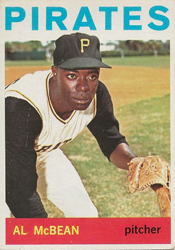 A right-hander from the Virgin Islands who pitched 10 years (1961-70) in the majors, McBean was a good pitcher (67-50, 63 saves) who was as effective with a bat as he was with his arm against the Cardinals.
McBean twice hit home runs in wins versus the Cardinals. In turn, the Cardinals used home runs to beat him. The most striking example came in 1964 when McBean was as good as any reliever in the National League. He yielded a mere four home runs that season _ and all were hit by Cardinals.
A sinkerball specialist with a showman’s flair, McBean struck out more Cardinals (92) than he did any other foe, but his record against them was 6-8.
Picture this
McBean played baseball as a youth on St. Thomas, one of the U.S. Virgin Islands, but had no plans to become a pro. When he finished his schooling, he worked as a photographer for a local daily newspaper, The Home Journal. “I only played ball on Sundays because there was nothing else to do on Sundays,” he recalled to columnist Larry Merchant.
The Pirates held a tryout camp on St. Thomas and McBean’s newspaper assigned him to cover it. A former coach saw him and encouraged McBean to join the prospects on the diamond. According to the Philadelphia Daily News, McBean was sent to center field, told to throw a ball toward home plate and delivered a missile. Then he was instructed to try it from the mound. The Pirates liked what they saw and signed him.
McBean, 20, began his pro career in the Pirates’ farm system in 1958. Three years later, in July 1961, he got called up to the big leagues and pitched in relief for the reigning World Series champions.
In a game against the Cardinals that season, the rookie gave up a grand slam to Bill White. The towering drive carried to the back of the screen on the pavilion roof at St. Louis. (White would torment McBean throughout his career, hitting .440 with four home runs against him.) Boxscore
Two weeks later, Stan Musial slugged a two-run homer versus McBean. Boxscore
Overall, though, McBean (3-2, 3.75) showed enough for the Pirates to put him in their plans for 1962.
Bold buccaneer
With Joe Gibbon and Vern Law having arm ailments in 1962, the Pirates moved McBean into the starting rotation. He delivered a 15-10 record, including 3-1 versus the Cardinals.
McBean got married in Pittsburgh during that 1962 season. Serving as best man at the wedding was his road roommate, Roberto Clemente.
McBean embraced the spotlight _ both on and off the field.
A lithe (165-pound) athlete, McBean’s voice had “the lilt of a calypso melody and is as bouncy as a bongo,” according to Milton Gross of the North American Newspaper Alliance.
McBean wore clothes designed for attention. A purple suit. A white Nehru jacket. Or, as Milton Gross described, “The large red bandana he pulls from his hip pocket to wipe his face on the mound is only a pale reflection of his vivid personality. He may, for instance, be seen coming to or leaving the ballpark clothed in an ascot, a Rex Harrison (houndstooth) hat, red vest, canary yellow shirt, dark sports jacket, checked pants and a rolled umbrella swinging from his arm.”
His flashy style wasn’t limited to his wardrobe.
Before games, McBean put on shows during infield practice, scooping grounders with behind-the-back moves. “He makes an infield drill look like a Harlem Globetrotters warmup with his uncanny fielding style and non-stop chatter,” Bill Conlin of the Philadelphia Daily News observed.
Red Schoendienst said to the Pittsburgh Post-Gazette, “Funniest guy I’ve ever seen in a uniform. McBean is full of fun, especially before a game in practice.”
In his prime years, when he went back to being a reliever, McBean walked from the bullpen to the mound with a swagger.
“McBean saunters into a game,” Pirates manager Danny Murtaugh said to the Philadelphia Daily News.
Columnist Stan Hochman wrote, “He sashays out of the bullpen.”
Or, as Pittsburgh Courier sports editor Bill Nunn Jr. noted, “If one envisions a rooster strutting, you have McBean’s walk. The swaying of his fanny is the equal to the backlash generated by most show girls. His quick gait does justice to a fancy-stepping drum major.”
One time, when he got called into a 1963 game, McBean reached the mound, handed his sunglasses to the bat boy, then sent him to the dugout for a different shade of glove, according to columnist Stan Hochman.
“He wants to be noticed,” Pirates general manager Joe Brown said to the North American Newspaper Alliance. “He does things to be seen. He’s an individualist who doesn’t want to stay in a mold. Everything he does, he wants to be different _ his clothes, his windup, the way he walks, the way he talks. He’s like a faucet. Turn him on and he goes until you turn him off.”
Trading places
McBean had the stuff to back up his struts.
He was 13-3 with 11 saves in 1963 and 8-3 with 21 saves and a 1.91 ERA in 1964. “He’s good, all right, and he’s cocky, too, but he gets the job done,” Cubs slugger Ron Santo said to The Pittsburgh Press. “McBean is as fast as anybody in the league. He just throws the ball right by you.”
From late July 1963 to mid August 1964, McBean pitched in 62 games for the Pirates without a defeat, totaling 11 wins and 19 saves.
He threw from a variety of arm angles and his pitches darted in a maze of directions. One year, when McBean struggled, his manager, Larry Shepard, advised him to quit trying to be so precise with location of his pitches. “I told him to throw the ball down the middle,” Shepard recalled to the Philadelphia Daily News. “The way his ball moves, there’s no way he can throw a strike down the middle anyway. So why try to hit the corners?”
According to the Pittsburgh Courier, Stan Musial described McBean as a “pitcher who moves the ball around on every pitch.”
Al Abrams of the Pittsburgh-Post Gazette wrote that Musial and Schoendienst “persisted for years in asking, ‘What’s a guy with Al McBean’s pitching talent doing in the bullpen?’ They would have loved to have had him pitch for the Cardinals. They almost did.”
In June 1967, when the Cardinals had Musial as general manager and Schoendienst as manager, the Pirates offered to trade McBean, outfielder Manny Mota and catcher Jim Pagliaroni to St. Louis for outfielder Curt Flood, reliever Hal Woodeshick and catcher Johnny Romano, The Sporting News reported.
The Pirates “came close” to making the deal, but “word is that Cardinals owner Gussie Busch vetoed the trade at the last minute,” according to the Pittsburgh Post-Gazette.
Muscling up
At the plate, McBean usually swung with all his slender might (in 1962, for instance, he struck out 32 times in 67 at-bats), but when he connected the ball could carry.
On June 16, 1963, at St. Louis, the score was tied at 3-3 in the 12th inning when McBean faced Ed Bauta and walloped a 400-foot home run halfway up the bleachers in left.
“Nobody believes me when I say I’m a good hitter,” McBean said to The Pittsburgh Press, “but when Ed Bauta gave me what I like _ a high, slow curve _ I almost jumped. This was right down my alley.”
In addition to his home run, McBean pitched six innings of scoreless relief and got the win. Boxscore
Five years later, in a 1968 game against the Cardinals at Pittsburgh, McBean hit a grand slam against Larry Jaster in a 7-1 Pirates victory. The Cardinals collected 13 hits and a walk against McBean but stranded 12 runners and hit into two double plays. Boxscore
In 1964, when McBean pitched in 58 games, the only team to hit home runs against him was St. Louis. Bill White hit two and Ken Boyer and Lou Brock had one apiece. Brock’s was a walkoff shot _ his first in the majors _ in the 13th inning. It landed on the right field roof and gave the Cardinals a 7-6 victory.
“He gave me a high, inside fastball and I jumped on it,” Brock told The Pittsburgh Press. “It was too good to be true.” Boxscore
For his career, Brock hit .476 with three home runs against McBean.
Some other future Hall of Famers didn’t fare as well. Hank Aaron batted .176 with one home run versus McBean and had more strikeouts (10) than hits (nine) against him. In 57 at-bats versus McBean, Ernie Banks hit .175 with no homers.
In 1967, after Jim Lonborg’s one-hitter versus St. Louis in World Series Game 2, Brock told the Boston Globe, “He had darn good stuff, but he’s not a (Juan) Marichal or a (Gaylord) Perry. He doesn’t even have the speed of Al McBean.”

 RetroSimba
Trading Curt Flood in June 1967? Wow. Reminds me of a big trade the St. Louis Blues made when they were riding high one year in the late-80s, early 90s. I don’t remember the particulars about it, but GM Ron Caron wanted to display his genius, ‘professorship.” Another early playoff exit for the Blues.
It is intriguing to consider a Pirates outfield with Roberto Clemente in right and Curt Flood in center.
In June 1967, when the trade was proposed, Harry Walker, the former Cardinal and teammate of Stan Musial and Red Schoendienst, was the Pirates manager. A former Cardinals instructor and manager in their farm system, Clyde King, was Pirates pitching coach and another ex-Cardinals player, Hal Smith, was Pirates bullpen coach. Makes me wonder whether Musial and Schoendienst were considering the trade based partly on information supplied by Walker, King and Smith.
Though Curt Flood was the better player, it’s easy to see how Manny Mota might have appealed to Musial and Schoendienst. With past National League batting champion Walker as his manager, Mota hit .332 for the Pirates in 1966 and he also hit .321 in 1967.
Today’s bland game could use a colorful talented individual like Al McBean. Before he suffered his first loss in 1964 he had an incredible ERA of 1.42 and held hitters to a .215 batting average. I’m also surprised though by the Cardinals being willing to trade Curt Flood for Al McBean. If I’m not mistaken Curt Flood hit over .330 that year. Good thing Mr.Gussie Busch vetoed the deal.
Like former Pirates pitcher Rip Sewell, Al McBean learned to throw a blooper pitch. With a 7-1 lead in the ninth inning of a 1968 game against the Cardinals, McBean threw the blooper pitch six times, according to the Pittsburgh Post-Gazette. He blooped a strike past Roger Maris and got Orlando Cepeda to bounce a blooper pitch to Jose Pagan to end the game. According to Stan Hochman of the Philadelphia Daily News, when McBean threw a blooper pitch to Willie McCovey, the Giants slugger “looked like a grizzly bear swinging a canoe paddle at a butterfly.”
In a two-year stretch, McBean was unbeatable at home. He was 3-0 at Pittsburgh’s Forbes Field in 1966 and 6-0 there in 1967.
It is interesting to consider whether Curt Flood would have reported had the Cardinals traded him to Pittsburgh in 1967, just like he refused to report when traded to the Phillies two years later.
What a story… I wouldn’t believe it if it wasn’t true. A photographer shows up and just happens to have a cannon. Wacky, wacky stuff. My lack of baseball knowledge shows up as well because I had never even heard of the guy. This blog is invaluable to me as you know.
I hope you and your loved ones had a relaxing SB Sunday, Mark. I enjoyed the game despite the constant muting of the commercials and the announcer that would never shut the hell up and let the game breathe. (Tony Romo) I guess the era of letting the picture speak for itself is over. Romo was flippantly spewing a million words per second, and it felt like he was describing even the most basic of game situations to an imbecile. The whole thing felt bush league, like I was watching the game with a 12 year old with ADD and a six pack of Jolt Cola. I believe at one point I would have seriously considered fighting the guy.
I am delighted you liked the Al McBean story, Gary. It was fun to research it.
I didn’t watch the Super Bowl. It represents to me some of the worst of over-the-top commercialism, excess, waste and greed. My wife had it on with the sound down and she watched it that way, just to see some football, which she enjoys. I appreciate your insights because it confirms that listening to one second of that overhyped nonsense is a waste.
I had the same thought as Gary regarding the unique origins of how he was first noticed as a player. I’m reminded of Ron LeFlore and him being noticed in prison. It’s always great to hear stories like this one, about players and their personalties. There used to be a pitcher for the Tigers – Daniel Norris who lived in a van during the offseason.
Good stuff, Steve. I did not know the Daniel Norris story.
Many of the characters in your short stories strike me as the types who would find unusual paths to baseball careers.
Thought you’d enjoy this anecdote from Tim Kurkjian of ESPN.com on how Ted Lyons of the White Sox began a pitching career that led to his election to the Baseball Hall of Fame:
“Ted Lyons was a trombone player in the Baylor Bears band in 1919 when a brawl broke out during a Baylor-Texas A&M football game. Lyons set down his trombone and joined the fight, but during the melee, his trombone was crushed, and he couldn’t afford a new one. Lyons had been a good high school baseball player, so he decided, because he had no instrument to play and had lost his music scholarship, to try to play baseball at Baylor. White Sox catcher Ray Schalk, who was on his way to spring training, visited the Baylor team, saw Lyons pitch and recommended him to his manager, Kid Gleason. Lyons signed with the White Sox, never spent a day in the minor leagues and wound up going to the Hall of Fame.”
Excellent! Thanks for sharing the Lyons story Mark, an excellent reminder to “expect the unexpected.”