Bobby Layne, who got an assist from the Cardinals in his development as a quarterback, returned the favor two decades later.
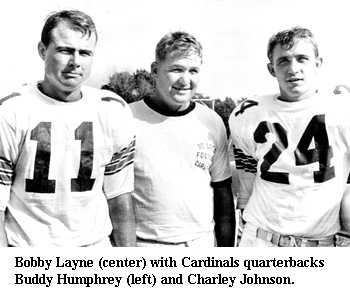 In 1965, Layne joined the St. Louis Cardinals as quarterback coach, helping to refine Charley Johnson.
During the 1950s, Layne was a savvy, swashbuckling quarterback who led the Detroit Lions to NFL championships. Before that, while at University of Texas, he got a crash course in how to play in a modern T formation when he was invited to visit the Chicago Cardinals.
Fast learner
A native of Santa Anna, a Texas town named after a Comanche chief, Layne experienced tragedy in 1935 when he was 8. According to Alcalde, the alumni magazine of the University of Texas, “he was riding in the backseat of the family car when his father coughed and lurched backward from the passenger seat, dying of a heart attack. The experience haunted Layne the rest of his life.”
Layne’s mother sent him to live with an aunt and uncle, and they settled in affluent University Park in suburban Dallas. At Highland Park High School, Layne became a friend and teammate of running back Doak Walker. They later played together with the Detroit Lions and were elected to the Pro Football Hall of Fame.
(Another Highland Park graduate, Matthew Stafford, surpassed Layne as the Detroit Lions’ all-time passing leader.)
Layne went to the University of Texas on a baseball scholarship. Though “he was a pitcher who couldn’t throw a fastball,” according to the Chicago Tribune, Layne was 38-7, including 28-0 against Southwest Conference foes, during his time at Texas. The Cardinals, Giants and Red Sox wanted him to pursue a professional baseball career with them, according to Alcalde magazine.
Football provided him with another option. He became the Texas quarterback and excelled at that, too.
Before Layne’s senior season in 1947, Texas head coach Blair Cherry made plans to convert the offense from a single wing to a T formation, which required deft ballhandling from the quarterback. Because the NFL’s Chicago Cardinals were adept at using the T, Cherry arranged for Layne to visit their summer training camp and learn the techniques.
Layne took his wife Carol on the trip north. “Every time they stopped for gas, Bobby and Carol jumped out of the car and practiced center snaps,” according to the Chicago Tribune.
Cardinals quarterback Paul Christman showed Layne how he operated in the T. Layne also got instruction from head coach Jim Conzelman and assistant Buddy Parker. A fast learner, Layne had a spectacular senior season, leading Texas to a 10-1 record. (The lone loss, 14-13, was to Southern Methodist, whose star player was Doak Walker.)
The Chicago Bears chose Layne in the first round of the 1948 NFL draft and he signed a three-year contract with them because “I could make more money in a hurry than I could have made if I’d started in as a baseball player … but doggone it if I still don’t like that baseball,” Layne told the Detroit Free Press.
Turning pro
With Sid Luckman and Johnny Lujack ahead of him at quarterback, there wasn’t much playing time available for Layne with the 1948 Bears. “I used to shine shoes for (center) Bulldog Turner when I was a Bears rookie,” Layne told the Chicago Tribune, “and … I used to sneak extra food out to Bulldog, too. He was at the fat man’s table and they were holding him down.”
When the Bears traded Layne after the season to the New York Bulldogs, he considered quitting. The 1949 Bulldogs were one of two NFL franchises in New York (the Giants were the other) and were a flop on the field and at the gate. The club was owned by Ted Collins, business manager of singer Kate Smith.
“Every time Kate Smith got a sore throat, we were worried about getting paid,” Layne told the Chicago Tribune. “If she couldn’t sing ‘God Bless America,’ there wouldn’t have been any checks.”
After one season with them, Layne was dealt to Detroit and his career soared. In 1951, when Buddy Parker became head coach, Layne threw 26 touchdown passes in 12 games. In Layne’s eight seasons (1950-58) with the Lions, they won three NFL championships (1952, 1953, 1957). They haven’t won one since.
Layne “couldn’t throw a spiral … but he could produce first downs and touchdowns like magic,” the Chicago Tribune noted.
Lions linebacker Joe Schmidt said to the Detroit Free Press, “Bobby was not a great pro thrower, but he was smart, knew the weaknesses of defenses and did what he had to do to win. He was a tremendous leader, highly competitive.”
His passes may have fluttered, but as Layne told the Chicago Tribune, “The only thing that counts is winning.”
According to United Press International, “Layne was perhaps the first NFL quarterback to make an art of getting a team downfield during the last two minutes of a game. Using plays and pass patterns designed specifically to gain yardage and stop the clock, Layne gave shape and substance to what became known as the two-minute drill.”
Fun and games
Layne was all business on the field and a carouser the rest of the time.
According to the Free Press, he “loved Cutty Sark whiskey, cards, gambling, jazz, a roomful of drinking buddies, picking up the tab and leaving a big tip.”
Lions guard Harley Sewell told the newspaper, “When I was a rookie, I went out with Bobby Layne to get some toothpaste, and we didn’t get back for three days.”
Lions safety Yale Lary added, “When Bobby said block, you blocked, and when Bobby said drink, you drank.”
Running back John Henry Johnson, Layne’s teammate with the Lions and Pittsburgh Steelers, said to The Pittsburgh Press, “He’d drink scotch, start perspiring and you could smell Cutty.”
Joe Schmidt told the Free Press that going to nightclubs with Layne “was like walking into a room with Babe Ruth. Everybody knew him, table down front, drinks for everyone and big tips to the musicians. You’d have a good time but pay for it the next day.”
One night, before playing the Cardinals, Layne was seen partying until 3 a.m., then showed up for the afternoon game and threw for 409 yards.
“No one can ever say I wasn’t 100 percent ready the day of a game,” Layne told the Chicago Tribune.
Dark side
After the second game of the 1958 season, the Lions dealt Layne to the Steelers for quarterback Earl Morrall and two draft choices. Layne was reunited with head coach Buddy Parker, who’d left Detroit for Pittsburgh during training camp in 1957. To Detroiters, the trade was as unimaginable as if the baseball Tigers dumped Al Kaline or the hockey Red Wings got rid of Gordie Howe.
Some speculated Layne was traded because the Lions suspected he was betting on their games.
In investigative journalist Dan Moldea’s 1989 book “Interference: How Organized Crime Influences Professional Football,” convicted gambler Donald “Dice” Dawson said he had placed bets with Layne.
In 1963, the Lions’ Alex Karras and Green Bay Packers halfback Paul Hornung were suspended for the season for betting on league games. In his 2004 autobiography “Golden Boy,” Hornung said Layne told him he bet on the Lions in games he played for them. “Bobby gambled more than anybody who ever played football,” Hornung said.
In his 1962 book “Always on Sunday,” Layne said, “I know I’ve been accused of betting on games … but I would have to be crazy to endanger my livelihood for a few thousand dollars … and to jeopardize my reputation would be ridiculous.”
Cardinals coach
After his final season as a player in 1962, Layne stayed with the Steelers as quarterback coach on Buddy Parker’s staff. When Parker quit just before the start of the 1965 season, Layne was out, too.
That’s when Cardinals head coach Wally Lemm invited Layne to join his staff in St. Louis. Layne accepted and arrived five days before the start of the season opener.
“There’s no doubt he can help us,” Lemm said to the St. Louis Post-Dispatch. “None of the rest of us (on the staff) had the experience of playing quarterback.”
Layne clicked with Cardinals quarterback Charley Johnson.
“A year ago, (Johnson) had an unfortunate habit of trying to force his passes _ throwing to his primary receiver no matter how tight the coverage on him,” Tex Maule of Sports Illustrated observed. “He also had a tendency to give up on his running game if it did not work immediately and to rely entirely on passes. Now he has almost rid himself of these vices. Some of the improvement is the natural result of an additional year’s experience; more of it is due to the intensive coaching of Bobby Layne.”
The concept of the ground game setting up the passing game wasn’t revolutionary, but, coming from Layne, it resonated with Johnson.
“Layne hasn’t told me anything that coach Wally Lemm didn’t,” Johnson explained to Sports Illustrated. “Coach Lemm said the same things to me last year, but I guess I didn’t pay as much attention as I have to Layne _ probably because I know he was a quarterback and a good one.
“For instance, Bobby told me not to quit on a running play because it doesn’t work at first. He told me to run it again now and then just to make the defense aware of it and to set them up for something else, and then, when you get them set up, to wait until the right time to use a particular play. He reminded me not to waste it deep in your own territory _ to save it until you need it.”
According to Sports Illustrated, Johnson was setting up for passes more quickly and was less vulnerable to a rush. “Layne has given me a feeling of security in my calls, and I think I understand tactics better,” he said.
After the 1965 Cardinals won four of their first five games, Layne received much of the credit. “Johnson listens to Layne,” Cardinals receiver Bobby Joe Conrad said to The Pittsburgh Press. “He has a lot of respect for Bobby.”
Running back Willis Crenshaw told the newspaper, “Bobby Layne has made this a different ballclub.”
Layne said to Sports Illustrated’s Edwin Shrake, “My contribution to Charley has been overrated. Charley was a finished quarterback before I came here. I wouldn’t trade him for any quarterback in the league, and I mean that. I’ve helped him with a few little things, but the main thing I’ve done for him is to watch him all the time.
“When I was playing, I didn’t have anybody to watch me constantly and I tended to get sloppy, as anybody will occasionally. One of the most vital things for a quarterback to do is to get back into the pocket and set up quickly, especially with all the blitzes you see now. Charley knows I’m watching and he concentrates on setting up fast. If you keep doing that in practice, it becomes a habit.”
Despite Johnson’s advancement, the Cardinals fizzled and Lemm was fired. His successor, Charley Winner, didn’t retain Layne, who went on to scout for the Dallas Cowboys in 1966 and 1967.
Texas two-step
Layne settled in Lubbock, Texas, and was involved in a variety of businesses. In addition, “Bobby was a big-time gambler, and poker was his best game,” the Lubbock Avalanche-Journal reported. “He often played seven days a week. He reportedly won between $200,000 and $750,000 annually playing poker locally.”
A single-digit handicap, Layne also played in country club golf tournaments. “One year, the tournament committee hired a group of musicians who entertained from a flatbed trailer near the 18th green as the players finished their rounds,” the Lubbock newspaper reported. “As the band played ‘When the Saints Go Marching In,’ Bobby led his somewhat tipsy group in a wiggling, twisting boogie across the fairway _ with Bobby twirling his golf club like a drum major.”

 RetroSimba
After winning four of those first five games, Johnson suffered a left shoulder injury and struggled the rest of the 1965 season. Ineffective backup quarterbacks (Buddy Humphrey in ’65, Terry Nofsinger in ’66) hurt the Big Red’s championship hopes.
I’m enjoying trying to envision this young guy jumping out of the car with his wife to practice taking snaps from center. I’ve seen a lot of strange things happening on the side of the road but that’s a new one to me.
I liked that anecdote, too.
Being in a car with Bobby Layne would be an adventure. Alex Karras was a Lions rookie in 1958 and Layne took a liking to him and insisted he carouse with him during training camp. Karras went along. Karras recalled one of those nights to the Detroit Free Press: “We were coming back to training camp at 1 o’clock in the morning and Bobby had his foot hanging out the window of the convertible and he’s going like 90 mph and he’s singing, ‘Ida red, Ida red, I love you.’ ”
“Ida Red” by Bob Willis and His Texas Playboys was Layne’s favorite song. Some of the lyrics:
Light in the parlor, fire in the grate
Clock on the mantle says it’s getting late
Curtains on the window snowy white
The parlor is pleasant on Sunday night
Ida red, Ida red
I’m a plumb fool ’bout Ida red
Lamp on the table, picture on the wall
There’s a pretty sofa and that’s not all
If I’m not mistaken and I’m sure I’m right
There’s somebody else in the parlor tonight
Ida red, Ida red
I’m a plumb fool ’bout Ida red
Thanks for that detail. Charley Johnson started 11 of the Cardinals’ 14 games in 1965 but, as you note, played many of those with an injured left shoulder. According to the St. Louis Post-Dispatch, “From the time Johnson was first hit on the left shoulder in the fourth game at Washington, the Big Red offense had a serious ailment … When he got back, he wasn’t sharp.”
Johnson sat out Games 6, 10 and 14. According to the Post-Dispatch, “The injury was first identified as a bruise, and only weeks later, after further battering, was it called a separation.” Johnson played with his left side taped and strapped. In December, in a start against the Cowboys, he suffered a complete shoulder separation, the Post-Dispatch reported. As the newspaper noted, “When he was healthy, the Cards were riding high.”
The 1965 Cardinals lost all three games started by Buddy Humphrey, the former Baylor and Los Angeles Rams quarterback. The Cardinals’ defense didn’t do Humphrey any favors, giving up 24, 27 and 27 (again) points in his three starts.
Incredible research Mark! I was intrigued by so many things in this post. First of all, how amazing that both Layne and later Mathew Stafford played at Highland park High School and Stafford later passed Layne as the Lions all-time passing leader!!! Mind boggling in the best, synchronicity kind of way. And also Layne and Doak Walker playing together on that same Highland Park team and both eventually being elected into the football HOF. Incredible.
There’s no way of knowing what kind of pitcher Layne would have been in the majors. But the fact that he apparently couldn’t throw a fastball seems to indicate that he was more of a pitcher than a thrower and also interesting that Lions linebacker Joe Schmidt said “Bobby was not a great pro thrower….” which maybe equates with him not throwing a fastball in baseball.
It’s great to read about the Babe Ruth of football. Makes me want to raise Layne a toast and buy him drinks all night!!
I enjoyed your observations, Steve. I, too, was astounded that Bobby Layne and Matthew Stafford graduated from the same high school. It gets even better: According to the Detroit Free Press, Layne and Stafford also resided on the same street _ Purdue Street in University Park, Texas, _ while in high school.
Though he could throw neither a fastball nor a spiral (Referring to Layne’s drinking, Steve Hubbard of The Pittsburgh Press wrote, “His breath was stronger than his arm.”), Bobby Layne knew how to win in both sports. It seems today there is more acclaim for pitchers getting strikeouts than wins, or quarterbacks getting touchdowns than wins. I think some of that has to do with the prevalence of fantasy sports betting. I’d take a winner such as Layne over a Dak Prescott or Baker Mayfield any day. Same with baseball. I’d rather have pitchers with high career winning percentages and a history of World Series appearances such as Spud Chandler (.717 winning percentage), Clayton Kershaw (.693), Whitey Ford (.690), Pedro Martinez (.687) and Don Gullett (.686) than the strikeout artists who settle for .500 records.
That Purdue street must have had some competitive pick up football games.
Very interesting insights Mark about fantasy sports gambling. There is definitely, in my opinion, something to being a winner. I’m reminded of Vuke in 1982. He had a horrible WHIP, but he won 18 games and yeh, the offensive support was part of it, but he fought out there on the mound and knew how to get guys out when it mattered most.
Great line about Purdue Street, Steve.
Good example with Pete Vuckovich. In 1980, the Cardinals’ Keith Hernandez said to the Decatur (Ill.) newspaper about Vuckovich, “He’s a strong finisher. He’s the type of guy who meets the challenge. He’ll reach back for something extra.”
What a quarterback and what a personality! I didn’t know he tutored Charlie Johnson. Too bad the Big Red didn’t give him a permanent position within the Organization. Even after all these years only Matthew Stafford has surpassed Bobby Layne when it comes to career stats. As to whether or not he placed bets on games, I’ll keep my opinions to myself. As for that “curse”, until the Lions win at least an NFC Championship its still in effect.
Good point, Phillip, about how the Cardinals would have been wise to find a way to keep Bobby Layne in the organization. It would have been interesting to see how he might have connected with Jim Hart, who joined the Cardinals in 1966.
Charley Johnson’s best game with Layne as quarterback coach came on Sept. 26, 1965, when Johnson threw six touchdown passes in the Cardinals’ 49-13 triumph against the reigning NFL champion Cleveland Browns. Three of the scoring throws went to Sonny Randle and one each to Willis Crenshaw, Bobby Joe Conrad and Billy Gambrell. As Bob Broeg noted in the St. Louis Post-Dispatch, “Not even the other great Johnson, Walter, had many days when he threw more strikes than Charley.”
Great write up, Mark. For fear of sounding like a robot your research is second to none.
Mr. “All Time Lions passing leader” is gonna return to Detroit on Sunday and kick their butts. :)
Thanks, Gary. I truly believe the 2024 Rams are loaded with talent and at the least will contend strongly for the NFC title. I wish them much success and good health.
In 1953, when Bobby Layne and the Lions became NFL champions, they lost only twice that season _ both times to the Los Angeles Rams. On Oct. 18, 1953, at Detroit, the Rams won, 31-19. Layne and the Rams’ Norm Van Brocklin each threw two touchdown passes. The Rams also got a touchdown run from Tank Younger and a punt return for a TD from Woodley Lewis. On Nov. 1, 1953, at Los Angeles, the Rams beat the Lions, 37-24. Layne was intercepted three times and two of those were returned for touchdowns _ one by Jack Dwyer and the other by Woodley Lewis. Other Rams scores in that game included a 74-yard TD run by Skeet Quinlan and a 54-yard touchdown toss from Van Brocklin to Vitamin Smith.