Call it boldly creative or plain folly, 72-year-old Mets manager Casey Stengel defied convention when he chose an 18-year-old rookie first baseman to be his Opening Day right fielder against the 1963 Cardinals.
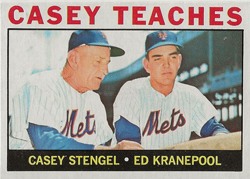 Ed Kranepool was the teen Stengel started that day, putting him in the No. 3 spot in the order ahead of cleanup hitter and future Hall of Famer Duke Snider.
Twelve years earlier, when he managed the Yankees, Stengel made a similar move, selecting a 19-year-old rookie shortstop to be his Opening Day right fielder against the 1951 Red Sox. Mickey Mantle batted third that day ahead of cleanup hitter and future Hall of Famer Joe DiMaggio. Boxscore
Mantle went on to become an acclaimed slugger and a Hall of Famer. Not so with Kranepool. Though he spent 18 seasons with the Mets and set their franchise record for most games played (1,853), Kranepool was a career .261 hitter who did some of his best work late in his playing days as a pinch-hitter.
Preps to pros
Kranepool’s father, a U.S. Army sergeant, was killed in action serving in France during World War II in the summer of 1944. Kranepool was born a few months later, in November, and was raised in the Bronx by his mother, Ethel.
At James Madison High School, Kranepool, a left-handed batter, broke the school home run record of Hank Greenberg, who became a Hall of Fame first baseman with the Tigers.
In June 1962, scout Bubber Jonnard, a former Cardinals catcher, and scouting supervisor Johnny Murphy went to the Kranepool house with an offer from the Mets. “I can still remember when they signed me on the dining room table,” Kranepool said to the New York Times years later. “I got $85,000 _ that included the bonus and salary.”
(Kranepool bought his mother a house in White Plains, N.Y., with some of the bonus money, according to Newsday. He bought himself a white Thunderbird.)
Kranepool went to the minors, hit .301 in 41 games and was called to the Mets in September 1962. He was 17 when he got into three games that month against the Cubs. After his first hit, a double sliced to left against Don Elston, “I was so happy, I danced around second base,” Kranepool told the Times.
Casey’s boy
At spring training with the 1963 Mets, Kranepool became a favorite of Stengel and Mets owner Joan Payson. Kranepool described Payson to the Times as “like a grandmother to me.”
Over the objections of his boss, club president George Weiss, who wanted Kranepool to play in the minors all season, Stengel insisted on him being on the Mets’ 1963 Opening Day roster. “He’s a ballplayer,” Stengel said to Newsday. “He stands up there with that bat in his hands and he’s not afraid of anybody.”
Kranepool told the newspaper, “I appreciate what Casey is doing for me. Very few managers would ever look at an 18-year-old.”
(Stengel was 22 when he debuted with the 1912 Dodgers and went 4-for-4 with a walk against the Pirates.)
Duke Snider, acquired from the Dodgers a week earlier, made his Mets debut in the season opener against the visiting Cardinals. Snider, 36, was twice the age of Kranepool, 18. It was a striking contrast to see the teen prospect in right field, and the graying former Brooklyn favorite positioned beside him in center.
(Snider, though, was a comparative pup to the Cardinals’ left fielder, 42-year-old Stan Musial.)
After the Cardinals cruised to a 7-0 victory on Ernie Broglio’s two-hitter, Stengel said to Newsday, “I thought we had two good players today _ one of them (Kranepool) is maybe too young and the other (Snider) is maybe too old.”
Regarding Kranepool, Stengel told the New York Daily News, “The kid in right didn’t look a bit nervous and he was the one everybody seemed worried about.” Boxscore
The next day, the Mets were shut out again (on Ray Washburn’s four-hitter), but Kranepool had two of the hits. Boxscore
Ups, downs
Kranepool’s first month with the 1963 Mets was fun. He hit a home run in their first win and batted .300 for April. “He excited the imagination with his good early start,” Newsday noted.
The good times faded quickly, however. Overmatched, especially against veteran left-handers, Kranepool slumped. When the Cardinals’ Curt Simmons struck him out four times in a game, Dick Young of the Daily News wrote, “Kranepool was made to look sick by Simmons.” Boxscore
Hearing the cheers turn to jeers, Kranepool batted .175 in May, .169 in June and got ornery. (Asked a decade later how he would describe himself during his early days with the Mets, Kranepool told Times columnist Dave Anderson, “Young, temperamental, a spoiled brat.”
Kranepool’s road roommate, pitcher Larry Bearnarth, said to Newsday, “He started getting very defensive when things got bad. Instead of trying to overlook things, everything bothered him. He heard people yell at him, or took to heart the little needling that all young fellows get.”
Hitless in July, Kranepool was taking his cuts in the batting cage when Snider suggested he quit trying to pull the ball so much. According to the Daily News, Kranepool snapped at Snider, “You’re not going so hot yourself.” (Snider hit .243 for the 1963 Mets.)
Though Snider laughed off Kranepool’s remark, the incident displeased Stengel, who believed young players shouldn’t disregard the advice of respected veterans.
Kranepool was shuffled off to Buffalo, a Mets farm club.
Snider said to Newsday, “He’ll be better off down there … I was sent down twice before I stuck and those two seasons in the minors helped.”
Change of tune
If the demotion was meant to serve as a wakeup call, it worked. Kranepool went 4-for-5 in his first game with Buffalo, and kept on hitting. His attitude was better, too. When Buffalo teammate Marv Throneberry, who played for Stengel with the Yankees and Mets, offered advice, Kranepool listened. “Marv has helped me tremendously,” Kranepool told the Buffalo Courier Express.
In 53 games with Buffalo, Kranepool hit .310. The Mets rewarded him with a September promotion. In his first game back, Kranepool played left field for the first time in his life and, batting in the leadoff spot, smacked four singles against the Cardinals. Boxscore
(Overall, Kranepool hit .209 for the 1963 Mets, but .265 against the Cardinals.)
Lost luster
When Kranepool pulled a thigh muscle the first week of 1964 spring training, Stengel seemed to sour on him. “You don’t pull muscles when you’re 19 if you’re in shape,” Stengel said to Newsday.
According to the newspaper, “Casey thinks Kranepool could run faster, throw harder, hustle more often.”
When Kranepool hit .167 in April and .184 in May, a couple of fans at Shea Stadium unfurled a banner: “Is Kranepool Over the Hill?”
He was 19.
The player who had bristled at Duke Snider’s suggestion now sought the advice of retired masters. Kranepool “has discussed hitting at every opportunity with Stan Musial, Paul Waner and any other acknowledged expert he has been able to find,” Times columnist Arthur Daley wrote.
Kranepool did better the second half of the 1964 season. He nearly sank the Cardinals’ pennant hopes. On the penultimate day of the season, Kranepool drove a curveball from former teammate Roger Craig deep to left-center for a three-run homer, the game-breaking blow in a Mets victory at St. Louis. The loss dropped the Cardinals into a tie for first with the Reds. Boxscore
(St. Louis won the pennant the next day, winning the season finale against the Mets while the Reds lost to the Phillies.)
Gap hitter
On July 16, 1967, reliever Jack Lamabe woke up in his St. Louis hotel room as a member of the Mets. When he got to Busch Memorial Stadium for that day’s doubleheader, he learned he’d been traded to the Cardinals.
The 1967 Cardinals were on their way to becoming World Series champions, but Kranepool knocked them backwards that Sunday afternoon. His two-run homer versus Ray Washburn carried the Mets to a 2-1 victory in Game 1. In the second game, Kranepool slugged another two-run homer, against Lamabe, giving the Mets the lead and sparking them to a sweep. Boxscore and Boxscore
Two years later, Kranepool hit a home run in Game 3 of the 1969 World Series versus Orioles reliever Dave Leonhard. Video
Kranepool, though, never hit more than 16 homers in a season. He said to columnist Arthur Daley, “I’m primarily a line drive hitter, don’t strike out much, and can wait for the final split second before committing myself.”
That approach helped Kranepool become a deluxe pinch-hitter late in his career. As a pinch-hitter, he batted .486 in 1974, .400 in 1975, .400 again in 1976 and .448 in 1977.
Turn back the clock
Kranepool batted .313 (36 hits, including two home runs) versus Bob Gibson and had some big years against the Cardinals (.323 in 1967, .429 in 1971, .348 in 1972 and .440 in 1974).
Nonetheless, he didn’t become the standout some hoped he’d be when he got the big bonus and reached the majors rapidly. As Newsday’s Tony Kornheiser noted, “There is a certain sadness to his career. It speaks of broken promises and wasted youth … He has never really been a symbol of the Mets. When the team was bad, he wasn’t bad enough. When the team was good, he wasn’t good enough.”
Looking back, Kranepool told Newsday’s Steve Jacobson it would have been better for him to spend three seasons in the minors before coming to the Mets.
“I might have been good at 20 instead of mediocre at 17 and staying there,” Kranepool said. “I might have grown and matured in three years in the minors.”

 RetroSimba
Kranepool did make the National League All-Star roster as the lone Met at the Met in Minnesota, 1965.
Thanks. I should have worded that sentence differently. I’ll clarify it.
Ernie Banks played the entire 1965 All-Star Game at first base for the National League. Gene Mauch, managing the NL team because Johnny Keane had jumped from the Cardinals to the American League Yankees after winning the 1964 World Series title, used three pinch-hitters (Frank Robinson, Billy Williams and Cookie Rojas of Mauch’s Phillies) but not Kranepool. The National League won the game. Asked about not getting into the game, Kranepool told Dick Young of the New York Daily News, “Oh, well, it’s great to be with a winner.”
Another enjoyable post where I also had a good time doing some research. Ed Kranepool was correct in saying that it probably would have been better to spend a couple years in the minors. Still though, a very good and admirable career. After all those years of losing its great that he had his moment of glory in 1969. I’m assuming he was the only player on that team who was also on the 1962 team. If I’m wrong please correct me. I really appreciate the way he embraced his role as a pinch hitter. It paid off. He’s still holds the Mets record for career pinch hits with 90. He was also someone you’d want at the plate if the bases were loaded. Ed Kranepool batted .337 in such situations. The 2024 Cardinals have hit so far only .160 with the bases loaded. Once again thanks Mark.
I am grateful that you appreciate stories that always aren’t about ex-Cardinals, Phillip.
Thanks for the information about Ed Kranepool holding the Mets record for pinch-hits and for how well he did in his career with the bases loaded. I didn’t realize how dreadful the 2024 Cardinals clutch hitters are. (I quit following the team a while ago.) Where’s Vic Davalillo when you need him? Just goes to show the skill it takes to be an effective pinch-hitter.
Gil Hodges platooned Ed Kranepool and Donn Clendenon at first base during the 1969 World Series and that is why Kranepool played in just one of the five games. The only right-handed starter the Orioles pitched was Jim Palmer in Game 3. Left-handers Mike Cuellar (Games 1 and 4) and Dave McNally (Games 2 and 5) were the other Orioles starters. Clendenon, a right-handed batter, played when they pitched.
Regarding original 1962 Mets who were on the 1969 Mets team, Kranepool was the only one to play for the 1962 Mets and play in the 1969 World Series. However, Gil Hodges, Al Jackson and Joe Pignatano all were members of the 1962 and 1969 Mets as well. Hodges, Jackson and Pignatano all played for the 1962 Mets. Hodges was the 1969 Mets manager and Pignatano was a coach. Jackson pitched in nine games for the 1969 Mets, but was dealt to the Reds in June 1969.
Poor Al Jackson. He pitched for the 1967 Cardinals and 1969 Mets, but didn’t appear in the World Series with either championship club.
Fun read Mark. I love it when a manager has the guts to take a chance and insert a rookie like Kranepool into the starting lineup. I guess it backfired according to Kranepool himself, him later on thinking he should have spent more time in the minors. But the Brewers did that this year with Jackson Chourio and even when he was slumping early on, they stuck with him and now he’s producing and seems to have an eye for the strike zone……encouraging.
It’s refreshing to read how Kranepool’s struggles made him ornery. It shows that he cared and what a tough life to lose his father before ever meeting him.
I appreciate you taking the time to read and to comment, Steve, knowing what an especially busy time this is for you.
One of those in attendance at the Polo Grounds when the Cardinals opened the season against the 1963 Mets was Branch Rickey, 81, then a Cardinals consultant. Asked about 18-year-old Ed Kranepool, Rickey replied to the New York Daily News, “It’s better to use a young man a year or two too early than to keep an old player playing a year or two too late.”
In 1969, when Kranepool, 24, was in his eighth season with the Mets, Dick Young of the Daily News wrote this splendid line: “Ed Kranepool is the youngest old man in baseball.”
Jackson Chourio seems to be the real deal. Pat Murphy seems to have been the perfect manager to bring along this special young talent. Brewers should clinch the division title week. Well-earned. Enjoy!
Reading your posts Mark is an enjoyable break from all the family going ons this week for me. We’re heading apple picking this afternoon . Should be fun.
Branch Rickey’s comment reminds of Steve Carlton who maybe hung around a little too long, but then again, I love his passion for the game, not wanting to quit.
I think you’re right about Murphy being the ideal manager for Chourio and the Brewers young team. I’m hoping that Adames sees this team as one he would like to stay with and sign with the Brewers long term.
Yikes. His numbers weren’t so good at all. Mind boggling that he got over 5,400 AB’s in the majors. He had one year as an All Star and his OPS was a putrid . 675. Kind of explains why the Mets were so bad for so long.
Great write up, Mark. Very informative. RIP Mr. Kranepool.
Ed Kranepool’s stock with the Mets dropped so low that they made him available in the first five rounds of the National League expansion draft after the 1968 season, but neither the Montreal Expos nor San Diego Padres chose him.
Then, a few months later, in March 1969, the Mets offered Kranepool, pitcher Nolan Ryan, infielder Bob Heise and a choice of catchers, J.C. Martin or Duffy Dyer, to the Braves for catcher Joe Torre and third baseman Bob Aspromonte, The Sporting News reported. Braves general manager Paul Richards rejected the four-for-two proposal because he wanted catcher Jerry Grote or outfielder Amos Otis, but the Mets “labeled them untouchables,” according to the Atlanta Constitution. “We aren’t making a deal with the Mets unless they change their minds,” Richards said. The Mets didn’t _ and the Braves then swapped Torre to the Cardinals for Orlando Cepeda.