By NFL standards, St. Louis Cardinals cornerback Pat Fischer was small. Not jockey size, but not as big as the team’s placekicker, Jim Bakken, who was two inches taller and 30 pounds heavier. Even another noted Fischer, 6-foot-1 chess grandmaster Bobby, towered over Pat.
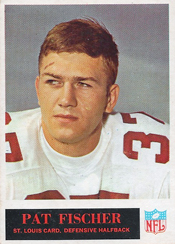 Listed at 5 feet 9 and 170 pounds _ “Anyone who ever saw him in person knew even those measurements were somewhat exaggerated,” the Washington Post noted _ Fischer shed the blocks of Goliath-like guards and tackles, took down steamrolling fullbacks, and stymied rangy receivers during a 17-year NFL career with the Cardinals (1961-67) and Washington Redskins (1968-77).
The signature play of Fischer’s NFL tenure came on Sept. 20, 1964, for the Cardinals against the Cleveland Browns. Jim Brown, the punishing fullback who regularly ran over defenders or carried them on his back, took a pitch, swept to the outside and roared into the clear like a bull entering the ring. Fischer, 62 pounds lighter than Brown, came up from his cornerback spot, lowered his shoulder and met the fullback head-on.
Making “a picture-book tackle,” Fischer “actually lifted the running back into the air and tossed him backward,” the St. Louis Post-Dispatch reported.
Joe Pollack of the Post-Dispatch, a longtime NFL observer, called it “the greatest individual play I’ve ever seen,” adding that Brown was “the best back I ever saw,” and Fischer was “maybe the best player, pound for pound, in NFL history.”
Noting that Fischer brought down Brown singlehandedly, the Post-Dispatch offered, “It isn’t often anybody does much singlehandedly against Brown, so the memory of that play will last a long time.”
In that same game, the feisty Fischer was involved in an incident that cost the Browns their halfback, Ernie Green, who was ejected in the second quarter for throwing a punch at Fischer, the Associated Press reported.
“Fischer had grabbed my face guard first and I was just backing up, trying to push him away,” Green told the Dayton Journal Herald, “but the official didn’t see that, just me pushing him off.”
According to the Cincinnati Enquirer, the officials ruled Green struck Fischer after the whistle, prompting the ejection. Game stats
A three-time Pro Bowl selection, Fischer intercepted 56 passes, including four for touchdowns, in his NFL career.
Big man on campus
After high school in Omaha, Fischer, like three of his brothers before him, played football at the University of Nebraska.
In his varsity debut as a sophomore in 1958, Fischer, listed as a 163-pound halfback and cornerback, returned a kickoff 92 yards for a touchdown in Nebraska’s 14-7 upset of Penn State. As a junior in 1959, Fischer ran back a punt 61 yards to the 3-yard line, setting up Nebraska’s winning touchdown against Oklahoma. The 25-21 victory snapped Oklahoma’s 74-game Big Eight Conference win streak.
Fischer became Nebraska’s starting quarterback as a senior in 1960. In the season opener, at Texas, he led the Cornhuskers to a 14-13 upset victory. Fischer returned a punt 76 yards for a touchdown and scored another on a two-yard scamper. As the holder on the extra-point try, Fischer pulled off a fake, firing a pass to Bill “Thunder” Thornton for the winning two-point conversion. (Thornton also was Fischer’s teammate on the Cardinals.) Video
Inhaling oxygen from a hissing tank in the locker room afterward, Fischer told the Lincoln (Neb.) Journal Star, “My head hurts and I’m tired, but I’d play another half if that’s what it took to beat Texas.”
(Like Fischer, two of his 1960 Nebraska teammates had long NFL playing careers. Defensive end Ron “The Dancing Bear” McDole played 18 seasons, including his rookie year with the Cardinals, and center Mick Tingelhoff played 17 years with the Minnesota Vikings and was elected to the Pro Football Hall of Fame.)
Fitting in
Drafted in the 17th round by the Cardinals, the pint-sized Fischer (listed at 166 pounds) arrived at 1961 training camp “and spent his first few practices in shorts and a T-shirt as the team tried to find equipment that would fit him,” according to the Washington Post.
In recalling his first exhibition game with the Cardinals, Fischer told the Post, “My game pants fell down below my knees. I had to tape them up. I had to tape my pads on to make sure they wouldn’t fall off.”
The Cardinals’ coaching staff wasn’t quite sure what to do with him. “Coaches all have a predetermined idea of what a cornerback is supposed to look like,” Fischer said to the Post. “I never did fit the description.”
He made the team, returning punts and kickoffs, and filling in as a backup receiver. In a December 1961 game versus Washington, Fischer returned two kickoffs, including one for 53 yards. He also lined up as a flanker. In the third quarter, with the Cardinals facing third-and-11 at their 45, Sam Etcheverry passed over the middle to Fischer. The throw was high and behind the rookie, but he leaped, twisted and made a 22-yard catch for the first down, keeping alive a drive that led to a field goal. Game stats
Fischer made four starts at cornerback in 1962 before he tore a hamstring. He came back in 1963, intercepted eight passes in 14 games and became “a big favorite with the fans” for his mighty-mite grit, the Post-Dispatch reported.
According to the Washington Post, Fischer was “one of the earliest defensive backs to employ the bump and run technique. He would initiate contact at the line of scrimmage, throwing a receiver off balance and disrupting his path toward his normal pass route.”
As for his ability to take on blockers at least 70 pounds heavier and half a foot taller, Fischer explained to United Press International, “Football really is a game of angles or leverage, and that works to my advantage. I’m usually attacking a guard or tackle at a pivotal point. If I can just get underneath him a little bit and raise up at the same moment, I can knock him off balance much easier than he can me because he doesn’t have good balance when he comes out of the line.”
Rough boys
It all came together for Fischer in 1964. Cardinals defensive coordinator Chuck Drulis told the Post-Dispatch, “Pat is the best cornerback in the league right now. He seldom has been beaten this season.”
According to Bob Broeg of the Post-Dispatch, only one receiver, Washington’s Bobby Mitchell, caught a touchdown pass against Fischer in 1964.
“Mitchell is the toughest receiver I’ve ever tried to cover,” Fischer said to Broeg. “Playing a corner, you line up about seven yards from the flanker. If you backpedal, you ordinarily can afford to let the receiver close the gap to three yards before you’re forced to turn your back and start to run. If you let Mitchell get that close, he’s gone and so are you. You’ll never match him stride for stride when he turns on the juice.”
Though often matched against gifted pass catchers such as Mitchell, Boyd Dowler, Tommy McDonald and Jimmy Orr, Fischer had 10 interceptions in 14 games for the 1964 Cardinals. He returned two of those for touchdowns (both on passes thrown by Sonny Jurgensen) and also turned a fumble recovery into a score. Video
Another top receiver, the Browns’ Gary Collins, told the Associated Press, “Pat Fischer stayed so close to me that I thought I’d wake up in the morning and find him next to me in bed.”
Though he seemed to be the underdog because of his size, Fischer was a rough and rugged player who used intimidation to his advantage. “When I get up in the morning and look in the mirror, I growl,” he said to the Post-Dispatch.
“If he hits you, he’ll knock your socks off,” Baltimore Colts quarterback Johnny Unitas told the Washington Post.
Chicago Bears head coach George Halas accused Fischer of gouging the eyes of receiver Johnny Morris on consecutive plays. “On our ballclub, we don’t mind a little punch in the puss,” Halas said to the Chicago Tribune, “but sticking your finger in somebody’s eye is another matter. That’s not the name of the game.”
Job well done
Fischer played out his option, became a free agent after the 1967 season, and signed with Washington. (NFL commissioner Pete Rozelle compensated the Cardinals, awarding them Washington’s No. 2 draft pick in 1969 and a No. 3 choice in 1970.)
During his Washington stint, Fischer played in a Super Bowl (against the undefeated Miami Dolphins) and had a series of fascinating duels covering Harold Carmichael, the 6-foot-8 Philadelphia Eagles receiver who would earn election to the Pro Football Hall of Fame.
Fischer never lost his edge. In 1976, when he was 36, Fischer found himself in a situation similar to the one with Jim Brown 12 years earlier. This time, the bruising fullback was the 237-pound Larry Csonka, then with the New York Giants.
Bracing himself and using leverage, Fischer upended Csonka, who landed upside down. According to the Washington Post, in a gesture of respect from one top pro to another, Csonka got up and patted the diminutive cornerback on the back.

 RetroSimba
The oft-repeated phrase, “departed after a falling out with Big Red management,” originated with Fischer, and lasted in St. Louis until the 1987 departure for the desert.
Yes, indeed, Cardinals management really botched that one. In an indication of their cluelessness, Bob Broeg reported in the Post-Dispatch that, after the 1967 season, Cardinals management and coaches “seemed genuinely certain Fischer would accept their contract terms and they were disturbed when he left.”
If the Big Red would have had a decent owner for the 20 plus years in St. Louis, they would have definitely advanced further into the postseason when they got there in the mid-seventies if management would not have been so narrow-minded and cheap. Bidwell was a greedy miser who let a plethora of great players slip away. Furthermore, his most egregious mistake was when Coryell walked away.
It sure would have been fun to see Pat Fischer play for those Don Coryell Cardinals clubs.
Of course, Fischer was the defender on the infamous 1975 “Phantom Catch” by the Cardinals’ Mel Gray. In his excellent blog, The Big Red Zone, Bob Underwood writes well about that play: https://thebigredzone.com/2022/01/02/big-red-tough-guy-pat-fischer/
Great story, Mark! I’ve been looking for video of Fischer’s hit on Jim Brown for a few years but haven’t had any luck.
Thanks, Bob. I learned of Pat Fischer’s death from reading your excellent report on The Big Red Zone blog. Your work as the historian of St. Louis Cardinals football is a treasure. If anyone can ever unearth a video of Fischer’s upending of Jim Brown, it will be you.
I love that comparison to the chess player Fischer. That cracked me up. What an athlete! As I was reading your piece, I kept thinking of Pete Rose in the guts the two had and the willingness to do whatever it took to win. I’m not much of a football fan, but I know the big names though not Fischer and writer Joe Pollack saying “Fischer was “maybe the best player, pound for pound, in NFL history.” Praise doesn’t get any better than that. His story, him being so small, reads like a legend.
It makes me happy that you appreciated the Bobby Fischer line, Steve.
Your comparison of Pat Fischer to Pete Rose is an apt one. In addition to that willingness to win, they also knew what it took to win. For example, regarding coverage of a receiver, Fischer told the Post-Dispatch, “The most important thing is how well you do on the third-and-eight and third-and-nine situations at a critical point of the game. You might let them catch the ball all day if you just break it up at the right time and place.”
Sorry to hear that Pat Fischer passed away. From what I understand for quite sometime he had dementia. He was certainly one of the greatest Big Red players. And yes, another one that the Organization basically gave away for nothing. Just like with the compensation picks that we received in exchange for Dave Butz , the Big Red wasted the extra draft picks in compensation for Pat Fischer. I really like an answer that Coach George Allen gave to a reporter on why he always started Pat Fischer. “When I find someone better I’ll play him.”
Dementia is such a cruel disease and especially so with someone who had such a good mind as Pat Fischer did. During his playing days, he was a stockbroker during the off-season. (One of his clients was quarterback Sonny Jurgensen, according to the Omaha World-Herald.) After his NFL career, Fischer was in the commercial banking business and then invested in thoroughbred horses.
As you noted, Washington head coach George Allen was a big booster of Pat Fischer. During his time with Washington, Fischer also got to play for head coach Vince Lombardi.
More STL Rams stuff please. :)
I’m kidding, Mark. I’m sure they left a bad taste in your mouth. I like when you do the football stuff. Always super interesting.
When the football Cardinals left St. Louis, I gave up on following the NFL. Unfortunately, you, too, Gary, know all too well what it’s like when a franchise abandons a caring fan base.
I do enjoy learning and writing about what made some of these NFL players tick. Looking for ways to relax, Pat Fischer reportedly chewed on a mouthful of stickum before games, and after games he frequently sat for many minutes facing inside his locker, smoking cigarettes, according to the Washington Post.
What a tough guy. Of all his impressive accomplishments, I took note of the fact he returned punts and still lived to 84.
That’s a good line about returning punts and still making it to age 84, Ken.
Pat Fischer was one of nine children in his parents’ household, and I imagine that helped him hone his survival instincts.
I was having dinner with PAT Fischer (who was married to my sister, Carol, at the time) the night before the Redskins played the St. Louis Cardinals. I said to Pt, “tomorrow you have to contend with Mel Gray (the Cardinals’ all-pro wide receiver). Pat said, “No, Mel gray has to contend with me”. Gray caught only two passes the follwing day.
Thank you for sharing that terrific anecdote, John. It sure shows that Pat Fischer had the right attitude, as well as the skills, to be a top-rate cornerback.