The Milwaukee Braves looked at Joey Jay and saw a problem pitcher. Fred Hutchinson looked at him and saw an ace.
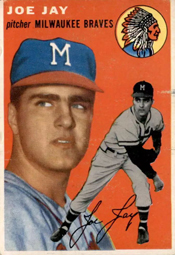 A right-hander, Jay became the first former Little League player to reach the majors when he joined the Braves out of high school at 17 in 1953.
At 6-foot-4, 225 pounds, Jay looked like a man but acted like a boy. He was immature, got labeled a spoiled kid and the Braves were reluctant to pitch him.
Fred Hutchinson, when he managed the Cardinals, got a look at what Jay was capable of accomplishing. In 1958, Jay, who had seven wins that year as a fill-in starter, was 3-1 with an 0.86 ERA versus the Cardinals.
Two years later, when Hutchinson was Cincinnati manager, the Reds acquired Jay at Hutchinson’s urging and he prospered, achieving consecutive 21-win seasons and helping the club become 1961 National League champions.
Not ready for prime time
As a Little Leaguer in Connecticut, Jay played first base. He was a pitcher in high school. Multiple pro teams were interested, including the Pirates. Jay met with their general manager, Branch Rickey, but accepted a $40,000 bonus from the Braves, in part, because his summer league coach was a Milwaukee scout, according to Sports Illustrated.
Because of the bonus amount, Jay was required under baseball rules then to be on the Braves’ roster for two full years before he could be sent to the minors.
The teen didn’t receive much of a welcome when he joined the Braves in June 1953. He rarely pitched and manager Charlie Grimm “never said two words to me,” Jay told The Sporting News.
According to Sports Illustrated’s Walter Bingham, “Jay quickly won himself a reputation as an eater and sleeper of championship caliber. He seldom was seen awake without a candy bar or a soft drink, often with both. He would eat in the bullpen during games. At one point, he weighed 245 pounds, which, even at his height, made him look fat.
“On his first trip with the Braves, he overslept one day and arrived at the park 20 minutes before game time. Some of the older players, who resented bonus players anyway, didn’t let Jay forget it. Another time, Jay fell asleep on the bus coming back from Ebbets Field. When the bus arrived at the hotel, all the players tiptoed off and the bus driver drove away still carrying Jay, fast asleep.”
Jay pitched 10 innings for the 1953 Braves and didn’t allow a run, but he was unhappy. “I felt I was a burden on the club,” he told The Sporting News. “My dad finally talked me out of quitting.”
The following year, he totaled 18 innings for the 1954 Braves and then 19 innings for the 1955 club before being sent to Toledo. Jay was in the minors in 1956 and for most of 1957.
“He hadn’t grown up,” Ben Geraghty, who managed Jay with Wichita in 1957, told Sports Illustrated. “He had an awful temper.”
One day, Jay got mad during a game, sulked and began lobbing pitches. Afterward, Geraghty said to him during a team meeting “that if he didn’t have the guts to act like a man, he could clear out,” Sports Illustrated reported.
Jolted, Jay went on to post a 17-10 record for Wichita.
Looking good
Jay, 22, began the 1958 season in the Braves’ bullpen, struggled (9.00 ERA in four appearances) and was “the lowest-ranking” of the club’s relievers, according to The Sporting News.
When starter Bob Buhl went on the disabled list in May because of elbow pain, Gene Conley replaced him but disappointed.
In desperation, manager Fred Haney started Jay on June 13 at St. Louis. He held the Cardinals scoreless and got the win in a game shortened to six innings because of rain.
“Stan Musial (0-for-2 with a walk) praised Jay” for showing the ability “to get over his good fastball, curve, changeup and slider,” the St. Louis Post-Dispatch reported. Boxscore
Nine days later, matched against Sal Maglie, Jay was a hard-luck loser in a 2-1 Cardinals triumph, but his impressive pitching in two starts versus St. Louis convinced Haney to keep him in the rotation. Boxscore
“He has the confidence to throw his best curve at two balls and no strikes,” Braves catcher Del Crandall told Sports Illustrated.
In seven July starts for the 1958 Braves, Jay was 5-2 with a 1.39 ERA. Two of those wins came against the Cardinals _ a four-hitter to beat Maglie at St. Louis on July 15, and a two-hit shutout at Milwaukee a week later. Boxscore and Boxscore
“There isn’t a better pitcher in our league right now,” Braves coach Whit Wyatt said to The Sporting News.
The good vibes didn’t last long, though. Jay pulled a tendon in his right elbow and was limited to 11 innings in August. Then, in his lone September appearance, a relief stint against the Cardinals, he fractured his left ring finger when he knocked down a hard grounder from Irv Noren. Boxscore
Milwaukee won the pennant but didn’t include Jay (7-5, 2.14 ERA) on the World Series roster.
Change of scenery
Jay regressed in 1959 (6-11, 4.09 ERA). “He just won’t do anything in pregame drills,” Haney complained to Sports Illustrated. “He’s fat and he’s too lazy to get in shape.” In 1960, he was 9-8.
Fred Hutchinson, fired by the Cardinals near the end of the 1958 season, became Reds manager in July 1959 and needed pitchers. The Reds allowed the most runs in the National League in 1959 and the second-most in 1960.
Hutchinson and Braves pitcher Lew Burdette had homes on Anna Maria Island in Florida and attended cookouts together. Hutchinson asked Burdette about Jay and Burdette recommended him, Jay told the Cincinnati Enquirer.
In December 1960, the Reds dealt shortstop Roy McMillan to the Braves for Jay and Juan Pizarro. (Pizzaro was flipped to the White Sox for third baseman Gene Freese, who played for Hutchinson with the Cardinals.)
Jay got off to a shaky start in his Reds debut at St. Louis. In the first inning, after he gave up two runs, he walked a batter to load the bases with two outs. Jay expected to be lifted when Hutchinson came to the mound. Instead, the manager challenged him: “Don’t walk yourself out of there. Make them knock you out.”
As author Doug Wilson noted in a book about Hutchinson, “Jay, surprised and grateful, pitched his way out of the jam. Jay lost his first three decisions in 1961 but his manager stuck with him. Jay responded to this confidence by turning into one of the best pitchers in the league.” Boxscore
“That’s all I did for him: Let him pitch,” Hutchinson told The Sporting News.
Joining a rotation with Jim O’Toole and Bob Purkey, Jay helped transform the Reds’ pitching staff from one of the worst in the league to the best.
In his book “Pennant Race,” reliever Jim Brosnan recalled how during a clubhouse meeting at Pittsburgh a confident Jay held a scorecard in one hand and a cigar in the other while going over the Pirates’ batters. After the game, which Jay won, he sat next to Brosnan on the bus ride to the airport and puffed on a pipe.
“You always smoke a pipe when you win?” Brosnan asked him. “Usually you got a cigar in your mouth.”
“Pipe relaxes me,” Jay replied. “You should try one.”
Jay still packed on the pounds _ “I’m about 12 jelly rolls and 15 cream puffs too heavy,” he told Brosnan. “I buy them for the kids, then eat them myself” _ but was fattening up on wins, too. He led the league in wins (21) and shutouts (four) as the 1961 Reds (93-61) won a pennant for the first time in 21 years.
In the World Series against the Yankees, Jay got the Reds’ only win _ a four-hitter in Game 2. Video and Boxscore
Ups and downs
Jay won 21 again in 1962, though he was 0-3 versus the Cardinals. The 1962 Reds (98-64) totaled five more wins than they did in their championship season, but finished in third place.
On the final day of the 1963 season, Stan Musial played his last game for the Cardinals and exited after getting a pair of singles against Jim Maloney. The Cardinals won in the 14th on Dal Maxvill’s RBI-double versus Jay. He lost 18 that season, including all four decisions against the Cardinals. Boxscore
Jay was involved in another noteworthy game on the last day of the 1964 season. The Cardinals and Reds entered the day tied for first place.
At Cincinnati, Jay relieved in the fifth with one out, two on and the Phillies ahead, 4-0, and got Tony Taylor to ground into a double play. In the sixth, however, Jay gave up a two-run single to Tony Gonzalez and a three-run homer to Dick Allen. The Phillies won, 10-0, enabling the Cardinals to secure the pennant when they beat the Mets. Boxscore
In spring 1966, Cardinals general manager Bob Howsam agreed to trade Nelson Briles, Steve Carlton, Phil Gagliano and Mike Shannon to the Reds for Leo Cardenas, Gordy Coleman and Jay, but the deal was blocked by Cardinals upper management, The Sporting News reported.
Soon after, in June 1966, Jay was dealt to the Atlanta Braves and he completed his career with them that season.
Jay was 99-91 in the majors. Willie Mays batted .200 (8-for-40) against him and Stan Musial was at .208 (10-for-48).
In his autobiography, Musial said of Jay, “Fred Hutchinson gave him confidence and a good talking-to. At Milwaukee, Jay struck me as having pretty good stuff … but he threw a lot of slow curves and wasted his fastball. When the Reds got him, Hutchinson … made him throw that good fastball for strikes.”

 RetroSimba
That $40,000 signing bonus probably came in handy. But long-term, starting off in the minors with a good pitching coach may have been better. It sure must have been tough on Joey Jay those first two years with the Braves. Besides his bonus baby contract he was the only player on the roster under the age of twenty. His connection with Fred Hutchinson is interesting. There was also a lot of hype and high hopes for Hutchinson when he first came up. And similar to Jay struggled during the early part of his career.
You make a good point, Phillip, about Fred Hutchinson struggling, like Joey Jay, as a teen pitcher in the majors. Hutchinson was 19 when he joined the 1939 Tigers and went 3-6 with a 5.21 ERA that season.. It wasn’t until Hutchinson completed service in the Navy during World War II that he matured into a consistent winner in the big leagues.
In his first season with the Reds, Joey Jay was 4-0 against the Braves. “I take particular delight in beating them,” Jay told The Cincinnati Post. “I’d be lying if I said that I didn’t.” John McHale, the general manager who traded Jay to Cincinnati, referred to Jay’s success against the Braves as “Joey Jay’s vendetta.”
Grear write-up on a pitcher that was as good as anyone in the game in 1961-62. Fred Hutchinson was also a very good baseball man, and I wonder if the Cardinals regretted letting him go. I don’t remember much about him as I was 5 years old at the time, but remember my grumbling a lot about Solly Hemus and not being happy he was the manager.
As for Jay, one of my favorite stories was from something I read, possibly in Sports Illustrated or maybe Sport magazine years ago. The mid-’60s Cardinals were a fun club with a lively clubhouse, and guys would tease each other a lot. One of the gags was asking Julian Javier how well he hit against “Hoey Hay”. :-)
Thank you for reading and for commenting.
In the book “Fred Hutchinson and the 1964 Cincinnati Reds,” author Doug Wilson wrote that the Cardinals’ firing of Fred Hutchinson “disappointed Cardinals players, including Stan Musial, who were angry with Gussie Busch for letting him go.”
In his autobiography, Musial said, “Fred Hutchinson was a ballplayer’s manager … and had good baseball instinct. Most of the ballplayers liked his type of baseball and respected him.”
For his career, Julian Javier batted .146 (7-for-48) with 10 strikeouts against Joey Jay. He did belt a two-run homer against him on May 17, 1963.
It must be tough to have such little time to grow up and then be thrown into the life of an MLB’er. His eating and pipe smoking make him into a little bit of a legend. I wonder if he got a ring for being on the Braves in 57?
To go along with that pipe smoking, Joey Jay also did crossword puzzles on the bus to the ballparks, according to Sports Illustrated.
By the time the Reds dealt him back to the Braves in 1966, Jay was well-liked by some of the journalists who knew him. Ritter Collett of the Dayton Journal Herald wrote, “People usually seem surprised when you tell them Jay is a sensitive, intelligent and frequently witty fellow.” Si Burick of the Dayton Daily News wrote, “Jay happens to be one of the most delightful athletes I’ve ever known.”
Jay probably didn’t get a 1957 World Series ring from the Braves. I base that on how the winner’s share was divided. According to United Press, 30 members of the 1957 Braves organization each received a full World Series winner’s share of $8,924.36, but the share Jay received was $200. He made just one appearance for the 1957 Braves (and earned a save).
In 1958, Jay did get a full World Series runners-up share of $5,896.08, according to the Associated Press.
Anyone able to complete a crossword puzzle has my respect.
Thanks Mark for finding info regarding WS rings.
I never heard of that rule that if you got a certain level of bonus you had to be on the big team’s roster for two years before you could be sent to the minors. Seems like it should be the other way around. What was the rationale for that? Almost seems like punishment for tossing out big bonuses.
You’re correct about that.
Major League Baseball had a rule then that any amateur who got a signing bonus of more than $4,000 had to stay with the big-league club for two full years, or 24 months. It was intended to keep the wealthiest clubs from signing scores of prospects and stockpiling them in the minors.
Joey Jay was outspoken in calling the rule a bad one. “It hurts everyone,” he told United Press International. “The young player loses his chance to play regularly, the team has a dead-head on the bench and the minors lose a player who could help somebody.”
Regarding his 24 months as a teen with the Braves, Jay told UPI, “I was just a kid who didn’t deserve to be on a major league team.”
FYI, the New York Giants bonus players in the same boat as Jay in the 1950s were Joey Amalfitano, Paul Giel and Mike McCormick
One that I think has been overlooked is that while the Cardinals lost Hayward to the 2016 Cubs, they returned the favor a year later by signing Fowler. Fowler had been a dynamic leadoff table setter for the World Champion Cubs, especially in the first half of the season when the team jumped off to a great start. I remember seeing box scores where the Cubs excelled at piling up early inning runs, often sparked by Fowler. Signing Fowler left the Cubs without an effective leadoff hitter, a problem they struggled with for years afterwards. It was probably a big reason the Cubs didn’t achieve more during their five year “window” between 2015 and 2019 when they had a strong core of young players that seemed destined to win multiple championships. Fowler never achieved the success he had with the Cubs while playing St. Louis, and, ultimately, Heyward never was the player the Cubs hoped he’d be when he signed that big eight year contract.
Another overlooked aspect of the Fowler signing is that it moved Matt Carpenter out of the leadoff spot, a spot in which he excelled despite his lack of speed. Carpenter batting lower in the middle of the lineup had some success as a power hitter but it seemed like he never again was the hitter he had been batting leadoff.
Thanks for your insights. You make a lot of good points.