A trade of Dave Parker for George Hendrick during their playing days would have been a headliner. That didn’t happen, but this did: Parker and Hendrick essentially were swapped for one another as coaches.
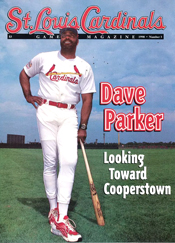 After coaching for the Angels in 1997, Parker became Cardinals hitting coach. He replaced Hendrick, who took the Angels coaching job Parker vacated.
Parker’s stint with St. Louis lasted one season. Though the Cardinals had the highest home run total in the National League with Parker as hitting coach in 1998, he wasn’t brought back. Manager Tony La Russa said Parker wasn’t dedicated to the job because he was spending time on the Popeyes fried chicken restaurant he owned in Cincinnati.
A success in the restaurant business, Parker capped his athletic career on Dec. 8, 2024, when a committee elected him to the Baseball Hall of Fame for his playing feats. The 16-member committee included former Cardinals Lee Smith, Ozzie Smith and Joe Torre, and Dick Kaegel, a former St. Louis Post-Dispatch reporter.
Show time
A left-handed batter and right fielder, Parker hit for average and power, produced runs and played with flair for the Pirates (1973-83), Reds (1984-87), Athletics (1988-89), Brewers (1990), Angels (1991) and Blue Jays (1991).
Nicknamed “Cobra” for the way he waved the bat before uncoiling with a quick swing, Parker was the National League batting champion in 1977 (.338) and 1978 (.334). He led the league in hits (215) and doubles (44) in 1977 and was the NL Most Valuable Player Award recipient in 1978.
A three-time Gold Glove Award winner with a powerful throwing arm, Parker played for two World Series champions (1979 Pirates and 1989 Athletics) and the 1988 pennant-winning A’s.
A career .290 hitter, he batted .314 versus the Cardinals. He totaled 2,712 hits and 1,493 RBI in 19 seasons in the majors.
(Parker respected fellow mashers. In his memoir, Keith Hernandez recalled, “Dave Parker, one of the most talented players I’ve ever seen, came strolling up to Ted Simmons and me after witnessing a round of batting practice in Pittsburgh and exclaimed, ‘You two are the hittingest white boys I’ve ever seen.’ Simmons laughed and I loved it: I’m Keith Hernandez, Hittingest White Boy.”)
Parker made his mark in other ways, too. He was one of the first ballplayers to wear an earring on the field (a diamond with a dangly cross) and one of the first to perform a showboating home run trot.
(Parker developed variations of his trot. He’d shoot at a base with his fingers as he neared it, according to the Post-Dispatch. Or, he’d trudge toward first “like a fat man up Heartbreak Hill,” Stan Sutton of the Louisville Courier-Journal noted, and slowly circle the bases. “I’ve hit over 300 of these,” Parker told the Los Angeles Times in 1989. “I deserve the opportunity to run them out any way I want.”)
Testifying in a 1985 federal drug trial regarding cocaine distribution among ballplayers, Parker detailed his cocaine use from 1976 to 1982, and identified colleagues who used the drug, in exchange for immunity.
Business decisions
In 1992, Parker sought to own a business in Cincinnati, where he grew up and still resided. According to the Cincinnati Enquirer, “A broker suggested Parker open a Burger King restaurant. Before the deal closed, the broker instead directed Parker to Popeyes because there were 18 Burger Kings in the region and one Popeyes.”
Parker and his wife, Kellye, bought a Popeyes on busy Reading Road in Roselawn, a Cincinnati neighborhood. According to the Enquirer, Parker could be found in the dining area or in the kitchen “where he regularly preps food or helps staff.”
“We call our Roselawn restaurant the colonel-killer,” Parker told the newspaper. “I think there are something like three KFCs that have gone out of business on Reading Road since we’ve been there.”
During the summer of 1996, Parker met with Terry Collins, then manager of the Astros, who were in town for a series against the Reds. Parker and Collins were teammates in the minors. Parker told him he was interested in getting back into baseball, the Los Angeles Times reported.
In November 1996, a month after the Astros fired him, Collins was hired to manage the Angels. He retained Rod Carew as hitting coach, but added Parker to the staff. Though Parker had no coaching experience, “He bring tremendous credibility,” Collins told the Times. “He knows how to win, what it takes to win. He brings the presence and knowledge of what it takes to be successful.”
Parker, 45, said to the Times, “I know I have to display clubhouse leadership. That was the understanding when I took the job.”
Or, as the Times put it, Parker was enlisted “to help give the Angels a long-needed kick in the rear end.”
Another motivation for Parker was his appearance on the Baseball Hall of Fame ballot for the first time in 1997. As he told the Post-Dispatch, “With the Hall of Fame voting, I came back to baseball just to be more visible.”
Parker was assigned to be the first base coach and instruct the outfielders, a group that included Jim Edmonds.
Here’s the plan
As a player, George Hendrick totaled 1,980 hits, including 267 home runs, and never struck out as many as 90 times in a season. In his two years as Cardinals hitting coach, the team ranked a lackluster seventh in the National League in runs scored in 1996 and 11th in 1997. Worse, the 1997 Cardinals struck out more than any other team in the league.
The combination of the strikeouts and the hitters’ lack of application frustrated Hendrick. Though manager Tony La Russa was interested in having him return in 1998, Hendrick opted to leave, the Post-Dispatch reported.
In October 1997, Parker, who played for La Russa when he managed the Athletics, was hired to replace Hendrick. “Parker will be entrusted with correcting the Cardinals’ strikeout total,” the Post-Dispatch reported.
Parker told the paper, “When I played for Tony, I taught Jose Canseco a two-strike stance and he cut down on his strikeouts quite a bit (from 157 in 1987 to 128 in 1988). He also hit 17 home runs (from a total of 42) with his two-strike stance.”
By encouraging a batter with two strikes in the count to spread out his stance and cut down his swing, “You concentrate on just putting the ball in play,” Parker said to reporter Rick Hummel. “You look for the fastball and adjust to everything else.”
Working with a 1998 Cardinals lineup that included Ron Gant, Brian Jordan, Ray Lankford and Mark McGwire, Parker arranged contests during batting practice at spring training. According to the Post-Dispatch, “Coaches call out situations to the hitters and points are subtracted for bad execution, such as not moving a runner along. At the end of the competition, the losing side of hitters has to serve drinks and sandwiches.”
Parker told the newspaper, “You put it in their heads every day and eventually it gets there. You get a guy at third base with less than two outs, you don’t swing at a slider away … It’s constant repetition.”
One and done
Though the Cardinals still struck out a lot (1,179 times), they scored more runs in 1998 (810) than they did in 1997 (689).
Afterward, Parker told the Post-Dispatch, “If they want me back, I’d come back.” However, the Cardinals informed him he wasn’t wanted because his business interests interfered with his coaching duties.
“Coaching is a commitment,” La Russa told the Post-Dispatch. “I don’t know any coach who’s really outstanding that can have a conflict (of interest). The entrepreneur side of (Parker) prevented a total dedication to coaching … Coaching, if you do it right, consumes you. If you get into professional coaching and managing, if you have a business, you’d better find somebody to run it for you. He made a decision to divide his interests, and you can’t do that.”
Parker told the newspaper, “I really enjoy baseball, but I just don’t like being away from business … It’s tough being gone for eight months a year. My wife is working almost to death.”
Regarding his stay with St. Louis, he added, “If I had known it would have been so short, I never would have left the Angels.”
Mike Easler replaced Parker. Soon after, Mark McGwire sued People First Inc, distributor of a pain reliever, The Freedom Formula, saying the company falsely claimed he endorsed the product.
According to the Post-Dispatch, the lawsuit contended that “Dave Parker, who promoted The Freedom Formula, distributed the product to McGwire and several teammates (in 1998). Parker asked McGwire to pose for a photograph of him holding a bottle of The Freedom Formula. As a courtesy to Parker, McGwire posed for the picture but never consented to its use for any commercial purpose.”
(McGwire’s lawyer told the newspaper the dispute had nothing to do with Parker’s departure from the Cardinals. The suit was dropped when People First Inc. agreed to stop using McGwire’s likeness, the Post-Dispatch reported.)
Parker’s Popeyes restaurant continued to do well and he eventually opened a second one in Forest Park, a Cincinnati suburb.

 RetroSimba
Another good post Mark. As soon as I read the name Dave Parker the first thing that came to my mind was how he killed the Cardinals during the 70’s. Another thing is how the game has changed. And not for the better. Even though Dave Parker was considered a power hitter he knew when to just simply make contact and put the ball in play. For his career Dave Parker hit .292 with risp. That’s excellent compared to today’s standards. It’s really no surprise that for one reason or another both George Hendrick and Dave Parker had short stays as hitting coach. The average tenure of an MLB hitting coach is only a little more than two full full seasons. One final thing this post reminded me of is former Cardinals hitting coach Mitchell Page.
I know what you mean, Phillip, about Dave Parker versus the Cardinals in the 1970s. In September 1973, when I was 17, I attended games in St. Louis for the first time, traveling there from Ohio. Both games were against the Pirates and that’s the first time I saw Dave Parker play in person. In the first one, Parker had two hits and scored a run in a 3-1 Pirates win against Reggie Cleveland. The next day, Parker doubled and scored against Mike Nagy in the first inning. It was a rocket that slammed against the outfield wagon gate. Then, in the seventh, Parker clouted a three-run homer versus Diego Segui. It was a rising liner that carried like a laser. Pirates won, 7-4. I can clearly remember these 51 years later how hard Parker hit that double and homer; the balls left his bat with an explosiveness that was distinctive.
As you might imagine, one of the best matchups in the 1970s was Dave Parker vs. Al Hrabosky. Lefty vs lefty, and showman vs. showman. As good as Parker was, he hit a mere .148 (4 for 27) vs. Hrabosky. However, Parker’s one homer vs. Hrabosky was a game-winner. It came on Sept. 8, 1977. With the count 1-and-0, Hrabosky tried to fool Parker with a curve, but, as Rick Hummel of the St. Louis Post-Dispatch wrote, “it hung like a noose.” Parker hit it out of the park. Asked about Hrabosky’s Mad Hungarian self-psyching theatrics, Parker told Hummel, “It’s good for baseball. If it helps him, I suggest he keep doing it. To each his own. I get up for the game my own way. I scream a lot in the locker room.” https://www.retrosheet.org/boxesetc/1977/B09080PIT1977.htm
To your point about putting the ball in play, Parker was on his way to winning the National League batting title that season. After hitting the homer vs. Hrabosky, he told Hummel, “If I wanted to take away from my batting average, I’d hit 40 home runs. I could be another Mike Schmidt.”
Mitchell Page had a good run as Cardinals hitting coach after replacing Mike Easler in July 2001. He had the job through the 2004 season. Like George Hendrick and Dave Parker, Page played for the Oakland Athletics.
Great post, Mark. I don’t remember Parker as hitting coach for the Angels, but I don’t think I was going to Anaheim Stadium in that era. I was in my early 20’s in 1997, and baseball had sort of taken a backseat to many different things.
Thanks, Gary. Oh, those early 20s years. Yep, that was prime time.
Those 1997 Angels were nothing special. They finished 84-78 _ second place in a four-team division and fifth overall in the American League. Tim Salmon was a stud that season _ 33 homers, 129 RBI, 95 runs scored, .394 on-base percentage.
Thanks Mark for delving into the thoughts behind Parker’s home run trot philosophy, a must class at the local university. No, but seriously, it’s almost like he changed the art of the home run trot which on on the one hand is an act of arrogance, but on the other hand, an act of gratitude and appreciation for what has just happened – a home run. I’m glad he was elected into the HOF and hope his speech goes well. I think he suffers from Parkinson’s disease and it makes it hard to speak.
As a Brewers fan, I imagine you enjoyed Dave Parker’s one season with Milwaukee. That was 1990, the year Parker turned 39. In a lineup with Robin Yount, Paul Molitor, Gary Sheffield, Greg Vaughn and Rob Deer, Parker led the 1990 Brewers in hits (176), RBI (92) and total bases (275) as their designated hitter. What’s more, Parker was a respected team player.
In an article by Steve Hubbard of The Pittsburgh Press, Vaughn called Parker his “dad away from home,” and Sheffield said Parker was “very much like a father to me.”
Parker gave playful nicknames to his Brewers teammates. For example, Robin Yount was called “General Custer” because of his blonde mane, Sheffield was called “Home Plate Face” because of his wide mug, and Greg Brock was called “Opie” because he should be in Mayberry, not Milwaukee.
Brewers GM Harry Dalton said of Parker, “He plays hard and keeps the club loose. He produces, and sets an example for the younger players. He’s helped everyone, black and white.”
According to the Society for American Baseball Research, “In August 2013, Parker revealed to Joe Starkey of the Pittsburgh Tribune-Review that he had been diagnosed with Parkinson’s disease in February 2012. Parker and his wife sold their restaurants and started the Dave Parker 39 Foundation (39 being the uniform number Parker wore), a non-profit organization focused on finding a cure for Parkinson’s disease in our lifetime, and to make life better for those living with the disease today.”
Parker strikes me as a rare type of guy, always looking to mentor younger players. I appreciate that.
Smart man. Popeye’s is so much better than Burger King.
Hah! Have it your way. No, wait, that’s the old Burger King slogan.
Popeyes sure has a loyal following. NFL wide receiver Stefon Diggs celebrated the return of a popular Popeyes chicken sandwich by wearing pregame cleats that paid homage to the restaurant chain. In 2019, Texans quarterback Deshaun Watson suffered an eye injury against the Raiders. A week later, after beating the Jaguars, Watson said what helped him heal from the injury so quickly was Popeyes’ new spicy chicken sandwich.