As a pinch-hitter in 1985, Hal McRae helped the Royals emerge from the brink of elimination against the Cardinals and advance to their first World Series championship. As a hitting coach two decades later, McRae helped the Cardinals become World Series champions for the first time in 24 years.
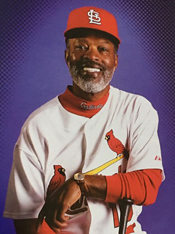 McRae spent more than 40 years in the big leagues _ 19 as a player, 15 as a coach, six as a manager and two in the front office. His last five seasons in the majors were as hitting coach of the Cardinals from 2005 to 2009.
During McRae’s St. Louis stint, the Cardinals won a World Series title in 2006, their first since 1982.
Segregated South
Harold McRae was from Avon Park, Fla., 85 miles south of Orlando. From 1927 to 1929, Avon Park was spring training home of the Cardinals.
As a youth in the 1950s, McRae developed into a right-handed hitter playing stickball on a makeshift diamond at the corner of Delaney and Castle streets in Avon Park. “A lot of skills I exhibited in the big leagues began right (there),” McRae recalled to the Tampa Tribune. “I remember a certain Mrs. Austin who lived on that corner. We knew that if we hit a ball into her yard, which was left field, she wouldn’t give it back. So that’s how I first learned to hit to right field.”
(In 1991, Castle Street was renamed Hal McRae Boulevard.)
McRae attended segregated E.O. Douglas High School in Sebring, Fla. Named for banker Eugene Oren Douglas, it was the only high school in the county available to blacks. (The school remained open until 1970, when integration finally occurred in Highlands County.)
After graduating in 1963, McRae attended Florida A&M in Tallahassee. Two years later, the Reds signed him. “I really enjoyed sliding headfirst, taking out the middle infielders, running into the catcher,” McRae told the Tampa Tribune. “I credit that outlook to my baseball coach (Costa Kittles) at Florida A&M. He was really a football coach. I was never afraid of contact.”
A few months after turning pro, McRae married his wife, Johncyna, in April 1966. Forty years later, in 2006, she was presented with an unsung hero award from the Florida Department of Health for “working tirelessly to end disparities in health care for racial and ethnic minorities.”
The award was presented with accolades from Florida Gov. Jeb Bush. According to the Bradenton Herald, Dr. Gladys Branic, director of the Manatee County Health Department, praised Johncyna “for her mentoring of migrant workers, her volunteer work for troubled teens, and the many scholarships and nurturing programs she helped develop for black girls.”
Slotted for second
In his first three seasons in the Reds’ system (1966-68), McRae was a second baseman. His minor-league manager in 1967 was former second baseman Don Zimmer. At the Florida Instructional League that fall, McRae’s instructor was former second baseman Sparky Anderson. Reds manager Dave Bristol told The Cincinnati Post, “Everyone, including scouts on the other clubs, tells me McRae is going to be Cincinnati’s next second baseman.”
McRae was called up to the Reds during the 1968 season and started 16 games at second base. Then in the winter, playing in Puerto Rico, he fractured his right leg in four places trying to knock the ball loose from a catcher on a play at the plate. That put an end to his ability to move nimbly as a second baseman.
After sitting out most of the 1969 season, McRae was shifted to the outfield and was with the Reds from 1970-72. In two World Series, he hit .455 against the Orioles in 1970 and .444 versus the Athletics in 1972. Video
(McRae also played in two World Series with the Royals. In 17 World Series games, he hit .400.)
Rough stuff
Traded to the Royals in November 1972, McRae benefitted from the American League’s adoption of the designated hitter in 1973. He told the Tampa Tribune, “Some people considered it being half a ballplayer … It just so happened that my best role was as the DH.”
Working well with hitting coaches such as Charley Lau and Rocky Colavito, McRae hit better than .300 seven times in 15 years with the Royals.
In 1976, when McRae hit .332, his teammate, George Brett, won the American League batting title at .333. In his final at-bat, Brett got an inside-the-park home run when Twins outfielder Steve Brye misjudged the ball. McRae suggested Brye intentionally let the ball drop.
Because of his aggressiveness, McRae was not a popular opponent. According to the Baseball Hall of Fame, while managing the White Sox, Tony La Russa said of McRae, “When you play against him, you detest him, but you would love to have him on your side.”
Mariners pitcher Glenn Abbott told Sports Illustrated, “I feel McRae has played dirty, but he plays to win, and that’s what it’s all about.”
Attempting to thwart a double play during a 1977 playoff game, McRae barreled into Yankees second baseman Willie Randolph with a rolling body block. The Yankees cried foul, but McRae said to United Press International, “I wasn’t trying to hurt Randolph … There was nothing dirty about it … We’re not supposed to be buddy-buddy out there.” Video
Teammates respected McRae. George Brett said to Sports Illustrated, “I look up to him. He learned the game from Pete Rose, and I learned it from him.” Whitey Herzog, McRae’s manager from 1975-79, told the Kansas City Star, “He’s the best designated hitter in baseball. He gives you everything he has on every play.”
Patience pays
The 1985 World Series between the Royals and Cardinals was played without designated hitters, but McRae still was involved in the drama.
With the Cardinals ahead, 1-0, in the ninth inning of Game 6 and on the verge of clinching the championship, the Royals got a break when umpire Don Denkinger ruled Jorge Orta safe at first, though TV replays clearly showed he was out.
As the inning unfolded, the Royals had runners on first and second, one out, when McRae batted for Buddy Biancalana. The Cardinals’ right-handed rookie closer, Todd Worrell, hoped to get McRae to ground into a game-ending double play.
According to the Kansas City Star, McRae said he reminded himself as he approached the plate to be patient and swing only if the pitch was a strike.
With the count 1-and-0, Worrell threw a slider that eluded catcher Darrell Porter for a passed ball, enabling the runners to move up to second and third. That changed the strategy. Behind in the count 2-and-0, Cardinals manager Whitey Herzog ordered Worrell to walk McRae intentionally, loading the bases and setting up a potential force-out at any base.
A left-handed batter, ex-Cardinal Dane Iorg, thwarted the plan with a two-run single. The Royals clinched the title the next night in Game 7. Boxscore
Good teacher
McRae batted .290 and totaled 2,091 hits in a big-league playing career that ended in 1987.
He managed the Royals (1991-94) and Rays (2001-02). A son, Brian, became a big-league outfielder and played for him on the Royals.
McRae coached for the Royals (1987), Expos (1990-91), Reds (1995-96), Phillies (1997-2000) and Rays (2001). As hitting coach, he was credited with helping develop Reggie Sanders with the Reds and Scott Rolen with the Phillies.
“Hitting instruction is probably my first love,” McRae told Todd Jones of The Cincinnati Post. “I enjoy the interaction with the players. As a manager, you look for results. As a hitting instructor, you look for improvement.”
After McRae helped Deion Sanders snap a slump, Reds veteran Lenny Harris told The Post, “Deion said to us, ‘It’s time to start listening to Hal McRae. He understands us.’ “
In a report on McRae’s hitting philosophy, Jim Salisbury of the Philadelphia Inquirer noted, “The plate is 17 inches wide. McRae teaches his hitters to concede the inner and outer two inches to the pitcher. That leaves 13 inches for the hitter.”
After being replaced as Rays manager by Lou Piniella, McRae moved into the role of assistant to Rays general manager Chuck LaMar, but there were “few requests for his input,” according to the St. Petersburg Times.
“I felt miserable half the time,” McRae told the newspaper.
Back in uniform
With Mitchell Page as hitting coach, the 2004 Cardinals won the National League pennant and led the league in hits and runs scored, but he was fired for reasons related to alcoholism. Page said to Joe Strauss of the St. Louis Post-Dispatch, “I have an alcohol problem and I’m going to get treatment for it.”
The Cardinals offered the job to McRae, 59, and he welcomed the chance to coach again. Recalling his start as a big-league manager with the White Sox in 1979, Cardinals manager Tony La Russa told the Bradenton Herald, “Winning was defined by George Brett and Hal McRae. In the West Division, Kansas City was the team to beat, and those were the two guys who showed how it was done. I always said I’d like to be a teammate of Hal McRae.”
After his hiring, McRae watched video and learned the habits of Cardinals batters. At 2005 spring training, he spent each day talking with the players and tailored his philosophies to their needs. As Roger Mooney of the Bradenton Herald noted, “McRae coaches like he played. He’s prepared, works hard and gets results.”
The 2005 Cardinals were loaded with big hitters such as Jim Edmonds, Albert Pujols, Scott Rolen, Reggie Sanders and Larry Walker. “With a veteran club, you’re talking about the (opposing) pitcher,” McRae said to the Herald. “We’re more concerned with the pitcher than ourselves.”
Helping hand
The 2006 Cardinals were a deeply flawed team that became World Series champions. Part of their success stemmed from the performance of rookie Chris Duncan, who slugged 22 home runs in 280 at-bats during the season.
“Hal McRae has been the biggest help because he’s working with me day in, day out,” Duncan told the Post-Dispatch. “He’s helped me the most to get through different phases and whatever is going on with me.”
In assessing McRae’s contributions to the 2006 Cardinals, Tony La Russa said to the St. Petersburg Times, “He’s a very smart man. He understands what hitting is about … and he understands winning.”
When Albert Pujols slumped early in the 2007 season, McRae gave him a tutorial _ “He needs to use his hands more,” the coach told the Post-Dispatch _ and used a video to convince Pujols that by being impatient, or jumpy, at the plate he was opening his hips too early in his swing. “He showed me, and I saw the difference,” Pujols said to reporter Joe Strauss.
In 2008, the Cardinals led the league in hits and batting average (.281, well above the league norm of .260), and got big production from a journeyman (Ryan Ludwick, 37 home runs, 113 RBI) and a former pitcher (Rick Ankiel, 25 homers).
Though division champions in 2009, the Cardinals were swept by the Dodgers in the playoffs, totaling six runs in three games. McRae, 64, was fired.
“You’re always disappointed when you get laid off,” McRae told the Post-Dispatch, “but I’m not disappointed in my work.”

 RetroSimba
Hitting coach is an easy target for team management trying to convince themselves and their team’s fans that they are doing something about underperformance. The hitting coach likely has no long-term contract, no guarantees. And no matter how good a hitting coach you are, if you’re working for an ineffective manager, you’re fired. All this because after reading your story it seems incredible that Hal McRae would be let go.
Agreed. The firing of Hal McRae by the Cardinals was a stinking injustice. It was done because manager Tony La Russa wanted to give Mark McGwire the job in the hope it would help McGwire repair his tarnished reputation in a bid for election to the Baseball Hall of Fame. McGwire had perpetrated a massive fraud on the public by cheating and using performance-enhancing drugs to generate excitement in a tainted home run race.
Asked by the St. Louis Post-Dispatch whether Hal McRae would have remained hitting coach if McGwire had turned down the job, La Russa declined to answer.
La Russa told the Belleville News-Democrat, “We’re replacing a man that I have great respect for, Hal McRae, who has done a very good job here for five years. It was not anything that Hal did not do; I thought Hal did a good job.”
According to the Post-Dispatch, in explaining McRae’s firing, Cardinals general manager John Mozeliak expressed desire for “more enthusiastic use of video as an instructional tool.” Mozeliak also acknowledged concerns about McRae’s ability to reach younger hitters such as Colby Rasmus and Brendan Ryan, the Post-Dispatch reported.
Both of Mozeliak’s explanations are lame. There are myriad examples of McRae effectively using video and of younger players expressing appreciation for the coaching he did.
Also, according to the Post-Dispatch, after the Cardinals fired McRae, Albert Pujols called him to express appreciation for what McRae did for him.
I can attest that having an awful neighbor that doesn’t give a ball back can certainly change the way you play. Haha.
I remember his son, Brian, being a hotshot prospect for a little while, but I sort of drifted away from baseball as his career was getting started. I guess he turned out to be a sort of middling player.
The at-bats for Hal McRae against those strong A’s pitching staffs would have been fun to see. Hal McRae batted .311 for his career versus the A’s, with 158 hits, including 41 doubles. He hit .333 against Catfish Hunter and .400 against Rollie Fingers.
Hal McRae was an old school guy who played baseball the old school way. While I’ve never been a fan of the DH, I have appreciation for players like Hal McRae who with a positive attitude make the most of their opportunities. I really like how he describes learning how to hit to the opposite field. As well as his learning experiences playing on the sandlot. It would be easy to think that he really didn’t do anything significant in the 9th inning of that fateful game 6. In my opinion however, the very fact that he demonstrated good plate discipline and just took those pitches from Todd Worrell also ended up contributing to the Royals comeback. Many of today’s players would have tried to swing for the fences and striking out. Finally, I agree that personal politics probably played a part in him being pushed out of his position as hitting coach.
Thanks for the thoughts you put into your comments, Phillip. I like how you expressed your views.
In 1998, when Scott Rolen was 23, Hal McRae saw that same kind of old-school approach from him. McRae told the Philadelphia Inquirer, “The game needs more players who play the game the way he does _ down and dirty, all out, all the time … The consistency of the way he plays is the most impressive thing about Scott. There’s never a different gear.”
McRae twice led the American League in doubles _ a franchise-high 54 in 1977 and 46 in 1982. He also was a league-leader in on-base percentage (.407 in 1976), extra-base hits (86 in 1977) and RBI (133 in 1982).
As a Cardinals fan and student of their history, I thought you’d appreciate this note: According to Joe Strauss of the St. Louis Post-Dispatch, before the Cardinals hired McRae they also discussed the job opening with minor-league coaches Tommy Gregg, Gene Tenace and Steve Balboni, and former players Will Clark and Mark McGwire.
I enjoyed learning more about a player I first saw as a DH on the Royals. There are so fewer opportunities these days to be a hard nosed player like McRae, no more breaking up double plays or crashing into the catcher and knocking the ball loose. But there are other ways like running right after the ball is hit and stretching singles into doubles. I bet McRae never dogged it.
I wish pitchers still batted in the National League, but at the same time I like the American League DH. It adds some spice to have leagues with different characters. I would think the DH would be a very tough position, all that sitting around and no playing in the field to take your mind off a bad at a bat, like stranding runners in scoring position.
We appreciate the same style of play, Steve.
In 1982, Hal McRae three times produced 5 RBI in a game. One of those came against the Brewers, who went on to win the American League pennant that year. Jerry Augustine started that game for Milwaukee and gave up 15 hits and 12 runs in 5 innings. For his career, McRae had a .500 on-base percentage versus Augustine, with 11 hits and 4 walks in 30 plate appearances. https://www.retrosheet.org/boxesetc/1982/B05110KCA1982.htm
Holy mackeral! 15 hits in five innings. That probably wouldn’t happen in today’s game. Augustine coached my alma mater – University Wisconsin Milwaukee. I’m proud to say that Daulton Varsho became the first MLB player from the school a few years ago.
Thanks for that info, Steve. In 12 seasons as head baseball coach at your alma mater, Jerry Augustine had a 347-297-1 record. I can understand why you are proud that Daulton Varsho is a fellow alum. I didn’t realize that he won an American League Gold Glove Award for his outfield play in 2024 with the Blue Jays.
He’s kind of rarity in that he plays both catcher and outfielder though since he’s been on the Blue Jays, he’s only been in the outfield and as you pointed out, he won a gold glove. I don’t really understand the WAR stat, but I get that 5.0 for one season is impressive and that was Varsho’s last season despite only hitting .214 with on OB% under.300 so his defense must have been stellar.