As a Cardinals player who struggled to manage his emotions, Garry Templeton didn’t seem a likely candidate to manage others. Yet that’s precisely what he did.
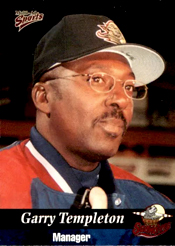 A shortstop for 16, sometimes stormy, seasons in the big leagues, Templeton went on to spend 13 years as a manager in the minors, often at the lowest levels.
He managed in the Angels’ system for four seasons, including two at Class AAA, one rung below the big leagues, and then for nine years with teams in independent leagues.
Beginning with Cedar Rapids, Iowa, in 1998 and concluding with Newark, N.J., in 2013, Templeton had an overall record of 636-692 as a manager. He was 294-272 with the Angels’ farm teams; 342-420 with the independent league clubs.
Asked why managing appealed to him, Templeton told the Cedar Rapids Gazette, “I like having a hand in everything … I like that challenge.”
Of the many players the former Cardinal managed, some who went on to become Cardinals were David Eckstein and John Lackey.
Growing pains
Templeton was 20 years old when he reached the majors with the Cardinals in 1976. He was exciting as well as excitable, and his six seasons with St. Louis were a mix of thrills and turmoil.
A switch-hitter with speed, Templeton was the first major-league player to get 100 hits from each side of the plate in a season. He produced a league-high 211 hits _ 111 from the left side; 100 from the right _ for the 1979 Cardinals. He also led the National League in triples for three consecutive seasons while with St. Louis (1977-79).
Before he turned 25, his prime years still ahead, Templeton was one of the sport’s top talents, but there was unhappiness. At 1979 spring training, Templeton asked the Cardinals to trade him and threatened to play at less than his best if his request wasn’t granted. During the season, he was chosen as a reserve on the National League all-star team, but turned down the opportunity because he said he should have been the starting shortstop.
Two years later, Templeton created his biggest tempest when he made obscene gestures to St. Louis spectators after he got booed for not hustling. Enraged by Templeton’s behavior, manager Whitey Herzog pulled him down the dugout steps and backed him against a wall before teammates separated them. The Cardinals suspended and fined Templeton, then moved him to the disabled list when he entered a St. Louis hospital for treatment of emotional problems.
During the winter, the Cardinals traded him to the Padres for a future Hall of Famer, Ozzie Smith.
“Of the thousands of players I’ve seen come and go, two who stand out are Garry Templeton and Dave Parker,” Cardinals broadcaster Jack Buck told the St. Louis Post-Dispatch in 1997. “I thought both could have been among the greatest players of all time … Templeton had more tools than Ozzie Smith, but Smith made himself a great player by working hard at it, and Templeton let his skills diminish because he didn’t work hard enough.”
Former Cardinals first baseman Keith Hernandez said to the New York Times in 2000, “The two greatest young players I ever saw were Darryl Strawberry and Garry Templeton, and both squandered it.”
In reflecting on those Cardinals days, Templeton told the Albuquerque Tribune in 2000, “I came into this game at a very young age. I think as a player everyone matures. It’s something gradual that happens. When you’re that young, you don’t even think about what things mean. You don’t think about what you’re saying.”
He also said to the Hammond (Ind.) Times in 2003, “I was just young and did young, foolish things … I wasn’t a hothead. I was more immature.”
Proud Padre
With the Padres, Templeton helped them to their first National League pennant (he hit .316 in the 1984 World Series) and was a steady contributor despite issues with his knees. (Templeton ranks second to Tony Gwynn for most career hits, doubles and games played as a Padre.)
He also had a good relationship with manager Dick Williams and their discussions got Templeton thinking about becoming a manager. “I’d ask (Williams) why he did certain things, and he’d tell me,” Templeton recalled to the Cedar Rapids Gazette. “We talked a lot of strategy. I learned a lot about the game. I learned how to play to win.”
Eventually, Templeton was asked by general manager Jack McKeon to help teach young teammates such as infielders Roberto Alomar, Joey Cora and Bip Roberts. Templeton found he liked doing it and was effective. “I love to teach,” Templeton told the Cedar Rapids Gazette.
After his playing days, Templeton was a roving infield instructor and baserunning coach in the Padres’ farm system in 1994 and 1995, then went home to be with his wife and their two sons and a daughter. He also developed a passion for golf. According to Mark Whicker of the Orange County Register, “Templeton had gotten so good (at golf) that he was playing in Golden State Tour events as an amateur and said he was seriously considering the PGA Tour Qualifying School.”
Then he got a call from a former Padres teammate, Angels minor-league hitting coach Gene Richards, who told him the Angels needed a manager for their Cedar Rapids farm club.
Manager material
Templeton applied for the job and was hired for the 1998 season by Angels director of player development Ken Forsch, brother of Templeton’s former Cardinals teammate, Bob Forsch. “His strength is teaching,” Ken Forsch said to the Cedar Rapids Gazette in explaining why he hired Templeton.
A skeptical Post-Dispatch declared, “Picture this: Garry Templeton sitting in the dugout of the Cedar Rapids Kernels, wearing a red, blue and silver uniform with a corncob logo and managing Class A ballplayers. Hard to imagine, if your memories of (Templeton) include him making obscene gestures to the Busch Stadium crowd at Ladies Day.”
Templeton, though, said he was committed to the task and that his goal was to return to the majors as a manager or coach. “This is the route I have to go,” he said to the Gazette. “I guess you could say I have to crawl before I can walk.”
Climbing the ladder
After a season at Cedar Rapids, Templeton was promoted to Class AA Erie, Pa., in 1999 and did well there, too. Baseball America magazine named Templeton the best managerial prospect in his league after each of his first two seasons.
Among the future big-leaguers he managed were pitchers Ramon Ortiz, Scot Shields and Matt Wise, and third baseman Shawn Wooten.
Templeton moved a step closer to his goal of the majors when he was named manager of Class AAA Edmonton for the 2000 season. Edmonton’s hitting coach was Templeton’s former Cardinals teammate, Leon Durham, who also was working to rebuild his baseball career. Durham got suspended for failing a drug test with the Cardinals in 1989, his final year as a big-league player.
Among the players on Edmonton’s roster was Edgard Clemente, nephew of Hall of Famer Roberto Clemente.
Edmonton was where David Eckstein revived his career. Placed on waivers in August 2000 after hitting .246 for the Red Sox’s Pawtucket farm club, Eckstein was claimed by the Angels, who assigned him to Edmonton. Playing for former Cardinals shortstop Templeton, future Cardinals shortstop (and World Series MVP) Eckstein hit .346. The Angels made him their shortstop the following year and Eckstein helped them become World Series champions in 2002.
Another future big-leaguer on that 2000 Edmonton team was pitcher Jarrod Washburn. “These guys are close to the next level,” Templeton told the Albuquerque Tribune. “I’m here trying to help them build on a few things and learn a few new things to get there.”
The Angels moved their Class AAA club to Salt Lake City for 2001. At the introductory news conference, Templeton and Angels front office staff wore Mickey Mouse ears, “welcoming Utah’s only triple-A team to the Disney Corp. family,” the Salt Lake City Tribune reported.
Among those who played for Templeton at Salt Lake City were catchers Bengie and Jose Molina (brothers of Yadier Molina) and John Lackey, who would pitch in the World Series for the Angels (2002), Red Sox (2013) and Cubs (2016), and in the playoffs for the Cardinals (2014-15).
The Angels, though, were overhauling their front office and Templeton wasn’t in the plans. General manager Bill Stoneman fired him after the 2001 season.
“He didn’t give me any reason other than (Angels manager) Mike Scioscia wanted someone easier to work with,” Templeton told the Salt Lake City Tribune. “It’s too bad … The Angels were good to me, but I felt I had at least one more year there.”
Wheel of Fortune
The next stop for Garry was Gary _ as in Gary, Ind., where he was named manager of a team in the Northern League. A son, Garry II, played for him there, but it didn’t work out. Templeton was fired after two seasons.
He then managed three teams in the Golden League (Fullerton, Long Beach, Chico) and one each in the North American League (Maui) and Canadian-American Association (Newark). One of the investors in the Golden League was TV game show host Pat Sajack. “I’m not in this to make money,” Sajack told the Los Angeles Times. “I’m in it to be closer to a game that I like very much.”
At Long Beach, Templeton managed a couple of former big-league pitchers trying to make comebacks _ Hideki Irabu and Jose Lima.
A year later, when Templeton managed the 2010 Chico Outlaws, one of his pitchers was Eri Yoshida, an 18-year-old Japanese woman knuckleball specialist. She said she learned to throw a knuckleball by watching video of Red Sox pitcher Tim Wakefield.
Yoshida was 0-4 for Chico but she played again for Templeton with Maui in 2011 and got her first win as a professional in the United States. “She’s not taken seriously (by others),” Templeton told the Honolulu Star-Advertiser. “Most people think of her as a novelty act, but you’ve got to look at her as if you’re looking at one of these guys who are out here trying to make it … I don’t see anything different between her and the (men) players.”
Another on the Chico roster was first baseman John Urick, a former Yankees prospect. Urick and Templeton had a serendipitous connection _ Whitey Herzog. Nearly 30 years after being yanked down the dugout steps by Herzog, Templeton was managing Whitey’s grandson.

 RetroSimba
I’m impressed that despite what Templeton realized in retrospect – that he was young and almost unconscious of what he did and said, he still sought advice from manager Dick Williams. Seems to suggest that he just needed time “to grow up.” It’s really a great story, one of second chances and forgiveness and based on your research Mark, it sounds like he had a big impact on younger players and carved himself a second career as a coach and what’s interesting is yeh, he suffered through a lot of punishment, but there were people who always believed in him.
Amazing that he was the first to reach 100 hits from both sides of the plate. Supports Keith Hernandez’s opinion of Templeton being one of the best young players he’d ever seen.
I’m so glad you mentioned Eri Yoshida. Such an amazing story. So rare to throw a knuckleball and on top of it, to be a woman! And the irony of Templeton’s comments about treating her like a player, as one of the guys.
I appreciate your comments, Steve. Yes, indeed, personal growth is a wonderful thing to see and to experience. It is something that, hopefully, each of us continues to experience, regardless of age.
You are correct about Garry Templeton having a positive impact on others as a manager and instructor. With Class A Cedar Rapids, he told the local newspaper, “A lot of these guys who will be playing for me are fresh out of college and in their first full year of (professional) baseball, My job is to develop their talent, get them to understand their limitations and to recognize situations. The Cardinals taught you to know your limitations, what you can and cannot do, and hopefully I can teach that and teach the players how to win.”
In 2000, when asked by the Edmonton Journal why some players who had successful playing careers later had trouble making it as managers, Templeton said, “What happens is a lot of great athletes run into the problem of trying to teach what they did instead of just teaching the fundamentals of what they did.”
Yes, excellent Mark, as you said “regardless of age.” I’ve been feeling so much better lately after realizing every day is a new beginning…..makes me feel young again.
I had no idea about Templeton’s long coaching career. It changes my opinion of him. Great post.
I believe that Chico team played in the same league as the Sacramento Steelheads, who only played one year in the River City before moving to Vacaville. Apparently and wisely, they didn’t want to contend with the soon-to-be RiverCats. I dragged my then girlfriend to their final home game in 1999. It was enjoyable enough, but the best part was the cadre of little kids outside the stadium skittering to retrieve all the foul balls.
Kids going all-out for foul balls is one of baseball’s endearing sights and I’m glad you appreciate it, Gary.
Those 1999 Sacramento Steelheads (excellent name) finished in last place in the Western League at 36-54. The Steelheads were managed by former Royals and Angels first baseman Bob Oliver. The Chico Heat, managed by Bill Plummer, finished in first place that year, 15 games ahead of the runner-up Tri-City Posse of Pasco, Washington (managed by Wally Backman). The top pitcher for the Steelheads was 31-year-old Ryan Bowen (9-4), a former Astro and Marlin. Steelheads first baseman Wayne Weinheimer, 29, a Sacramento native and Sacramento High School graduate, hit .319 and had an on-base percentage of .429.
Tickets prices for Steelheads home games ranged from $6 to $12, with $1 for parking at Hughes Stadium, according to the Sacramento Bee. Hitters must have liked the dimensions _ 305 to right and 320 to left.
On May 20, 1999, the Sacramento Bee reported, “Ostensibly, Pete Rose was in town as part of the $50,000 personal service agreement he signed with the Steelheads. It’s an agreement that states he will be one of the team’s batting instructors during the 1999 season. At the moment, the only time Rose is scheduled to return to Sacramento is May 28, the date of the Steelheads’ home opener when he will throw out the first pitch.”
We all make mistakes when we’re young. I made lots of them. What counts is that your willing to admit you messed up. Learn from your mistakes and don’t repeat them. It’s true that Gary Templetons time in St.Louis was a bit tempestuous. And most of us probably thought that when he was traded to San Diego his career was over. Truth is though that he redeemed himself, played admirably ,became a good teammate and developed leadership qualities. I will always wonder what Whitey’s reaction was upon finding out that his grandson’s manager was no other than Gary Templeton.
Thanks for sharing the wisdom of your experience, Phillip.
In 2010, Dan O’Neill of the St. Louis Post-Dispatch wrote that Whitey Herzog and Garry Templeton never quite settled their differences. “While they occasionally conversed and exchanged pleasantries when their teams met during subsequent years, Templeton and Herzog never came to an understanding over what took place in St. Louis,” O’Neill reported.
“He never said anything about it and, you know, I wasn’t going to bring it up,” Herzog said.
When asked about clearing the air with Herzog, Templeton told O’Neill, “No, we never did that. I don’t think we ever got to where we patched things up.”
PS: John Urick hit .307 with 10 home runs in his season with Garry Templeton as manager.
Anther great story about another of my childhood heroes. I was sad when Garry had to go but soon realized the greatness of Ozzie.
Although he seemingly matured and played with San Diego several years, he was never the same hitter he had been with the Cardinals. Thats surprising for such a talented player. Somewhat like Albert I guess
Thanks for reading and for commenting. Apparently knee injuries while with the Padres kept Garry Templeton from being the kind of hitter he had been with the Cardinals. In April 2000, Templeton told the Edmonton Journal, “It took away a lot of my great assets _ the quickness. the speed, the way I hit left-handed. I still did some good things, but there’s no telling what I would have done if I would have had a healthy knee like the first six years I was in the league.”
Reflecting on the trade that sent him to the Padres, Templeton said to the Orange County Register in 1998, “The trade was good for me, but it was great for Ozzie. In San Diego I got to go to a World Series and played for some people who taught me how to win. I think they appreciated me, too.”
As with so many of us, things look different when you’re 40 or 50, than when you were 20. Fortunately I wasn’t in a position that would make anyone want to write about the stupid things I did when I was 20.
I like your perspective, Ken.