One year after they traded Steve Carlton because he wanted a $65,000 salary, the Cardinals offered a college pitcher a six-figure contract.
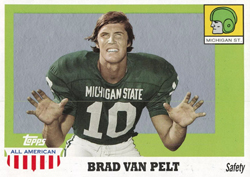 Michigan State’s Brad Van Pelt, a right-hander with a 100 mph fastball, was the prospect who prompted the Cardinals to consider coughing up the cash. He also was a football talent, a recipient of the Maxwell Award presented to the most outstanding college player in the sport.
Drafted in January 1973 by the baseball Cardinals and the NFL New York Giants, Van Pelt opted for pro football. He went on to play 14 seasons, helping to form one of the all-time best linebacking units.
Abundant athleticism
Van Pelt was from Owosso, Mich., a town 90 miles northwest of Detroit. Thomas Dewey, twice the Republican nominee for president, was from there, too. (Dewey lost to Franklin Delano Roosevelt in 1944 and to Harry Truman in 1948.)
An athlete who excelled in every sport he tried, including bocce, golf and soccer, Van Pelt was a high school sensation as a quarterback in football, a rebounder in basketball (he hauled down 42 in one game) and a pitcher in baseball (consecutive no-hitters as a senior).
The Tigers, his favorite team, chose Van Pelt, 18, in the 14th round of the 1969 June baseball draft but he took a football scholarship from Michigan State instead.
(It was the first of five times Van Pelt was selected in the baseball draft. He declined to sign each time. After the Tigers in June 1969, others to draft him were the Angels in June 1972, Cardinals in January 1973, Pirates in June 1973 and Indians in January 1974.)
“Rangy, fast and strong,” Van Pelt, 6-foot-5, 220 pounds, had the “defensive end’s body with the receiver’s speed,” according to the Lansing State Journal.
Michigan State guard Joe DeLamielleure (elected to the Pro Football Hall of Fame for his skill as a Buffalo Bills and Cleveland Browns lineman) told the newspaper, “Van Pelt was the modern day Jim Thorpe, and that’s no exaggeration … He could have been our starting quarterback because he could throw the ball a mile.”
Michigan State head coach Duffy Daugherty said Van Pelt could have played any position on the football team. “He is the most versatile athlete I’ve ever coached,” Daugherty told the Associated Press.
Daugherty dubbed Van Pelt his “secretary of defense” and put him at safety. Often called a rover back, Van Pelt had the size and speed to intimidate receivers, stuff rushers and pressure quarterbacks with blitzes. “I’ve never seen a safety able to come up to the line of scrimmage to make tackles as quick as Brad can,” Daugherty said to the Flint Journal.
George Perles, an assistant on Daugherty’s staff before eventually becoming head coach, told the Lansing newspaper, “During his college career, he (Van Pelt) might have been the biggest safety in the Big Ten (Conference), if not the country.”
In his three varsity seasons (1970-72), Van Pelt totaled 256 tackles and 14 interceptions. “He (Daugherty) gave me the freedom to blitz when I wanted and to go to the ball on every play,” Van Pelt said to the State Journal. “I can’t thank him enough.”
Man for all seasons
Described by Joe Rexrode of the Lansing newspaper as “the purest all-around athlete in Michigan State history,” Van Pelt played varsity basketball and baseball.
He got into 31 basketball games for head coach Gus Ganakas, who told the State Journal, “Van Pelt helped define the position of power forward.”
In baseball, Van Pelt pitched for head coach Danny Litwhiler, a former big-leaguer who played in two World Series (1943 and 1944) as the Cardinals’ left fielder.
As a sophomore, Van Pelt was on the 1971 Big Ten championship baseball team. The next season, he struck out 84 in 56.1 innings and had a 2.07 ERA. The Angels picked Van Pelt in the 13th round of the June 1972 draft and offered $100,000 _ “The first three days after they made the offer I really thought about signing,” Van Pelt told the Flint Journal _ but he chose to return to college for senior year.
Instead of spending the summer of 1972 pitching in the Angels’ system, Van Pelt went to the Netherlands with an amateur team from Grand Rapids, Mich., to compete in an international honkbal (Dutch for baseball) tournament.
Cardinals calling
After Van Pelt’s senior football season, big-league baseball held a winter draft on Jan. 10, 1973. In those days, a secondary phase was conducted for players who had been drafted in prior years but hadn’t signed.
Selecting seventh in the first round, the Cardinals chose Van Pelt. “He was one of a few premium players available,” Cardinals director of player procurement George Silvey told the St. Louis Post-Dispatch.
Cardinals general manager Bing Devine said to United Press International, “He’s an all-American boy in every sense of the word.”
(The Tigers, who had the next pick after the Cardinals, were planning to draft Van Pelt, the Post-Dispatch reported. When the Cardinals beat them to it, the Tigers went with Van Pelt’s Michigan State teammate, pitcher Larry Ike.)
Van Pelt told the Cardinals he’d wait until the NFL draft was held on Jan. 30, 1973, before making a decision.
When the Cardinals made it known they intended to sign Van Pelt, NFL teams didn’t want to risk losing a first-round pick in a bidding war with a baseball team. As the New York Times put it, Van Pelt became “a player of unquestioned ability but highly questionable availability.”
New York Jets head coach Weeb Ewbank told the Times, “We just didn’t see any sense in fighting baseball for him, but he is one hell of an athlete.”
The Giants, who had traded their first-round pick to the Browns for defensive end Jack Gregory, grabbed Van Pelt in the second round, where, as head coach Alex Webster noted to the Times, “he was worth the risk.”
Decision time
A year earlier, the Cardinals reportedly offered Steve Carlton a 1972 salary of $57,500. Carlton wanted more. As spring training got under way, Carlton said he and the club were less than $10,000 apart, The Sporting News reported, but owner Gussie Busch, angry when the pitcher didn’t sign, ordered Bing Devine to trade him. Carlton was sent to the Phillies, who gave him $65,000 in 1972, and he won 27 games for them that season.
Devine offered a lot more than that to Van Pelt in February 1973. Braving a snowstorm, Devine met with Van Pelt in Owosso and made an enticing pitch. “We went to a peak level with the offer we made him,” Devine told Milton Richman of United Press International. “By that I mean over $100,000.”
Giants owner Wellington Mara followed Devine to Owosso and presented Van Pelt with a three-year, no-cut contract worth $300,000.
Van Pelt said the money offered by the Cardinals and Giants was about the same. “The two offers were so close that I almost thought they had gotten together,” he remarked in an article published in the Post-Dispatch.
Van Pelt chose the Giants primarily because he could begin his pro career in the NFL rather than in baseball’s minor leagues.
(Danny Litwhiler told United Press International that Van Pelt would need at least two years of total concentration on baseball to become ready for the majors. Van Pelt acknowledged to the Jersey Journal, “I know I have a major-league fastball, but my curve leaves a lot to be desired.”)
As Devine said to Milton Richman, “With us, he would have had to go to the minor leagues to develop. With the football Giants, he went right to the big-league club. That was the key.”
Crunch Bunch
The Giants tried Van Pelt at tight end and strong safety during a frustrating rookie year. After Bill Arnsparger replaced Alex Webster as head coach in 1974, Van Pelt shifted to outside linebacker. His career soared when Marty Schottenheimer arrived as linebacker coach in 1975. “I’d say 85 percent of what I am now, I learned from him,” Van Pelt told the Detroit Free Press in 1979.
Van Pelt was named to the Pro Bowl five years in a row (1976-80) and was chosen as the Giants’ player of the decade for the 1970s. “If Brad Van Pelt played on a good team, he would be a household name,” Los Angeles Rams general manager Don Klosterman said to Mike Lupica of the New York Daily News.
The Giants had one winning record in Van Pelt’s 11 seasons with them. As club executive John Mara told the Daily News, “If you look at those (Van Pelt) years, our teams were as bad as could possibly be. We really had some awful teams in the 1970s. He was the one guy who was consistently a good player.”
Van Pelt played for five Giants head coaches _ Alex Webster, Bill Arnsparger, John McVay, Ray Perkins and Bill Parcells. (Bill Belichick was a Giants assistant coach from 1979-84 and Van Pelt’s linebacker coach from 1980-83.)
When Parcells joined the Giants as defensive coordinator on Perkins’ staff in 1981, he installed a 3-4 defense after the club drafted Lawrence Taylor. From 1981-83, the Giants’ four hard-hitting starting linebackers _ Harry Carson, Brian Kelley, Taylor and Van Pelt _ became known as the Crunch Bunch. (Carson and Taylor were elected to the Pro Football Hall of Fame.)
According to Newsday, Taylor called Van Pelt “one of the greatest players I ever played with.”
The arrival of linebacker Carl Banks, a first-round pick from, of all places, Michigan State in 1984 prompted the Giants to break up the Crunch Bunch. In July 1984, Van Pelt was traded to the Minnesota Vikings for fullback Tony Galbreath.
Van Pelt refused to report, telling the Vikings he preferred to be with a team either in California or Florida. He never played a game for the Vikings. They traded him to the Los Angeles Raiders for two draft choices. Van Pelt spent two seasons (1984-85) with the Raiders and one (1986) with the Browns.
In 1998, Van Pelt returned to Michigan State and completed his school work, earning a degree in health and physical education. Three years later, he was inducted into the College Football Hall of Fame. A son, Bradlee, was a quarterback for Colorado State and played in three games for the 2005 Denver Broncos.

 RetroSimba
What a scary name for linebackers – Crunch Bunch, for the opposition that is. Ouch! I wonder if Van Pelt regretted his decision to play football after his first year struggles?
Another amazing story of how one coach, in this case Marty Schottenheimer as linebacker coach, can literally change a player’s career around for the best.
I appreciate your observations, Steve.
Asked during his rookie year with the Giants whether he had second thoughts about turning down the baseball offer, Brad Van Pelt told Milton Richman of United Press International, “I still don’t regret what I’ve done. Like Mr. (Bing) Devine says, I know I would’ve had to go to the minor leagues for more seasoning.”
However, in a story published in the St. Louis Post-Dispatch about his decision to select football over baseball, Van Pelt said of his boyhood baseball favorites, the Tigers, “It might have made a big difference if they had chosen me.”
I’m glad you took note of Marty Schottenheimer’s contribution. Schottenheimer had been a linebacker for the Bills and Patriots, and his experience and knowledge resonated with Van Pelt. “He and I spent a lot of long hours after practice,” Van Pelt told the Flint Journal. “He and I would be out there long after everybody else was gone.”
I love that loyalty to a team, Van Pelt wondering if things might have played out differently if the Tigers had drafted him.
It is pretty crazy to consider how much more money the baseball Cardinals were willing to invest in Brad Van Pelt as opposed to Steve Carlton. At 6’5 and 220 pounds you can only wonder what kind of pitcher he would have become had he chose to pursue baseball. What Brad Van Pelt accomplished with the New York Giants is something to admire if we take into consideration that the Giants overall record during Van Pelt’s time there was a dismal 49-108-2. Just as a note of interest Brad Van Pelt’s son Bradlee spent a couple of years in the Italian football league as well as some time in the European football league.
Thanks for the insights, Phillip. I didn’t know about the Italian football league. I look forward to doing some reading about it.
Yes, it is intriguing to think what the Cardinals would have done with Brad Van Pelt after paying him all that money. If they would have had him start out with the rookie league Gulf Coast Cardinals in 1973, he would have played for its manager, Ken Boyer. The Cardinals’ minor league pitching instructor in 1973 was the veteran coach, Bob Milliken. In a story published in the St. Louis Post-Dispatch, Brad Van Pelt said of his decision to choose the NFL, “I was afraid I might have got lost in the minors in baseball.”
Van Pelt also told the Jersey Journal, “The Cardinals told me they would keep me on their roster my first year in baseball and that I would be used as a relief pitcher. If I cut the mustard, I could have a bright future.” However, Bing Devine told the Post-Dispatch that the Cardinals offered Van Pelt a major-league contract but couldn’t promise him he’d play in the big leagues in 1973.
Thanks for compiling the Giants’ record during Van Pelt’s time with them. A dismal mark indeed. Van Pelt played 19 games against the St. Louis football Cardinals, and the linebacker developed quite a respectful rivalry with Cardinals offensive tackle Dan Dierdorf.
Regarding Dierdorf, Van Pelt told Newsday, “I’m sure I’ve never faced a better tackle when he was in his prime. I’ve never seen so much muscle on one body. When the tight end blocked down and Dan looped out at you, you had 290 pounds coming at you. I couldn’t see around him. I had to try to knock him off balance as he was turning sideways.”
Dierdorf said to Newsday, “Brad’s one of those guys that’s fun to play against. He’s aggressive but smart.”
You can kind of fall between the cracks if you play for a bad team, and that’s what happened here. I’d never even heard of the guy (strange, considering he played in the 80’s) even though he was sort of the Bo Jackson of his generation.
I’m not sure what was going on in the Cardinals front office…but what a clown show. I hope someone was fired.
I like your comparison of Brad Van Pelt to Bo Jackson. The Lansing State Journal noted that Van Pelt hit “300-yard golf drives with such ferocity that people would actually gasp.” During the 1970-71 college basketball season, Michigan State coach Gus Ganakas assigned Van Pelt to guard 6-foot-8 Indiana forward George McGinnis, who averaged 30 points and 15 rebounds per game that season. “Brad was an aggressive defensive player, and he more than held his own against McGinnis,” Ganakas told the Lansing newspaper.
The chief clown of the Cardinals’ clown show then was club president and team owner Gussie Busch. Like the clown we have today in the White House, the self-proclaimed Baron surrounded himself with sycophants, declared himself dictator and bullied people to try to get his way. If a player dared to stand up for himself, Busch ordered him gone. He wasn’t going to fire himself and there was not enough resistance to force a change.