Trying to inspire a ballclub that had become accustomed to losing, Roger Bresnahan was willing to do whatever it took for the Cardinals to win, even if it meant playing second base.
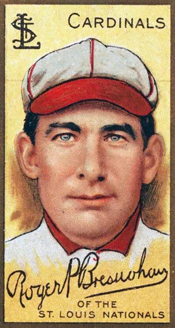 Bresnahan, the Cardinals’ player-manager in 1911, would become the second catcher (after Buck Ewing) elected to the National Baseball Hall of Fame. Yet, when the Cardinals were in a pinch at second base, Bresnahan inserted himself there in a game against the Pirates.
According to researcher Tom Orf, Bresnahan is one of six Cardinals who have played both at catcher and at second base in the same game. The others: Art Hoelskoetter (1907), Jose Oquendo (1988), Scott Hemond (1995), Tony Cruz (2011) and Pedro Pages (2025).
Quality catcher
A 5-foot-9 scrapper, Bresnahan made his mark with the Giants, displaying the same kind of intensity as the club’s manager, John McGraw.
In the 1905 World Series, Bresnahan caught four shutouts _ three from Christy Mathewson; the other from Joe McGinnity _ in wins against the Athletics. Bresnahan also produced a .500 on-base percentage in that Series, with five hits, four walks and two hit by pitches in 22 plate appearances.
Two years later, Bresnahan became the first catcher to wear shin guards and brought other protective gear innovations, including a rudimentary batting helmet, to the sport, according to the Baseball Hall of Fame.
The Cardinals, who had the worst record in the majors (49-105) in 1908, acquired Bresnahan, 29, after the season and made him player-manager, giving him the task of injecting fight and hustle into the moribund ballclub.
As a syndicated item in The Cincinnati Post noted in 1911, Bresnahan “is a fighter, and dead anxious to make fighters of others. That’s why he keeps after his men all the time _ to keep them in a fighting mood while on the diamond.”
The Cardinals got a little bit better in each of Bresnahan’s first two seasons as player-manager _ 54-98 in 1909 and 63-90 in 1910 _ but he was looking for greater improvement in 1911. That also was the year Helene Britton took over the Cardinals as the first woman to own a major-league team.
Cincinnati commotion
Determined to establish an aggressive tone early on, Bresnahan gave the Reds a steady stream of trash talk from behind the plate during an April 18, 1911, game at Cincinnati. As the Cincinnati Enquirer put it, “Bresnahan had been using a great deal of coarse language and the Reds claim that his remarks were such that they could not be passed by unnoticed.”
On their way to the clubhouses after the game, Bresnahan and Reds left fielder Bob Bescher continued jawing at one another. “Both men were thoroughly angry,” the Enquirer noted. Bescher threw a punch, socking Bresnahan “flush on the mouth,” The Cincinnati Post reported. “Blood squirted right and left like thick spray from a wind-blown fountain.”
Bresnahan retaliated and the two engaged in what the Enquirer described as “a ferocious fistfight” before Bescher’s teammates, shortstop Dave Altizer and first baseman Dick Hoblitzell, joined in. According to the St. Louis Star-Times, though Altizer and Hoblitzell appeared to be trying to separate the men, “in reality they were taking sly punches at Bresnahan.”
Bresnahan fought back until police and other players broke up the melee, the Star-Times reported.
“Bescher hit at me and, of course, I came back,” Bresnahan told the St. Louis newspaper. “Then Hoblitzell and Altizer broke into the fray. I attended to them. The Cincinnati fans then tried to get us, but the police stopped the doings.”
Bescher said to the Star-Times, “Bresnahan had been goading me all afternoon to the point where I lost my temper. I did not need any help from Altizer and Hoblitzell, but as fellow teammates they felt called upon to interfere.”
The brouhaha made the headlines but another significant story was the injury suffered by Cardinals second baseman Miller Huggins in the game.
With two outs and the bases loaded in the eighth inning, the Reds’ Johnny Bates looped a fly ball to short right. Huggins, first baseman Ed Konetchy and right fielder Steve Evans all chased after the ball. As Huggins made the catch, Konetchy and Evans collided with him. Huggins injured a leg and had to remain in Cincinnati for treatment while the Cardinals returned to St. Louis. Boxscore
Rough and tumble
Beginning a homestand with four games against the Cubs, Bresnahan replaced Huggins with rookie Wally Smith at second base. Smith started two games, but then third baseman Mike Mowrey became bedridden with a severe cold. So, Bresnahan shifted Smith to third and put another rookie, Dan McGeehan, at second for the final two games of the Cubs series. The Cubs swept all four, dropping the Cardinals’ record to 2-5.
Then the Pirates came to town. In 1910, the Cardinals lost 17 of 21 against Pittsburgh. Bresnahan was determined to show the Pirates his 1911 club wasn’t intimidated by them, but three regulars (Steve Evans, Miller Huggins and Mike Mowrey) were sidelined and Bresnahan was playing with a bum knee “swollen to almost twice its normal size,” the St. Louis Post-Dispatch reported.
The series opener on Monday afternoon, April 24, 1911, at Robison Field in St. Louis was played with the intensity of a pennant race showdown. Pirates runners were tagged out at the plate by Bresnahan in the second and in the sixth.
In the seventh, the Cardinals’ Jack Bliss batted for Dan McGeehan, then stayed in the game at catcher as Bresnahan moved to second base. (He had filled in at second for nine games late in the 1909 season.)
With the Pirates ahead, 5-4, in the eighth, Honus Wagner was on third when Dots Miller tried a suicide squeeze bunt. He tapped the ball toward first but Ed Konetchy got to it quickly and flipped to Bliss. Wagner tried to knock over the catcher, but Bliss blocked the dish and tagged out The Flying Dutchman.
The Cardinals tied the score in the bottom half of the eighth and the game advanced to extra innings.
In the last half of the 11th, Bresnahan punched a single to right and Rebel Oakes moved him to second with a sacrifice bunt. Bliss followed with a tapper to pitcher Lefty Leifield, who fielded the ball and threw to rookie first baseman Newt Hunter.
According to the Pittsburgh Post-Gazette, Bliss “deliberately threw himself at Hunter, knocking him on his back.” The ball fell from Hunter’s grasp and rolled away as he writhed on the ground in agony. Bresnahan, who had reached third, streaked to the plate and scored the winning run.
“Bliss undoubtedly intentionally knocked Hunter down,” The Pittsburgh Press declared. “Bliss could have veered to the right instead of throwing his entire weight upon the Pirates’ first baseman. The Cardinals are evidently being taught by Bresnahan to be aggressive.”
Though Hunter dropped the ball, rookie umpire Bill Finneran ruled that Bliss was out for interference but allowed Bresnahan’s run to count. As the Post-Gazette noted, “If he called Bliss out for interference, why did he permit Bresnahan to move up on the play? Bresnahan should have been sent back to third, where he started from after Hunter had been rendered helpless.” Boxscore
Off the rails
Bresnahan and his Cardinals players faced a far more dire challenge three months later in July 1911 when they boarded the Federal Express train at Philadelphia’s Broad Street Station for a 10-hour ride to Boston.
Here’s an account by Tom Shieber, senior curator of the Baseball Hall of Fame:
“Originally, the ballplayers occupied a pair of Pullman sleepers located near the front of the train, close behind the 10-wheel locomotive and a U.S. Fishery coach. The position wasn’t ideal. Amid the sweltering heat that saw the mercury rise to 100 degrees that day, it was nearly impossible to sleep with the car windows closed, but opening the windows only made matters worse, letting in the unpleasantness of engine cinders and the stench of baby trout.
“The engine had been reduced to a mound of twisted metal and glowing coals. Behind the ruins of the engine lay a melee of crushed cars haphazardly strewn about, their structures mangled into splinters of wood and piles of iron.

 RetroSimba
Man, Bresnahan sounds like one tough SOB, the kind of guy any team would want around, always having a teammate’s back in a scuffle and laying it all out every game. I find it a bit odd in today’s game how players from different teams are all chummy with each other. The Brewers have a relief pitcher – Abner Uribe who was suspended to start this season because of an altercation with the Rays’ Jose Siri. I don’t like to necessarily promote violence or fighting, but I think it shows a player’s guts and determination to win. Bresnahan sure had that and a damn good career too. I love players like him, ones that don’t strike out much.
I appreciate your observations, Steve. Roger Bresnahan had several connections to Milwaukee during his baseball days. Here’s a couple you might enjoy:
_ In 1901, his first full season in the majors, Bresnahan was a catcher for the American League’s Baltimore Orioles, who were managed by John McGraw. Bresnahan said he had fond thoughts of Milwaukee because one of his best days that rookie season occurred there. The Brewers were in the American League that year. In a Sunday doubleheader on July 21, 1901, at Milwaukee’s Lloyd Street Grounds, Bresnahan had three hits, including a triple and a home run, drove in two runs and scored twice in the opener. In Game 2, he had another hit and scored a run.
After his big-league days, Bresnahan managed the Toledo Mud Hens of the American Association for six seasons. The Milwaukee Brewers also were in that league. Here is a report in the Wisconsin State Journal from a Mud Hens game at Milwaukee on June 29, 1918:
“Roger Bresnahan’s saucy young men hopped right off the rattlers onto the necks of the Brewers Friday afternoon and nosed them out of a 4 to 3 contest that did not start until close to the dinner hour. A wreck between Chicago and Kansas City delayed the visitors several hours and it was 4:45 when the battle started. The visitors lit into Rees Williams so hard that they had the game cinched by the fifth inning. They hurried things along at a rapid gait, and though 20 hits were compiled by the two clubs, the game was played in an hour and 40 minutes.”
Thanks for adding some Milwaukee history to the post post. Always appreciated. 1901 was an important date in Milwaukee and American League history with the league being founded in Brew City.
The “tobacco card era” is so fascinating.
Yes, I appreciate that era now much more than I did when I was younger. It provides a wealth of good material.
The train wreck incident is an incredible story. Roger Bresnahan and the Cardinals proved to be heroes. In many ways he was an individual who was ahead of his time. It probably wasn’t very easy managing the team back then. The Cardinals Organization was on a financial shoe string. Not only did the Browns have better attendance but even the St. Louis Terriers of the short lived Federal League drew more fans. Roger Bresnahan is one of only a handful of full time catchers to lead either the NL or AL in walks. Please correct me if I’m wrong but I’ll assume that the 4 shutouts he caught in the 1905 World Series remains the all time record. Thanks for taking the time to post this Mark. It’s another enjoyable and interesting piece.
I like your summation of Roger Bresnahan: “an individual who was ahead of his time.” He had an innovator’s mind and spirit.
I’m glad you mentioned Bresnahan leading the league in walks for a season, Phillip. It prompts me to note his impressive career on-base percentage of .386 in 5,389 plate appearances. That’s better than the likes of later Cardinals catchers such as Ted Simmons (.348), Tim McCarver (.337) and Yadier Molina (.327).
You are correct that the 1905 Giants are the only club to achieve four shutouts in one World Series. Thus, Bresnahan is the only player to catch four shutouts in one World Series. John Roseboro of the 1965 Dodgers and Andy Etchebarren of the 1966 Orioles came close to matching Bresnahan’s feat. Roseboro caught three shutouts (two by Sandy Koufax; the other by Claude Osteen) in the 1965 World Series versus the Twins. Etchebarren caught three shutouts (one each by Jim Palmer, Wally Bunker and Dave McNally) in the 1966 World Series versus the Dodgers.
There’s always a certain charm about the grittiest guy on a lousy team. Some of the games you described sound like a softball game between the inebriated patrons of two bar teams.
Hah! That’s a good way to put it, Ken.
I didn’t realize Huggins managed the Cards. I always associate him with the ’27 Yankees.
The top two Cardinals baseball people at that time both had law degrees, club president Branch Rickey and manager Miller Huggins. Decades later, another law school graduate, Tony La Russa, would manage the Cardinals.