Though it is a franchise that has benefitted from hitters the likes of Stan Musial, Rogers Hornsby, Albert Pujols, Lou Brock and Enos Slaughter, the Cardinals have had only one player achieve 20 doubles, 20 triples and 20 home runs in a season: Jim Bottomley.
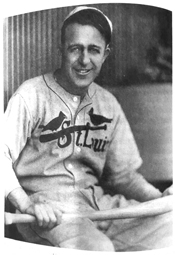 A left-handed batter whose stroke regularly produced highly elevated line drives, Bottomley totaled 42 doubles, 20 triples and 31 home runs in 1928, the year he earned the National League Most Valuable Player Award and helped the Cardinals win their second pennant.
Bottomley is one of seven players in the 20-20-20 club. The others are Frank Schulte (1911 Cubs), Jeff Heath (1941 Indians), Willie Mays (1957 Giants), George Brett (1979 Royals), Curtis Granderson (2007 Tigers) and Jimmy Rollins (2007 Phillies). Schulte, Mays, Granderson and Rollins also had 20 stolen bases in the seasons in which they produced 20 doubles, 20 triples and 20 home runs.
Finding his footing
In 1916, when Bottomley was 16, he quit high school in Nokomis (Ill.) and worked as a truck driver, grocery clerk, railroad clerk and blacksmith’s apprentice while also playing semipro baseball, according to the Associated Press. His father and brother were coal miners. The brother was killed in a mine accident.
“I know how hard that kind of work was on my father and how much my mother worried about it,” Bottomley later told The Sporting News. “When I went into baseball, it was a choice of making good at that or returning to the mines. It hardly was any choice at all.”
A policeman saw Bottomley hit two home runs and three triples in a local game and told Cardinals manager Branch Rickey he should give Bottomley a look. In the meantime, Bottomley wrote to Rickey and asked for a tryout. Cardinals scout Charley Barrett was sent to watch Bottomley play and was impressed.
In early fall of 1919, Bottomley, 19, was summoned to St. Louis so that Rickey could see him perform. Rickey sought prospects for the farm system he was starting to build.
Bottomley’s introduction to the big city was expensive. Unsure how to get to Robison Field, he hailed a taxi when he arrived at the bus station. The driver charged him more than $4 to go to the ballpark, according to the Brooklyn Eagle.
When Bottomley reported to the field, Rickey hardly could believe what he saw. The first baseman wore shoes half a dozen sizes too large for him. The shoes curled up at the toes and had spikes nailed to the front. The Brooklyn Eagle described them as Charlie Chaplin clown shoes. Bottomley tripped over the bag, falling on his face and then on his back.
“I told Charley Barrett this fellow could never do it because his feet were too big,” Rickey recalled to the Brooklyn newspaper, “but Barrett declared his feet were all right. It was that pair of shoes.”
In the book “The Spirit of St. Louis,” Rickey said, “Bottomley, properly shod, had the grace and reflexes of a great performer.”
The Cardinals signed Bottomley for $150 a month and arranged for him to report to the minors in 1920.
Man of the people
Bottomley gave the Cardinals a big return on their modest investment. Called up to the majors in August 1922, he became their first baseman. He hit .371 in 1923 and the next year drove in 12 runs in a game against the Dodgers. Boxscore
Using a choked grip on a heavy bat, Bottomley drove in more than 110 runs six seasons in a row (1924-29), and hit better than .300 in nine of his 11 years with the Cardinals. (In the other two years, he hit .299 and .296.)
When he was Cardinals manager, Rogers Hornsby told United Press, “I’d rather see Jim Bottomley at the plate when a run is badly needed than any other player I could name.”
Bottomley “was the best clutch hitter I ever saw,” Hall of Famer Frankie Frisch said to the New York Times.
Nicknamed Sunny Jim _ “He has a disposition that refuses to see the gray outside of the clouds of life,” Harold Burr of the Brooklyn Eagle noted _ Bottomley was a fan favorite, especially with the Knothole Gang kids and the Ladies Day crowds.
“Cap perched jauntily over his left eye, the smiling Bottomley walked with a slow swagger that was as much a trademark as his heavy hitting,” Bob Broeg of the St. Louis Post-Dispatch noted.
Bottomley was a bachelor during his playing days with the Cardinals. (In 1933, he married Betty Brawner, who operated a beauty salon in the Missouri Theater building in St. Louis.) Cardinals bachelors stayed at a hotel in the West End of St. Louis during Bottomley’s time. According to The Sporting News, “There every night you could see Jim and his cohorts seated in chairs out in front of the hotel, holding court with the fans.”
Gold standard
Of Bottomley’s 187 hits in 1928, roughly half (93) were for extra bases. His 362 total bases led the league.
Dodgers pitcher Rube Ehrhardt told the Brooklyn Eagle, “Bottomley is a great slugger … He pulls a ball to right field by a combination of strength, wrist snap and perfect timing.”
By June 1928, Bottomley had his 20th double of the season, and his 20th homer came the next month. All he needed were 20 triples to become baseball’s second 20-20-20 player. Entering September with 14 triples, Bottomley made his run for the mark.
He hit a triple at Cincinnati on Sept. 2, then got triples in three consecutive home games _ Sept. 9 versus the Pirates and Sept. 10-11 against the Reds. His 19th triple came Sept. 22 at the Polo Grounds versus the Giants.
On Sept. 29 at Boston, the Cardinals went into the next-to-last game of the season with a 94-58 record, two games ahead of the Giants (92-60). A win would clinch the pennant.
Leading off the game for the Cardinals, Taylor Douthit hit a slow roller to second. Braves player-manager Rogers Hornsby tried to scoop it, but the ball trickled between his legs and into right field for a two-base error. After a Frankie Frisch single scored Douthit, Bottomley drove a pitch from ex-Cardinals teammate Art Delaney into right-center. Eddie Brown, the center fielder, reached for it, but the ball caromed off his glove and hit the bleacher wall. Frisch scored and Bottomley streaked into third with his 20th triple. Chick Hafey followed with a sacrifice fly, scoring Bottomley, and the Cardinals went on to a 3-1 pennant-clinching win. Boxscore
For the season, Bottomley hit .325, scored 123 runs and drove in 136. He had a .402 on-base mark and a .628 slugging percentage. Bottomley batted .359 with runners in scoring position.
“Bottomley is the Lou Gehrig type _ a hustler, carefree, great in the pinches,” Yankees pitcher Waite Hoyt told North American Newspaper Alliance.
(Bottomley clouted a home run versus Hoyt in Game 1 of the 1928 World Series at Yankee Stadium. He also was credited with a triple in Game 3 at St. Louis when Yankees center fielder Cedric Durst took several steps toward the ball, then futilely tried to turn back as it sailed over his head. Boxscore)
For being named National League MVP by the Baseball Writers Association of America, league president John Heydler awarded Bottomley $1,000 in gold.
The league and the Cardinals arranged for the prize to be given before a game against the Phillies at St. Louis on June 8, 1929. Because of Bottomley’s popularity with youngsters, Cardinals owner Sam Breadon invited girls and boys of school age to attend the Saturday afternoon game for free.
A total of 12,806 youths _ 9,643 boys and 3,163 girls _ attended. “They packed the upper and lower decks of the left wing of the grandstand and overflowed into the bleachers and pavilion,” the Post-Dispatch reported. Paid attendance was 7,000, putting the total number of spectators at 19,806.
Before the game, Bottomley tossed many baseballs to youngsters in the stands. Then, in a ceremony at home plate, Heydler gave Bottomley $1,000 worth of $5 gold coins in a canvas sack.
During the game, “all available paper was made into schoolroom airplanes and sailed out into the field” by the urchins, the Post-Dispatch noted. Bottomley produced two hits, including a triple, and the Cardinals beat Phillies starter Phil Collins like a drum, winning, 7-2. Boxscore

 RetroSimba
Thanks for another great article! He is loved in my hometown of Sullivan, MO where and he and his wife retired. All of us grew up playing little league baseball at Sunny Jim Bottomley park and are proud he chose to settle down here.
It’s terrific that Sullivan, Mo., remembers Jim Bottomley by naming the local ballpark in his honor. Thanks for sharing that, James.
In an editorial, The Sporting News declared, “Few players ever have been more affectionately regarded by the fans than Sunny Jim was by the baseball lovers in St. Louis. Bottomley was the idol of the kids in the Cardinals’ Knothole Gang and his presence helped make Ladies Day an extravagant spectacle in St. Louis in the late 1920s and early 1930s. The jaunty tilt to his cap and the strut which was his natural gait endeared him to the kids and the ladies.”
This was some fun reading Mark. What an incredibly pure hitter he was. In the game you mentioned where he drove in 12 runs Jim Bottomley not only went 6 for 6 at the plate but also 6 for 6 with runners in scoring position. So much for today’s hitting approach! In 1925 when he led the league in base hits there were only 12 games all year where the opposing team kept Jim Bottomley from getting on base or driving in a run with a sacrifice. Those are very impressive numbers.
Thank you for sharing the impressive numbers on Jim Bottomley, Phillip.
Here’s one more of note to further support your contention about his timely hitting: With the bases loaded, Bottomley batted .526 (10-for-19) with 24 RBI in 1928.
As the Brooklyn Eagle noted of Bottomley in July 1928, “He has formed (a) habit of keeping his hardest hits for the closing innings.”
George Kirksey of United Press wrote, “He (Bottomley) is always dangerous in the pinch.”
Terrific read, Mark. A player I had not heard of until now. Enjoyed the behind-the-scenes of his family life. I saw in the comments what a clutch hitter he was as well. I always like to see guys be able to get it done when the based are loaded and the pressure is highest.
I am delighted you enjoyed learning about Sunny Jim Bottomley, Bruce.
It’s amazing that the small town of Nokomis, Illinois, produced two future Baseball Hall of Famers: Bottomley and Red Ruffing. Both spent significant parts of their childhoods residing and attending schools in Nokomis. By the way, the town’s name was inspired by the character Nokomis from the Henry Wadsworth Longfellow book “Song of Hiawatha.”
Sorry to say that Bottomley was a terror against the Phillies. (But, then, who wasn’t in those days?) His career numbers versus the Phillies include a .358 batting average and .421 on-base percentage.
That’s so true about people terrorizing Philly, Mark. Lots of times (as in this one) your posts seem to at some point highlight a player or coach’s success…often at the Phillies expense (sigh). They were pretty bad for a long time…
So much to love about this post beginning with your digging to come up with this rare feet of 20’s and i love the end and you slipping in the word “drum” with Phil Collins. I’m a big fan or was a big fan of Genesis, the early years with Peter Gabriel on vocals and Collins on drums.
I admire Bottomley and not just for his hitting ability but because he was so kind to children and those scenes outside the hotel where the bachelors held court with them. Man that musta been a thrill and it seemed to build bonds with all those kids showing up at the gold giving day.
I wasn’t sure if he was in the HOF so I looked and see that he was/is a member and I’m kind of relieved because for what it’s worth Harold Baines had a higher career WAR 38.8 than Bottomley at 36.0. Now I say this without really understanding how WAR is computed, but I got so tired of hearing that Baines doesn’t deserve to be in the Hall because of his WAR and interesting that both Baines and Bottomley were considered clutch hitters.
I enjoy learning which parts of the post connected with you, Steve, and it is a reflection of your good heart that you appreciated Jim Bottomley’s kindness to children. As the St. Louis Globe-Democrat noted, Cardinals owner Sam Breadon and general manager Branch Rickey “conceived the idea of the Knothole Gang, letting kids in free to see the game. Sunny Jim was their idol. During practice before the game(s), he would usually wander out to the left field section and flip a baseball up into the stands.”
The WAR statistic is meaningless to me. What does matter to me is that Harold Baines established a scholarship fund to help deserving college-bound students. His hometown of St. Michaels, Md., thinks so highly of him that it designated January 9 as Harold Baines Day. And Harold Baines was influenced by his father, Linwood Baines, who supported and encouraged his son’s dreams. Linwood Baines played for the Eastern Shore Negro baseball St. Michael’s Red Sox when the league was segregated. The St. Michael’s Red Sox allowed two white players to join the team. “We didn’t bar anybody from our league,” Linwood Baines said. “If the white players wanted to play, we let them. We just wanted to play baseball.”
Like Jim Bottomley, Harold Baines (and his father) had a good heart, too. You never need to justify Baines’ Hall of Fame honor.
Phil Collins the drummer in 2000 launched the Little Dreams Foundation, a non-profit that aims to aid children in pursuing their dreams in the fields of sports and art.
You chose well in being a fan of Baines and Collins. At a time when the vice president of the United States is talking about the “sin of empathy,” it’s critically important that those with good hearts are not forgotten, or diminished.
Beautiful! Just beautiful Mark. I knew of Baines day and his devotion to his father. It came out in tears at his HOF speech. The details of his father are fascinating, that he played some Negro League ball and that all were welcome and his son’s scholarship fund and Collins launching the Little Drream Foundation. I think kids will need tons of support going forward considering the direction our country is headed.
I don’t remember hearing much about Bottomley. What a great player! The most surprising part of the 20-20-20 thing is the triples. You don’t see most of the sluggers with big home run stats burning up the bases.
So true about the triples, Ken.
By the way, the only Mets player to achieve 20 triples in a season was the ex-Cardinal, Lance Johnson. With the 1996 Mets, Johnson had 21 triples along with 31 doubles and 50 stolen bases but only nine home runs.
Jose Reyes came close to 20 triples, hitting 19 for the Mets in 2008. Reyes is the Mets’ career leader in triples, with 113, nearly twice as many as the runner-up, Mookie Wilson, with 62.
Sunny Jim was a Kolker Family Icon. According to family lore, besides being a tremendous, Hall-of-Fame worthy hitter and fielder, he was even more a Hall-of Fame worthy genleman. Unlike the aloof, blunt, crude Rogers Hornsby, who, according to my Uncle Lee, ‘was the Greatest Hitter of his day, but a world-class asshole every day.” Sunny Jim was just a tad less of a hitter, but far better fielder. As a human, no contest. That is why everyone loved Bottomley.”
I have previously commented that my father, born in St. Louis in Nov, 1913, was raised in the shadow of Sportsman’s Park. Being somewhat an iconoclast, although a huge baseball fan, he was more of a Browns fan than a Cardinals fan. “Everyone in the family loved baseball, by far they loved the Cards.” He also admitted he was only the second greatest baseball fan in the family. “My sister, Gertude three years my junior, the baby of the family, famous for being as knowledgable about baseball as any boy in the neighborhood, was also acknowledged as one of the greatest Cardinals fans in town” Getrude was also a beauty who captured the heart of her neighbor, Lee Snyder, a year older than my father. Lee’s family owned the corner Mom and Pop grocery. Lee, who served as a cook in the army during World War ll, knew wll when he advised me, “If you can’t be independently wealthy, work with food. You’ll always eat.”
Having survived the War, he came home and married Gert. With no children of third own, their nieces and nephews rap their familial love. Gert, whie loving, was closer to her older sister Rose’s three daughters. One of her nieces, three years my senior was my Godparent’s eldest. married her University City HS sweetheart, Marty Hendon. Reckon you know the name.
However, I seemed to be Lee’s favorite nephew.
I was sixteen, living in Ballwin for a year when my father died in April, 1967. A year later Mom and I moved to the new Villa Dorado Condominiums in Creve Couer, in part to be neighbors living between Rose on one side, Gert and Lee on the other. Lee became my surrogate father. He was a trip.
I asked Lee who his favorite ballplayer was, and he immdiately smiled “Sunny Jim. As you know, a number of players, both Cardinals and Browns lived in the neighborhood. Many of them would stop in our store for groceries on their way home from the game. Most were pretty good guys, but when they walked through the door you could tell by their expression if the team won and how they personally did. Each reacted differently, and it behooved you to know how they did before you spoke. Some could get pretty grouchy, even to a kid.
“All of them except ‘Sunny Jim.’ Win or lose, he was always the same. He could have driven in twlve runs or stranded twelve going 0-5 with three strikeouts and you could not tell. He was always cheerful, always courteous, and always had a moment to ask you about your day. No wonder the neighborhood kids loved ’em and their older sisters loved him.
,
Wise words from your Uncle Lee about Jim Bottomley, Rogers Hornsby and the advantage of being able to work with food. Uncle Lee also showed he was a smart man when he married your sister Gert. Thanks for sharing the wonderful family stories.