A run-of-the-mill second game of a Saturday afternoon doubleheader at Wrigley Field turned into a showcase featuring a trio of future Hall of Fame pitchers.
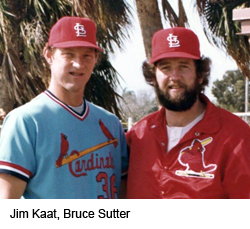 Jim Kaat and Lee Smith were the starters in the Cardinals versus Cubs game on June 26, 1982, at Chicago. Kaat got the win and Smith took the loss in a 2-1 St. Louis triumph. The save went to Bruce Sutter. All three pitchers would be elected to baseball’s shrine in Cooperstown, N.Y.
For Sutter, earning a save was standard _ a five-time National League saves leader with the Cubs (1979-80) and Cardinals (1981-82 and 1984) _ but starts were uncommon then for Kaat and always were rare for Smith.
A prominent starter during his prime with the Twins and White Sox, Kaat was converted to a relief role in 1979. The start against the Cubs was just his second in two years.
Smith pitched in 1,022 games in the majors but made only six starts.
The longshot odds of Kaat and Smith opposing one another as starters made their matchup extra-special.
Making adjustments
Kaat, 43, was the primary left-handed reliever in a 1982 Cardinals bullpen that had Sutter as the closer and Doug Bair as the right-handed setup man. After Kaat struggled early _ his ERA for the season was 6.75 on May 1 _ pitching coach Hub Kittle worked with him to use a sidearm motion. “When he drops down, his ball moves more,” Kittle told the St. Louis Post-Dispatch. “I think he throws harder down low, too.”
The altered delivery helped Kaat. He didn’t allow a run in 12 of 15 relief appearances from May 2 to June 20.
Meanwhile, Smith, 24, was part of a 1982 Cubs bullpen with veterans Willie Hernandez, Bill Campbell and Dick Tidrow. Hernandez and Campbell got most of the save opportunities early in the season, but Cubs pitching coach Bill Connors told the Chicago Tribune, “Smitty can be a bullpen star. If you need a strikeout, he’s the guy who’s going to get it for you. Some people say he’s not consistent with his fastball, that he tires easily and loses his stuff. They’re wrong.”
When Cubs starters Dickie Noles (knee) and Randy Martz (shoulder) went on the disabled list in June, manager Lee Elia moved Smith into the rotation. Before then, his only big-league start came in the 1981 season finale against the Phillies.
Smith started twice for the 1982 Cubs before facing the Cardinals.
Fine-tuned engine
With the Cubs’ top run producer (Bill Buckner) and best home run hitter (Leon Durham) batting left-handed, Cardinals manager Whitey Herzog chose a pair of left-handers, Dave LaPoint and Kaat, to start the June 26 doubleheader.
In Game 1, LaPoint (eight innings) and Sutter (one) confounded the Cubs, and St. Louis won, 4-1. Boxscore
As Kaat recalled to podcaster Jon Paul Morosi, “I’m sitting in the clubhouse and (broadcaster) Harry Caray’s on the air and he’s saying, ‘Well, the Cardinals got the best of us, but we’ve got a chance in Game 2, because we’ve got hard-throwing Lee Smith and the Cardinals got 43-year-old, soft-tossing Jim Kaat.’ ”
(Kaat had been around so long that his manager, Whitey Herzog, batted against him 20 years earlier when Herzog was with the 1962 Orioles. Kaat struck Herzog on the right elbow with a pitch and Herzog had to leave the game.)
The Cubs scored a run in the first, but Kaat found a groove and held them scoreless over the next five innings. Described by the Tribune as “a genuine geriatric marvel,” Kaat relied on “guile, breaking stuff and an occasional sneaky fast one,” the newspaper noted.
“In relief pitching, you have a tendency to come in and gun like you’re gunning the engine of a car,” Kaat said to the Post-Dispatch. “Starting pitching is entirely different. I don’t try to throw as hard. I try to stay within myself.”
Unlike Kaat, Smith was a hotrod. Displaying a 95 mph fastball, he gave up a run in the second on consecutive doubles by Ken Oberkfell and Gene Tenace. The winning run came in the third when, with two outs, Lonnie Smith singled, stole second and scored on a Keith Hernandez single.
Herzog said he planned to let Kaat pitch five innings, but he sent him out in the sixth because Buckner and Durham were due to bat. Kaat retired the side in order, then was lifted for a pinch-hitter in the seventh.
On being taken out after throwing 82 pitches, Kaat told the Post-Dispatch, “Emotion always tells you that you could have gone longer, but common sense tells you that you’ve got to bring pitchers in when you’ve got our bullpen.”
The Cubs loaded the bases in the seventh against Bair, and again in the eighth versus Bair and Sutter, but couldn’t score either time. (The Cubs stranded 11 runners in the game.) Sutter got his second save of the day with a scoreless ninth. The win for Kaat was his 280th in the majors.
Kaat, Sutter and Smith were three of eight future Hall of Famers in uniform during that game. The others: Cardinals shortstop Ozzie Smith, Cubs second baseman Ryne Sandberg, Cardinals manager Whitey Herzog, Cardinals coach Red Schoendienst and Cubs coach Billy Williams. Boxscore
What a relief
Smith was 0-4 with a 4.94 ERA as a starter for the 1982 Cubs. In July, they moved him back to the bullpen and he excelled as the closer (seven saves, 1.32 ERA in August; seven saves, 0.57 ERA in September.) He never started another game in the majors.
Kaat returned to the Cardinals bullpen. In July, he allowed just one run in 14 appearances. The Cardinals gave him one more start, his 625th and last in the big leagues, on Sept. 18 against the Mets. Boxscore
Sutter (nine wins, 36 saves, 70 games pitched) and Kaat (five wins, two saves, 62 appearances) helped the 1982 Cardinals become division champions. Then they won the National League pennant and World Series title.
Kaat pitched his final season, his 25th in the big leagues, with the 1983 Cardinals before being released in July.
After stints with the Cubs and Red Sox, Smith was acquired by the Cardinals in May 1990. In four seasons (1990-93) with St. Louis, Smith earned 160 saves. Only Jason Isringhausen has more saves (217) as a Cardinal. In 1991, Smith had 47 saves for St. Louis. The only Cardinals with a higher single-season total are Ryan Helsley (49 in 2024) and Trevor Rosenthal (48 in 2015).

 RetroSimba
I can hear the announcers on a Kaat fastball.
“It’s only coming in at 92 but it looks like 100 when you’re seeing nothing but breaking stuff.”
Great stuff, Mark. Impeccable research as always, but this one seemed a little more special.
Thanks, Gary. I think you will appreciate this anecdote Jim Kaat tells in his autobiography, “Still Pitching:”
“When I was a starting pitcher, I was warming up one day in Milwaukee, and Kenny Sanders, who had been my teammate and my golfing partner in Minnesota and who was now pitching for the Brewers, was watching me.
“You going out there with that trash and try to win?”
“That’s all I got,” I said.
Sanders had a great slider.
“Kenny,” I said, “how do you hold your slider?”
He came over and showed me. He put his thumb on the side of the ball, which was unusual. Most pitchers put their thumb under the ball. I tried it and, wow, the ball really moved. I decided to use that grip to throw my slider in the game. It was the eighth inning and I had them shut out. I went to the (dugout) phone, looked up the directory for the Milwaukee bullpen, and called down there and asked for Sanders. “Hey Kenny,” I said. “Thanks for the tip. I’ve been using that slider grip the whole game.”
That’s why this game is so fascinating. Thanks for the story, Mark.
I remember a lot about the 1982 season but I guess I had forgotten about that game. Amazing trifecta with the 3 pitchers, along with the other Hall of Famers. Thom A (TWA)
In his autobiography, “Still Pitching,” Jim Kaat said, “What made Bruce Sutter so great was his demeanor and determination. He wouldn’t get too high after he saved a game, and he wouldn’t get too low … when he blew a save. He had the perfect temperament for a closer. And, of course, he was a pioneer in throwing the split-finger fastball, and his was devastating.”
What a gem of a mention about Kaat being around so long Whitey Herzog batted against him 20 years earlier…and hit him on the right elbow with a pitch…and Herzog had to leave the game. Awesome detail, Mark. When I was playing baseball, sometimes the hardest guys to hit were the ones who threw curves and sliders 95% of the time, and then threw what was considered their fastball. Kaat was a genius, and his observation about staying within himself when starting as opposed to relieving…oh for the days when a starter actually tried to go the distance and you tried not to dip into the bullpen. My how the game has changed. Great recap, Mark.
Thanks, Bruce. I appreciate your insights from your playing days.
Along the lines of what you stated, here’s what Jim Kaat said in his autobiography:
“In my day, the pitching philosophy was low and away, low and away. You never pitched inside early in the count because that’s when the hitter is most aggressive and more apt to hit the inside pitch. Get two strikes on him, and a hitter will be more defensive. He’ll protect the outside part of the plate. Then you can get inside on him.”
Between the three of them you have more than 400 wins and nearly 800 saves. I say that’s pretty good! The old Harry Caray should have known better than to write off a 43 year old soft tossing Jim Katt.
That wasn’t the first time Harry Caray wrote off Jim Kaat and then had to eat his words. (or, at least, gulp down those words with an ice-cold Budweiser.)
Harry was the White Sox broadcaster when Kaat achieved records of 21-13 for the White Sox in 1974 and 20-14 in 1975. After winning four of his first five decisions in 1974, Kaat lost five in a row and his ERA soared to 4.81. As Kaat recalled in his autobiography, “Harry Caray was killing me on the air. ‘Folks,’ he said, ‘when your fastball and your slow curve are the same speed, it’s time to call it a career.’ ”
White Sox manager Chuck Tanner stayed confident in Kaat. After Kaat went to the bullpen to work out his problems, Tanner brought him back to the starting rotation and Kaat won his next seven in a row. Holy cow!
Love the site! I blog about the New York Mets, mets-madness.com feel free to check out my blog, this link is the correct one if you scroll all the way down on my blog you can subscribe, can you please follow mine too? Let’s help each other grow! -Mikayla Scotlynd Littrell, MetsMadness.
Thank you! I followed back. Wishing you continued success and satisfaction with your blog.
What a brilliant idea to not only encourage Kaat to drop down a bit, but to find a way for him to pitch such a prominent role in that WS winning 82 season though he wasn’t used much in the actual series.
Great find Mark, this post had me saying what? Lee Smith as a starter. I would think the road a pitcher has to take is very rarely excellent from the git-go. There are exception like Skenes, but I love thinking about Greg Maddux’s troubles at the beginning of his career and then what he became!
Thanks, Steve. You make a good point about how the road a pitcher takes is rarely smooth from the beginning. Perhaps the most famous example is Sandy Koufax. Jim Kaat also notes the same about Rollie Fingers. The A’s tried Fingers as a starter early in his big-league career and he was 7-17 with a 4.32 ERA in the starts he made.
In his autobiography, Kaat explained how Fingers became a dominant closer: “He was particularly tough against right-handed hitters because of his devastating slider … He had great poise and exuded confidence on the mound. He could handle those pressure situations. When Rollie came into a game, he gave the impression that he was in control of the situation _ and he was. And that was before the one-inning save. Often, he came in and pitched two innings or more for a save.”
It’s amazing that the Brewers retired Finger’s number 34 and he only pitched four seasons, the last of his career with the Crew, but what a bummer that he was injured for the 82 series……either way a great series that I now sadly confuse with replays of the games, forgetting how I felt as a 12 year old in Milwaukee, the peak of Brewers success.