A player with the baseball smarts Whitey Herzog had didn’t need to be told when it was time to quit. It was autumn 1963. Herzog just turned 32, but his prime playing days had past. “His baseball epitaph could read: A Nice Guy Who Couldn’t Hit The Slow Curve,” Detroit columnist Joe Falls noted.
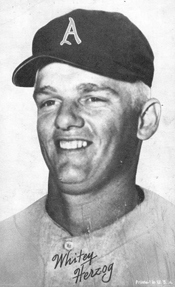 A journeyman outfielder, Herzog squeezed out every bit of talent he had, lasting eight seasons in the majors, mostly with losing teams, before the Tigers removed him from their big-league roster after the 1963 season. The Tigers offered him a role as player-coach at Syracuse, with a promise he’d be considered for a managerial job in their farm system some day, the Detroit Free Press reported. The Kansas City Athletics proposed he join them as a scout.
Herzog, though, was through with baseball. He could earn more ($16,000 a year) supervising construction workers for a company back home in Kansas City than he could coaching in the minors or pursuing prospects on the sandlots.
So Herzog took the construction job, but soon found he didn’t like it, mainly because he had little say in selecting the crew he was tasked with supervising. Hoping to trade his hard hat for a ball cap, Herzog asked the A’s if the scouting job still was open. It was, and he was hired to scout amateur players in 1964.
The scouting experience with the A’s, and then the Mets, gained Herzog a reputation as an astute talent evaluator and helped him develop the managing skills that would lead to his eventual election to the Baseball Hall of Fame.
Going pro
As a teen in New Athens, Ill., Herzog was a good basketball player. “Your basic small, scrappy guard,” he said in “White Rat,” his autobiography. Herzog received seven college basketball scholarship offers, but he wanted to play pro baseball. He could run, throw and hit a fastball.
The St. Louis Browns made an offer: no signing bonus, a minor-league salary of $200 a month and a chance to pitch. Herzog said no. Actually, he claimed in his autobiography, he said to Browns scout Jack Fournier, “Now I know why you guys are in last place all the time, if you wanted to sign a wild-ass left-hander like me.”
On the day after he graduated from high school in 1949, Herzog was invited to a Yankees tryout camp in Branson, Mo. The Yankees told him he could make it as an outfielder. Heck, they said, Joe DiMaggio would be retiring just about the time Herzog should be ready for the majors. (What he didn’t know is that another prospect, Mickey Mantle, was signing with the Yankees in 1949, too.) Herzog took the Yankees’ offer of a $1,500 bonus and a minor-league salary of $150 a month.
Years later, Herzog told the Kansas City Star, “If I had gotten more money, it would have been all right, but I was foolish to sign for that kind of a bonus. I could have gone out and broken my leg the first year, and then where would I have been? If I had it to do over, I would have gone to college (on a basketball scholarship) and then signed a baseball contract.”
Tough breaks
Herzog played five seasons in the Yankees’ farm system and served a two-year Army hitch. He never did appear in a regular-season game for the Yankees, but he got to know their manager, Casey Stengel, during 1955 and 1956 spring training and developed a fondness for him. “Of all the managers I’ve ever played for, Casey had the most influence on me,” Herzog said in his autobiography. “Casey took a liking to me, spent a lot of time with me.”
On Easter Sunday in 1956, after attending a church service with Yankees players Tony Kubek and Bobby Richardson, Herzog was called up to Stengel’s hotel suite. “When I got there,” Herzog recalled in his autobiography, “I saw that Casey had already been celebrating Easter with a few drinks. He was rambling on.”
After a while, Stengel blurted out that Herzog was going to the majors _ with the Washington Senators. “Go over there and have a good year,” Stengel told him, “and I’ll get you back.”
As Herzog noted in his book, “I never had that good year, and I never wore the pinstripes in Yankee Stadium. In my heart, though, I was always a Yankee. I never got over the fact that they’d traded me.”
Herzog was with the Senators (1956-58), A’s (1958-60) and Orioles (1961-62) before being traded to the Tigers in November 1962. Going to Detroit meant he’d do a lot of sitting, not playing. Herzog was an outfielder and first baseman, and the Tigers had standouts with Rocky Colavito in left, Bill Bruton in center, Al Kaline in right and Norm Cash at first base. “There was no use kidding myself _ all those guys were better ballplayers than I was,” Herzog told the Kansas City Times.
To pass the time, Herzog told teammates he would keep count of the home runs he hit in batting practice all season.
“I hit my 250th in Detroit in late August,” Herzog told Kansas City journalist Joe McGuff. “(Coach) Bob Swift was pitching that day. I hit my 249th into the upper deck in right field. (Teammate) Gates Brown was standing by the batting cage and I told Gates I was really going to crank up and see if I could hit my 250th on the roof. Sure enough, I did. There was an usher nearby and I asked if he’d mind going up on the roof and getting the ball for me. He found it and brought it back. The ball landed in a big patch of tar. So it looked legitimate. I got it autographed (by teammates) and fixed up and I’ve got it in a trophy case at home.”
In Baltimore, on the day before the 1963 season finale, Herzog hit his 299th batting practice homer. “Everybody on the club knew I was going for my 300th on the last day,” he said, “so they told me I could keep hitting until I got 300. It rained that day and they had to call off batting practice, so I wound up with 299.”
A tiger in batting practice, Herzog was a pussycat in the games that season. He hit no homers and batted .151. “You’ll find no nicer guy on the Tigers than Whitey Herzog,” Joe Falls of the Detroit Free Press informed readers, “and it grieves us to see him struggling so much at the plate.”
Talent hunt
Jim Gleeson left the A’s scouting department to join the coaching staff of Yankees manager Yogi Berra, creating the opening for Herzog to quit the construction job and return to baseball.
Herzog displayed the same desire and determination for scouting amateurs as he had for playing in the pros. In June 1964, he told the Kansas City Star, “Last month, I saw 52 high school and college games. I’ve been averaging about 1,500 miles a week on the road. I’ve been seeing the country.”
Though he was competing with other scouts to sign talent, Herzog earned their respect. The scouts welcomed him into the fraternity and offered their advice on how to succeed.
“The old scouts like Bert Wells of the Dodgers and Fred Hawn of the Cardinals took him under their wing and really helped him,” Herzog’s colleague, Joe McDonald, recalled to Cardinals Yearbook in 2010. “He always talked about them. It’s not easy doing amateur scouting for the first time. You have to find ballparks (and) call the coach in advance to try to determine if the pitcher you want to see is pitching. You have to do all that preliminary work. Whitey did all that, which was a great foundation (to managing), because his evaluating skills matched his strategic ability in game situations. That was the key.”
The best of the 12 prospects Herzog signed in 1964 were Chuck Dobson, who went on to pitch nine seasons in the American League and won 74 games, and catcher Ken Suarez, who played seven seasons in the majors, including 1973 with the Rangers when Herzog managed them.
The one who got away was pitcher Don Sutton, the future Hall of Famer. “I had him in my hotel room, ready to sign an A’s contract for $16,000,” Herzog said in his autobiography. “What a bargain he would have been.”
The deal needed the approval of Charlie Finley, but the A’s owner wouldn’t go over $10,000. “I went out and told Bert Wells of the Dodgers that he ought to sign him,” Herzog said. The Dodgers did and Sutton went on to pitch 23 seasons in the majors, winning 324 games and pitching in four World Series, including three with the Dodgers and one with the Brewers against Herzog’s 1982 Cardinals.
Wise judge
After rejecting an offer to become head baseball coach at Kansas State, Herzog coached for the A’s in 1965 and for the Mets in 1966. He scouted pro talent as a special assistant to Mets general manager Bing Devine in 1967, then was promoted to director of player development. “The people in the organization reached the point where they relied more and more on my judgment about who to sign and who to get rid of,” Herzog said in his autobiography.
After the Mets vaulted from ninth-place finishers in 1968 to World Series champions in 1969, Herzog went to the victory party at Shea Stadium to congratulate manager Gil Hodges. In recalling the moment years later to Cardinals Yearbook, Herzog said, “When he saw me coming, he jumped out of his chair and said, ‘I want to congratulate you. Every time I’ve called you and asked for a ballplayer, you’ve sent me the right one.’ That meant a lot to me.”
Later, when Herzog managed the Royals to three division titles and then led the Cardinals to three National League pennants and a World Series championship, his skill as a talent evaluator often was cited as a significant factor in his success.
“It wasn’t just Whitey’s ability to manage a game,” Jim Riggleman, a coach on Herzog’s St. Louis staff before becoming a big-league manager, told Cardinals Yearbook. “There are other good game managers. It was his ability to evaluate talent. He knew who could play and who was on the last leg.”
Red Schoendienst, who managed St. Louis to two pennants and a World Series title before coaching for Herzog, said to Cardinals Yearbook, “You manage according to what you have. That’s what managing is all about, knowing your ballplayers … Whitey had a lot of practice judging players … He could see the kind of abilities they had and whether they just came out to play or if they were winners … Some guys just know how to win. Those are the guys you want.”

 RetroSimba
Joe Falls had a weekly column in The Sporting News in the 1960s and 1970s, in the first couple of pages, near the “Voice of the Fan” (letters to the editor). Seeing his name in your post brings back memories of other TSN contributors: Wells Twombley, Dick Young, Bob Addie, Furman Bisher, Dick Kaegel and Leonard Koppett. Whitey should’ve gotten the Mets’ manager job after Gil Hodges died, but Yogi Berra had the big name.
Like you, I was a loyal reader of The Sporting News in the 1970s. My parents got me a subscription and it was a thrill to receive it in the mail each week. Joe Falls and Wells Twombly were my favorite columnists. Falls had a big influence in my life. In 1971 or 1972, when I was a sophomore in high school, I wrote to him and asked for advice on how to become a sportswriter. He wrote back, gave me his office direct phone number and told me to call him. The straightforward, specific advice he gave prompted me to go to the high school newspaper office the next day and ask for a reporter job. That launched me into a 40-year career in journalism.
Yes, Whitey Herzog blamed Mets chairman M. Donald Grant for bypassing him on the manager job after Gil Hodges died. In the book “White Rat,” Herzog said to collaborator Kevin Horrigan, “I really hoped I’d get a chance to manage the Mets. I knew the personnel in the organization better than anyone, but the ink was barely dry on the newspaper obits for Gil when Grant hired Yogi Berra … Grant’s people even ordered me to stay away from Gil’s funeral just so there wouldn’t be speculation that I’d be the new manager. I’ve never forgiven them for that.”
I would have never figured Whitey for a hoopster. He certainly knew how to get the best from his roster – maybe that came from being a great guard. I did not know about that backstory with managing the Mets, but it certainly is understandable they wouldn’t be his favorite topic after that snub.
Norm Sanders of the Belleville (Ill.) News-Democrat wrote in 2010, “Hometown folks who watched Whitey Herzog play basketball for New Athens High School still wonder whether that wasn’t his best sport. Herzog, a left-handed guard who played with intensity, attracted basketball scholarship offers from Illinois, St. Louis University and several other Division I schools.”
In his autobiography, Herzog said to collaborator Kevin Horrigan, “People in New Athens remember me best as a basketball player. I’d go back to New Athens when I was playing in the major leagues, and people would say to me, ‘Your brother Herman was a better (baseball) player than you. Why aren’t you playing basketball?’ … Our basketball team finished 35-2 in my senior year. We lost in the sectionals of the state tournament when we had to play our first game in a gym with glass backboards. I remember shooting 6 for 12 from the field and going 0 for 6 from the foul line. Our team lost by one point.”
Another excellent post Mark. I didn’t know that Whitey had received seven basketball scholarships. Neither did I know about his experience in the construction business. We can all be thankful that he went back into baseball. The A’s of the early 70’s already had a great pitching staff. Had Don Sutton also been on that staff it’s scary to think what they might have accomplished. I don’t think it’s an exaggeration to say that without the work of Whitey Herzog with the Mets there would have never been that magical 1969 World Series Championship.
Thanks, Phillip. In addition to his coaching, scouting and player development roles for the Mets, Whitey Herzog managed the Mets’ team in the Florida Instructional League in the fall of 1967. His players included Nolan Ryan, Jerry Koosman, Jon Matlack, Steve Renko, Jim McAndrew, Danny Frisella, Ken Boswell and Ken Singleton.
Another item of note: After he coached the Kansas City A’s in 1965, Herzog said in his autobiography he signed with the Orioles to manage their Class AA Elmira (N.Y.) farm club in 1966. However, soon after, George Weiss and Bing Devine of the Mets called and offered him a coaching job with the 1966 Mets. The Orioles allowed Herzog to take the Mets’ offer. Darrell Johnson managed Elmira in 1966.
I got such a i don’t know what to call it kick? to hear that he didn’t get into the construction job because he couldn’t pick his own crew. It’s like some have that bartender spirit and Herzog a manager spirit, but i’d drink at a place Herzog was the bartender
I love the idea of Whitey Herzog being a bartender. Oh, yes. What a venue for a storyteller.
In explaining why he wanted to be able to pick his own construction crew, Herzog said in his autobiography, “In construction, the good workers get the dirtiest jobs because the lazy ones just screw them up. Baseball players have a hell of a union, but if someone isn’t doing the job, you can still get rid of him. Not in construction.”
I’d kill to hang out with a buzzed Casey Stengel in a hotel room as he rambled on about nonsense.
Great stuff. I I have no idea Herzog was associated with the A’s.
I’m with you, Gary, on wanting to hang out with Casey Stengel, have a few drinks with him and listen to him ramble.
Whitey Herzog told this Stengel story to Cardinals Yearbook in 2010: “He had his own language, Stengelese. I remember one time hitting against the Dodgers in spring training. Bases loaded, first inning, Carl Erskine pitching, and Casey tells me, ‘Tra-la-la.’ He was saying, ‘Relax,’ but he said, ‘Tra-la-la, hey doctor, tra-la-la.’ ”
Pitching prospect Chuck Dobson was leaning toward signing with the Yankees. He explained to the Kansas City Star why he opted for the A’s instead: “Whitey went over the A’s pitchers with me and showed me a lot of statistics that convinced me I’d have a better chance getting to the majors in a hurry with the A’s than I would with the Yankees.”
A’s general manager Pat Friday to the Kansas City Times on why the A’s moved Herzog from a scouting role to a big-league coaching role for 1965: “He did a hell of a job for us (as a scout). He was aggressive and dedicated to his job … I hated to lose him off our scouting staff (but) I feel he’ll be of even more value to us as a coach, working with some of our young players. He has tremendous enthusiasm and the ability to teach.”
This a guy who paid his dues. We remember his successes, but don’t realize how hard it was to get to that point.
You summarized well the essence of the post, Ken.
Whitey Herzog was popular with fans and writers during his season as Mets third-base coach in 1966. He was aggressive in sending runners home and sometimes more entertaining than the players. As Stan Isaacs of Newsday noted, Herzog “drops to the ground to signal a player coming into third to slide.” Family Weekly magazine observed, “Whitey is one of the most flamboyant in the business, racing halfway toward the plate in advance of base runners, even hurling himself on the grass to warn them to slide.”
According to Dick Young of the New York Daily News, “Whitey Herzog operated on the theory that, with two outs, there is a much better chance sending a Mets base runner in than there is of having the next batter get a hit. When you force the other team to throw the ball, you have several things going for you.”
Loved the story about my favorite manager. I’ve read much on Whitey but always enjoy reading more
What he did in 1980 after becoming the manager and GM to turn the franchise around was remarkable. I didn’t love it at the time as Whitey shipped out some of favorite players but that quickly changed watching the new Whitey Ball.
He worked with a limited payroll in KC and St Louis but still had an amazing run with both teams
As much as I also loved those successful LaRussa years with some great players, those scrappy underdog teams of the 80’s will forever be my favorite era of Cardinal baseball
And I had a Sporting News sub as well for many years starting sometime in the early 80’s
Thanks for the comments. I enjoyed your insights.
Yep, those Whitey Herzog teams were fun to watch and fundamentally sound.
Regarding the 1985 Cardinals, Herzog told Cardinals Yearbook in 2010, “That was one hell of a year. I really enjoyed managing, to watch how good we could play, and how good we could run the bases, and all the things we could do fundamentally. That team could really, really play baseball.”
He also said then, “Here’s what’s bad about baseball today: Man on second base and no outs … They don’t even try to get him to third. They lose that run. He doesn’t advance, and it takes a base hit now to score him the rest of the inning. If you get him over to third, you get that run easy with just a ground ball because the infield plays back. You pick up a couple of those runs early, and now you’re up by one in the seventh instead of down by one. That’s the damn difference.”