Roy Face had Stan Musial’s respect, but Musial had his number.
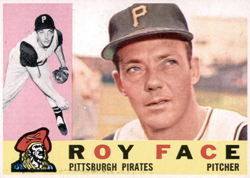 In his book “Stan Musial: The Man’s Own Story,” the Cardinals standout named Face the relief pitcher on his all-time team of players he saw during his 22 years in the majors.
A pint-sized right-hander with an exceptional forkball, Face “had confidence, courage and control,” Musial said.
In 16 seasons with the Pirates (1953 and 1955-68), Tigers (1968) and Expos (1969), Face totaled 191 saves and 104 wins. He led the National League in saves three times, posted an 18-1 record in 1959 and had three saves in the 1960 World Series for the champion Pirates.
Musial, though, had a .472 career on-base percentage (15 hits, 10 walks) against Face, according to retrosheet.org. The most noteworthy of those hits was a walkoff home run in the heat of the 1960 National League pennant chase.
Face, who remains the Pirates’ franchise leader in saves (186) and games pitched (802), died on Feb. 12, 2026, at 97, eight days before his 98th birthday.
Sandlot sensation
Elroy Face was from Stephentown, N.Y., near the Massachusetts state line. The town was named for Stephen Van Rensselaer, a founder of the Albany (N.Y.) public library and Rensselaer Polytechnic Institute (RPI), a private research university.
Face grew up in a working-class household. In the book “We Played the Game,” he told author Danny Peary, “My father was a carpenter by trade, but at times worked in the woods cutting logs and in a factory. My mother was a homemaker, but worked briefly gathering eggs at a chicken farm.”
At age 5, Face had rickets and his “bones were soft and bent” and his “body was racked with pain,” according to The Pittsburgh Press.
During his childhood, “I wasn’t a baseball fan and couldn’t have named 10 players in the big leagues, but I was the first in my family to play ball,” Face said to Danny Peary. “We didn’t have Little League, so I just played pickup ball.”
In high school, Face experienced two years of varsity baseball, pitching and playing short and second. “I realized I had special talent when I was 8-1 and pitched a shutout to give us our first league title,” Face told Danny Peary.
Face quit high school at 18 and spent a year and a half in the Army as a mechanic. After his discharge, he got a job in an Oldsmobile garage and played sandlot baseball for a town team in New Lebanon, N.Y.
During Labor Day weekend 1948, Phillies scout Fred Matthews was vacationing in the Berkshires when he went to see a sandlot game. Face pitched and Matthews offered the 20-year-old a contract for $140 a month.
Assigned to the Class D Bradford (Pa.) Blue Wings, Face primarily started and was 14-2 in 1949 and 18-5 in 1950, but the Phillies exposed him to the minor league draft and the Dodgers selected him. After two years in the Dodgers’ farm system, including a 23-9 mark for Class A Pueblo (Colo.) in 1951, Face was plucked by the Pirates in the December 1952 Rule 5 draft.
During the winters, Face studied carpentry and became a union carpenter. “Swinging that hammer, I figure, gives me more strength in my right arm,” Face told the Associated Press.
Fork in the road
Baseball’s rules required that the Pirates pitch Face in the big leagues in 1953 or offer him back to the Dodgers. The Pirates had little to lose in keeping him. Relying on two pitches, fastball and curve, the rookie appeared in 41 games, including 13 starts, and was 6-8 with a 6.58 ERA for a club that finished 50-104.
At 1954 spring training, Joe Page, the former Yankees closer who hadn’t pitched in the majors in four years, was attempting a comeback with the Pirates. Face watched how Page threw a forkball and learned to throw the pitch, a forerunner of the split-fingered fastball.
“To throw a forkball, you hold the ball between your (index) and (middle) fingers and let it slide through,” Face told Danny Peary. “I had long fingers and just wrapped them around the ball. You wouldn’t get the rotation you got on a fastball. On the fastball, you had your fingers behind the ball, giving it force. Page would move the ball so that one of his fingers would catch on one of the seams and he’d get a little pull on the seam to break it in or break it out. I’d throw it with the same delivery as my fastball. I’d throw it three-quarters speed so batters couldn’t tell it apart from the fastball. Usually it would sink, but sometimes it moved in and out, (or) would shoot upward. I didn’t vary it on purpose. I threw it the same way every time, aiming for the middle of the plate, and let it take care of itself.”
Face was sent to the minor-league New Orleans Pelicans in 1954 to work on developing the forkball for a team managed by Danny Murtaugh. Brought back to the majors in 1955, Face was a workhorse. He relieved in nine consecutive Pirates games in September 1956, going 3-1 with a save in that stretch. Face also started occasionally until Murtaugh became Pirates manager in August 1957 and made him a fulltime reliever.
“I was often asked how I could stand the pressure of going into a game in late innings with men on base and a one-run lead,” Face said to Danny Peary. “I always felt the pressure was on the batter. I had eight guys helping me and he was all alone. He not only had to hit the ball, but hit it where someone wouldn’t catch it. My philosophy was to throw strikes and let them hit the ball and have my teammates do their jobs. I never felt scared on the mound.”
On a roll
Face led the league in saves for the first time in 1958. He was successful on 20 of 23 save chances.
“By now I had four pitches: a 90 mph fastball, a curve, the forkball and a decent slider, which I developed in 1957 and 1958,” Face told Danny Peary. “Because I had good control, I threw all pitches on all counts. I’d throw harder stuff to a breaking-ball hitter and more breaking stuff to a fastball hitter. If a guy had me timed on the fastball, I might throw my slider at the same speed and the little bit of movement took the ball to the end of the bat instead of the sweet part.”
His money pitch, though, was the forkball. In “We Played the Game,” Face said, “There was no such thing as a good forkball hitter. Some batters would swing a foot over it. I was hurt by hanging curves and sliders, but not with the forkball if it broke properly.”
In describing Face’s forkball to The Pittsburgh Press, Dick Groat, who batted against him after being traded from Pittsburgh to St. Louis, said, “Coming at you, it looked exactly like a fastball. Then when it got to the plate, it absolutely died.”
Face became famous in 1959 because of his 18-1 record. He won his last five decisions in 1958 and his first 17 in 1959, giving him 22 consecutive wins. Face lost to the Braves on May 30, 1958, and didn’t lose again until Sept. 11, 1959, to the Dodgers. He made 98 appearances in a row without a loss.
(Rube Marquard holds the record for most consecutive wins in a season, with 19 for the 1912 Giants. The mark for most consecutive wins over two seasons is held by Carl Hubbell, who won 24 straight for the 1936-37 Giants.)
In “We Played the Game,” Face said, “1959 wasn’t my best season … I had my share of luck … I could easily have gone something like 12-7.”
Face blew nine of 19 save chances in 1959 and allowed 53 percent of inherited runners to score, but Pirates batters rescued him with runs, setting up wins.
Big blasts
On Aug. 26, 1960, the Pirates were in St. Louis to open a three-game series with the Cardinals. First-place Pittsburgh (75-46) had a 6.5-game lead over the Braves (67-51) and was 8.5 ahead of St. Louis (66-54). Face, who would be successful on 24 of 29 save opportunities in 1960, was a big factor in the Pirates’ success.
Batting third in the Cardinals’ order for the Friday night series opener was Stan Musial. It had been a strange, stressful year for the 39-year-old seven-time National League batting champion. In May, during a slump, manager Solly Hemus benched Musial indefinitely. Frustrated, Musial told Bob Broeg of the St. Louis Post-Dispatch he would accept a trade to Pittsburgh and end his career near his hometown of Donora, Pa. The deal didn’t develop and, after a month on the bench, Musial was restored to the lineup.
On Aug. 11 at Pittsburgh, Musial slammed a two-run home run in the 12th inning against Bob Friend, propelling the Cardinals to victory.
Two weeks later, Friend was the starter in the series opener at St. Louis. Musial beat him again, with another two-run homer that gave the Cardinals a 3-1 win.
On Saturday night, for Game 2 of the series, a standing-room crowd of 30,712, the Cardinals’ largest at home since July 22, 1956, came out. With two outs and the score tied at 4-4 in the bottom of the ninth, Musial batted against Face. Musial fell behind in the count, 1-and-2, then walloped Face’s next pitch over the pavilion roof in right for a game-winning homer.
As the ball fell out of view behind the lights, the roar of the crowd reached a crescendo and left no doubt “that Mr. Musial is the most popular thing in St. Louis since tap beer,” Hank Hollingworth noted in the Long Beach Press-Telegram. Boxscore
Musial watched the finale on Sunday afternoon from the shade of the dugout, but the Cardinals won, 5-4, against Harvey Haddix, sweeping the series and moving within 5.5 games of the Pirates. Boxscore
“I don’t get a particular kick out of beating the Pirates,” Musial said to The Pittsburgh Press, “but I do my best. If we can’t win the pennant, naturally I want the Pirates to win because it’s my hometown (team).”
Pittsburgh prevailed, winning the pennant for the first time since 1927. In the World Series against the Yankees, Face saved Games 1, 4 and 5.

 RetroSimba
Besides being one of the best to ever play you would have to say that Roy Face was probably the first modern relief pitcher to possess not only consistency and durability, but who was also successful in the won-lost column. I enjoyed reading about how he learned to throw the fork ball as well as how he would use his repertoire of pitches during a game. You have to appreciate his honesty and humility regarding the 1959 season. In all honesty, the Pirates offense did come through for him on a couple of occasions. Still though, it doesn’t take away from what he accomplished that year. Without him the Pirates probably don’t win the World Series in 1960.
Thanks for reading and for commenting, Phillip.
Teammate Harvey Haddix said Roy Face had the perfect temperament for a reliever. “If he’d won, he’d sit in front of his locker and have a beer,” Haddix told the Associated Press. “If he’d lost, he’d sit in front of his locker and have a beer.”
Face said to the wire service, “Relief pitching involves a lot of things, including a lot of luck … You especially have to be able to throw strikes with all of your pitches, and you have to have enough guts to throw strikes with all of your pitches.”
The name Stephentown being named after a public library founder and Polytech institute…public and private…..public libraries in my opinion are one of the greatest gifts we get.
these stories of players who ploughed or dug or in Face’s case, a carpenter and then there’s going to war. Can you imagine a billion dollar baseball baby going to fight in the military. would never happen today….and all those years of prime time age to be playing baseball and instead, fighting a war.
I loved the paragraph when Face explains how to throw a forkball…..it really hammers home what Face later said in this post that he as a pitcher felt with his defense and assortment of pitches, he had the advantage which nicely contrasts with what Henry Aaron said about the batter having an advantage.
The story behind his 19 win season, his honesty that he got a little lucky…..an argument for the advanced metrics people, but I’ll still take a guy who wins 19 games any day…..I can’t help wondering if the fact that he threw strikes and got his defense involved helped the offense because on defense they weren’t bored and that impacted their hitting I think ora theory, waiting to be debunked.
tap beer and musial…..probably doesn’t get much better than that.
I enjoyed all your comments, Steve.
Roy Face became quite an accomplished carpenter. According to The Pittsburgh Press, he bought a four-room house in the Penn Hills section of Pittsburgh and built a second floor, plus a first-floor addition, expanding the number of rooms to eight. He later became the carpenter foreman for Mayview State Hospital in Bridgeville, Pa.
“I definitely believe the active use of the arm hammering and sawing keeps it in shape,” Face told the St. Louis Post-Dispatch.
Murry Dickson, who pitched 18 years in the majors, also was a carpenter. In his autobiography, Stan Musial said, “I wonder if there isn’t significance to the fact that two of the most durable pitchers I remember, Roy Face and Murry Dickson, exercised their right arms during the off-season through carpentry rather than resting them.”
i’ve read somewhere….maybe in a comments thread from long ago?…the shovelling cow manure theory which aligns well with the cow manure theory, that working those peripheral muscles in the off season is a saving grave for a pitcher’s arms.
I’m glad you wrote this in recognition of Elroy Face. It was a tough month for longtime Pirates fans with the loss of both Face and Bill Mazeroski. Back in 2019, I did some research for a post about the rules on how pitchers’ wins and losses are decided. I wondered whether Face’s 18-1 season was as dominant as such a record implies. As he said, he had to have a lot of luck, and as you pointed out, several of his wins came after he blew saves. That being said, I don’t think early pioneer relievers like Face get as much credit for how good they were as maybe they deserve. Clay Carroll is another guy who comes to mind. Their saves usually involved more than coming into the game to start the ninth inning and getting the final three outs.
I agree with your analysis about the pioneer relievers. The example of Clay Carroll is a good one. I’ll take Roy Face and Clay Carroll on my team any day, any era.
Some of the good luck that went the way of Roy Face in 1959 included:
_ On April 24, with Pittsburgh ahead 4-3 in the 8th, Face gave up a two-run double to Carl Sawatski of the Phillies, but the Pirates scored four in the ninth to win.
_ On Aug. 30, with the score tied at 5-5 in the 10th, Face gave up a home run to the Phillies’ Ed Bouchee, but the Pirates scored twice in the bottom of the 10th.
_ On June 11, with Pittsburgh ahead 7-5, Face gave up a three-run home run to pinch-hitter Willie Mays, but the Pirates rallied for five runs and won: https://www.retrosheet.org/boxesetc/1959/B06110PIT1959.htm
Mays hit .422 with five home runs against Face in his career.
I remember Elroy Face from the 1960 World Series. I think I was in 4th or 5th grade at the time. World Series games were still played during the day then and I had a teacher who brought in a small TV with rabbit ears and set it up in front of the class. So what we learned in that class was the existence of something called a forkball.
That’s my kind of school!