A string bean who slung sinkers with a sweeping sidearm motion, Wayne Granger peered warily from the mound as Hank Aaron took his stance in the batter’s box. It was the ninth inning, two outs, bases loaded, and the 1973 Cardinals led the Braves, 4-3, at Atlanta.
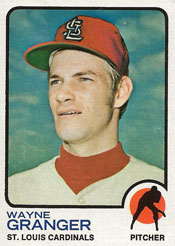 Granger had been in this spot before since getting to the majors with St. Louis in 1968. Aaron would wait for the right-handed reliever’s sinking fastball and bash it if it didn’t dip as it neared the plate.
This time, Granger told himself, he’d do it differently. He’d throw soft instead of hard.
“He was throwing that slow curveball,” Aaron said to Dick Kaegel of the St. Louis Post-Dispatch, “and it just kept getting slower and slower and slower, and slower and slower and slower.”
Aaron took the first pitch for ball one. He fouled off the second, looked at strike two and watched another go by for ball two. Tension building on every pitch, he fouled off seven in a row. Four of the fouls sailed deep into the seats in left.
“I wasn’t about to turn up one notch to his speed,” Granger said to the Atlanta Journal. His offerings to Aaron were “my slop pitch, a sort of slider-curve thrown underhanded,” Granger told the Post-Dispatch
Finally, on Granger’s 12th pitch to him, Aaron lofted a shallow fly to Lou Brock in left for the game-ending out.
“I love that kind of situation _ except he won,” Aaron told the Journal. Boxscore
Finding his form
Granger might have become Aaron’s teammate if not for a scout changing jobs.
Pitching for a semipro team in his home state of Massachusetts, “I was all set to sign with the Braves in the fall of 1964,” Granger recalled to Wilt Browning of the Atlanta Journal. “Jeff Jones, who was the regional scout for the Braves in New England, had made me a good offer, but he asked me to wait until the first of the year. He didn’t say why, but he said it was something good. Then he called me on the first of January and asked me if I’d like to sign with the world champions.”
Jones had jumped from the Braves to the Cardinals, the 1964 World Series champions. The Cardinals agreed to give Granger the $20,000 bonus Jones had offered when he worked for the Braves. Granger, who turned 21 in 1965, followed the money, signing with St. Louis.
At 6-foot-2 and 165 pounds, Granger was a broomstick. “He might be mistaken for Ichabod Crane,” the Tulsa World noted. According to the Post-Dispatch, “He’s so skinny that you couldn’t get three digits on the back of his uniform.”
“Other pitchers complained of sore muscles,” Granger told the Cincinnati Enquirer, “but I didn’t have any muscles to get sore.”
The Cardinals tried him as a starter his first season in their farm system. Granger threw overhand then. Though he totaled 200 innings, “I just didn’t throw with enough velocity to (eventually) get the ball past major league hitters,” Granger told the New York Times, “so I switched from a three-quarter motion to sidearm, where my natural sinker is much more effective.”
Granger broke a thumb on a rundown play at 1966 spring training. When he recovered, Arkansas manager Vern Rapp had Granger work himself into condition in the bullpen. Granger did so well as a reliever that Rapp kept him in that role. Granger responded with an 11-2 record and 1.80 ERA.
Promoted to Tulsa in 1967, Granger came under the guidance of its manager, Warren Spahn.
“The luckiest break I had in my career was when I had Warren Spahn as my manager,” Granger said to Arthur Daley of the New York Times. “He’s to pitching what Ted Williams is to hitting. It’s a pure science to them. They know absolutely everything there is to know about their specialties.
“Spahnie told me about the instructions he once had given Del Crandall, his catcher. ‘When you give a target,’ he said, ‘I don’t want to see the glove. I want to be able to see the pocket of the glove so that I can feel I’m looking down a funnel at the precise target, and that’s where I want to put the ball.’ He taught me concentration. I can’t throw within the six-inch circle he used to target, but I can hit it one out of three times and come close enough on the others.”
Redbirds to Reds
Called up to the Cardinals in May 1968, Granger’s sidearm sinker baffled National League batters. He totaled four wins, four saves and posted a 2.25 ERA in 34 games. Asked what was the best thing about being a big-leaguer, Granger replied to the Enquirer, “Getting up at noon and going to have a steak and then going to the ballpark to play a boy’s game.”
In the 1968 World Series, the rookie made one appearance, mopping up in Game 6 when the Tigers led, 13-0. “Nervous as hell,” Granger recalled to the Orlando Sentinel. After hitting Al Kaline with a pitch in the eighth inning, “I got a lot more nervous,” Granger said. Then he plunked Willie Horton, too. Boxscore
On the day after the Tigers won Game 7, Granger and Bobby Tolan were sent to the Reds for Vada Pinson. One reason Granger was included was the Cardinals didn’t think they could protect him from being taken in the Oct. 14, 1968, National League expansion draft. In addition to their core veterans, the Cardinals had prospects Jerry Reuss and Ted Simmons among the 15 players on their protected list. Rather than lose Granger to the draft, the Cardinals offered him to help land Pinson, a player they coveted to replace Roger Maris, who retired.
(In an unusual twist, Granger and Tolan continued to play for the Cardinals for a while after the trade. The Reds gave permission for Granger and Tolan to participate in the Cardinals’ 18-game goodwill tour of Japan in fall 1968. Granger was 5-0 for the Cardinals against Japanese all-star teams. “The Japanese baseball is smaller than ours,” Granger told John Hollis of the Houston Post. “I swear I threw a pitch one time that dropped three feet. You can make that Japanese baseball do a lot of funny things.”)
Reds general manager Bob Howsam, who had the same title with the Cardinals when Granger and Tolan were in the St. Louis farm system, was delighted to acquire the pair. “It had to come close to being the worst trade St. Louis ever made,” Arthur Daley of the Times declared.
While Pinson disappointed and lasted one season in St. Louis, Granger and Tolan had breakout years for the 1969 Reds. Tolan batted .305 with 93 RBI and 26 stolen bases. Granger pitched in 90 games and had nine wins, 27 saves and a 2.80 ERA. Enquirer columnist Barry McDermott described the lanky reliever as “a 165-pounder with a 500-pound arm and 1,000-pound heart.”
“He’s the coolest individual I’ve ever seen under pressure,” Reds manager Dave Bristol told the newspaper. “Nothing seems to bother him.”
In 1970, with Sparky Anderson as manager, the Reds won the pennant and Tolan and Granger were key contributors. Tolan hit .316 with 80 RBI and 57 steals. Granger had 35 saves and a 2.66 ERA. “His sidearm ball zings in with whiplash effect,” the New York Times observed.
(Granger did not pitch well, though, in the 1970 World Series. In Game 3, he gave up a grand slam to Orioles pitcher Dave McNally. “”It was probably the worst pitch in baseball history,” Granger told the Enquirer. Boxscore, Video
Turn on the power
The zip began disappearing from Granger’s sinker. As he told the Orlando Sentinel, “From 1971 on, it was a downhill race.” He ended up pitching for seven clubs in nine big-league seasons. The Cardinals reacquired Granger in November 1972 and it turned out to be another bad deal for them. They gave up Larry Hisle and John Cumberland to get him. Granger was 2-4 with five saves and a 4.24 ERA for the 1973 Cardinals before they shipped him to the Yankees.
This post, though, started with a story about Granger and Hank Aaron, so it’s fitting that it ends with a story about a home run.
In a most unlikely scenario, Granger made like Babe Ruth, calling his shot, and swatting the lone home run of his professional career.
On July 9, 1971, Granger retired five Mets batters in a row. With the Reds ahead, 5-3, in the eighth, Sparky Anderson wanted to keep Granger in the game, so he let him bat with two outs, none on, against Ray Sadecki, the former Cardinal.
Granger rarely batted. He’d never produced a RBI or extra-base hit since coming to the majors.
He grabbed a bat belonging to slugger Lee May and went to face Sadecki. Reds pitching coach Larry Shepard yelled out, “Take a good cut, Wayne.” Granger yelled back, “You watch this swing,” and then pointed to the center field stands.
Granger took a big swing at Sadecki’s first pitch and missed it by a foot. He took a similar hack at the second pitch. This time, the skinny man got the fat part of the bat on the ball, and it carried over the wall in left-center for a home run.
As Granger trotted around the bases, his teammate, Jim Merritt, was stretched out in the dugout as though he had fainted, the Dayton Journal Herald reported.
Granger told the Troy Daily News, “I never hit a ball that far before.” Boxscore

 RetroSimba
What a Bartolo Colon bizarre moment for Granger to hit a homerun and to actually call his shot!!!,,,,,,,a legend hardly ever told. Thanks Mark. I’m amazed by maybe the obvious, but it’s confusing how a pitcher like Granger suddenly loses the zip on his sinker. i guess it’s similar to our bodies just not being reliable in the end as we all meet the same fate if we’re lucky enough to survive a while. SIde note about 1973 Topps. I never tire of seeing the silouette. I’m not sure why, but it just looks good and now with knowledge of Granger’s sinker, i’ll see the card differently the next time i see it. i had hoped to complete the 1973 set one day, but i can’t find my mike schmidt, ron cey, and __________ rookie card, one of the missing sock mysteries of my collection.
Thanks for mentioning Bartolo Colon. The image of 165-pound Wayne Granger contrasting with 285-pound Bartolo Colon can’t help but bring a smile. Colon’s lone big-league homer in 299 career at-bats came on May 7, 2016, for the Mets at San Diego against James Shields of the Padres: https://www.retrosheet.org/boxesetc/2016/B05070SDN2016.htm
From what I’ve read, location of the sinker was the key to whether Granger succeeded or failed. I think it got more difficult to have that ability to pinpoint the pitch the way he described Warren Spahn instructing him. “I’ve always got to keep my pitches down,” Granger told the Tulsa World. “If I don’t, I’m in trouble.”
After his last big-league appearance with the Expos in 1976, Granger pitched two seasons (1977-78) in the Mexican League. “The Mexican League is tough … You travel only by bus and the rides average 14 to 16 hours,” Granger told the Orlando Sentinel.
and yet homeruns are a private club. i never hit one over a fence in all my short baseball life. actually, it lasted until i was 18….all those games and no homers. oh well, i can still dream about a trot or preach about bunting. Ha!
i’m immediately smitten by the Mexican league or the way it was, riding busses for 14 to 16 hours. Musta been annoying, but what a builder of brotherhood.
i forgot to mention Mark….i love the way you painted the picture in the opening paragraph, of Aaron at bat, really drew me in, that duel of pitcher and batter.
Thanks, Steve. Your comment made my day!
Glad to hear. Here’s to the night going well too. Cheers!
Thanks for another good post Mark. I’ve got to say though, that it stings a bit looking back at the terrible moves the Cardinals Organization made during the late 60’s and early 70’s. They brought the lost decade upon themselves. Giving up too soon on young players. Trading for veterans that were on the downside of their careers. Throw in also the likes of Dave Giusti, Jerry Johnson, Steve Carlton, Larry Hisle, Reggie Smith, etc, and you have a recipe for disaster. Just wondering Mark, did Wayne Granger lose his effectiveness because of making too making appearances or physical issues?
The list of productive players sent away by St. Louis during that time is staggering. One of those players who often gets overlooked is Fred Norman, who went on to total 85 wins for the Reds and helped them to consecutive World Series titles (1975-76): https://retrosimba.com/2020/09/30/demotion-from-cardinals-was-blessing-for-fred-norman/
In answer to your question, Phillip, Wayne Granger told the Atlanta Constitution, “I hurt my arm in 1973 and went through a period where I couldn’t pitch.”
When Granger signed with Durango of the Mexican League in 1977, he replaced Jim Bouton on the roster.
Bobby Tolan in RF for the Cardinals through the early 1970s might have swung a division for the Cardinals! Also check out Vada Pinsons 1970 stats after we gave up on him! Just non stop bad moves in the 1970s.
Yep. After one season with them, Vada Pinson was traded by the Cardinals to Cleveland for Jose Cardenal. “If I were the Cardinals, I wouldn’t have made the deal,” Mudcat Grant told the Cleveland Plain Dealer in November 1969. “He (Pinson) is a better player than Jose. He could be the best player on the Cleveland club.”
Pinson hit .286 with a career-high 24 home runs for Cleveland in 1970. He led the 1970 Cleveland team in total bases (276), hits (164), doubles (28), triples (6) and RBI (82). Russell Schneider of the Plain Dealer described Pinson as the “inspirational and offensive leader” of the Cleveland team in 1970.
Nice post, Mark. Everyone remembers the sluggers on that 1970 Reds team, and rightfully so. But Granger led what had to be the top bullpen in the NL. He and Clay Carroll combined to pitch 189 innings and save 51 games. Plus, a young Don Gullett chipped in six saves.
As a kid, I could not understand why Bobby Tolan didn’t get more opportunity with the Cardinals than he did; he probably should have been playing more than Roger Maris. When he joined the Reds, he teamed back up with Alex Johnson, another outfielder the Cardinals gave up on who immediately started knocking the cover off the ball. Part of it likely had to do with moving from cavernous Busch Stadium to cozy Crosley Field (which likely worked the other way for Pinson), but still I wonder how things would have worked out for Tolan and the Cardinals had he remained in St. Louis.
Thank you for your thoughtful comments.
What sometimes gets overlooked is that Bobby Tolan originally was in the Pirates system and the Pirates got no player in return when Tolan was taken by the Cardinals in the minor-league draft. Tolan in a Pirates lineup with Roberto Clemente and Willie Stargell would have given Pittsburgh an even more potent punch.
Tolan punished the Cardinals after they traded him. In his first three seasons with Cincinnati, Tolan’s totals versus the Cardinals were .348 batting average, .388 on-base percentage in 1969; .360 BA and .407 OBP in 1970; and .396 BA and .431 OBP in 1972. (Tolan was hurt in 1971.)
While he may have lost the velocity on his sinker he seems to have kept up his sense of humor.
You are correct, Ken. In telling the story of how he met his first wife, a nurse, Wayne Granger said to The Sporting News, “I first met her when I went to a hospital with abdominal pain. She gave me a shot. It must have been a shot courage. I married her three months later.”
Another fun and interesting article Mark. I often wondered the rationale behind why we traded him to the Reds and your explanation helped although, as other readers have commented, it was another example of late ’60s and early 1970s trades that didn’t know how to value young talent. Thom A
Thanks, Thom.
By the way, the Cardinals taken in that October 1968 National League expansion draft were Dave Giusti (first round), Clay Kirby (second round) and Jerry DaVanon (third round) by the Padres, and Jerry Robertson (fourth round), Larry Jaster (fifth round) and Coco Laboy (sixth round) by the Expos.
Organist Ernie Hayes should have selected the Beatles’ “Hello Goodbye” as Jerry DaVanon’s at-bat song. Somebody in the front office sure liked re-acquiring him (and sending him away).
Hah! Yep, the Cardinals had some kind of weird thing going on with middle infielders then, such as Dick Schofield and Jerry DaVanon. Schofield had three stints with the Cardinals in three different decades (1950s, 1960s, 1970s). The Cardinals gave DaVanon his first pro contract, lost him to the Padres in the expansion draft, acquired him back from the Padres, traded him to the Orioles, acquired him from the Angels, sent him to the Tigers and acquired him yet again from the Astros.
Funny thing about DaVanon: He hit three big-league home runs and each was a three-run shot. The first was for the Cardinals against the Expos, the second was for the Astros against the Cardinals (Harry Parker was the pitcher) and the last came for Houston against the Pirates’ John Candelaria. https://www.retrosheet.org/boxesetc/1975/B08110HOU1975.htm
Wow, at least the scouting department was still good even as they lost their trade acumen! Thom A