A St. Louis Browns player was part of a mob that lynched a man.
The murder of Allen Brooks occurred March 3, 1910, in Dallas. Brooks, a black man, was in court on charges he attacked a 3-year-old white girl. A mob stormed the courtroom, tied a rope around Brooks’ neck, then pulled and hurled him from a second-story window to a frenzied crowd below. Brooks’ body was dragged several blocks and hung from a telephone pole. Then the rioters marched to the county jail, looking for two black men accused of murders, and used steel rails to force their way inside, but the prisoners had been taken away by officers.
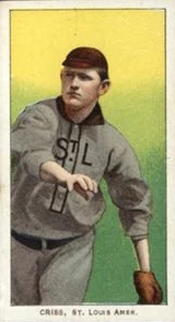 The mob included Dode Criss of the Browns. “Criss was with the crowd when it moved on to the courthouse and jail,” the St. Louis Star-Times reported. “… Dode does not say he led the mob on the jail, but says he saw what transpired and believes the black was given his just desserts.”
Spitter and hitter
Dode Criss was born in Mississippi, near Tupelo, and raised in rural Texas. His farming family settled in Ellis County, near Waxahachie, and he went to school in Rockett. According to the Fort Worth Star-Telegram, Criss “had an ability to spit and never miss a mark. Around the grocery in the evening, Dode entertained the crowd with his capacity of saliva control, hitting rat holes, striking chalk marks and lambasting dogs in the eye. He was a faultless shot.”
Criss played ball, too. He threw right, batted left, pitched and roamed the outfield. In 1906, at 21, Criss was with a Class D minor-league club in Texas. A teammate was 18-year-old Tris Speaker, a future Baseball Hall of Famer. In his book “Baseball As I Have Known it,” Frederick G. Lieb wrote that Speaker confessed to being a member of the Ku Klux Klan.
After spending another season in the minors, Criss was brought to spring training with the Browns in 1908. The Browns thought he was a pitcher. What he did best, though, was hit. Manager Jimmy McAleer kept the rookie on the club and made him its primary pinch-hitter. Criss hit .341 overall (in 82 at-bats) for the 1908 Browns and .333 as a pinch-hitter.
“He is a player who excels all others as a hitter but is sadly deficient as a pitcher or a fielder,” the St. Louis Post-Dispatch observed.
Billy Murphy of the Star-Times wrote, “He can’t run. He can’t field. He can’t think. There is nothing that he can do but hit and throw (and) his throwing isn’t even accurate … He has to make a hit to the fence to get two bases. Sometimes he has been nearly thrown out at first on hits to the outfield … Criss is valuable for just one thing. That is to hit in a pinch. Then someone has to run for him. Someone has to think for him.”
Foreshadowing the designated hitter rule that was to be adopted by the American League 65 years later, Syd Smith, a teammate of Criss with the 1908 Browns, told the Houston Chronicle, “If a 10th position were to be provided for on a ballclub, I think Dode would come into his own.”
Criss’ second season with the Browns, in 1909, resulted in a .304 batting mark as a pinch-hitter and 1-5 record as a pitcher.
Trouble brewing
In March 1910, Criss and his wife made the 30-mile trek from their home to Dallas so that Mrs. Criss could get a train to Mississippi, where she would visit relatives, he told the Star-Times. Criss had bought a railway ticket to Houston, where the Browns were training for the spring, but had it redeemed so that he could stay in Dallas until after the “fun” was over, the Star-Times reported. The “fun” was joining the mob forming for the court hearing of Allen Brooks.
Acting on a tip he received, Star-Times reporter Brice Hoskins asked Criss upon his arrival at spring training about being part of the Dallas mob responsible for Brooks’ lynching. Criss confirmed he was there.
A nationally syndicated sports feature that was published in newspapers such as the Akron Beacon Journal, Dayton Herald, Milwaukee Daily News and San Francisco Bulletin flippantly reported, “Criss … is the possessor of probably the most unique excuse of any ballplayer for reporting late for the spring workout. He was two days late in showing up at Houston this spring because he stopped in Dallas to participate in a lynching. Dode is a Texan who relishes excitement.”
Volatile mix
According to multiple published reports, Allen Brooks, 58, was arrested on Feb. 23, 1910. Brooks was employed as a laborer at the home of Mr. and Mrs. Henry J. Buvens of Dallas. Police said Brooks took the Buvens’ daughter, Mary Ethel Buvens, to a barn on the property and carried her into the loft. A black housekeeper went looking for the child and found her with Brooks in the barn. The woman took the girl and ran into the house. Police found Brooks hiding in a basement furnace room. The next day, Feb. 24, he was indicted by a Dallas grand jury and charged with criminal assault.
(While in custody, Brooks told officers he was drunk on the day he confronted the child and didn’t know what he was doing, the Fort Worth Star-Telegram reported.)
The heinousness of the crime Brooks was accused of committing produced an outburst of rage and racism. In the predawn hours of Feb. 25, a mob of about 500 men surrounded the county jail in Dallas and demanded that Brooks be turned over to them, the Waco Times-Herald reported. The mob had a 30-foot steel rail and threatened to batter down the jail doors if Brooks didn’t appear. The county sheriff and city police chief allowed 12 mob members to search the jail and see for themselves Brooks wasn’t there. Brooks had been moved to a secret location.
The mob dispersed. Officials urged the public to trust the legal process. “There is absolutely no need for mob violence,” assistant county attorney B.M. Clark said to the Fort Worth Record-Register. “… Prompt justice will be administered.”
Order in the court
An arraignment was scheduled for March 3 in Dallas. According to police and county officials, early-morning trains into Dallas that day unloaded passengers from Ellis, Hunt and Rockwell counties. Joining men from rural sections of Dallas County, they formed the heart of the mob that went to the courthouse, the Fort Worth Record-Register reported.
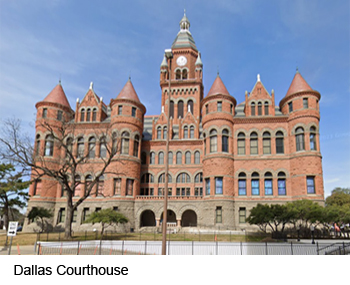 The county sheriff and all his men were on duty at the courthouse along with about 15 city police officers. In all, Brooks was guarded by about 50 law enforcement personnel, the St. Louis Globe-Democrat reported.
The arraignment was held in a second-floor courtroom. About 1,000 people crowded into the corridors and stairways of the courthouse, the Record-Register reported. At least another 1,000 more waited outside.
During the morning hearing, Brooks’ attorneys asked Judge R.B. Seay for a continuance in order to construct their case. The judge gave the defense attorneys an hour in which to prepare their motion in writing. Brooks was taken from the courtroom to a jury room to wait.
When word of this procedure filtered out to the simpletons in the hallways, the message got misinterpreted. The crowd thought a change of venue was being considered. That angered them, and a call went out to rise up.
The invaders “swept county officials and policemen aside like chaff before the wind,” the Record-Register reported. The door to the courtroom was battered down and sheriff deputies were overpowered. According to the Fort Worth newspaper, “The officers fought back desperately but refrained from using their pistols … One by one the officers dropped from sheer exhaustion.”
Mob rule
The mob forced its way into the jury room, where Brooks was guarded by two sheriff’s deputies. According to the Record-Register, as one drew a revolver, a mob leader snarled at him, “Shoot, (expletive) you, shoot; you nigger lover.”
Brooks, crouching under a table, was seized. One end of a rope was tied around the neck of the shaking man and the other end was pitched to the crowd below. As Brooks was shoved from behind, a “mighty tug was made on the rope from below,” the Record-Register reported. Brooks tumbled out of a second-story window 30 feet above the ground. As he fell headlong, Brooks spread out his arms and legs. His head struck the pavement.
“Dozens of men jumped on him and his face was kicked into a pulp and he was bruised all over,” the Globe-Democrat reported.
Men grabbed the rope and, with the rest of the mob following, dragged the body several blocks up Main Street through the business district. The number of people in the mob had swelled to between 3,000 and 5,000, according to published estimates. “From the windows in the office buildings along Main Street … faces poked out to take in the horrible sight,” the Record-Register reported.
Brooks’ body was strung up to an iron spike on a telephone pole next to an arch built to honor the Benevolent and Protective Order of Elks of the United States of America, a fraternal organization focused on charity, justice and brotherly love.
“Just as the body was swinging upward, men and boys grabbed at the clothing and tore nearly every rag from his body,” the Record-Register reported. “A fight ensued for the torn bits of clothing, as they were wanted as souvenirs.” (Brooks was one of five black men lynched in Texas in 1910, according to D Magazine.)
The bloodlust of the savages wasn’t quenched by their ghastly act. The mob marched to the county jail, seeking two black men, Burrell Oates and Bubber Robinson, charged with murders. The sheriff told the mob the prisoners had been moved. Unconvinced, the mob “started in to demolish the doors and underpinnings with steel rails as battering rams,” the Globe-Democrat reported. “They then got dynamite and threatened to blow up the jail.”
Officers allowed some of the crowd to search the jail. Seeing the cells were empty, the throng dispersed.
American injustice
A Dallas County grand jury was convened to investigate the lynching. On March 20, the Star-Times reported “Secret Service agents are endeavoring to find out what Dode Criss knows of the recent lynching at Dallas.”
The investigations led nowhere. The grand jury didn’t return an indictment. No one was arrested nor charged in the lynching of Brooks.
“The grand jury admitted it was either unable to reach the facts, or that it regarded the lynching of Allen Brooks … as too trivial an occurrence to be worth its notice,” the Record-Register reported.
According to the Fort Worth newspaper, indications were “the grand jury not only never had any intention of investigating the mob, despite the orders to do so by Judge Seay, but preferred to silently endorse the outbreak.” The same grand jury returned 110 felony indictments in other cases but noted it endeavored not “to encumber the court docket with cases of a doubtful or frivolous nature.”
For the record
Dode Criss spent two more seasons (1910-11) in the majors with the Browns before returning to the minors. His departure “will not be mourned by local fans,” the Star-Times declared. “… During the time Criss was with the Browns, three different managers tried to make something out of him and all failed.”
Criss went on to play six seasons with the Houston Buffaloes. After Criss died in 1955, Clark Nealon of the Houston Post wrote that Criss “was more than just a Houston Buff all-time ballplayer. He was and forever will be in Texas League history a legend.” At team reunions, Criss “basked in admiration the likes of which generally is reserved for Ruth and Cobb,” Nealon noted.
In 2021, the Texas Historical Commission recognized the lynching of Allen Brooks with a historical marker at Main and Akard streets in Dallas, D Magazine reported. In 2023, a second state marker was installed at the southwest corner of the courthouse, near the window Brooks was thrown from.

 RetroSimba
Leave a comment