Growing up in Binghamton, N.Y., Bill Hallahan learned to play baseball on a sandlot near State Hospital Hill. His boyhood idol was big-league pitcher Grover Cleveland Alexander.
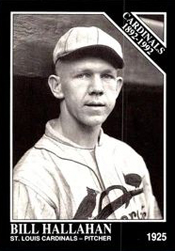 Hallahan was 8 when Alexander won 28 in his rookie season for the 1911 Phillies. Fifteen years later, Hallahan, 23, was a left-handed pitcher for the Cardinals when they acquired Alexander, 39, in 1926. Known to teammates as Alex, the old master made a lasting impression on Hallahan.
Easy does it
“I’ll never forget the first time he pitched for us,” Hallahan recalled to Donald Honig in the 1979 book “October Heroes.”
“I was sitting on the bench with another young pitcher and naturally we glued our eyes on Alex when he went out to warm up. He flipped a few into the catcher, then stopped, put his glove under his arm, took out a piece of gum, very casually took the paper off, put the gum in his mouth, looked around through the stands, then put his glove back on and started throwing again.
“He threw just a few more pitches, very easily, with no effort. Then he was through. He came back to the bench, put on his sweater _ we wore those big, red-knit sweaters on the Cardinals _ and sat down.
“I looked at this other fellow and said, ‘This is going to be murder. He isn’t throwing anything.’ Well, Alex went out that day and stood the other team on its ear. (Alexander limited the Cubs to four hits in 10 innings for the win.) Control, that’s how he did it. Absolute, total control. He had this little screwball that he could turn over on the corners all day long. Amazing fellow. Born to be a pitcher.”
Wild Bill
After finishing his schooling, Bill Hallahan worked as a clerk at the Corona Typewriter Company factory in Groton, N.Y. A left-hander, he pitched for the factory baseball team. He turned pro at 21 in 1924 and reached the majors with the 1925 Cardinals. Hallahan made six relief appearances for St. Louis before being returned to the minors. He rejoined the Cardinals in 1926 as a reliever on a staff with starters Jesse Haines, Flint Rhem, Bill Sherdel and then Alexander.
Described by writer Bob Broeg as “short, stocky, round-faced and pug-nosed, head cocked almost shyly to one side even when he pitched,” Hallahan threw hard but lacked command, earning him the nickname “Wild Bill.”
Hallahan was “the wildest man alive,” according to the Brooklyn Eagle. “He has so much stuff that it can’t be controlled.”
Hallahan couldn’t work up the nerve to ask Alexander for pitching tips.
“Alex never said much about anything,” Hallahan told Donald Honig. “When he did talk, it was seldom above a whisper. As a rule, we didn’t see him around after a game. He was a loner. He would go off by himself and do what he did, which I suppose was drink. That was his problem.
“He liked to go out before a game and work in the infield, generally around third base. One day we were taking batting practice and there’s Alex standing at third, crouched over, hands on knees, staring into the plate. A ground ball went by him and he never budged. Just remained there stock still, staring at the batter. Then another grounder buzzed by and same thing _ he never moved a muscle. Then somebody ripped a line drive past his ear and still he didn’t move. That’s when (Rogers) Hornsby noticed him. Rog was managing the club at the time.
“Hornsby let out a howl and said, ‘Where in the hell did he get it?’ ‘Where did he get it,’ he kept yelling. He ordered a search made and they found it, all right. In old Sportsman’s Park in St. Louis there used to be a ladies’ room not far from the corridor going down to the dugout, and that’s where he had stashed it, up in the rafters of the ladies’ room. One of those little square bottles of gin.”
Alexander sobered the spirits of Yankees batters in the 1926 World Series. He pitched a four-hitter to win Game 2. With the Cardinals on the brink of elimination, he pitched another complete-game gem to win Game 6 and then hurled 2.1 scoreless innings of relief, including the famous strikeout of Tony Lazzeri with the bases loaded, to save Game 7.
Curves and speed
Like Alexander, Hallahan pitched masterpieces in the World Series for the Cardinals. First, though, came detours through the minors.
Hallahan spent 1927 with Syracuse (19-11) and 1928 with Houston (23-12). Leading Houston to the championships of the Texas League and Dixie Series, Hallahan became the toast of the Texas oil town.
“Bill Hallahan’s name is a household word in Houston,” wrote Houston Chronicle sports editor Kern Tips in October 1928. “The restaurants serve eggs a la Hallahan; soda fountains can mix you a Hallahan frappe; a girl is the Hallahan if she has curves _ and speed. You go Hallahan in a card game when you run wild through the deck. Never has Houston had a more colorful, a more amiable, a more popular ballplayer.”
Hallahan said Houston player-manager Frank Snyder, a former Cardinals catcher, brought out the best in him. As Hallahan recalled to the St. Louis Star-Times, “I simply lacked confidence and walked everybody in the ballpark, including the soda boys and umpires … Snyder went behind the plate believing in me and I knew what he expected of me … It was the first time anybody had enough confidence in me to give me confidence in myself.”
The Cardinals brought back Hallahan in 1929, but he went winless the first five months of the season. A turnaround came when Grover Cleveland Alexander got turned out. Manager Bill McKechnie was fed up with Alexander’s drinking and in August 1929 the Cardinals told the pitcher to go home. Hallahan moved into the starting rotation and won four of his last five decisions.
Finding his groove
At spring training in 1930, Hallahan, 27, showed he was ready for a big role on the St. Louis staff. “Ever since he joined the Cardinals in the spring of 1924, shrewd baseball observers have been predicting a great future for Hallahan,” Sid Keener of the Star-Times noted. “The youngster fizzled annually, but this spring he has been more impressive than ever before.”
None other than Babe Ruth praised Hallahan’s pitching. In an exhibition game at Bradenton, Fla., the Yankees’ slugger swung late at a Hallahan fastball in the first inning and dribbled a slow roller to third. In his next at-bat, Ruth watched another Hallahan fastball dart across the inside corner for strike three.
According to Sid Keener, Ruth said to Cardinals manager Gabby Street, “You showed me a great young pitcher out there this afternoon. I don’t know when I’ve ever seen a left-hander with such burning speed and a curve that almost completely baffles a batter. Hallahan almost whipped that fastball past me before I could get the bat off my shoulder in the first inning, and when I was expecting a curve from him in the third with two strikes called, he whistled across his fastball and I could not get my bat off my shoulder.”
Hallahan was a prominent starter for the Cardinals between 1930 and 1935. He twice led National League pitchers in strikeouts but also three times issued the most walks and threw the most wild pitches. He was the Cardinals’ wins leader in 1930 (15) and 1931 (19). Hallahan was the National League starter in the first All-Star Game in 1933.
“When he had it, especially when he could put his blazing fastball and jagged overhanded curve over the plate, Hallahan was second probably only to the New York Giants’ Carl Hubbell among National League left-handed pitchers,” Bob Broeg wrote in the St. Louis Post-Dispatch.
Big-game pitcher
Hallahan pitched in seven World Series games for the Cardinals and was 3-1 with a save and a 1.36 ERA.
After Hallahan pitched a shutout against the Athletics in Game 3 of the 1930 World Series, Babe Ruth gushed in his syndicated newspaper column, “I don’t think there’s a ball team in the country that could have beaten him in that game, or even caused him very much trouble.” Boxscore
Hallahan’s World Series save came in Game 7 versus the A’s in 1931. Boxscore
Hallahan won both of his starts in the 1931 World Series _ Games 2 and 5. The Game 2 ending was a dandy.
With the Cardinals ahead, 2-0, in the ninth, the A’s had two on, two outs and pinch-hitter Jimmy Moore at the plate.
“I got two strikes on him,” Hallahan recalled to Donald Honig, “and then broke off a beauty of a curve and he struck out on it. Or so I thought.”
The ball hit the ground before catcher Jimmie Wilson gloved it. Wilson needed to either tag the batter, or throw to first, to complete the out. Instead, he fired the ball to third baseman Jake Flowers, thinking the game was over. Moore was safe at first, loading the bases.
“You don’t like to give a team like the A’s four outs in an inning, but that’s what I had to do,” Hallahan recalled to Donald Honig. “The batter was Max Bishop, a fellow I didn’t like to pitch to. He was a smart little hitter who generally got the bat on the ball … A fellow like Bishop _ they called him ‘Camera Eye’ _ guarded the plate like a hawk and it was hard to get a ball past him.
“I put everything I had on it and Bishop popped one up in foul ground that Jim Bottomley chased down and then dove over the Athletics’ bullpen bench and caught by reaching into the stands. It was a really remarkable play by Jim. That ended the game for real. I always said it was a lucky thing we were playing at home because the fans got out of the way and let Jim make the play. If we had been in Philadelphia, I’m sure they wouldn’t have been so helpful.” Boxscore

 RetroSimba
Leave a comment