Feeds:
Posts
Comments

Archive for the ‘Bloggers’ Category

The 1982 Cardinals had no player hit 20 home runs. One of their best relievers was 43 and had been in the majors since the 1950s. Only one of their pitchers struck out as many as 90 batters.
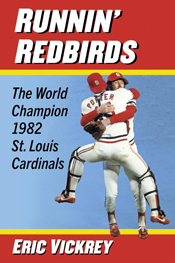
Yet, the 1982 Cardinals may be the franchise’s greatest team since baseball went to a divisional alignment. Since 1969, the only Cardinals club to finish a regular season with the best record in the National League and win a World Series title was the 1982 team.

A new book, “Runnin’ Redbirds: The World Champion 1982 St. Louis Cardinals,” provides insights into why that team was so special.

Written by Eric Vickrey, a member of the Society for American Baseball Research, the book is available on Amazon and direct through the publisher, McFarland Books. Until Nov. 27, there is a 40 percent discount (the discount code is HOLIDAY23) for those who order direct from McFarland.

Here is an email interview I did with the author in November 2023:

Q: Hi, Eric. What prompted you to do a book on the 1982 Cardinals?

A: “Growing up in Alton, Illinois, during the 1980s, I fell in love with baseball watching the Cardinals sprint around the bases and play amazing defense. Ozzie Smith, Willie McGee, Vince Coleman and Tommy Herr were my heroes as a kid. Fast-forward to 2020. During the early days of the pandemic, when I was stuck inside and there was no baseball to watch, I started writing player bios for the Society for American Baseball Research. I enjoyed the research and writing process as well as the nostalgia of revisiting the roots of my baseball fandom. I miss the Cardinals’ style of play in the 1980s, which was so different than the game today. I thought it would be interesting to really dig into one season as a longer narrative project. I chose 1982 because it included the arc of Whitey Herzog’s rebuild and the pinnacle of a championship.”

Q: What makes your book different from other books, such as those from Whitey Herzog or Keith Hernandez, about the 1982 Cardinals?

A: “Herzog’s memoir, White Rat, was incredibly insightful, particularly in regard to his roster reconstruction in 1980 and 1981. In typical Whitey fashion, he pulled no punches. Ozzie, Hernandez, Bob Forsch and Darrell Porter also authored books that touched on their experiences in 1982. But there had not been a book that focused primarily on the Cardinals’ 1982 season. In addition to delving into the on-field highlights of that year, Runnin’ Redbirds examines the team in the context of baseball history with some modern analytics sprinkled in. It is also very much a human-interest story. The Cardinals were an eclectic group, and I tell a bit of each player’s story.”

Q: Could you provide an example or anecdote about a 1982 Cardinal who was the most fun or enjoyable for you to interview?

A: “I interviewed Dane Iorg, who was one of the stars of the World Series for St. Louis. In his 17 at-bats against Milwaukee, he recorded nine hits, five of which went for extra bases. If there is such a thing as a clutch player, he was it. I’m sure he has been asked about the 1982 World Series a million times, but to hear the pure joy in his voice while describing the thrill of a championship more than 40 years ago was really cool.”

Q: Since baseball went to a divisional format in 1969, 1982 is the only year in which the Cardinals finished with the best record in the National League and won the World Series title. Do you think then the case can be made that the 1982 group is the last great Cardinals team? 

A: “I think that depends on how you define greatness. I’d consider the 1985, 2004 and 2005 Cardinals great teams even though they fell short of a championship. Anything can happen once you get to the postseason and sometimes a bit of luck swings things in favor of one team. The 1982 Cardinals, for example, benefitted from a rainout in Game 1 of the National League Championship Series when they were trailing the Braves in the fifth inning. Then there was Game 6 of the 1985 World Series, but let’s not go there.”

Q: Who do you think is the most under-appreciated member of the 1982 Cardinals, and why so?

A: “That’s a really tough question because the Cards received contributions from so many players during the course of the season. Unheralded guys like Mike Ramsey, Doug Bair, Ken Oberkfell and Glenn Brummer all made key contributions. But perhaps the most under-appreciated player, relative to his production, is Lonnie Smith. He led the league in runs scored and led the Cardinals in hits, extra-base hits, stolen bases and Wins Above Replacement _ an MVP-level season.”

Q: Could you provide an example of something surprising you learned about the 1982 Cardinals in doing your research and interviewing?

A: “The 1982 Cardinals are most remembered for their speed and defense, and rightly so. But until I dug into the numbers, I never realized how historically dominant the Cardinals’ pitching staff was during the playoff push. They had a stretch in September in which they allowed two earned runs or less in 11 straight games. Only three pitching staffs in the live-ball era have longer streaks, and two of those occurred during the pitching-dominant season of 1968.”

Q: In the postseason, the 1982 team came face to face with prominent Cardinals of the past. In the National League Championship Series, the Braves were managed by Joe Torre and coached by Bob Gibson and Dal Maxvill. In the World Series, the Brewers had players Ted Simmons and Pete Vuckovich. Did that create any drama?

A: “It certainly made things more intriguing. Torre and Gibson were still beloved in St. Louis and got enormous ovations at the start of the NLCS, but Cardinal fans wanted to see them lose. Gibson, on the other hand, said before the series he wanted the Braves to ‘beat the blazes’ out of the Cards. Simmons was another St. Louis icon, and there were many fans who wished he could have been a part of the 1982 team. Now if Garry Templeton had been in the opposing dugout, that may have created some drama.”

Q: Thanks, Eric. To wrap it up, I’m going to list five names from the 1982 Cardinals and ask you to respond, in a sentence or two, with the first thing that comes to mind for you on each. First up: Lonnie Smith?

A: “Lonnie could not seem to crack the Phillies lineup, but Herzog shrewdly traded for him before the 1982 season and what a steal that was. The guy was a winner. He played in five World Series.”

Q: Joaquin Andujar?

A: “Andujar is probably more remembered for his off-the-wall quotes and blowup in the 1985 World Series, but the 1982 team probably doesn’t win it all without him. He was nearly unhittable down the stretch.”

Q: George Hendrick?

A: “Silent George was a solid all-around player and accounted for nearly a third of the Cardinals’ home runs in 1982. One of my favorite anecdotes from Game 7 is that after the last out, Hendrick headed straight for his car and listened to the postgame celebration on his drive home.”

Q: Jim Kaat?

A: “Kitty pitched to Ted Williams during the Eisenhower administration and to Ryne Sandberg during the Reagan administration. He kept reinventing himself and was the quintessential crafty lefty.”

Q: Whitey Herzog?

A: “Pure baseball genius who was not afraid to take risks. An excellent communicator. Every player I talked to who played for him raved about the way he communicated with his players.”

Read Full Post »

Author Mike Mitchell has written a book, “Mr. Rickey’s Redbirds,” and it’s a compelling blend of baseball and American history.

I read it and found it to be thought-provoking and informative.

The book can be ordered on Amazon or at the author’s website, rickeysredbirds.com.

I interviewed Mitchell via email in May 2020. The interview is presented here in an edited, condensed form.

Q: Congratulations on writing the book. What inspired you to do it?

A: “I wrote a book many years ago and appreciated the process. I enjoy researching and writing, but needed time and a new idea. Both emerged around 2015. I had moved back to St. Louis just a few years before, having wound down some previous business commitments. I was fortunate to have the freedom to pursue a new venture. What started as a curious peek into the team’s first World Series championship squad in 1926 eventually became the book that is out today.”

Q: How does this book differ from others about the Cardinals and baseball?

A: “A lot of baseball books focus on a particular person or a particular season. At the other end of the spectrum are books that present a comprehensive history. This book is somewhere in between. It’s largely about Branch Rickey, but also the eras in which he played, managed or ran a front office. It covers a lot of ground because Rickey covered a lot of ground.

“At times, it’s also a book that delves into the broader sweep of history. Prohibition, the Black Sox scandal, the Great Depression, and segregation are all topics Rickey and the Cardinals face during his time in St. Louis.”

Q: From inception to completion, how long did the project take and what was the most time-consuming aspect?

A: “It started around 2015 when I began researching the 1926 team, but as I continued to dig into the material, I quickly realized it was a much bigger story. By 2017, I had the outline for what the book became and by the summer of 2018, I was probably 75 percent complete and expected to have a book done by Christmas of that year. But my father passed away in January of 2019, and from about six months before that until six months afterward, I lost my appetite for the project. I picked it up again in the second half of last year.”

Q: What was the biggest obstacle or challenge you had to overcome and how did you do it?

A: “With the Internet and digitalization of many newspapers, magazines and books, access to information isn’t an issue. Deciding what to include among the fire hose of facts, figures and data available is. One of the ways I handle this is to include all sorts of supplemental information in the end notes of every chapter.”

Q: The book is honest and accurate, and doesn’t sugarcoat or sensationalize. How were you able to strike the right balance?

A: “I can’t say it was some grand strategy, but I can say I started with a blank slate and a curious mind. Whether the information was positive or negative, my main interest was telling a captivating story in a compelling fashion. One thing I notice is that once a book is in print, certain ideas, stories, and quotes get injected into the bloodstream of history. Good stories tend to get told again. I’m sure I’ve fallen for it myself, but I try to be skeptical anytime I see a quote that gets endlessly repeated without attribution. Skepticism, combined with curiosity, goes a long way.”

Q: Do you think anyone in baseball today has qualities similar to Branch Rickey?

A: “If Bill James is the father of SABR metrics, Branch Rickey is the grandfather. As manager of the Browns in 1914, he had a sportswriter named Travis Hoke charting pitches and counting bases, not hits. Later with the Dodgers, he hired a statistician, Allan Roth. The two developed a formula for wins based on things like on-base and slugging percentage.

“If I had to name one person that fits the Rickey mold, Bill DeWitt Jr. comes to mind. His father had a long history with Rickey, worked for him for years. It was Rickey who brokered the deal that saw DeWitt Sr. and Don Barnes take control of the Browns. As a general manager, DeWitt Sr. became the first executive to win pennants in both leagues (1944 Browns, 1961 Reds). Bill Veeck said in the early 1960s, that outside of Rickey, there’s no smarter man in baseball than DeWitt. This is the environment in which DeWitt Jr. grew up.”

Q: What are your personal remembrances of Cardinals baseball and what was its impact on you?

A: “When I think of Cardinals baseball, I think of my family and summertime. My earliest memories aren’t of watching games, but listening to them on the radio with my father, either in the car or on our patio. While I live in St. Louis now, I didn’t grow up here. The only time we saw the Cardinals on television was Sunday road games, or the rare occasion the team would be on the Game of the Week. We made the trip to St. Louis to watch games only a handful of times a year.

“My father got his love for Cardinals baseball from his father, my grandfather, who was born in 1893. I like to think that between the three of us, we’ve had memories of nearly every Cardinals team.

“The weekend Ozzie Smith was inducted into the Hall of Fame, my father and I were there for his speech. That’s the only time I’ve been to Cooperstown, and it’s a memory I’ll always cherish.

“My mother merely tolerated baseball for many years. She’d watch the games because the males in the house would be watching them. That all changed in the summer of 1998. She became a fan that season because of Mark McGwire and the chase to break the record set by Roger Maris. She’s 88 now, still a fan, and like all of us, can’t wait for baseball to return.”

Q: Can you share with us a favorite personal baseball anecdote?

A: “Hands down, Game 6 of the 2011 World Series is my favorite baseball moment. I got lucky. It was the only game of the Series I attended. I remember the knot in my stomach in the bottom of the ninth inning as a group of Rangers fans in front of me stood up to cheer what seemed to be inevitable. Then the David Freese triple happened. Then Josh Hamilton homered and back to despair.  Somehow the Cardinals clawed back to tie it again. The roller coaster ride ended with the Freese home run to center. A friend said I began shouting, ”David Freese!” I don’t remember that, but I do remember the feeling. Pure joy.

“I’d never experienced a moment quite like that as a fan, and doubt I will again.”

Q: Anything else about the book?

A: “I hope readers can think about two questions after reading the book: 1. Why isn’t scout Charley Barrett in the Cardinals Hall of Fame? It may surprise people to realize how influential and well-known Barrett was in St. Louis. 2. Why isn’t Rickey’s image on the left-field wall at Busch Stadium along with other greats of the franchise? He didn’t play for the Cardinals, but neither did Jack Buck nor Gussie Busch. If a franchise can honor a broadcaster and an owner, why not a general manager?”

Read Full Post »

A bonus to being able to interview Cardinals broadcaster and ex-pitcher Rick Horton at Cardinals Legends Camp Jan. 27 was the chance to watch a few innings of a game between former players and the campers at Roger Dean Stadium in Jupiter, Fla.

Because the public isn’t allowed to attend the games, there were only about five people in the stands — likely friends or relatives of the players. So the event took on a “Field of Dreams” aura as Hall of Fame players such as Lou Brock, Ozzie Smith and Bruce Sutter stepped onto the field in crisp, white Cardinals uniforms to play inside a ballpark so empty it might as well have been an Iowa cornfield.

Sitting along the right-field line in the warm sunshine, I regrettably had only about 20 minutes to watch the action before having to return to my day job.

Pitching for the Cardinals was Dave LaPoint, the left-hander nicknamed “Snacks” who was a member of the 1982 World Series champions’ starting rotation.

Brian Jordan and Tom Lawless and Tom Pagnozzi were among those in the field. Sutter coached first base. And playing shortstop, wearing the familiar No. 1 and still looking to be in big-league shape, was The Wizard, Ozzie Smith.

In the home half of the first inning, Smith, batting second, stepped into the left side of the batter’s box against a right-handed camper. The first couple of pitches missed the strike zone. Smith, giving the camper his money’s worth, swung at several subsequent pitches out of the strike zone, fouling off one offering after another until he got one to his liking.

When the right pitch came, Smith uncoiled and launched a high fly ball into medium right field, near where I was sitting. The camper stationed in right looked into the sun and staggered, trying to follow the ball’s flight and gauge where it might land.

He extended both arms, the glove on his left hand turned up, and prepared for the ball to fall. It landed halfway up one arm, near the edge of his shirtsleeve. With arms still stretched outward, he brought them together as the ball rolled toward his hands as if on a conveyor belt.

For a moment, it appeared the ball might travel down his arms and into the glove. But then it slipped off his wrist and off his glove and toward the outfield grass. The fielder lurched forward, reached out with his bare right hand and snagged the ball, just as it was about to hit the ground.

“Out!” was the umpire’s correct call.

Ozzie Smith, who had circled first base and was headed to second, flashed a smile and headed back to the Cardinals’ third-base dugout, taking a good-natured razzing along the way from campers and Cardinals teammates.

Witnessing that gave me a sense for the special vibes that come from Cardinals Legend Camp. The retired players clearly enjoy being together again and being on the ballfield.

“That’s the neat thing about this camp _ the access to the players,” said camper Joe Pfeiffer, a Cardinals account executive. “These players want to be here. It’s genuine _ which makes it better for the campers.”

The camp, which was launched with significant help from broadcaster and former pitcher Al Hrabosky, is in its 12th year. Rick Horton has participated in 10 of the camps.

“It’s just been a blast every time I come down here,” Horton told me. “The fun we have here is unprecedented. Anything else I do the entire year _ nothing is as fun as this camp.”

Proceeds from the weeklong camp benefit Hire Heroes USA, a non-profit group that helps military veterans and their spouses find jobs after the completion of their service time.

“They do phenomenal work with job placement and counseling for people who are trying to get back into the workplace after their military service,” Horton said. “They really try to encourage businesses to hire heroes, people who have given an awful lot to our country, and kind of give them a head start into assimilating into a nice job opportunity.”

Asked about pitching in a camp game the day before, Horton described the feeling of being reconnected with former Cardinals teammates and the special bond they maintain.

“Sometimes we wonder, ‘Whose fantasy is this, really?’ ” said Horton. “I fielded a ground ball back to me yesterday. I turn around and throw the ball to Ozzie Smith. He jumps straight up in the air, avoids the slide and throws on to first base for a double play. I got to tell you, it was a rush for me. 

“I know I’m getting out a dentist or a doctor or a lawyer, but just to be on the field with Ozzie again _ I really want to be a part of that. Playing is what gets us back to the relationships we were in 25 years ago. So that’s part of the magic of this.

“The campers see us transform into players again. They see us get into that persona again. It’s a thing that’s very special, very meaningful. It’s a part of our lives that will never really go away and this gives us a chance to celebrate it.”

Previously: Rick Horton discusses the 2012 Cardinals

Previously: Rick Horton pays tribute to Bob Forsch

Read Full Post »

(Updated Sept. 10, 2022)

My choices for the top 5 iconic moments in Cardinals history:

1: STAN MUSIAL’S FINAL AT-BAT

What happened: In a fitting ending to an illustrious career, Stan Musial went out like he came in. Playing in his final big-league game on Sept. 29, 1963, against the Reds at St. Louis, Musial broke a scoreless tie in the sixth by smacking a single past second baseman Pete Rose, scoring Curt Flood. Lifted for a pinch-runner, Musial left to a thunderous ovation. He finished his final game with two hits and a RBI. Boxscore Ever consistent, Musial began his career in similar fashion, getting two hits and two RBI in his big-league debut on Sept. 17, 1941, against the Braves at St. Louis. Boxscore The Cardinals won both games by the same score: 3-2. For his career, Musial had 3,630 hits (1,815 at home and 1,815 on the road).

Why it qualifies: The final at-bat brought to a close the career of the greatest Cardinal. No Cardinal has been more outstanding.

Fun fact: After being lifted from the game, Jim Maloney, the Reds pitcher who gave up the two hits to Musial, went to the St. Louis clubhouse to seek out the retiring Cardinal and tell him, “It was a pleasure watching you play ball.”

Top quote: “It was a great day and I’m grateful that I was able to do something well in my last game.” _ Stan Musial to the Associated Press.

2: THE STRIKEOUT OF TONY LAZZERI

What happened: On Oct. 10, in Game 7 of the 1926 World Series at New York, the Cardinals led 3-2. In the seventh, the Yankees loaded the bases with two outs against starter Jesse Haines, who split a finger on his pitching hand. Cardinals manager Rogers Hornsby called on Grover Cleveland Alexander to relieve. Alexander had pitched a complete game the day before in the Cardinals’ Game 6 victory. Boxscore In the book “The Glory of Their Times,” Cardinals catcher Bob O’Farrell said Alexander was “tight asleep in the bullpen, sleeping off the night before,” when Hornsby called him into Game 7.

Facing rookie Tony Lazzeri, who had 18 home runs and 114 RBI that season, Alexander struck him out on four pitches. Alexander shut down the Yankees with 2.1 hitless innings, earning a save to go with two World Series wins and preserving the 3-2 St. Louis victory. Boxscore

Why it qualifies: By defeating the Yankees and winning their first World Series championship, the Cardinals transformed from a perennial also-ran into an elite franchise in the National League.

Fun fact: Alexander faced seven batters in Game 7. None of the first six hit the ball out of the infield. The seventh, Babe Ruth, walked with two outs in the ninth and was thrown out attempting to steal.

Catcher Bob O’Farrell, who fired the ball to Hornsby at second to nab Ruth, told author Lawrence Ritter, “I wondered why Ruth tried to steal second there. A year or two later, I went on a barnstorming trip with the Babe and I asked him. Ruth said he thought Alexander had forgotten he was there. Also, that the way Alexander was pitching they’d never get two hits in a row off him, so he better get in position to score if they got one. Maybe that was good thinking and maybe not. In any case, I had him out a mile at second.”

Top quote: “I knew he was all rattled and nervous and would go after anything, so I gave him a low curve a foot and a half from the plate and he swung and missed.” _ Grover Cleveland Alexander to The Sporting News, describing the pitch on which he struck out Tony Lazzeri.

3: DAVID FREESE’S HOME RUN

What happened: On Oct. 27, in Game 6 of the 2011 World Series at St. Louis, third baseman David Freese, whose two-out, two-run triple in the ninth tied the score, delivered a game-winning home run to lead off the 11th. The Cardinals rallied from deficits of 1-0, 3-2, 4-3, 7-4 and 9-7 against the Rangers to win 10-9 in 11 innings. St. Louis became the first team to score in the eighth, ninth, 10th and 11th innings of a World Series game. The Cardinals were within one strike of elimination in the ninth and 10th innings, and survived. Boxscore

Why it qualifies: The home run capped the most dramatic World Series comeback victory in Cardinals history. It advanced the Cardinals to Game 7 and they clinched their 11th World Series title.

Fun fact: Freese became the fourth Cardinal to receive the World Series Most Valuable Player Award, joining pitcher Bob Gibson (1964 and 1967), catcher Darrell Porter (1982) and shortstop David Eckstein (2006).

Top quote: “Your Game 6 performance, David, will turn out to be one for the ages.” _ Baseball commissioner Bud Selig, in presenting the World Series MVP Award to David Freese.

4: ENOS SLAUGHTER’S DASH TO HOME PLATE

What happened: On Oct. 15, in the eighth inning of Game 7 of the 1946 World Series at St. Louis, the Cardinals’ Enos Slaughter was on first base with two outs and the score tied, 3-3. Harry Walker hit a line drive that fell into left-center, where Leon Culberson (who had replaced an injured Dom DiMaggio) retrieved the ball and threw to the cutoff man, shortstop Johnny Pesky. Slaughter rounded third and slid home safely, beating Pesky’s throw. The daring baserunning gave the Cardinals a 4-3 victory and the championship. Boxscore

Why it qualifies: Slaughter’s hustle symbolized the smart and sound Cardinals teams that dominated the National League in the 1940s. The Cardinals won four pennants and three World Series championships in the decade and finished second five times.

Fun fact: Slaughter credited third-base coach Mike Gonzalez for waving him to home plate as soon as he reached third. It was redemption for Gonzalez, who was criticized after Game 4 when two Cardinals baserunners he waved home were thrown out at the plate.

Top quote: “They say if Pesky hadn’t held the throw I would have been out by a country mile. I don’t know about that. I know the throw to the plate was a little wide, up the third-base line. I also know I had to score.” _ Enos Slaughter to International News Service.

5: OZZIE SMITH’S HOME RUN

What happened: In Game 5 of the best-of-seven National League Championship Series on Oct. 14, 1985, at St. Louis, Ozzie Smith snapped a 2-2 tie with a home run in the ninth against Dodgers reliever Tom Niedenfuer, giving St. Louis a 3-2 victory. Boxscore It was the first home run Smith hit left-handed in eight years as a big-leaguer.

Why it qualifies: The blast (along with broadcaster Jack Buck’s memorable call of “Go crazy, folks! Go crazy!”) symbolized the spirit of manager Whitey Herzog’s 1980s Cardinals clubs and helped clinch Smith’s reputation as a Hall of Famer.

Fun fact: Niedenfuer said the pitch was supposed to be up and in to Smith, but instead was down and in. That mistake enabled Smith to drop the head of the bat on the ball and golf it over the right-field wall.

Top quote: “All I was trying to do was get the ball down the line, into the corner. Fortunately, I got enough to put it out. It was exciting.” _ Ozzie Smith to the Associated Press.

Read Full Post »

(Updated on Jan. 15, 2025)

The Hall of Famer who hit the most career home runs against Cardinals ace Bob Gibson was Billy Williams, with 10.

Of the 257 regular-season home runs Gibson yielded in his career, 67 were hit by fellow Hall of Famers.
Williams, an outfielder for the Cubs from 1959-74, slugged more home runs (10) and drew more walks (24) against Gibson than any other player, Hall of Famer or otherwise. Williams batted .259 (45-for-174) versus Gibson.

In the book “Sixty Feet, Six Inches,” Gibson said, “Billy Williams probably hit me better than anybody, but even so, and despite the fact that he was left-handed, I went ahead and pitched to him because he had Ron Santo and Ernie Banks behind him and I didn’t want either of them hitting two-run homers. If Williams had batted cleanup, I’d have probably pitched around him more.”

Even in the two seasons in which Gibson won the Cy Young Award _ 1968, when he posted a 1.12 ERA, and 1970, when he recorded a career-best 23 wins _ Williams hit two home runs against him in each year.

Entering the Cardinals’ game against the Cubs on Aug. 4, 1968, Gibson had given up three runs in 101 innings before the Cubs scored five times on two home runs, including one by Williams. Boxscore

One of Williams’ most memorable home runs decided a showdown between Gibson and Ferguson Jenkins: In the 1971 season opener between the Cardinals and Cubs at Wrigley Field, Williams hit a home run off a Gibson fastball in the 10th inning for a 2-1 Chicago victory. Boxscore and Video

“Gibson and Williams were good friends and formed a mutual admiration society except when they faced each other in a game,” Bob Burnes of the St. Louis Globe-Democrat wrote in the 1986 Baseball Digest.

Hall of Famer and ex-Cardinal Rogers Hornsby was a hitting instructor with the Cubs when Williams was a prospect. In the book “We Would Have Played For Nothing,” Williams recalled, “One thing he said that always stuck is that when you get two strikes on you, you got to be like a goalie. You got to protect the outside. You got to protect the inside. You got to protect everything. So that’s what you did. You shortened your swing and you wanted to make contact. You didn’t swing for the fences. If you get your pitch on the first pitch, you swing for the home run, and that’s what I did.”

The Hall of Famers who hit home runs against Gibson in the regular season (listed in order of number of homers hit):

_ Billy Williams, 10

_ Hank Aaron, 8

_ Willie McCovey, 7

_ Willie Stargell, 5

_ Roberto Clemente, 4

_ Eddie Mathews, 4

_ Frank Robinson, 4

_ Ernie Banks, 3

_ Johnny Bench, 3

_ Orlando Cepeda, 3

_ Willie Mays, 3

_ Joe Morgan, 3

_ Ron Santo, 3

_ Duke Snider, 3

_ Bill Mazeroski, 1

_ Tony Perez, 1

_ Mike Schmidt, 1

_ Dave Winfield, 1

NOTE: In nine World Series games, Gibson yielded one home run to a Hall of Famer _ Mickey Mantle of the Yankees in 1964.

Read Full Post »

(Updated June 20, 2024)

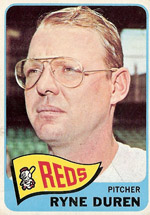
Ryne Duren played a key role in nearly derailing the Cardinals’ National League pennant bid in 1964.

Duren was a hard-throwing, hard-drinking pitcher with the Yankees from 1958-61. In 1964, he was 35 and a middle-innings reliever with the Reds.

On Sunday morning, Sept. 20, 1964, the Cardinals were in second place, 5.5 games behind the Phillies and a game ahead of the Reds. Most figured St. Louis needed a win that afternoon in Cincinnati to keep alive its hopes of catching the Phillies and prevent the Reds from moving into a tie for second.

Ken Boyer’s two-run triple, solo home runs from Lou Brock and Dick Groat and a successful squeeze bunt by Bill White put St. Louis ahead 5-0 after three innings. When Mike Shannon led off the fourth with a home run, Reds starter Joe Nuxhall was replaced by Duren.

With St. Louis ahead 6-0, the Reds appeared beaten.

“I looked around the dugout and everyone was really down,” Duren told author Doug Wilson in the book “Fred Hutchinson and the 1964 Cincinnati Reds.”

“I got mad and said to everyone on the bench, ‘If you don’t want to compete, let’s just go home, but if you’re out here, let’s have a little life.’ ”

Duren backed his words with action, on the mound and at the plate, and his efforts changed the momentum.

He pitched four scoreless innings and held the Cardinals to three hits.

In the fifth, with the score 6-1, Duren batted with Leo Cardenas on first and two outs. An .061 career hitter who wore thick lenses on his glasses because of poor sight in both eyes, Duren was “a terrible hitter,” his former Yankees manager, Ralph Houk, said in the book “Season of Glory.” According to Houk, Duren “choked way up on the bat and it was like he was using a hammer to hit a nail. He swung at the ball like that.”

Nonetheless, Duren was challenged by his Reds teammates to get on base.

“I made up my mind I would take one for the team, which I did,” Duren said.

Duren leaned across the plate as Cardinals starter Gordon Richardson delivered his pitch. The ball struck Duren on the upper thigh and he was awarded first base. The Cardinals protested vehemently to no avail.

“He didn’t even try to get out of the way,” Reds pitcher Sammy Ellis said. “And there’s no way he would have gotten a hit. He couldn’t even see.”

Inspired, the Reds rallied against the flustered Richardson. Pete Rose singled, scoring Cardenas. Duren and Rose scored on Vada Pinson’s single. When Duren got to the dugout, all the Reds were on their feet to greet him.

Cincinnati tied the score in the sixth. Ellis relieved Duren in the eighth and, in the bottom half of the inning, Cincinnati scored three runs against closer Barney Schultz and won 9-6.  Boxscore

“Frank Robinson (Reds outfielder) always gave me credit for waking the club up,” Duren said.

The Phillies beat the Dodgers that day and went into the final two weeks of the season with a 6.5-game lead over the Cardinals and Reds with 12 to play.

After that, the Phillies lost the next 10 in a row, Cincinnati won nine in a row and the Cardinals won 10 of their final 13. When the Phillies beat the Reds in the final two games, St. Louis won the title on the last day of the season.

Duren never pitched another game for the Reds after his performance against the Cardinals. He was released in April 1965 and pitched for the Phillies and Senators that season, the last of his big-league career.

Read Full Post »