Feeds:
Posts
Comments

Archive for the ‘Executives’ Category

Four weeks after experiencing one of his most satisfying feats _ a 1942 World Series title for a Cardinals team composed primarily of players developed within the minor-league system he created _ Branch Rickey left the organization.
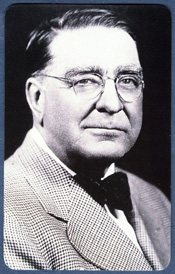
Though he had played a major role in the Cardinals becoming one of baseball’s best franchises, Rickey’s relationship with club owner and president Sam Breadon had deteriorated beyond repair.

On Oct. 29, 1942, Rickey, the Cardinals’ vice president and general manager, resigned and signed a five-year contract to become president and general manager of the Dodgers.

He left the Cardinals in good shape.

Benefitting from the farm system, the Cardinals had a pipeline of talent despite departures of players into military service during World War II. In their first four seasons after Rickey left, the Cardinals won three National League pennants (1943, 1944 and 1946) and two World Series titles (1944 and 1946).

Rickey, meanwhile, upgraded the Dodgers’ farm system _ his moves positioned Brooklyn to win six NL pennants in a 10-year stretch (1947-56) while the Cardinals had none in that period _ and prepared to make his most important contribution: integrating the major leagues by bringing Jackie Robinson to the Dodgers in 1947.

Golden magic

In 1917, Breadon was part of a group of St. Louis investors who bought the Cardinals from Helene Britton. The new owners lured Rickey from the American League Browns and put him in charge of baseball operations. Breadon became the Cardinals’ principal owner in 1920.

“Finding it impossible to compete in the open market for players, Rickey conceived the idea of finding prospects when they were young and planting them on minor-league clubs, or farms,” wrote J. Roy Stockton of the St. Louis Post-Dispatch. “Rival baseball operators laughed at the idea, but it worked with golden magic.”

From 1926-42, the partnership of Breadon and Rickey produced six NL pennants and four World Series titles.

For most of that time, Breadon and Rickey were an odd couple who worked well together.

“It was a strange partnership always, with each having a great respect for the ability of the other while their personalities, habits and views of extracurricular things were so diametrically opposed that there never was any strong bond of friendship between the partners,” Stockton wrote.

Ice formations

The relationship began to change in 1939 when the Cardinals got embroiled in a scandal.

Baseball commissioner Kenesaw Mountain Landis, who disliked Rickey, launched an investigation into the farm system and determined the Cardinals had violated rules by colluding to control minor-league franchises and their players.

Embarrassed, Breadon concluded Rickey had betrayed his trust.

According to Murray Polner, author of “Branch Rickey: A Biography,” Breadon “insisted his reputation had been stained, his honesty questioned” because of Rickey’s actions.

“To have the stigma broadcast by Landis, whom he loathed, was simply too much for Breadon to bear,” Polner wrote.

Breadon also was miffed with Rickey’s role in a managerial turnover. Frankie Frisch, a Breadon favorite, feuded with Rickey. Fed up, Rickey threatened to join the Cubs unless the Cardinals changed managers. In September 1938, Breadon reluctantly fired Frisch. Rickey hired a friend, Ray Blades, to replace Frisch. When the Cardinals started poorly in 1940, Breadon fired Blades without consulting Rickey.

“Persons close to the club had noticed a coolness developing between president and general manager in recent years,” Stockton wrote.

Time to go

In spring 1941, the relationship reached a breaking point. Breadon informed Rickey he wouldn’t renew his contract at the present terms when the pact expired in December 1942. Rickey was getting a yearly salary of $50,000 and a percentage of the club profits.

(The Post-Dispatch estimated Rickey received more than $1 million in salary and bonuses during his time with the Cardinals.)

Looking ahead to when his contract would expire at the end of 1942, Rickey began to plot an exit.

The 1942 Cardinals won 106 games during the regular season and edged the Dodgers, who won 104, for the pennant. When the Cardinals won four of five against the Yankees to earn the World Series crown, Rickey said it was the happiest moment of his life “because it was a victory for his boys, young men who, with only a few exceptions, were products of the now far-flung chain store system Branch had fathered and developed,” the Post-Dispatch reported.

The Dodgers, seeking a team president to replace Larry MacPhail, who was commissioned into the Army as a lieutenant colonel, contacted Rickey, 60, after the World Series. Rickey’s son was head of the Dodgers’ farm system.

Rickey also was approached by the Browns, who made a surprisingly lucrative offer. “Under its terms, Rickey might have made stock arrangements that would have netted him as much as $100,000 in little more than a year,” The Sporting News reported.

Said Browns owner Donald Barnes: “We went the limit trying to keep Mr. Rickey in St. Louis … We probably went higher in our offer than present conditions would justify. We wanted him that badly.”

Tempted to remain in St. Louis, Rickey came “very, very close” to signing with the Browns, The Sporting News wrote.

However, because the Cardinals and Browns had their offices at Sportsman’s Park and played their games there, Rickey and Breadon would have had to work in close proximity to one another. “Sam and Branch could no longer live in the same ballpark,” The Sporting News concluded.

Rickey notified Breadon in a telegram that he was joining the Dodgers.

Saying he wished Rickey “all the luck in the world,” Breadon told the Post-Dispatch, “We hardly ever had a hard word … If we failed to agree on a policy, we would iron it out. We never had any hard feelings. There are none now.”

Because of federal wartime restrictions on income, Rickey agreed to a yearly salary with the Dodgers of $35,000, but he negotiated a bonus plan in which he “stands a good chance of drawing close to a quarter of a million dollars” over the length of the contract, The Brooklyn Daily Eagle reported.

Breadon decided to divide Rickey’s duties among various Cardinals personnel rather than hire a replacement.


Read Full Post »

(Updated March 5, 2022)

Though given an offer he called the best he’d ever received, Gene Mauch rejected a chance to manage the Cardinals.

In August 1980, when Whitey Herzog was promoted from manager to general manager of the Cardinals, Mauch was Herzog’s choice to replace him.
If Mauch had accepted the offer, he might have earned the prize that eluded him.

Mauch, who would manage for 26 years in the major leagues, never led a team to a league pennant or World Series championship. Two years after Mauch turned down the Cardinals, Herzog managed the team to the 1982 National League title and World Series crown.

Whether the Cardinals would have achieved the same with Mauch as their manager is conjecture, but it is a fact Herzog wanted to give him the opportunity.

Wanted: Type A

In June 1980, with the Cardinals’ record at 18-33, manager Ken Boyer was fired and replaced by Herzog. Two months later, Cardinals general manager John Claiborne was fired and replaced by Herzog. Red Schoendienst, Cardinals coach and former manager, was named interim manager for the rest of the season.

Cardinals owner Gussie Busch elevated Herzog to the general manager role because he believed a roster overhaul was needed to make the club a contender and he wanted Herzog to oversee the rebuilding job.

One of Herzog’s first tasks was to find a manager.

“The players are too passive … I want the players to be more aggressive,” Herzog said to the St. Louis Post-Dispatch. “One quality I’ll be looking for in a manager is someone who is aggressive himself.”

The first candidate Herzog contacted was Mauch. “I do know he’s a fine manager _ I managed against him _ and he has a great baseball mind,” Herzog said.

Mauch, 54, was available because he had resigned as Twins manager in August 1980.

After Mauch joined the Twins in 1976, the organization severed ties with several of their best players through trades (Rod Carew, Bert Blyleven) or free agency (Larry Hisle, Bill Campbell). Mauch led the Twins to winning records in three of his first four seasons, but they had a 54-71 mark in 1980 when he chose to leave rather than return for the final year on his contract.

“I’ve had some bad teams _ teams that were bad enough to gag a maggot _ but even those teams were able to steal some games by executing,” Mauch told The Sporting News. “This season, we have lost because of a failure to execute.”

Mauch, an infielder, played nine seasons in the big leagues, including seven games with the 1952 Cardinals.

At 34, he was named manager of the Phillies in 1960. Four years later, Mauch had the Phillies in first place _ a 6.5-game lead with 12 to play _ but the team lost 10 in a row and finished a game behind the champion Cardinals.

Mauch managed the Phillies for nine years (1960-68), Expos for seven (1969-75) and Twins for five (1976-80).

He and Herzog competed in the same division, the American League West, from 1976-79 when Herzog managed the Royals.

Change of plans

Asked by Rick Hummel of the Post-Dispatch in September 1980 whether he was interested in becoming Cardinals manager, Mauch replied, “Let me say this: If I take another managing job, it will have to be with a team which has a chance to win. I think the Cardinals have a chance to win.”

Hummel concluded, “Mauch … would be Herzog’s type of manager. The Cardinals are in need of a demanding, tough-guy sort of leader.”

By early October, just before the 1980 regular season ended, Herzog’s top two choices for the managerial job became clear:  Mauch and Dick Williams.

Williams, manager of the Expos, was under contract to them for 1981, but there was published speculation the club could be considering a change. Williams was a St. Louis native and, like Mauch, an experienced manager with a no-nonsense approach. He had managed the 1967 Red Sox to a pennant and he had led the Athletics to World Series championships in 1972 and 1973.

When it became evident Williams would stay with the Expos, Herzog offered the job to Mauch.

“It is no secret that Mauch was Herzog’s first choice for the job,” Hummel wrote in the Post-Dispatch.

Unsure he was ready to manage again, Mauch declined.

Recalled Herzog: “He said, ‘I don’t want you to hold off on me. It’s probably the best offer I’ve ever had, but I just don’t feel like I want to do it.’ ”

Herzog also confirmed to Larry Harnly of The State Journal-Register of Springfield, Ill., that Mauch had turned down the Cardinals’ offer.

With Mauch and Williams unavailable, Herzog decided to hire himself.

On Oct. 24, 1980, the Cardinals announced Herzog would have the dual role of general manager and manager. Herzog hired his friend, Joe McDonald, former general manager of the Mets, to be executive assistant/baseball and take care of the administrative and business duties while Herzog focused on baseball matters.

(Herzog’s first choice for the assistant’s role had been Bing Devine, who had served two stints as Cardinals general manager, but Lou Susman, attorney for club owner Gussie Busch, opposed the move and blocked it, according to Hummel in the Post-Dispatch.)

Four months later, in February 1981, Mauch was named director of player personnel for the Angels.

“I had offers to manage four clubs this winter,” Mauch said. “If I wanted to manage, I’d be in one of those places. Right now, I don’t want to manage.”

According to Dave Anderson of the New York Times, Mauch turned down offers to manage the Padres, Giants and Mariners, in addition to the Cardinals.

In May 1981, the Angels fired manager Jim Fregosi _ and replaced him with Mauch.

Read Full Post »

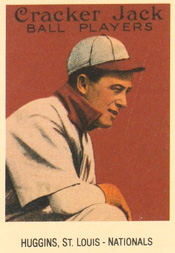
Though the Cardinals were cash poor and never had won a National League pennant, their outlook was hopeful in 1917 because the top two leaders of their baseball operations, Branch Rickey and Miller Huggins, were among the best in the business.

Rickey, the Cardinals’ president, and Huggins, their manager, were smart, innovative and effective. Both would build careers that would earn them election to the Baseball Hall of Fame.
They worked together, however, for just one season in St. Louis.

Rickey and the Cardinals wanted Huggins to stay. Rickey, however, was the decision-maker on all key baseball matters _ a role Huggins wanted. Huggins also felt he’d been misled when denied a chance to become part of the ownership group.

On Oct. 25, 1917, Huggins left the Cardinals to become manager of the Yankees. With a lineup anchored by Babe Ruth and Lou Gehrig, Huggins managed the Yankees to six American League pennants and three World Series titles.

Rickey went on to build the first minor-league system, establishing a steady supply of affordable talent that transformed the Cardinals from a lackluster franchise into an elite one.

Front-office intrigue

Huggins, who, like Rickey, earned a law degree, played in the major leagues as a second baseman for the Reds (1904-09) and Cardinals (1910-16).

A favorite of team owner Helene Britton, Huggins became player-manager in 1913. In that role, Huggins made all the important baseball decisions, including acquisition of players. His friend and most trusted scout, St. Louis native Bob Connery, discovered the future Hall of Famer, Rogers Hornsby, and brought him to the Cardinals.

After the 1916 season, Britton decided to sell and she promised Huggins he would have first chance to buy the franchise. Huggins was friends with the owners of the Fleischmann’s Yeast company of Cincinnati and they planned to bankroll his bid to purchase the Cardinals.

When Britton’s attorney, James C. Jones, learned of his client’s intentions, he organized a St. Louis group of investors, who included auto dealer Sam Breadon, and convinced her to sell the Cardinals to them. Jones was named chairman of the club. Needing someone to run the baseball side of the business, the group hired Rickey from the crosstown American League Browns and named him president.

As the St. Louis Post-Dispatch noted, the new management structure “placed over (Huggins) a man who did all the club’s business of finding and hiring players and left Huggins nothing to do but to direct them. Furthermore, with Rickey as president, getting a $15,000 salary, or twice the sum Huggins received, friction was inevitable.”

Though stung by the sale of the team and by the emergence of Rickey as baseball boss, Huggins managed the Cardinals to an 82-70 record and third-place finish in 1917. Those were the most wins in a season for the franchise since 1899 and just the second time the club finished as high as third place in the National League.

“The fact that he had suffered a bitter disappointment in not being given a chance to buy the club himself _ a chance promised him by Mrs. Britton _ did not interfere with his services” to the 1917 Cardinals, the Post-Dispatch proclaimed.

Bidding game

After the 1917 season, Rickey offered Huggins a salary of $10,000, plus 10 percent of all club profits over $25,000, to remain Cardinals manager in 1918, the Post-Dispatch reported

Huggins. who made a counter offer, told the St. Louis Star-Times that Rickey “failed to meet my terms.”

Rickey said Huggins “seemed to agree with me that the percentage above $25,000 was fair in these days of inflated baseball salaries, but managers, like players, are seeking more money every day. I felt that in justice to my board of directors that I could offer Huggins no greater percentage of the club’s profits.”

Huggins accepted a Yankees offer of a two-year contract at $12,000 per year. According to a report in the Post-Dispatch, the Yankees also agreed to pay Huggins “a small percentage of the profits of the club.”

Noting that Huggins “has put up with a world of inconveniences and misfits” as Cardinals manager, the Star-Times opined, “Huggins has made a great leader for the Cardinals and has been very much unappreciated … There is no doubt that Huggins is one of the smartest fish in baseball. The wisest men on the diamond will tell you that.”

Right move

Huggins replaced Bill Donovan, who managed the Yankees to a 71-82 record in 1917. The Yankees had losing records in two of Donovan’s three seasons.

“I had no quarrel with the St. Louis club and I’m leaving the Cardinals under the most friendly circumstances and with the best of wishes for their success,” Huggins said. “The club made me an offer to remain, but I left because I felt that I could do better (in New York).”

Rickey added, “I can only say that my best wishes go with Huggins and that he is a great field general _ one of the best I have ever known. We hold no grievance against him.”

The Sporting News concluded, “Rickey understood that it was not entirely a money proposition with Huggins. The opportunity to lead a club in New York, where he would be in supreme charge of the makeup and handling of his team, was bound to appeal to any ambitious baseball man.”

Huggins managed the Yankees for 12 years (1918-29) and had a 1,067-719 mark. Including his Cardinals years, Huggins had 1,413 career wins.

Rickey replaced Huggins with a manager from the minor-league Indianapolis Indians, Jack Hendricks, and it was a disaster. The Cardinals finished 51-78 in 1918. Rickey took over as manager the following year.

Previously: How Branch Rickey escaped Browns, joined Cardinals

Read Full Post »

(Updated April 5, 2025)

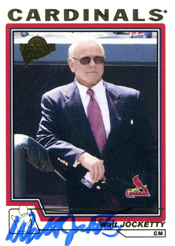
General manager Walt Jocketty, whose trades transformed the Cardinals into perennial contenders, was the victim of an internal management mess.

Cardinals owner Bill DeWitt Jr. became enamored of a data-driven consultant, Jeff Luhnow, who had business acumen. DeWitt brought Luhnow onto the management team, promoted him and put him in charge of the Cardinals’ player development group.

In essence, Jocketty was head of major-league baseball operations and Luhnow became head of minor-league baseball operations.

The problem was DeWitt did this without gaining the support of Jocketty. Though Luhnow reported to Jocketty, their relationship was icy _ Luhnow was DeWitt’s guy, not Jocketty’s _ and created division and tension throughout the front office.

DeWitt expected Jocketty and Luhnow to work out their differences and create organizational harmony.

Feeling undercut and underappreciated, Jocketty couldn’t work collaboratively with a baseball newcomer with whom he had wide philosophical differences.

DeWitt had said he hired Luhnow to be a “problem solver.”

The problem-maker, in DeWitt’s view, was Jocketty.

On Oct. 3, 2007, DeWitt surprised nearly everyone by firing Jocketty. The dismissal came a year after the Cardinals had won their first World Series championship in 24 seasons.

Redbirds revived

In 1994, when Anheuser-Busch owned the Cardinals, Jocketty was hired to replace Dal Maxvill as general manager. At the time, Jocketty was assistant general manager of the Rockies.

A year later, in 1995, Jocketty hired Tony La Russa to be the Cardinals’ manager. Jocketty and La Russa had worked together in the Athletics organization.

In 1996, a group led by DeWitt completed the purchase of the Cardinals from Anheuser-Busch.

With new ownership expressing a commitment to winning, Jocketty and La Russa went to work rebuilding a Cardinals club that hadn’t been to the postseason since 1987 and hadn’t won a World Series championship since 1982.

After qualifying for the postseason once in their first four years together, the leadership team of DeWitt, Jocketty and La Russa got the Cardinals into the postseason six times in a seven-year stretch from 2000-2006. The 2006 team won the World Series title.

Jocketty largely was responsible for the turnaround. His trades brought talent such as Mark McGwire, Jim Edmonds, Scott Rolen, Edgar Renteria, Darryl Kile, Woody Williams, Larry Walker and Adam Wainwright, to name just a few.

In an interview with Cardinals Yearbook in 2014, La Russa said, “Walt is an excellent example of a leader who has a great heart and is good with people. He is smart, knows the game of baseball and has the necessary toughness.”

Front office duel

Though the Cardinals had become successful, DeWitt determined the organization needed a different approach to scouting and player development. DeWitt hired Luhnow in October 2003 for the newly created position of vice president for baseball development.

Luhnow and Jocketty clashed. Communication between Luhnow and Jocketty and their staffs broke down.

“There was basically a difference of philosophy,” Jocketty said to the St. Louis Post-Dispatch. He added, “It’s not a way I’m comfortable operating.”

Luhnow said, “I wasn’t trying to cram things down people’s throats,” but added, “I have definitely stimulated a lot of debate since I’ve been here.”

John Mozeliak, Cardinals assistant general manager, was placed in the uncomfortable role of being the conduit between Jocketty and Luhnow.

“(Mozeliak) has done a very good job of staying above the fray,” DeWitt said.

Said Cardinals president Mark Lamping: “(Mozeliak) was sometimes torn between two factions within baseball operations. Tough job for anybody to do that.”

Divorce court

After the championship high of 2006, the Cardinals finished with a losing record (78-84) in 2007.

On Oct. 3, three days after the end of the 2007 season, Jocketty was called to a morning meeting at DeWitt’s house in Clayton, Mo. During the 45-minute session, DeWitt, saying it was “time to move forward with undivided vision and purpose,” fired Jocketty, though the owner chose to frame the departure as a mutual decision. DeWitt said he and Jocketty “were in agreement our relationship … had likely run its course.”

Joe Strauss of the Post-Dispatch cited “a widening front office split” and “Jocketty’s refusal to embrace the new structure” as reasons for DeWitt’s decision.

“I don’t think it played out where we could close the divide,” DeWitt said. “There had been a divide from prior years, but not as severe as it became.”

Said Lamping: “A division within baseball operations continuing without a common purpose just doesn’t work.”

Tangled web

Jocketty had a year remaining on his contract and DeWitt said he would pay him the $1 million in salary for 2008.

Jocketty asked DeWitt to hold off announcing the dismissal to the media until he had a chance to tell his son, a high school junior, who turned 17 that day. DeWitt agreed. The announcement was made at 3 p.m.

Soon after Jocketty departed the meeting, DeWitt called La Russa at his residence in California. La Russa said he was “surprised and disappointed” by Jocketty’s departure. “I thought Walt would be back,” said La Russa.

Reflecting on his relationship with Luhnow, Jocketty said, “There are probably things I could have done and should have done to try and make it work better, but I wasn’t comfortable. I didn’t do it.”

Regarding his tenure from 1994-2007, Jocketty said, “We’ve had one of the most successful eras in Cardinals history. I hope that is how it is remembered.”

Three weeks after the shakeup, La Russa, surprising some, signed to return as Cardinals manager. On Oct. 31, Mozeliak was named to succeed Jocketty.

La Russa and Mozeliak led the Cardinals to a World Series championship in 2011.

Jocketty became general manager of the Reds in 2008 and went on to serve the club in a variety of executive roles.

Luhnow left the Cardinals in December 2011 to become general manager of the Astros. Four years later, it was learned a member of the Cardinals front office unlawfully had hacked into the Astros’ database. In 2016, Cardinals scouting director Chris Correa pleaded guilty to the crime and was sentenced to prison.

On Jan. 13, 2020, the Astros fired Luhnow and manager A.J. Hinch after the two were suspended for the 2020 season by Major League Baseball for their roles in a scandal involving the stealing of signs opposing catchers flashed to pitchers.

Read Full Post »

In a move that shifted the balance of baseball power in St. Louis, Branch Rickey left the American League Browns and joined the National League Cardinals.

branch_rickey2On March 20, 1917, Rickey, the Browns’ business manager, became president of the Cardinals.
Rickey’s departure was fought by Browns owner Phil Ball, even though the two men didn’t get along.

At the time, the Browns were the dominant baseball franchise in St. Louis.

Under Rickey, the Cardinals would transform from a lackluster franchise into an elite one.

Meet the new boss

In 1915, Rickey served the dual roles of Browns manager and assistant to team owner Robert Hedges. Rickey performed many of the duties of a general manager.

After the 1915 season, Hedges sold the Browns to Phil Ball. One of Ball’s first moves was to hire Fielder Jones, former White Sox manager, to be manager of the Browns and reassign Rickey to the position of business manager.

In his 1982 book “Branch Rickey: A Biography,” author Murray Polner wrote Rickey and Ball “took an instant dislike to one another.”

“Ball thought Rickey’s ideas too radical and Rickey’s endless talk and large vocabulary made him uncomfortable,” Polner wrote. “Rickey was, in turn, uncomfortable with Ball’s crudeness. He considered Ball uncouth and, in matters of baseball, virtually illiterate.”

According to Rickey, Ball agreed to honor Rickey’s contract, but told him he wouldn’t stand in his way if Rickey wanted to leave.

First choice

The 1916 Browns entered September four games out of first place and finished with a 79-75 record.

The 1916 Cardinals were a mess and finished in last place at 60-93. Ownership was strapped for cash and had trouble paying bills.

On March 5, 1917, Cardinals owner Helene Britton sold the club for $375,000 to a consortium of investors led by former team president James C. Jones.

Jones and the investors polled a group of seven St. Louis journalists for their advice on who should be hired to run the baseball operations.

The response was unanimous: Rickey.

Lucrative offer

Jones offered Rickey a three-year contract at $15,000 per year to be Cardinals president, according to the St. Louis Star. Rickey, who was to be paid $7,500 as Browns business manager in 1917, went to Ball and asked to be released from his contract.

Rickey said he received absolute assurance from Ball on March 19, 1917, that he could negotiate for a job that would better his position, the St. Louis Post-Dispatch reported.

A day later, Rickey accepted the Cardinals’ offer and signed a contract with them, according to a Page 1 story in the Post-Dispatch.

Ball, though, was having second thoughts.

Baseball battle

Ban Johnson, president of the American League, didn’t want Rickey going to a club in the rival league, Rickey said. Johnson pressured Ball to stop Rickey from joining the Cardinals.

Displaying a Browns contract Rickey signed for 1917, Ball told the Post-Dispatch, “I will insist that he fulfill his agreement.”

“Rickey seems to be confused over certain promises I made to him when he signed this (Browns) contract,” Ball said. “I promised Rickey … I would also help him in bettering himself if any opportunity offered itself for him apart from baseball.

“I at no time had the notion that he would consider this offer applicable to any proposition he might receive from one of my competitors,” Ball said. “My idea was that should Rickey care to enter the law business in St. Louis I would give him every assistance that I could.”

Ball went to court and received a restraining order that prohibited Rickey from working for the Cardinals until a hearing could be held before a judge.

In the Post-Dispatch, columnist John Wray wrote, “The battle between Rickey and Ball … seems a useless waste of time and money in which the only persons to come out of the conflict with all the honors _ and considerable cash _ will be the attorneys.”

The St. Louis Star opined, “Squeamish people who have doubted that Rickey will be allowed to preside over the Cardinals on account of a prior contract with the Browns are now inclined to view the position of Rickey as one that will impregnably withstand legal assault.”

Let’s make a deal

On April 6, 1917, the day a hearing was to be held, a settlement was reached that allowed Rickey to join the Cardinals.

“Rickey agreed to the terms of the settlement only after much persuasion,” the Post-Dispatch reported. “He and his personal attorney, George Williams, were very eager to bring the case to trial, but they were persuaded in the end, for the good of baseball, to accept the settlement out of court as proposed by Ball’s lawyers.”

Though the Cardinals under Rickey improved significantly in 1917 _ they finished in third place at 82-70 _ it wasn’t until Sam Breadon became principal owner in 1920 that the franchise had the backing it needed to solidify and blossom.

Supported by Breadon, Rickey built professional baseball’s first farm system, providing the Cardinals with a steady supply of talent trained under a shared organizational philosophy.

Rickey, who had returned to the field as Cardinals manager in 1919 while still running the administrative baseball operations, was put back in the front office by Breadon fulltime in May 1925 and the Cardinals won their first pennant and World Series championship the next year.

Previously: The story of Branch Rickey and his final journey

Read Full Post »

(Updated May 26, 2020)

Looking to build on a reputation as a keen talent evaluator and decision-maker, Ted Simmons left a front-office job with the Cardinals for an executive position with a National League division rival.

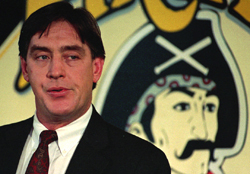
ted_simmons19On Feb. 5, 1992, Simmons, 42, resigned as Cardinals director of player development and accepted an offer to become general manager of the Pirates.

Emerging from a field of finalists that included Walt Jocketty, Simmons got the job because of the work he had done in improving the Cardinals farm system and because of his connections with Pirates president Mark Sauer.

Simmons’ rise was derailed, however, when, 16 months after becoming general manager, he suffered a heart attack and resigned.

Talent show

Elected to the Baseball Hall of Fame in December 2019, Simmons, a catcher, played 13 seasons (1968-80) for St. Louis, batting .298 and producing 1,704 hits and 929 RBI in 1,564 games.

In 1988, after Simmons finished his playing career with the Braves, he rejoined the Cardinals as head of their minor-league system.

Ray Lankford, Bernard Gilkey and Todd Zeile were among the prospects who developed into Cardinals players during Simmons’ tenure, enabling St. Louis to replace Willie McGee, Vince Coleman and Terry Pendleton.

Donovan Osborne, John Mabry and Dmitri Young were drafted by the Cardinals while Simmons was farm director.

Sauer, an Anheuser-Busch executive, joined the Cardinals as deputy chief operating officer and learned the baseball operation from Simmons.

Sauer was promoted to Cardinals executive vice president and chief operating officer in 1990. He left in October 1991 to become president and chief executive officer of the Pirates.

Search for success

Three months after he arrived in Pittsburgh, Sauer fired general manager Larry Doughty. Though the Pirates had won division titles in 1990 and 1991, Sauer was dissatisfied with the quality of the farm system under Doughty.

In his search for a general manager, Sauer identified five finalists. In addition to Simmons, they were:

_ Cam Bonifay, Pirates assistant general manager.

_ Bill Lajoie, former Tigers general manager.

_ Murray Cook, former general manager of the Yankees, Reds and Expos.

_ Walt Jocketty, director of baseball administration for the Athletics.

Simmons interviewed with Sauer in late January 1992. Simmons told Dan O’Neill of the St. Louis Post-Dispatch the session was “thorough, intense and in-depth.”

Eliminating Jocketty (who two years later would become general manager of the Cardinals) and Cook, Sauer pared the list to Simmons, Lajoie and Bonifay.

Lajoie, a scout with the Braves, was the preferred choice of Pirates manager Jim Leyland. When he was scouting director of the Tigers, Lajoie was a mentor to Leyland, who had been a player and manager in Detroit’s farm system.

Simmons told the Post-Dispatch he thought Bonifay would get the job.

Earned reward

Simmons was in a meeting when Cardinals chief executive officer Stuart Meyer came in and told him to expect a call from Sauer. A short while later, Sauer asked Simmons to be general manager.

Sauer described Simmons as “an outstanding evaluator of young talent” and “a good communicator.”

Asked whether their friendship was a factor in hiring Simmons, Sauer told the Pittsburgh Press, “My experience with Ted gives me a comfort level and confidence in what he can do, but this was not an issue of friendship. What I think made Ted the best choice was his demonstration of skills in the area of developing players in St. Louis.”

Said Simmons: “There’s no question Mark and I are friends, but there is also no question that during the time I was with Mark in St. Louis he was my boss … If I thought I stood here as general manager of the Pirates because I was Mark’s friend, No. 1, I would be embarrassed; No. 2, I would be ashamed.”

Simmons departed the Cardinals with the respect of general manager Dal Maxvill and manager Joe Torre.

“I’m extremely happy for him,” said Maxvill. “We had a great relationship. He was very loyal to me and to the organization. You couldn’t ask for better than Teddy.”

Said Torre: “He never does anything halfway.”

Pressure in Pittsburgh

Dedication and drive were qualities that helped Simmons get the job. Those attributes could become negatives, though, if not kept in check.

In their praise of Simmons, Maxvill and Sauer unintentionally foreshadowed trouble.

“His skin will have to be thick,” Maxvill said. “You can’t get too excited or too upset … You have to not let things bother you and just try to do the best you can and the best for the ballclub. I think he knows that.”

Said Sauer: “He’s very consumed with baseball. He lives and breathes baseball on many different layers.”

The Pirates won a third consecutive division title in Simmons’ first year as general manager. They were on the verge of clinching the 1992 pennant until the Braves rallied for three runs in the ninth and won Game 7 of the NL Championship Series.

With ownership putting pressure on Sauer and Simmons to cut payroll, the Pirates’ best hitter, Barry Bonds, and best pitcher, Doug Drabek, became free agents and left. Second baseman Jose Lind was dealt to the Royals for prospects.

Simmons, who smoked two to three packs of cigarettes a day, was tasked with trying to rebuild from within the organization.

Medical emergency

On June 8, 1993, Simmons, 43, was working in his office when he was stricken with a heart attack.

“I thought I was going to die,” Simmons told the Pittsburgh Post-Gazette.

“It was tolerable pain in my chest and between my shoulder blades. It was acute, intolerable pain in my upper left arm. I knew what was happening.”

Simmons called the team trainer, who got Simmons to a car and drove him to a hospital. Simmons underwent an emergency angioplasty operation to re-open a completely blocked artery to his heart.

Two weeks later, on June 19, 1993, Simmons was back at the ballpark when he announced he was resigning to focus on his health.

Sauer promoted Bonifay to the position of general manager.

In an interview in 2020 with Stan McNeal of Cardinals Gameday Magazine, Simmons said, “I’m very proud of my time in Pittsburgh because it was a very difficult time for the franchise. By getting payroll down like I did, that was essentially the first step of what was a four-step process that led to their new ballpark.”

Simmons said he stopped smoking the day he went into the hospital: “You know what helped me? I was in intensive care, and one of the nurses was a smoker. She had that cigarette smell on her clothes, in her hair, and it dawned on me: That’s how I’ve been stinking all these years.”

Read Full Post »

« Newer Posts - Older Posts »