Feeds:
Posts
Comments

Archive for the ‘Executives’ Category

(Updated April 30, 2023)

From a public relations perspective, the trade of Ken Boyer from the Cardinals to the Mets was a disaster. From a baseball perspective, it was a marquee deal that produced mixed results.

ken_boyer11On Oct. 20, 1965, the Cardinals traded Boyer, their third baseman and cleanup batter, to the Mets for pitcher Al Jackson and third baseman Charlie Smith.

Cardinals general manager Bob Howsam made the trade because he indicated he believed Boyer, 34, was in decline and the club needed pitching and speed to adapt to their spacious new downtown stadium in 1966.

Howsam said Jackson, 29, bolstered the rotation, and he saw Smith, 28, as a more agile third baseman than Boyer with more power potential.

Bing Devine, former Cardinals general manager who was special assistant to Mets president George Weiss, advocated for New York to acquire Boyer as much for his leadership and professionalism as for his ability to produce runs and stabilize the third base position.

In their first four seasons after entering the National League as an expansion team in 1962, the Mets developed a reputation as a clownish club. Devine envisioned Boyer as a player who could help change that perception.

Ham-handed Howsam

The trade was unpopular with many Cardinals fans. Boyer was Cardinals royalty. In handling the trade callously, Howsam appeared to treat Boyer disrespectfully.

Boyer, who signed with the Cardinals as an amateur free agent in 1949, played 11 seasons for St. Louis (1955-65) and was named an all-star seven times.

He also won the Gold Glove Award five times and earned the NL Most Valuable Player Award in 1964, when he produced 24 home runs, 119 RBI and 100 runs in leading the Cardinals to a pennant and World Series title. Overall, Boyer had 1,855 hits in 1,667 career games with the Cardinals, including 255 home runs and 1,001 RBI.

Boyer learned of the deal in a phone call with reporter Jack Herman of the St. Louis Globe-Democrat.

“You’re kidding,” Boyer said when told of the trade. “That’s really something.

“Seventeen years is a long time (with one organization). I don’t know what to think right now. I wouldn’t be truthful if I didn’t say I was sorry to be leaving.”

The Sporting News reported “various Cardinals officials tried to contact” Boyer to tell him about the trade, but Cardinals fans concluded management, especially Howsam, didn’t try hard enough.

“As soon as the Boyer deal became public property, Cardinals fans touched off a storm,” The Sporting News reported. “They swamped all the news media and even tried to get through to Cardinals general manager Bob Howsam to register protests and threats to cancel tickets.”

The furor was comparable to the uproar that ensued when the Cardinals traded popular standouts such as Rogers Hornsby, Enos Slaughter and Red Schoendienst.

Support from Stan

Schoendienst, who completed his first season as Cardinals manager in 1965, endorsed the trade of Boyer. “We’re sorry to see Kenny go, but good left-handed pitchers are few and far between,” Schoendienst told the Associated Press. “Smith can drive in the runs and is an improved fielder.”

Stan Musial, a Cardinals vice president in 1965, told United Press International the trade was a “good deal” for St. Louis. Musial was impressed by Jackson. “Al is a good competitor,” Musial said. “That guy can beat the tough clubs.”

Said Howsam: “We hate to see a player of Ken’s caliber go, but we had a chance to get a man in Smith who is a power hitter and good fielder, and a fine starting pitcher in Jackson. We felt we couldn’t pass it up.”

Developing a deal

Initially, the Cardinals talked with the Astros about a deal that would have featured Boyer for third baseman Bob Aspromonte. The Mets had been discussing with the Angels a trade of Jackson and Smith for outfielder Jose Cardenal.

When those talks stalled, The Sporting News reported, the Cardinals and Mets struck their deal.

Jackson earned a franchise-leading 40 wins in his four seasons with the Mets. In 1965, Jackson was 8-20 with a 4.34 ERA.

Smith, who played for the Dodgers, Phillies and White Sox before joining the Mets, hit .244 in 1965. His power numbers that season (20 doubles, 16 home runs, .393 slugging percentage) were better than those produced in 1965 by Boyer (18 doubles, 13 home runs, .374 slugging percentage).

“I think I’ll be able to help the Mets,” Boyer said. “The sentiment is gone for the Cardinals … It will strictly be on a business basis now.”

Boyer led the 1966 Mets in RBI (61) and doubles (28) and was second on the club in home runs (14).

In his autobiography, “Cleon Jones: Coming Home,” Mets outfielder Cleon Jones said, “Ken Boyer was an icon, the very best at what he did at his position. Ken Boyer was one of the greatest third basemen to play the game. He was a great defensive player, an offensive force and became a great teammate.

“He was the kind of guy who would always reach out to his teammates. He could talk about the game in a way that made you feel like you belonged in the league, that you could do it because he wasn’t talking to you about what you did wrong but about how you have to be prepared to be successful. That was one of the bright spots in my early career. to have Ken Boyer as a teammate and to watch him go out on the field and perform like he did.”

Al Jackson was second to Bob Gibson in wins (13), complete games (11) and innings pitched (232.2) for the 1966 Cardinals. He had nine wins for the 1967 World Series champion Cardinals, then was dealt back to the Mets.

Charlie Smith had 104 hits and struck out 81 times in 116 games for the 1966 Cardinals. He produced 10 home runs and 43 RBI. After the season, Smith was traded to the Yankees for Roger Maris and was replaced at third by Mike Shannon.

 

Read Full Post »

Seeking a general manager who could turn the Cardinals from flops into champions, team owner Gussie Busch sought the advice of the leader of the publication considered the authority on baseball.

frank_laneAs the 1955 season neared its end, Busch asked J.G. Taylor Spink, publisher of The Sporting News, to recommend the best general manager to hire. Spink suggested Frank Lane of the White Sox.

In September 1955, Lane resigned from the White Sox and sent a telegram to Busch. The wire read: “Have tux, will travel.”

On Oct. 6, 1955, Busch hired Lane to be general manager of the Cardinals.

In a column for The Sporting News, Spink wrote of Lane’s hire, “Probably the most exciting chapter in the history of St. Louis baseball is about to be enacted … The Cardinals will have a team that will win more games _ or the players who lose won’t be around long.”

Taking a trader

Busch bought the Cardinals in 1953 and appointed one of his Anheuser-Busch executives, Dick Meyer, as general manager. Meyer was better suited to run the business side of the franchise rather than the baseball operations side.

As the Cardinals headed to a 68-86 record and next-to-last finish in the National League in 1955, Busch wanted a general manager with a proven record of producing a winner.

Lane, a longtime baseball executive, became general manager of the White Sox after they finished the 1948 season in last place at 51-101. He improved the White Sox through trades and they posted 89 wins in 1953, 94 in 1954 and 91 in 1955.

In seven seasons (1949-55) with the White Sox, Lane made 241 trades involving 353 players, earning the nickname “Trader.”

Rich resources

Busch sent Meyer to New York to begin negotiations with Lane during the 1955 World Series between the Dodgers and Yankees. That led to a follow-up meeting involving Busch, Lane and Meyer in St. Louis.

The Cardinals signed Lane, 59, to a three-year contract. Meyer was promoted to executive vice president. Bill Walsingham Jr., a Cardinals vice president for nine years, resigned, acknowledging the club didn’t need two vice presidents.

Busch gave Lane “full authority” to make all baseball decisions.

“I had three offers but only considered one of them _ the job with the St. Louis club,” Lane said. “Why? Because the Cardinals have the potential for a great club and I know the management has the wherewithal to get what it needs if it doesn’t have what it takes to win.

“I don’t think I’m going too far when I say we should be a first division club and quite possibly a contender if we made the deals needed to augment an already fine nucleus of talent.”

Asked if any Cardinals players were untouchables for trading, Lane replied, “Yes. We’ll start with Stan Musial, then add Red Schoendienst, Bill Virdon, Wally Moon, Ken Boyer, Harvey Haddix and a few others.”

Lane identified the Cardinals’ top needs as a first baseman, catcher and pitching.

His first major move was to replace manager Harry Walker with Fred Hutchinson, the former Tigers manager.

Bad deals

According to Bob Broeg in the book, “Redbirds: A Century of Cardinals Baseball,” Lane would watch Cardinals home games from the roof outside the Busch Stadium press box, “squinting like a sun worshipper who didn’t see well and listening to the radio.”

“Lane lived for baseball, traveling always with a radio at his ear and a stack of newspaper sports sections under his arm,” Broeg observed.

Expecting magic, the Cardinals instead saw blunders in the trades Lane made in 1956. Among his worst deals that season:

_ Pitchers Harvey Haddix and Stu Miller to the Phillies for pitchers Murry Dickson and Herm Wehmeier.

_ Center fielder Bill Virdon to the Pirates for outfielder Bobby Del Greco and pitcher Dick Littlefield.

_ Second baseman Red Schoendienst and others to the Giants for shortstop Alvin Dark and others.

When Busch got wind of Lane’s plans to trade Musial to the Phillies for pitcher Robin Roberts, he blocked the deal, then told Lane that any future trade proposals would have to be approved by Busch and Meyer before being enacted.

The 1956 Cardinals finished in fourth place at 76-78.

Win or else

Before the 1957 season, Busch told a Knights of Columbus banquet audience, “If the Cardinals don’t win this year or next, Frank Lane will be out on his ass.”

Lane was miffed. Wanting assurances he had the owner’s support, Lane asked Busch to extend his contract beyond 1958. Busch refused.

Lane did make a couple of good trades before the 1957 season, acquiring pitcher Sam Jones from the Cubs and slugging outfielder Del Ennis from the Phillies. The Cardinals placed second in the NL in 1957 at 87-67.

Still upset by Busch’s win-or-else ultimatum before the season and offended that he had to get approval before making deals, Lane resigned in November 1957, with a year remaining on his Cardinals contract, and became general manager of the Indians.

Busch replaced Lane with Bing Devine.

Read Full Post »

(Updated June 23, 2020)

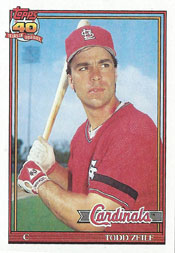
In June 1995, the Cardinals were a franchise in disarray. The depth of their dysfunction was revealed on one dismal day, June 16, when they fired their manager, Joe Torre, and traded their cleanup hitter, Todd Zeile.

todd_zeileRather than signal an inspiring beginning, the moves had the feel of surrender.

The termination of Torre largely was viewed as a lame effort to deflect attention from management’s shortcomings.

The trading of Zeile largely was viewed as spiteful.

A bad team

After being named Cardinals manager in August 1990, Torre led the Cardinals to winning seasons each year from 1991 through 1993. His best record was 87-75 in 1993. When the Cardinals fell to 53-61 in strike-shortened 1994, Torre’s friend, general manager Dal Maxvill, was fired and replaced by Walt Jocketty.

By then, the Anheuser-Busch ownership of the Cardinals seemed more interested in minimizing expense to enhance profitability than it did in investing in the team.

After splitting their first 18 games, the 1995 Cardinals lost 10 of their next 13 and fell to 12-19.

“This is a bad team and someone must pay the price,” columnist Bob Nightengale wrote in The Sporting News. “They don’t have a marquee power hitter. They’re awful defensively. They have no speed.”

Published reports indicated Cardinals president Mark Lamping was pressuring a reluctant Jocketty to appease a restless fan base by changing managers.

Cheap PR move

On the morning of June 16, with the Cardinals’ record at 20-27, Jocketty went to Torre’s home and informed him he was fired.

“It didn’t surprise me,” Torre told Rick Hummel of the St. Louis Post-Dispatch.

His overall record as Cardinals manager: 351-354. “We worked hard and we did a lot of things,” Torre said. “We just didn’t win enough.”

Said Jocketty: “We will not stand pat and let things keep going as they were.”

Unimpressed, Post-Dispatch columnist Bernie Miklasz concluded the Cardinals “dumped a classy guy, Torre, to feed the wolfpack.”

“All I see is a cheap PR move.” Miklasz wrote. “All I see is a twitch reflex from a panic attack.”

Change the dynamics

After considering Cardinals coaches Chris Chambliss and Gaylen Pitts as candidates to replace Torre, Jocketty chose director of player development Mike Jorgensen. “He is an intense guy … He’ll bring a little fire to the clubhouse as well as to the field,” Cardinals pitcher Tom Urbani said of Jorgensen. Said Jocketty: “I wanted to bring in someone who could change the dynamics a little.”

Jocketty, though, wasn’t done for the day. Next, he dealt Zeile.

Deal or no deal

Zeile was batting .291 with five home runs and 22 RBI as the first baseman and cleanup hitter for the 1995 Cardinals. In June that year, he revealed the Cardinals had reneged on a three-year, $12 million handshake agreement he said they made in April.

Lamping was furious and said, “There never was a deal with Todd Zeile.”

The Cardinals were paying Zeile a 1995 salary at a rate of $3.2 million, the Chicago Tribune reported. Zeile opted to seek a 1995 salary of $4.2 million in an arbitration hearing scheduled for June 16, according to the Tribune.

On the night of June 15, the Cardinals offered Zeile a $4 million contract for 1995, the Tribune reported, but he rejected it. “It wasn’t the brightest business decision, but based on principle, I would not accept that offer,” Zeile said.

Rather than go to arbitration, the Cardinals traded Zeile, 29, to the Cubs for pitcher Mike Morgan, 35, and a pair of minor-league players, first baseman Paul Torres and catcher Francisco Morales.

“Todd Zeile was not happy,” Jocketty told the Tribune. “He had asked that we trade him and I have been spending the last couple of weeks trying to accommodate him.”

According to the Post-Dispatch, Jocketty had offered Zeile to the Padres for pitcher Andy Benes, but the proposal was rejected.

“We’re not happy with the chemistry and the focus of this team,” Jocketty said. “If you saw Todd Zeile play, you could see he’s not a real aggressive person in his approach to the game. He was kind of at one gait.”

In seven seasons with St. Louis, Zeile started at three positions _ catcher, third base and first base _ and batted .267 with 75 home runs.

Zeile told Hummel he would depart “with a lot more fond memories than negative,” but added, “Unfortunately, this situation turned kind of ugly at the end. I think it will be better in the long run to go somewhere where I’ll be embraced.”

In comments to the Tribune, Zeile said, “The organization hasn’t made a commitment to the players to win. They should be able to produce winners.”

Miklasz blasted Lamping and Jocketty, saying the Cardinals executives “smeared Zeile, suggesting he was responsible for poor team chemistry. Zeile wasn’t any more at fault than any of the other veterans on the team. Why single him out as the villain?”

Noting the decisions by Jocketty to acquire underperforming third baseman Scott Cooper and pitcher Danny Jackson, Miklasz wrote: “Jocketty traded for Cooper and he’s a nervous wreck. Jocketty signed Jackson and he’s a physical wreck.”

The aftermath

Getting fired by the Cardinals turned out to be a blessing for Torre. He was hired to manage the Yankees and led them to four World Series titles and six American League pennants. Torre was inducted into the Baseball Hall of Fame in 2014.

Jorgensen managed the Cardinals to a 42-54 record and returned to the front office after the season. He was replaced as manager by Tony La Russa, who would lead St. Louis to two World Series championships and three National League pennants and would be inducted into the Hall of Fame with Torre.

Rookie John Mabry replaced Zeile as the Cardinals’ first baseman.

The Cubs signed Zeile for $3.7 million for one year, but he was a bust with them in 1995, hitting .227. He became a free agent after the season and signed with the Phillies.

Zeile played for 11 teams: Cardinals, Cubs, Phillies, Orioles, Dodgers, Marlins, Rangers, Mets, Rockies, Yankees and Expos. He had 2,004 hits and 1,110 RBI in 16 seasons in the majors, and also played in 29 postseason games with the Orioles, Rangers and Mets.

Morgan made 17 starts for the 1995 Cardinals and was 5-6 with a 3.88 ERA. The next year, he was 4-8 with a 5.24 ERA for St. Louis before he was released.

The two minor-league players acquired with Morgan from the Cubs never reached the big leagues.


Read Full Post »

(Updated July 23, 2022)

Joe Medwick was a special hitter for the Cardinals. He also was expensive and high maintenance. When his popularity waned, the Cardinals decided the value Medwick could bring them in a trade was greater than what he could produce for them in the lineup.

joe_medwick3On June 12, 1940, the Cardinals traded Medwick and pitcher Curt Davis to the Dodgers for $125,000 and four undistinguished players, or, as one writer described them, “a few ham sandwiches.”

Cardinals owner Sam Breadon and his top baseball executive, Branch Rickey, got exactly what they wanted. With attendance sagging and the Cardinals out of contention, Breadon and Rickey were seeking cash.

Rickey had a personal incentive to trade players for cash because his contract called for him to get a percentage of the sale as remuneration in addition to his salary.

As The Sporting News noted, the Cardinals traded Medwick “while he had high market value.”

Medwick, a hitter of Hall of Fame skills, had sulked about being lifted in the late innings for a defensive replacement. When he fell into a hitting funk, Cardinals fans taunted him from the Sportsman’s Park bleachers. Witnessing this, Breadon realized there wouldn’t be a public relations backlash if he traded the club’s standout hitter, and instructed Rickey to pursue a deal.

Breadon told the St. Louis Star-Times, “Medwick was through with the Cardinals. The fans had sent me that message.”

“The tide had turned,” wrote columnist Dan Daniel. “The fans would not shout against the departure of (Medwick).”

Remarkable hitter

A right-handed batter who swung at pitches outside the strike zone with savage aggressiveness, Medwick debuted with the Cardinals in September 1932 and became their starting left fielder in 1933.

Among his many remarkable hitting feats with the Cardinals, Medwick:

_ Achieved the Triple Crown in 1937, leading the National League in batting average (.374), home runs (31) and RBI (154). Medwick is the last NL player to accomplish the feat.

_ Won the NL Most Valuable Player Award in 1937. He also led the NL that season in runs (111), hits (237), doubles (56), slugging percentage (.641) and total bases (406).

_ Led the NL in hits in 1936 (223).

_ Led the NL in doubles in 1936 (64) and 1938 (47).

_ Led the NL in RBI in 1936 (138) and 1938 (122).

_ Hit .379 (11-for-29) with five RBI in the 1934 World Series vs. the Tigers.

Medwick remains the Cardinals’ all-time single-season leader in doubles (64) and RBI (154).

Interest from Dodgers

Dodgers president Larry MacPhail offered the Cardinals $200,000 for Medwick in 1939, The Sporting News reported, but the Cardinals were in contention and rejected the offer.

In 1940, the Cardinals started poorly, losing 20 of their first 32 games. On June 3, Medwick was hitting .297 _ good for most but subpar for him.

“I believe Joe is slowing up and will not be the star he was,” Breadon said to the St. Louis Star-Times. “He also proved conclusively to me he did not care to hustle for the Cards this year.”

Medwick felt disrespected by Breadon and Rickey. After his Triple Crown and MVP season in 1937, the Cardinals rewarded Medwick with a salary of $20,000 in 1938. When he followed his .374 batting average of 1937 with a .322 mark in 1938, the Cardinals cut his pay to $18,000 in 1939. After hitting .332 in 1939, Medwick demanded a $20,000 salary in 1940, but the Cardinals gave him $18,000.

“They ruined my incentive,” Medwick told the Brooklyn Daily Eagle.

Recalling MacPhail’s interest in Medwick, Rickey contacted the Dodgers in June 1940. “Rickey telephoned and said that the Cardinals were in the mood to do some trading,” MacPhail told The Sporting News.

The ensuing conversation:

MacPhail: “Who will you trade?”

Rickey: “Anybody.”

MacPhail: “Does that go for Medwick, too?”

Rickey: “Yes.”

MacPhail took a flight to St. Louis and closed the deal.

Said MacPhail: “Frankly, the Medwick deal surprised me more than anyone else. If you’d have told me a week before that we’d come up with Medwick, I’d have said you were crazy. A month ago, I put out a feeler for him and was told there wasn’t a chance.”

Finances a factor

In exchange for Medwick and Davis (who had 22 wins for the 1939 Cardinals), the Dodgers sent the cash, plus pitchers Carl Doyle and Sam Nahem, outfielder Ernie Koy and third baseman Bert Haas. The Cardinals assigned Nahem and Haas to the minor leagues.

“St. Louis believes the passing of Medwick and the development of a better feeling on the club, minus Joe and his $18,000 salary, will lift the (Cardinals),” Daniel wrote.

Said Breadon: “The Cardinals were going no place with Medwick and Davis on the job _ and they certainly couldn’t be any worse without them.”

The reduction in salaries paired with the infusion of cash helped the Cardinals overcome a drop in attendance. After drawing 400,245 paid customers in 1939, the Cardinals had a total home attendance of 324,078 in 1940. According to columnist Dick Farrington, Breadon was facing “the specter of a financial loss on the season.”

Hit by pitch

In joining the Dodgers, Medwick was reunited with his pal, manager Leo Durocher. They had been Cardinals teammates from 1933-37, and played golf together in the off-season. Medwick called Durocher “the greatest guy in the world,” the New York Daily News reported.

A New Jersey native, Medwick said, “Ever since I was a kid, I wanted to play in Brooklyn.” Regarding hitting in Ebbets Field, Medwick told the Brooklyn Daily Eagle, “That right field wall is going to be duck soup for me.”

On the day of the trade, the Dodgers and Reds were tied atop the National League standings. “No ballplayer is sorry to join a first-place club,” Medwick said to the St. Louis Post-Dispatch.

On June 18, in his sixth game for the Dodgers, Medwick faced the Cardinals at Brooklyn. In the first inning, a fastball from Bob Bowman struck Medwick behind the left ear, knocking him unconscious. As Medwick was carried on a stretcher to the clubhouse, MacPhail “stormed over to the Cardinals dugout and challenged the players, individually and collectively,” The Sporting News reported.

All of the Cardinals stood but none made a move. “Take it easy,” Cardinals outfielder Pepper Martin said to MacPhail.

Medwick was taken to a hospital and diagnosed with a concussion.

Bowman said he didn’t intend to hit him. “Medwick was looking for a curveball, expecting the ball to break,” Bowman said.

According to author Robert Creamer, Dodgers coach Chuck Dressen was stealing signs and would whistle when he thought a curve was coming. Bowman said he and catcher Don Padgett decided to try to fool Medwick. When Padgett called for a curve, Dressen whistled but Bowman threw a high inside fastball. Leaning in for the curve, Medwick couldn’t get out of the way.

After the game, Bowman was being escorted from the ballpark by two detectives when MacPhail approached and “sent a wild swing at him,” according to The Sporting News.

The Cardinals visited Medwick in the hospital. Manager Billy Southworth, the only member of the contingent admitted to the room, expressed regret for the injury. Medwick absolved the Cardinals, calling the incident “just one of those things.” Boxscore

Medwick was released from the hospital on June 21. He hit .300 in 106 games for the 1940 Dodgers. In 1941, he helped them win the pennant, hitting .318 with 18 home runs and 88 RBI.

Medwick returned to the Cardinals in 1947 and finished his playing career with them in 1948. He was elected to the National Baseball Hall of Fame in 1968.


Read Full Post »

(Updated June 7, 2020)

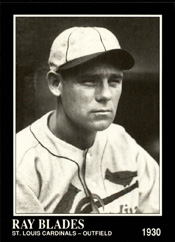
Cardinals manager Ray Blades lost the confidence of his pitching staff and he lost the confidence of the team owner, so, naturally, he lost his job.

ray_bladesOn June 7, 1940, Blades was fired and replaced by Billy Southworth. Cardinals owner Sam Breadon made both decisions without consulting his top baseball executive, Branch Rickey.

Blades had been Rickey’s choice to be manager. By firing Blades and keeping Rickey out of the decision-making process, Breadon made it clear who was boss. In doing so, he damaged the relationship with Rickey. Two years later, in October 1942, Rickey resigned and became general manager and president of the Dodgers.

Star pupil

The connection between Rickey and Blades took root in 1920 when Rickey, the Cardinals’ manager, discovered the outfielder at a tryout camp. Rickey said Blades “ran like a deer,” according to Rickey’s biographer, Murray Polner.

Blades made his big-league debut in 1922, played 10 seasons with the Cardinals and hit .301 with a .395 on-base percentage. Rickey managed him from 1922-25.

After Rickey moved into the front office, he continued to mentor Blades, grooming him for leadership roles. Blades was a Cardinals player-coach from 1930-32 before becoming a manager in the farm system Rickey built.

Blades managed the Cardinals’ Columbus (Ohio) club from 1933-35 and their Rochester affiliate from 1936-38.

Manager moves

During the 1938 season, Rickey clashed with Cardinals manager Frankie Frisch, who was a favorite of Breadon. The Cubs were wooing Rickey for their front office and Rickey used their interest as leverage.

Faced with the prospect of losing Rickey to the Cubs, Breadon reluctantly allowed him to fire Frisch in September 1938. Rickey selected Blades to replace Frisch.

Blades led the 1939 Cardinals to a 92-61 record and second-place finish. His pitching staff had the fewest complete games (45) in the major leagues. Most starting pitchers wanted and expected to pitch complete games, but Blades had a different approach, believing a team should utilize whichever pitcher could be most effective.

Because of the Cardinals’ good record in 1939, Blades’ steady use of relievers was tolerated. When the Cardinals started poorly in 1940, Blades’ handling of the pitching staff became an issue.

Trouble in St. Louis

The 1940 Cardinals lost six of their first eight games and 16 of their first 24. Their slugger, Joe Medwick, was miffed at Blades, pouted and went into a slump.

Published reports indicated Blades would be fired. Breadon issued a denial, telling The Sporting News, “I’m not thinking of any change now. Sure, we’re disappointed, but the failure of the Cardinals cannot be blamed on the manager.”

On June 4, 1940, the Cardinals played their first home night game, but what was supposed to be a celebratory occasion turned into an embarrassment. The Dodgers scored five runs in the first inning and fans booed and threw bottles onto the field. The Dodgers won, 10-1, and Breadon decided a change was necessary.

“After our miserable showing in the night game against the Dodgers, I thought over the entire matter and then decided on Southworth for my man,” Breadon recalled to the St. Louis Star-Times. “I don’t think we’re as bad as our standing shows.”

The plot thickens

On June 5, 1940, Breadon contacted Oliver French, president of the Rochester farm team, and arranged to meet in New York City. The Rochester club was playing a series in Newark, N.J. French called his manager, Southworth, and asked him to come to the New Yorker Hotel in Manhattan. When Southworth arrived, Breadon was there, according to Southworth biographer John C. Skipper.

Breadon informed Southworth he would replace Blades.

“I acted solely on my own in this case,” Breadon told the St. Louis Globe-Democrat.

With the Cardinals’ record at 14-24, Breadon announced the firing of Blades and hiring of Southworth on June 7, 1940, at St. Louis. The Sporting News described the moves as “impulsive.”

“Branch Rickey was not even informed by Breadon on either of these moves … While Breadon was away doing his plotting, Rickey was telling sports writers that no change was contemplated,” The Sporting News reported.

“Rickey had been holding out for more time on Blades.”

Breadon said firing Blades was necessary because “the team was in a rut,” adding, “I like Ray and I’m sorry it had to happen. It hurt me a whole lot to do it … I have no criticism to make on his strategical moves.”

The Sporting News, however, reported “the entire (pitching) staff was demoralized” by Blades’ handling of the starters.

Asked for his reaction to the firing, Blades told the St. Louis Post-Dispatch, “Naturally, it was a bitter disappointment for me, but there is no bitterness in my heart toward the Cardinals. They have been very kind to me. I realize there was nothing else Mr. Breadon could do. We were getting worse every day. Perhaps a change will help to snap the club back into a winning streak.”

Southworth was coming back for a second stint as Cardinals manager. The first time, Breadon hired him to manage the Cardinals in 1929, but replaced him in July when the defending National League champions were falling out of contention at 43-45.

Better prepared for the opportunity in 1940, Southworth’s success eventually led to his election to the Baseball Hall of Fame. Southworth led the Cardinals to two World Series championships (1942 and 1944) and three consecutive National League pennants (1942-44) before resigning after the 1945 season.

Blades became a coach with the 1942 Reds. After Rickey joined the Dodgers, he hired Blades, who managed the Dodgers’ St. Paul affiliate from 1944-46. Blades was a Dodgers coach in 1947 and 1948.

In 1951, Blades returned to St. Louis as a coach on the staff of Cardinals manager Marty Marion. Blades also was a Cubs coach from 1953-56.

Previously: How Mike Gonzalez became first Cuban manager in majors


Read Full Post »

(Updated June 4, 2020)

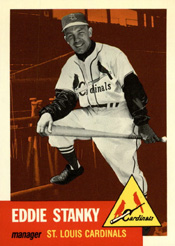
An unhappy fan base and an unreliable pitching staff combined to create an unhealthy situation for Eddie Stanky and the 1955 Cardinals.

eddie_stanky2Unable to overcome those obstacles, Stanky was fired in his fourth season as Cardinals manager on May 28, 1955.

The Cardinals replaced Stanky with Harry Walker, who was managing their farm club at Rochester. Walker was more popular than Stanky but no better able to win with such poor pitching.

From foe to friend

A three-time all-star, Stanky was the second baseman on National League pennant winners with the 1947 Dodgers, 1948 Braves and 1951 Giants. His aggressive play earned him the reputation as a pest and led to him being a frequent target of boos when he played the Cardinals at St. Louis.

When Stanky played for the Dodgers, manager Leo Durocher told New York Sun columnist Frank Graham, “He’ll knock you down to make a play if he has to. That’s the kind of guy I want on my ball club. Look at him. He can’t run, he can’t hit, he can’t throw, he can’t do nothing, but what a ballplayer. I wouldn’t give him for any second baseman in the league.”

Imagine the surprise of Cardinals fans when on Dec. 11, 1951, St. Louis acquired Stanky from the Giants for pitcher Max Lanier and outfielder Chuck Diering. The surprise turned to rancor when Stanky was named player-manager, replacing Marty Marion, who was fired by team owner Fred Saigh. Marion, the popular former shortstop, guided the 1951 Cardinals to an 81-73 record and third-place finish in his lone season as manager.

Good start

In his first St. Louis season, Stanky, 36, led the 1952 Cardinals to an 88-66 record and third place in the NL. The Sporting News named him manager of the year.

In 1953, Saigh sold the Cardinals to Gussie Busch. Stanky, in his last season as a player, managed the 1953 Cardinals to another third-place finish at 83-71.

Stanky’s career took a downturn in 1954. The low point occurred when he used stalling tactics in an attempt to avoid a loss. Umpires forfeited the game to the Phillies and, in a stunning rebuke of Stanky, Cardinals fans cheered the decision. Stanky was suspended. Humbled, he apologized for his actions. With a staff ERA of 4.50, the 1954 Cardinals finished sixth at 72-82.

Heightened expectations

Heading to spring training in 1955, expectations soared because young standouts such as Ken Boyer, Wally Moon and Bill Virdon joined a lineup with Stan Musial and Red Schoendienst.

Bill Walsingham, a club vice president, told The Sporting News the 1955 Cardinals “will run faster and throw better than players on the Cardinals champions of 1942.”

Stanky heightened the hope, telling the St. Louis Post-Dispatch his everyday lineup “is the best _ the fastest and finest-fielding _ I’ve had. And, unless the kids fail to hit at all, it’s of championship caliber.”

The pitching, though, hadn’t improved.

On May 22, 1955, in the first game of a doubleheader at Cincinnati, the Reds rallied for two runs in the bottom of the ninth and won, 4-3. Stanky stormed into the clubhouse and smacked at jars of mustard and mayonnaise on a food table, sending glass and goo flying.

Displaying a hand dripping with blood and condiments, Stanky said, “No, it’s not true I was trying to cut my throat.”

Time for a change

Four days later, on May 26, Cardinals general manager Dick Meyer met with Walker in Rochester and told him he would replace Stanky. Meyer instructed Walker to be in St. Louis on May 28 and to keep the news a secret.

Stunned, Walker said to Meyer, “Is this a joke?”

Replied Meyer: “We have been considering the change for some time.”

Walker, 38, played for Cardinals World Series championship clubs in 1942 and 1946. He managed Cardinals farm clubs at Columbus (1951) and Rochester (1952-55).

His brother, Dixie Walker, was a coach on Stanky’s Cardinals staff.

At 8:15 on the morning of May 28, Stanky got a call from Meyer, who informed the manager he was fired. Meyer asked Stanky to attend a 2 p.m. press conference at Busch’s estate at Grant’s Farm and Stanky agreed.

Flanked by Stanky and Walker, Busch said the change had been contemplated for three weeks. The Cardinals’ record was 17-19.

The Sporting News reported “Stanky’s unpopularity had reached a point regarded as alarming to an organization concerned with the goodwill of consumers as well as customers.”

Said Stanky: “Nothing in baseball shocks me any more and there’s no such word as malice in my vocabulary.”

Dixie Walker was named Rochester manager, replacing his brother.

Different styles

Among reactions to the dismissal of Stanky:

_ The Sporting News: “The move perhaps was inevitable because of the disappointing start of the young, highly regarded team and the mounting fan clamor for a change.”

_ J. Roy Stockton, Post-Dispatch: “Eddie showed major-league courage and acumen in the rebuilding of the Redbirds. All the club needs now to make a serious bid for the pennant is good pitching.”

_ Lloyd Larson, Milwaukee Sentinel: “Eddie Stanky undoubtedly knows baseball … So where did he fall down? The answer, I believe, rests in his handling of people _ the key to successful management in many fields.”

New boss, same results

After the press conference announcing his promotion, Walker made his Cardinals managerial debut against the Reds at St. Louis. Jackie Collum, a former Cardinal, spoiled the festivities, pitching a four-hitter in a 5-1 Reds triumph.

The 1955 Cardinals were 51-67 under Walker and finished seventh at 68-86 overall. The staff ERA of 4.56 was the worst in the NL.

After the season, the Cardinals replaced Walker with Fred Hutchinson, former Tigers manager. Walker went back to managing in the Cardinals’ farm system. He would return to the big leagues as manager of the Pirates (1965-67) and Astros (1968-72).

Stanky managed the Giants’ farm club at Minneapolis in 1956. After serving as an Indians coach in 1957 and 1958, Stanky rejoined the Cardinals as player development director and special assistant to general manager Bing Devine. Stanky departed the Cardinals after Devine was fired by Busch in August 1964.


Read Full Post »

« Newer Posts - Older Posts »