Feeds:
Posts
Comments

Archive for the ‘Football’ Category

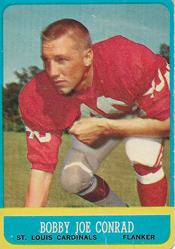
As a youth in small-town Texas, Bobby Joe Conrad would go to a vacant lot near his house and practice kicking a football. He taught himself to boot the ball high and far and straight. After a while, he was kicking footballs over the arching branches of a cluster of hackberry trees.

“I guess a lot of it came naturally,” he recalled to the Bryan-College Station Eagle.

Conrad could throw, catch and run with a football, too. There wasn’t much, actually, he couldn’t do on a football field. When Conrad got to college at Texas A&M, he was a quarterback, running back, receiver and defensive back.

Those kicking skills, though, are what first got him national attention.

Home on the range

Conrad was from the Texas town of Clifton, which was settled by Norwegian immigrants in the 1800s. Located along the Bosque River, 100 miles south of Dallas, Clifton’s population never topped 3,500. Conrad felt right at home there. “I never found any compelling reason to leave,” he told the Waco Tribune-Herald.

A standout prep quarterback, Conrad planned to attend Texas Christian but the arrival of head coach Bear Bryant at Texas A&M in 1954 changed his mind. “A&M wasn’t among my top five choices but Bear came up and sold me, not only sold me on himself but the school as well,” Conrad told the Fort Worth Star-Telegram.

As Conrad explained to the Waco Tribune-Herald, “The main thing I wanted was a college degree because no one in my family had one.”

Conrad found the position he liked playing best in college was receiver but Texas A&M didn’t pass much. So he mostly played cornerback and substituted at quarterback and at running back (behind John David Crow and Loyd Taylor). “I never did anything spectacular,” Conrad told the Bryan-College Station Eagle. “I just did my job wherever they wanted me to play.”

One of his best games came as a senior in 1957 when Texas A&M won at Missouri, 28-0. Conrad totaled 196 yards. He ran back the second-half kickoff 91 yards for a touchdown, rushed for 92 yards on 13 carries and caught a pass for 13 yards.

Conrad also did some kicking on extra-point attempts, sharing that duty with two teammates. It was his skill as a cornerback, though, that enticed the New York Giants to select him in the fifth round of the 1958 NFL draft.

Going pro

A fellow Texan and former cornerback, Giants defensive coordinator Tom Landry, signed Conrad. However, in May 1958, four months after they drafted him, the Giants swapped Conrad and Dick Nolan (future head coach of the San Francisco 49ers and New Orleans Saints) to the Chicago Cardinals for Lindon Crow and Pat Summerall (the future sportscaster).

Noting how being dealt to New York led to Summerall getting national broadcast opportunities, Conrad later quipped to the Belleville (Ill.) News-Democrat, “If it weren’t for me, Pat Summerall would be a Falstaff beer salesman in St. Louis.”

Soon after the trade, Conrad earned a business degree from Texas A&M. He would put that to good use, but first he wanted to give the NFL a try.

His first test would come as a member of the college all-star team in an exhibition against the reigning NFL champion Detroit Lions at Chicago in August 1958. Though projected to be a reserve defensive back in that game, Conrad practiced placekicking while home in Clifton during the summer in order to be ready if the all-stars needed kicking help.

Getting his kicks

Being prepared paid off for Conrad. At workouts with the college all-stars in Chicago, he surprised and impressed head coach Otto Graham with his placekicking skills.

According to the Clifton Record, Graham said, “I knew nothing about his kicking except that he had done some kicking off and kicked some extra points (in college) … Conrad simply kicked better than anybody else during our workouts.”

Though the college all-stars had Lou Michaels, a lineman who had been a good placekicker for Kentucky, and Wayne Walker, an Idaho linebacker who, like Michaels, would kick successfully in the NFL, Graham chose Conrad to do the placekicking against the Lions.

“I never kicked a field goal before in my life _ high school or college,” Conrad said to the Clifton Record. “I never even tried to kick a game field goal before.”

In addition to doing kickoffs and placekicking for the all-stars, Conrad started in the defensive secondary after Jim Shofner of Texas Christian injured an ankle.

Playing before 70,000 spectators at Chicago’s Soldier Field and a national TV audience on Aug. 15, 1958, Conrad booted four field goals (19, 44, 24 and 24 yards) and three extra points in a 35-19 victory for the college all-stars.

In explaining why he’d never tried to kick a field goal in college, Conrad told the Chicago Tribune, “At Texas A&M we either scored (a touchdown) or didn’t get close enough to attempt a field goal.” Video

Eight days later, Conrad’s 30-yard field goal with four seconds left enabled the Chicago Cardinals to salvage a 31-31 tie with the Baltimore Colts in a NFL exhibition game at Austin, Texas.

Conrad followed that with 16 points _ a 17-yard touchdown catch, two field goals and four extra points _ in the Cardinals’ 27-26 exhibition game win against the Los Angeles Rams at Seattle.

Mr. Versatility

Cardinals first-year head coach Pop Ivy liked what he saw from his versatile rookie. Ivy gave Conrad three roles with the 1958 Cardinals _ placekicker, defensive back and punt returner.

In the Cardinals’ regular-season finale against the Pittsburgh Steelers, Conrad intercepted three Bobby Layne passes. Game stats

For the season, he totaled 51 points _ six field goals and 33 extra points.

Conrad remained the Cardinals’ placekicker in 1959, but Ivy moved him from defense to running back. In the season opener versus Washington, Conrad scored three touchdowns (35-yard run on a double reverse, 56-yard run and five-yard catch) and kicked seven extra points for a total of 25. Two of his touchdowns came in the second half when he played with a broken nose. Game stats

Conrad’s scoring total for the 1959 season was 84 points. He threw a touchdown pass (52 yards to Joe Childress against the Steelers) and returned a punt for a touchdown (69 yards versus the Giants). He also scored two touchdowns rushing and three receiving, and kicked six field goals and 30 extra points.

“You never could tell where I was going to be, or what I was going to do, throughout my football career,” he said to the Bryan-College Station Eagle.

The Cardinals relocated from Chicago to St. Louis in 1960 and Conrad no longer was the primary placekicker. Two years later, when Wally Lemm replaced Pop Ivy as head coach, Conrad became a fulltime receiver, moving to the flanker position, and he excelled in the role.

“Bobby Joe was a natural at flanker,” Cardinals quarterback Charley Johnson told the Waco Tribune-Herald. “He ran very precise patterns which made him hard to cover. He wasn’t afraid to go over the middle. Not every receiver was like that.”

Conrad had consecutive seasons of 62 catches (1962), a NFL-leading 73 (1963), 61 (1964) and 58 (1965). He caught passes in 94 straight games. Video at 3:10 mark

Conrad’s last season with the Cardinals was 1968. He ended his playing career with the 1969 Dallas Cowboys.

Back in Clifton, he raised cattle on 630 acres. Then he became a bank executive for 16 years. In 1994, Conrad was elected Bosque County judge and served eight years before retiring in 2002.

Read Full Post »

Coveted by the NFL St. Louis Cardinals for his uncanny ability to return kickoffs and punts for good gains, as well as for his skills as a cornerback covering the game’s top receivers, Abe Woodson provided a bonus.

At a time when cornerbacks gave receivers lots of room at the line of scrimmage in the hope of not getting outmaneuvered, Woodson used a different technique _ the bump-and-run.

Sixty years ago, in 1965, when he was acquired from the San Francisco 49ers for running back John David Crow, Woodson taught his teammates in the Cardinals’ secondary, most notably Pat Fischer, how to line up closer to a receiver and, after the ball was snapped, bump him, throwing off the timing of the pass route.

Before long, Woodson’s effective bump-and-run technique was utilized throughout pro football until the NFL passed a rule in 1978, restricting its use.

Streaking to success

One of the best high school athletes in Chicago, Woodson went on to the University of Illinois and excelled in track (matching a world record in the 50-yard indoor high hurdles) and football (running back, defensive back, punter).

In a game against No. 1-ranked Michigan State in 1956, Woodson gave a performance reminiscent of The Galloping Ghost, Illinois legend Red Grange. Michigan State led, 13-0, at halftime, but Woodson scored three touchdowns in the second half, lifting Illinois to a 20-13 victory.

Helped by the blocking of fullback Ray Nitschke (the future Green Bays Packers linebacker), Woodson scored on a two-yard plunge, a 70-yard run (in which he took a pitchout, reversed his field and outran the secondary) and a screen pass that went for 82 yards. On that winning score, Woodson took the screen pass near the sideline, angled across the field and hurdled over a defender at the 30 before sprinting to the end zone.

Chicago Cardinals head coach Ray Richards said to the San Francisco Examiner, Woodson “rates as one of the five best backs in the country.”

The 49ers took him in the second round of the 1957 NFL draft but Uncle Sam’s draft took priority. Drafted into the Army, Woodson was inducted in January 1957 and had to skip the football season. He was 24 when he was discharged and joined the 49ers during the season in October 1958.

Though Woodson made his mark in college as a running back, 49ers head coach Frankie Albert needed help in the secondary and put Woodson there. The rookie made a good early impression when he tackled Chicago Bears halfback Willie Galimore, nicknamed the Wisp for how he slipped through defenses like a puff of smoke, and caused him to fumble.

As Woodson put it to the San Rafael Daily Independent, “I was switched to defense accidently. I accidently looked good in my first game.”

Los Angeles Times columnist Jim Murray suggested that using Woodson on defense instead of offense “was like asking Caruso if he could also tap dance,” but when Red Hickey replaced Albert as head coach in 1959, Woodson was given a starting cornerback spot. “Woodson has whistling speed and such remarkable reactions that Hickey can give him assignments which would trouble veteran defenders,” Sports Illustrated observed.

On the run

Stellar on defense, Woodson was in a special class on kickoff returns. In 1959, he stunned the crowd at the Coliseum in Los Angeles with a 105-yard kickoff return for a touchdown against the Rams. As the San Rafael Daily Independent described it: “Woodson sidestepped a couple of Rams with a perfect change of pace and then poured it on. He cut from one sideline to the other, shaking off pursuers, before drawing a direct bead on the goal line.” Video

On most kickoff returns, Woodson “starts out like a fat man dragging a sled” until he gets to the 20 and then turns on the sprinter’s speed, Jim Murray noted.

In games against the Detroit Lions in 1961, Woodson scored touchdowns on a kickoff return and a punt return. Asked to describe how it felt to return punts, Woodson told the San Rafael newspaper, “Like looking a tiger in the face.”

(In 1961, Red Hickey decided to experiment with Woodson at running back. In his first start, against the Minnesota Vikings, Woodson lost three fumbles and bobbled the ball five times. The experiment ended soon after.)

Woodson led the NFL in kickoff return average in 1962 (31.1 yards) and 1963 (32.2 yards). He averaged more than 21 yards per kickoff return each year from 1958-65. In 1963, Woodson had kickoff returns for touchdowns of 103 yards (Vikings), 99 yards (New York Giants) and 95 yards (Vikings again).

For the sheer excitement he created on the gridiron, the Modesto Bee called Woodson “the Willie Mays of football.”

During his first few years with the 49ers, Woodson worked in the off-seasons as a bank teller and then in the installment loan and credit analysis departments of Golden Gate National Bank.

In 1963, he joined the sales staff of Lucky Lager Brewing Company, California’s largest beer producer. The year before, “Lucky Lager was boycotted by Negro consumers in the southern California area because it did not have a Negro salesman,” the San Francisco Examiner reported.

Tricks of the trade

As a cornerback, Woodson “was quick and tricky,” Bears safety Roosevelt Taylor said to the San Francisco Examiner.

Woodson began using his signature trick, the bump-and-run, in 1963 against the Baltimore Colts. “We wanted to stop that Johnny Unitas to Raymond Berry surefire short pass to the sideline,” Woodson told Art Rosenbaum of the Examiner.

As Woodson explained to the San Rafael Daily Independent, “I know (Berry) can’t outrun me. So I decided to move up to him at the line of scrimmage. By staying right with him, it eliminates the double fake he uses so well. It makes him play my game. When you take away Berry’s moves, he’s just another end.”

(The receiver who gave Woodson the most problems was Max McGee of the Packers. “He has speed and he’s big,” Woodson told the Peninsula Times Tribune of Palo Alto. “He has some of the best moves in the league, and Bart Starr, the quarterback, hits him just at the right time.”)

Woodson credited 49ers defensive backs coach Jack Christiansen with giving him the idea for the bump-and-run. Christiansen, a former Lions defensive back, told the Examiner, “I borrowed it from Dick “Night Train” Lane when he played for the Chicago Cardinals in the 1950s … He used it if there was blitz coverage up front and man-to-man in the outer secondary. Then he’d line up four to five yards instead of the usual six to eight behind the line of scrimmage, pick up his man immediately, give him one shocker of a bump, and take it from there.”

American Football League defensive backs Willie Brown and Kent McCloughan of the 1960s Oakland Raiders also were considered pioneers of the bump-and-run.

“I think if you researched it deeply enough you’d find Amos Alonzo Stagg (who began coaching in the 1800s) probably picked it up from one of the math students at the University of Chicago,” Christiansen quipped to the Examiner. “There isn’t a whole lot that’s truly new in football.”

Change of scenery

Traded to the Cardinals in February 1965, Woodson, 31, was “regarded as the premier kickoff return specialist,” the St. Louis Post-Dispatch suggested. Columnist Bob Broeg noted, “Woodson still has speed and, above all, the ability to elude a tackler … He’s got better moves than a guy with itchy underwear.”

In a 1965 exhibition game versus the Colts, Woodson intercepted a Gary Cuozzo pass, scoring the Cardinals’ lone touchdown, and totaled 77 yards on three kickoff returns. However, in the exhibition finale against the Packers, he dislocated a shoulder. After sitting out the opener, Woodson returned kickoffs (averaging 24.6 yards on 27 returns) and punts, and provided backup at cornerback.

Woodson’s most significant contribution may have come on Dec. 5, 1965, when he showed Pat Fischer the bump-and-run technique against Rams receivers Jack Snow and Tommy McDonald.

“Abe came up and hit them, or held them up, as they came at him,” Fischer said to William Barry Furlong of the Washington Post. “All of a sudden, the precision that they were trained to run patterns at was lost. The receiver wasn’t concerned about getting off on the count, or where he was going to go. Now he was concerned about one thing: How am I going to get around that guy?”

Snow was limited to four catches for 38 yards; McDonald totaled two receptions for 27 yards. Game stats

Moving on

Under Charley Winner, who replaced Wally Lemm as Cardinals head coach in 1966, Woodson’s days as a kickoff and punt returner were finished. He was used exclusively at cornerback and started in 11 of the club’s 14 games.

Woodson used the bump-and-run to hold down fleet receivers such as the Dallas Cowboys’ Bob Hayes. “I don’t blame Abe Woodson for trying to stop me from going downfield,” Hayes told the Post-Dispatch. “I don’t think the Cardinals play dirty. They just play hard.”

Of Woodson’s four interceptions for the 1966 Cardinals, the most prominent secured a 6-3 victory against the Pittsburgh Steelers. With 1:20 left in the game, the Steelers drove into Cardinals territory but Woodson picked off a Ron Smith pass intended for Gary Ballman at the St. Louis 22. Game stats

Given a chance to go into executive training for a position with S&H Green Stamps, Woodson retired from football in February 1967. “He did a tremendous job for us (in 1966) and showed no sign of slowing down, either in coming up to stop runs or in covering pass receivers,” Charley Winner told the Post-Dispatch.

Woodson eventually settled into sales and management positions with an insurance company.

Read Full Post »

On an evening in March 1964, St. Louis Cardinals running back Bill Triplett was having dinner at home when he felt a dull ache in his chest. “My wife said I probably ate too fast,” Triplett recalled to Newsday.

When the chest pain returned at dinner the next night, Triplett and his wife grew more concerned. At a visit to a doctor the following day, X-rays showed a dark spot on his right lung, Newspaper Enterprise Association reported.

“I was thinking cancer,” Triplett, 23, confided to Newsday.

Instead, the diagnosis was tubercle bacillus, a bacterium that causes tuberculosis. As Triplett said to Newsday, “When … they told me I had tuberculosis, I was shocked, yet I was relieved (it wasn’t cancer).”

After sitting out the 1964 NFL season, Triplett returned to the lineup and was the leading rusher for the 1965 Cardinals.

Making the grade

Growing up in Girard, Ohio, near Youngstown, Bill Triplett had 11 siblings _ nine sisters and two brothers, according to the St. Louis Post-Dispatch. An older brother, Mel, was a fullback for eight NFL seasons with the New York Giants (1955-60) and Minnesota Vikings (1961-62). Giants receiver Kyle Rote told Newsday that Mel “is the best blocking fullback in the league. There’s no fullback who protects the passer better.”

Bill Triplett also was a football talent, but schoolwork was a struggle. “When I was a sophomore in high school, I was looking forward to one thing _ getting out,” he recalled to the Post-Dispatch.

Triplett’s attitude changed when pole vaulter Bob Richards, a two-time Olympic gold medal winner, gave a talk at the school. “Listening to him, it dawned on me that the only way I’d play pro football would be to study and make the grade in college,” Triplett said to the Post-Dispatch. “It didn’t come easy, studying. I’d been timid and shy. If I did know an answer, which wasn’t too often, the teacher had to drag it out of me. So I started taking speech courses.”

In 1958, Triplett accepted a football scholarship offer from Miami University in Oxford, Ohio, and majored in industrial technology. Fast and strong, Triplett developed into a top college running back for head coach John Pont. As a senior in 1961, Triplett rushed for 1,418 yards and became the first Miami player selected to the East-West Shrine game.

“My parents trained each of us that being a person of color, in order to stand out or to get ahead, you had to be twice as good as the next person, and that’s always been embedded in the back of my mind,” Triplett told the Warren (Ohio) Tribune Chronicle.

Do the right thing

The Giants drafted Triplett in the sixth round but he didn’t make it to training camp with them. Seeking a veteran quarterback to back up Y.A. Tittle, the Giants traded Triplett to the Cardinals for Ralph Guglielmi in May 1962.

After Triplett clocked the team’s second-fastest time in the 50-yard dash at training camp (only receiver Sonny Randle was faster), Cardinals head coach Wally Lemm tested him at multiple positions (running back, flanker, defensive back). Triplett also returned kickoffs.

When the Cardinals arrived in Jacksonville, Fla., for an exhibition game against the Green Bay Packers in August 1962, St. Louis’ black players were told they’d be staying at “a motel on the other side of the tracks” instead of at the team hotel, Triplett recalled to the Warren Tribune Chronicle.

Though the hotel wouldn’t permit blacks to stay as guests, the black Cardinals were informed by the club that they were expected to attend team meetings at the hotel. “I refused,” Triplett told the Tribune Chronicle. “By my refusing, two of my teammates did the same.”

According to the Warren newspaper, in a meeting with Cardinals co-owner Charles Bidwill, Triplett told him, “You speak of family. What parent would take some of their children and disband them to an unknown facility and tell them to just find their way? I said, ‘Not with me, sir.’ ”

In the game against the Packers, Triplett ran back kickoffs for 55 and 30 yards. The next week, in an exhibition against the Vikings in Minnesota, he returned a kickoff 91 yards for a score.

Versatile skills

The 1962 Cardinals determined they were OK at running back with John David Crow and Prentice Gautt but needed help in the defensive backfield, so Triplett spent his rookie season as a strong safety (six starts) alongside free safety Larry Wilson and returned kickoffs (averaging 25.3 yards on 24 returns).

Triplett got a chance to return to his preferred position, running back, when Gautt (kidney) was injured in the 1963 season opener against the Dallas Cowboys. Triplett rushed for 82 yards on 12 carries and made two catches for 51 yards. Game stats

With Gautt sidelined for the season, Triplett stepped in and performed well. He rushed for 85 yards and a touchdown against the Giants and rushed for 102 yards versus the Cleveland Browns. Game stats and Game stats

Triplett’s 1963 totals:

_ Rushing, 652 yards, five touchdowns. He averaged 4.9 yards per carry. Only Cleveland’s Jim Brown (6.4) and Green Bay’s Tom Moore (5.0) did better.

_ Receiving, 31 catches, three touchdowns.

_ Kickoff returns, 16.4-yard average on 14 returns.

Triplett figured prominently in the Cardinals’ plans for 1964 _ until it was discovered he had tuberculosis.

On the mend

Admitted to a hospital, Triplett was given strong antibiotics. His weight dropped from 210 pounds to 175, but the drugs “helped limit his hospital confinement to 18 days,” Bob Broeg of the Post-Dispatch noted.

That was followed by six months of rest at home, according to Newsday. He spent part of that time studying game films of other running backs. “I’ve learned a lot,” Triplett told the Post-Dispatch. “I’ve seen on power sweeps how the best ball carriers use their blockers to the best advantage, staying behind them until just the right instant … I’ve studied the better pass receivers among the running backs. I had a tendency to fight the ball rather than relax in catching it.”

Given medical clearance to play in 1965, Triplett looked strong, beating out Prentice Gautt for the starting halfback spot. However, his rustiness showed in the first half of the regular season. In the Cardinals’ first six games, Triplett rushed for more than 33 yards just once, gaining 93 on 22 carries versus the Cowboys.

“Coming back after sitting out a year was like learning how to run again,” Triplett said to the Associated Press. “I was just gauging myself. I was overanxious, not waiting for the holes to open, and running into blockers.”

Heading into Game 7 against the Giants, head coach Wally Lemm opted to start Gautt instead of Triplett. The plan disintegrated, however, when Gautt broke an arm on the opening kickoff. Triplett came in and gave a career-best performance, rushing for 176 yards on 23 carries and scoring a touchdown. Game stats

“I can still run as fast as ever,” Triplett explained to the Associated Press. “Maybe knowing I wouldn’t start relaxed me and I didn’t have time to get too anxious, but I don’t want to go through that (a benching) again.”

Triplett led the 1965 Cardinals in rushing yards (617) and rushing touchdowns (six). He also made 26 catches, including one for a touchdown.

New boss

Charley Winner replaced Wally Lemm as Cardinals head coach in 1966 and chose rookie Johnny Roland to be the starting halfback. Triplett was relegated to special teams. “There was nothing wrong with me,” Triplett told Newsday. “I was strong physically. I had my speed … but John played too good to be taken out.”

While Roland rushed for 695 yards and five touchdowns, Triplett landed in Charley Winner’s doghouse. Triplett told Newspaper Enterprise Association it was a “personality conflict” with Winner, who determined Triplett lacked drive.

“I’m not one of those fellows who shows a lot of emotion,” Triplett told columnist Murray Olderman. “I can’t be rah-rah. I build a fire within myself, and when it’s ready to come out, I’m ready to play. That’s the way I am.”

In March 1967, Triplett was traded to the Giants for linebacker Jerry Hillebrand. “We didn’t like to give up Triplett,” Charley Winner told the Post-Dispatch. “We think he still has lots of potential.”

In his first regular-season game with the Giants, Triplett rushed for two touchdowns against the Cardinals. It was the only time in his 10 NFL seasons that Triplett carried for two touchdowns in a game. Game stats and Video

Those also were the only touchdowns Triplett scored for the Giants. After one season, they dealt him and linebacker Bill Swain to the Detroit Lions for safety Bruce Maher.

Triplett spent five seasons (1968-72) with Detroit, playing mostly on special teams the last three years.

Read Full Post »

One year after they traded Steve Carlton because he wanted a $65,000 salary, the Cardinals offered a college pitcher a six-figure contract.

Michigan State’s Brad Van Pelt, a right-hander with a 100 mph fastball, was the prospect who prompted the Cardinals to consider coughing up the cash. He also was a football talent, a recipient of the Maxwell Award presented to the most outstanding college player in the sport.

Drafted in January 1973 by the baseball Cardinals and the NFL New York Giants, Van Pelt opted for pro football. He went on to play 14 seasons, helping to form one of the all-time best linebacking units.

Abundant athleticism

Van Pelt was from Owosso, Mich., a town 90 miles northwest of Detroit. Thomas Dewey, twice the Republican nominee for president, was from there, too. (Dewey lost to Franklin Delano Roosevelt in 1944 and to Harry Truman in 1948.)

An athlete who excelled in every sport he tried, including bocce, golf and soccer, Van Pelt was a high school sensation as a quarterback in football, a rebounder in basketball (he hauled down 42 in one game) and a pitcher in baseball (consecutive no-hitters as a senior).

The Tigers, his favorite team, chose Van Pelt, 18, in the 14th round of the 1969 June baseball draft but he took a football scholarship from Michigan State instead.

(It was the first of five times Van Pelt was selected in the baseball draft. He declined to sign each time. After the Tigers in June 1969, others to draft him were the Angels in June 1972, Cardinals in January 1973, Pirates in June 1973 and Indians in January 1974.)

“Rangy, fast and strong,” Van Pelt, 6-foot-5, 220 pounds, had the “defensive end’s body with the receiver’s speed,” according to the Lansing State Journal.

Michigan State guard Joe DeLamielleure (elected to the Pro Football Hall of Fame for his skill as a Buffalo Bills and Cleveland Browns lineman) told the newspaper, “Van Pelt was the modern day Jim Thorpe, and that’s no exaggeration … He could have been our starting quarterback because he could throw the ball a mile.”

Michigan State head coach Duffy Daugherty said Van Pelt could have played any position on the football team. “He is the most versatile athlete I’ve ever coached,” Daugherty told the Associated Press.

Daugherty dubbed Van Pelt his “secretary of defense” and put him at safety. Often called a rover back, Van Pelt had the size and speed to intimidate receivers, stuff rushers and pressure quarterbacks with blitzes. “I’ve never seen a safety able to come up to the line of scrimmage to make tackles as quick as Brad can,” Daugherty said to the Flint Journal.

George Perles, an assistant on Daugherty’s staff before eventually becoming head coach, told the Lansing newspaper, “During his college career, he (Van Pelt) might have been the biggest safety in the Big Ten (Conference), if not the country.”

In his three varsity seasons (1970-72), Van Pelt totaled 256 tackles and 14 interceptions. “He (Daugherty) gave me the freedom to blitz when I wanted and to go to the ball on every play,” Van Pelt said to the State Journal. “I can’t thank him enough.”

Man for all seasons

Described by Joe Rexrode of the Lansing newspaper as “the purest all-around athlete in Michigan State history,” Van Pelt played varsity basketball and baseball.

He got into 31 basketball games for head coach Gus Ganakas, who told the State Journal, “Van Pelt helped define the position of power forward.”

In baseball, Van Pelt pitched for head coach Danny Litwhiler, a former big-leaguer who played in two World Series (1943 and 1944) as the Cardinals’ left fielder.

As a sophomore, Van Pelt was on the 1971 Big Ten championship baseball team. The next season, he struck out 84 in 56.1 innings and had a 2.07 ERA. The Angels picked Van Pelt in the 13th round of the June 1972 draft and offered $100,000 _ “The first three days after they made the offer I really thought about signing,” Van Pelt told the Flint Journal _ but he chose to return to college for senior year.

Instead of spending the summer of 1972 pitching in the Angels’ system, Van Pelt went to the Netherlands with an amateur team from Grand Rapids, Mich., to compete in an international honkbal (Dutch for baseball) tournament.

Cardinals calling

After Van Pelt’s senior football season, big-league baseball held a winter draft on Jan. 10, 1973. In those days, a secondary phase was conducted for players who had been drafted in prior years but hadn’t signed.

Selecting seventh in the first round, the Cardinals chose Van Pelt. “He was one of a few premium players available,” Cardinals director of player procurement George Silvey told the St. Louis Post-Dispatch.

Cardinals general manager Bing Devine said to United Press International, “He’s an all-American boy in every sense of the word.”

(The Tigers, who had the next pick after the Cardinals, were planning to draft Van Pelt, the Post-Dispatch reported. When the Cardinals beat them to it, the Tigers went with Van Pelt’s Michigan State teammate, pitcher Larry Ike.)

Van Pelt told the Cardinals he’d wait until the NFL draft was held on Jan. 30, 1973, before making a decision.

When the Cardinals made it known they intended to sign Van Pelt, NFL teams didn’t want to risk losing a first-round pick in a bidding war with a baseball team. As the New York Times put it, Van Pelt became “a player of unquestioned ability but highly questionable availability.”

New York Jets head coach Weeb Ewbank told the Times, “We just didn’t see any sense in fighting baseball for him, but he is one hell of an athlete.”

The Giants, who had traded their first-round pick to the Browns for defensive end Jack Gregory, grabbed Van Pelt in the second round, where, as head coach Alex Webster noted to the Times, “he was worth the risk.”

Decision time

A year earlier, the Cardinals reportedly offered Steve Carlton a 1972 salary of $57,500. Carlton wanted more. As spring training got under way, Carlton said he and the club were less than $10,000 apart, The Sporting News reported, but owner Gussie Busch, angry when the pitcher didn’t sign, ordered Bing Devine to trade him. Carlton was sent to the Phillies, who gave him $65,000 in 1972, and he won 27 games for them that season.

Devine offered a lot more than that to Van Pelt in February 1973. Braving a snowstorm, Devine met with Van Pelt in Owosso and made an enticing pitch. “We went to a peak level with the offer we made him,” Devine told Milton Richman of United Press International. “By that I mean over $100,000.”

Giants owner Wellington Mara followed Devine to Owosso and presented Van Pelt with a three-year, no-cut contract worth $300,000.

Van Pelt said the money offered by the Cardinals and Giants was about the same. “The two offers were so close that I almost thought they had gotten together,” he remarked in an article published in the Post-Dispatch.

Van Pelt chose the Giants primarily because he could begin his pro career in the NFL rather than in baseball’s minor leagues.

(Danny Litwhiler told United Press International that Van Pelt would need at least two years of total concentration on baseball to become ready for the majors. Van Pelt acknowledged to the Jersey Journal, “I know I have a major-league fastball, but my curve leaves a lot to be desired.”)

As Devine said to Milton Richman, “With us, he would have had to go to the minor leagues to develop. With the football Giants, he went right to the big-league club. That was the key.”

Crunch Bunch

The Giants tried Van Pelt at tight end and strong safety during a frustrating rookie year. After Bill Arnsparger replaced Alex Webster as head coach in 1974, Van Pelt shifted to outside linebacker. His career soared when Marty Schottenheimer arrived as linebacker coach in 1975. “I’d say 85 percent of what I am now, I learned from him,” Van Pelt told the Detroit Free Press in 1979.

Van Pelt was named to the Pro Bowl five years in a row (1976-80) and was chosen as the Giants’ player of the decade for the 1970s. “If Brad Van Pelt played on a good team, he would be a household name,” Los Angeles Rams general manager Don Klosterman said to Mike Lupica of the New York Daily News.

The Giants had one winning record in Van Pelt’s 11 seasons with them. As club executive John Mara told the Daily News, “If you look at those (Van Pelt) years, our teams were as bad as could possibly be. We really had some awful teams in the 1970s. He was the one guy who was consistently a good player.”

Van Pelt played for five Giants head coaches _ Alex Webster, Bill Arnsparger, John McVay, Ray Perkins and Bill Parcells. (Bill Belichick was a Giants assistant coach from 1979-84 and Van Pelt’s linebacker coach from 1980-83.)

When Parcells joined the Giants as defensive coordinator on Perkins’ staff in 1981, he installed a 3-4 defense after the club drafted Lawrence Taylor. From 1981-83, the Giants’ four hard-hitting starting linebackers _ Harry Carson, Brian Kelley, Taylor and Van Pelt _ became known as the Crunch Bunch. (Carson and Taylor were elected to the Pro Football Hall of Fame.)

According to Newsday, Taylor called Van Pelt “one of the greatest players I ever played with.”

The arrival of linebacker Carl Banks, a first-round pick from, of all places, Michigan State in 1984 prompted the Giants to break up the Crunch Bunch. In July 1984, Van Pelt was traded to the Minnesota Vikings for fullback Tony Galbreath.

Van Pelt refused to report, telling the Vikings he preferred to be with a team either in California or Florida. He never played a game for the Vikings. They traded him to the Los Angeles Raiders for two draft choices. Van Pelt spent two seasons (1984-85) with the Raiders and one (1986) with the Browns.

In 1998, Van Pelt returned to Michigan State and completed his school work, earning a degree in health and physical education. Three years later, he was inducted into the College Football Hall of Fame. A son, Bradlee, was a quarterback for Colorado State and played in three games for the 2005 Denver Broncos.

Read Full Post »

By NFL standards, St. Louis Cardinals cornerback Pat Fischer was small. Not jockey size, but not as big as the team’s placekicker, Jim Bakken, who was two inches taller and 30 pounds heavier. Even another noted Fischer, 6-foot-1 chess grandmaster Bobby, towered over Pat.

Listed at 5 feet 9 and 170 pounds _ “Anyone who ever saw him in person knew even those measurements were somewhat exaggerated,” the Washington Post noted _ Fischer shed the blocks of Goliath-like guards and tackles, took down steamrolling fullbacks, and stymied rangy receivers during a 17-year NFL career with the Cardinals (1961-67) and Washington Redskins (1968-77). 

The signature play of Fischer’s NFL tenure came on Sept. 20, 1964, for the Cardinals against the Cleveland Browns. Jim Brown, the punishing fullback who regularly ran over defenders or carried them on his back, took a pitch, swept to the outside and roared into the clear like a bull entering the ring. Fischer, 62 pounds lighter than Brown, came up from his cornerback spot, lowered his shoulder and met the fullback head-on.

Making “a picture-book tackle,” Fischer “actually lifted the running back into the air and tossed him backward,” the St. Louis Post-Dispatch reported.

Joe Pollack of the Post-Dispatch, a longtime NFL observer, called it “the greatest individual play I’ve ever seen,” adding that Brown was “the best back I ever saw,” and Fischer was “maybe the best player, pound for pound, in NFL history.”

Noting that Fischer brought down Brown singlehandedly, the Post-Dispatch offered, “It isn’t often anybody does much singlehandedly against Brown, so the memory of that play will last a long time.”

In that same game, the feisty Fischer was involved in an incident that cost the Browns their halfback, Ernie Green, who was ejected in the second quarter for throwing a punch at Fischer, the Associated Press reported.

“Fischer had grabbed my face guard first and I was just backing up, trying to push him away,” Green told the Dayton Journal Herald, “but the official didn’t see that, just me pushing him off.”

According to the Cincinnati Enquirer, the officials ruled Green struck Fischer after the whistle, prompting the ejection. Game stats

A three-time Pro Bowl selection, Fischer intercepted 56 passes, including four for touchdowns, in his NFL career.

Big man on campus

After high school in Omaha, Fischer, like three of his brothers before him, played football at the University of Nebraska.

In his varsity debut as a sophomore in 1958, Fischer, listed as a 163-pound halfback and cornerback, returned a kickoff 92 yards for a touchdown in Nebraska’s 14-7 upset of Penn State. As a junior in 1959, Fischer ran back a punt 61 yards to the 3-yard line, setting up Nebraska’s winning touchdown against Oklahoma. The 25-21 victory snapped Oklahoma’s 74-game Big Eight Conference win streak.

Fischer became Nebraska’s starting quarterback as a senior in 1960. In the season opener, at Texas, he led the Cornhuskers to a 14-13 upset victory. Fischer returned a punt 76 yards for a touchdown and scored another on a two-yard scamper. As the holder on the extra-point try, Fischer pulled off a fake, firing a pass to Bill “Thunder” Thornton for the winning two-point conversion. (Thornton also was Fischer’s teammate on the Cardinals.) Video

Inhaling oxygen from a hissing tank in the locker room afterward, Fischer told the Lincoln (Neb.) Journal Star, “My head hurts and I’m tired, but I’d play another half if that’s what it took to beat Texas.”

(Like Fischer, two of his 1960 Nebraska teammates had long NFL playing careers. Defensive end Ron “The Dancing Bear” McDole played 18 seasons, including his rookie year with the Cardinals, and center Mick Tingelhoff played 17 years with the Minnesota Vikings and was elected to the Pro Football Hall of Fame.)

Fitting in

Drafted in the 17th round by the Cardinals, the pint-sized Fischer (listed at 166 pounds) arrived at 1961 training camp “and spent his first few practices in shorts and a T-shirt as the team tried to find equipment that would fit him,” according to the Washington Post.

In recalling his first exhibition game with the Cardinals, Fischer told the Post, “My game pants fell down below my knees. I had to tape them up. I had to tape my pads on to make sure they wouldn’t fall off.”

The Cardinals’ coaching staff wasn’t quite sure what to do with him. “Coaches all have a predetermined idea of what a cornerback is supposed to look like,” Fischer said to the Post. “I never did fit the description.”

He made the team, returning punts and kickoffs, and filling in as a backup receiver. In a December 1961 game versus Washington, Fischer returned two kickoffs, including one for 53 yards. He also lined up as a flanker. In the third quarter, with the Cardinals facing third-and-11 at their 45, Sam Etcheverry passed over the middle to Fischer. The throw was high and behind the rookie, but he leaped, twisted and made a 22-yard catch for the first down, keeping alive a drive that led to a field goal. Game stats

Fischer made four starts at cornerback in 1962 before he tore a hamstring. He came back in 1963, intercepted eight passes in 14 games and became “a big favorite with the fans” for his mighty-mite grit, the Post-Dispatch reported.

According to the Washington Post, Fischer was “one of the earliest defensive backs to employ the bump and run technique. He would initiate contact at the line of scrimmage, throwing a receiver off balance and disrupting his path toward his normal pass route.”

As for his ability to take on blockers at least 70 pounds heavier and half a foot taller, Fischer explained to United Press International, “Football really is a game of angles or leverage, and that works to my advantage. I’m usually attacking a guard or tackle at a pivotal point. If I can just get underneath him a little bit and raise up at the same moment, I can knock him off balance much easier than he can me because he doesn’t have good balance when he comes out of the line.”

Rough boys

It all came together for Fischer in 1964. Cardinals defensive coordinator Chuck Drulis told the Post-Dispatch, “Pat is the best cornerback in the league right now. He seldom has been beaten this season.”

According to Bob Broeg of the Post-Dispatch, only one receiver, Washington’s Bobby Mitchell, caught a touchdown pass against Fischer in 1964.

“Mitchell is the toughest receiver I’ve ever tried to cover,” Fischer said to Broeg. “Playing a corner, you line up about seven yards from the flanker. If you backpedal, you ordinarily can afford to let the receiver close the gap to three yards before you’re forced to turn your back and start to run. If you let Mitchell get that close, he’s gone and so are you. You’ll never match him stride for stride when he turns on the juice.”

Though often matched against gifted pass catchers such as Mitchell, Boyd Dowler, Tommy McDonald and Jimmy Orr, Fischer had 10 interceptions in 14 games for the 1964 Cardinals. He returned two of those for touchdowns (both on passes thrown by Sonny Jurgensen) and also turned a fumble recovery into a score. Video

Another top receiver, the Browns’ Gary Collins, told the Associated Press, “Pat Fischer stayed so close to me that I thought I’d wake up in the morning and find him next to me in bed.”

Though he seemed to be the underdog because of his size, Fischer was a rough and rugged player who used intimidation to his advantage. “When I get up in the morning and look in the mirror, I growl,” he said to the Post-Dispatch.

“If he hits you, he’ll knock your socks off,” Baltimore Colts quarterback Johnny Unitas told the Washington Post.

Chicago Bears head coach George Halas accused Fischer of gouging the eyes of receiver Johnny Morris on consecutive plays. “On our ballclub, we don’t mind a little punch in the puss,” Halas said to the Chicago Tribune, “but sticking your finger in somebody’s eye is another matter. That’s not the name of the game.”

Job well done

Fischer played out his option, became a free agent after the 1967 season, and signed with Washington. (NFL commissioner Pete Rozelle compensated the Cardinals, awarding them Washington’s No. 2 draft pick in 1969 and a No. 3 choice in 1970.)

During his Washington stint, Fischer played in a Super Bowl (against the undefeated Miami Dolphins) and had a series of fascinating duels covering Harold Carmichael, the 6-foot-8 Philadelphia Eagles receiver who would earn election to the Pro Football Hall of Fame.

Fischer never lost his edge. In 1976, when he was 36, Fischer found himself in a situation similar to the one with Jim Brown 12 years earlier. This time, the bruising fullback was the 237-pound Larry Csonka, then with the New York Giants.

Bracing himself and using leverage, Fischer upended Csonka, who landed upside down. According to the Washington Post, in a gesture of respect from one top pro to another, Csonka got up and patted the diminutive cornerback on the back.

Read Full Post »

Studying a football playbook or the intricacies of a defense don’t seem so daunting compared with preparing a dissertation on chemical engineering or doing research for the space program.

Charley Johnson was a good quarterback for 15 years in the NFL, including from 1961-69 with the St. Louis Cardinals. He led the NFL in completions (223) and passing yards (3,045) in 1964. His 170 career touchdown passes are more than the likes of Troy Aikman (165), Roger Staubach (153) and Bart Starr (152).

Perhaps even more impressive is that Johnson earned master’s and doctorate degrees in chemical engineering from St. Louis’ Washington University while playing in the NFL. He used that education to go into business, forming his own natural gas compression company, and then to become head of the chemical engineering department at New Mexico State University.

Basketball boost

As a high school quarterback in his hometown of Big Spring, Texas, Johnson was on a team that rarely passed the ball. No Division I college football program offered him a scholarship, so he enrolled at Schreiner Institute, a school in Kerrville, Texas, that specialized in preparing students for military careers.

After Johnson’s first year at Schreiner, the school dropped its football program. “I’m still not sure whether it was because of me or in spite of me,” Johnson said to the St. Louis Globe-Democrat.

Johnson stayed and played basketball for the school. At a tournament in Big Spring, New Mexico State athletic trainer Brick Bickerstaff was scouting players. Later that night, at a local chili parlor, Charley’s uncle, Jack Johnson, cornered Bickerstaff and persuaded him to offer his nephew a scholarship, according to Newspaper Enterprise Association. “I was recruited to play basketball,” Johnson told the Albuquerque Journal.

He left Schreiner in mid term and joined the 1957-58 New Mexico State basketball team, playing in two games. “I was very lucky to have received a scholarship anywhere,” Johnson told the Las Cruces Sun-News.

When the basketball season ended, Johnson tried out for the football team at its spring practice. Impressed, head coach Warren Woodson not only gave him a spot on the roster, he named him the starting quarterback.

With Johnson running an offense that featured scoring threats Pervis Atkins, Bob Gaiters and Bob Jackson, New Mexico State was 8-3 in 1959 and 11-0 in 1960, capping each season with a win in the Sun Bowl.

While excelling in football, Johnson also successfully pursued a bachelor’s degree in chemical engineering. He said he chose that field after he observed engineers on the site while he was digging ditches for a summer job in Texas. “I knew right then I wanted to be an engineer,” Johnson told the Albuquerque Journal.

Scholar-athlete

While studying New Mexico State game films of Pervis Atkins and Bob Jackson, the NFL Cardinals noticed Johnson, according to Newspaper Enterprise Association. He was drafted by both the Cardinals and the American Football League’s San Diego Chargers. He also got an offer from the Canadian Football League’s Winnipeg Blue Bombers, who were coached by Bud Grant.

The Cardinals made the highest bid, $15,000. 

After spending the 1961 Cardinals season as third-string quarterback behind Sam Etcheverry and Ralph Guglielmi, Johnson enrolled in a master’s program at Washington University, taking spring semester courses in engineering analysis, statistics and chemical kinetics.

During the 1962 season, he replaced Etcheverry as starting quarterback.

According to Sports Illustrated, “Johnson didn’t have much use for sleep. His day started at 5:15 a.m. when he wrote a commentary that he delivered on a St. Louis radio station (WIL) at 8. Following the broadcast, he went to classes at Washington U., carrying his playbook with his schoolbooks. Around noon, he headed to practice, and afterward back to class (or to research projects).”

At Washington U., Johnson “can be found leaning over a laboratory table, measuring the viscosity of polymer plastics,” the Globe-Democrat reported.

His specialty was rheology. He told the newspaper, “Rheology involves the science of flow characteristics of various materials. Many plastics, if you melt them, will flow through a small tube and then will expand to be larger than the tube as they come out. I’m trying to figure out why.”

The title of Johnson’s master’s thesis on polymers was titled, “Expansion of Laminar Jets of Organic Liquids Issuing From Capillary Tubes.”

After receiving his master’s in a June 1963 ceremony, Johnson met with teammate Sonny Randle and practiced pass patterns.

At the helm

Johnson led the Cardinals to records of 9-5 in 1963 and 9-3-2 in 1964. Some of his most intense duels were with Cleveland Browns quarterback Frank Ryan, who earned a doctorate in advanced mathematics from Rice in 1965.

Describing that period as “the Charley Johnson era,” Cardinals owner Bill Bidwill said to the St. Louis Post-Dispatch, “It was a team that would innovate. It was a good football team.”

Post-Dispatch columnist Bob Broeg called Johnson “underrated” and added, “He didn’t have the strongest or even the most accurate arm, but he had a knack of getting something out of most scoring opportunities, and he was superb when competing against the two-minute clock at the end of a half or a game.”

In his biography, quarterback Jim Hart, who joined the Cardinals in 1966, said Johnson “studied the game, he knew defenses, and he knew just what he wanted to do. I marveled at the game plan he would call. He didn’t have the overpowering arm. It was more like (Fran) Tarkenton’s. He wasn’t going to break a pane of glass at 50 yards, but he really feathered the ball in there.”

Regarding Johnson’s leadership skills, Hart said, “He had a quiet confidence that I’ve tried to emulate.”

Asked by Post-Dispatch columnist Bernie Miklasz in January 1988 to name the starting quarterback on his all-St. Louis Cardinals team, Bill Bidwill chose Johnson over Hart. “If he hadn’t been hurt, Johnson would have been in the (Pro Football) Hall of Fame,” Bidwill said. “He was an outstanding player.” Video

Rocket man

Johnson suffered a shoulder separation in 1965 and tore ligaments in his right knee in 1966. He was called to active Army duty as a second lieutenant in 1967 and 1968, and assigned to do research on high temperature plastics for the National Aeronautics and Space Administration (NASA) in Hampton, Va. “The project could eventually be important in developing heat- and radiation-resistant material for spacecraft,” the Post-Dispatch reported.

Johnson commuted to Cardinals games during his Army stint but rarely played. When he completed his tour of duty, he continued his NASA research at Monsanto Chemical in St. Louis as a doctoral project for Washington U.

(To the delight of an audience at an April 1967 fundraising banquet in Las Cruces, N.M., Johnson shared the dais with actor Leonard Nimoy, who played Mr. Spock in the “Star Trek” TV series.)

Though Johnson, 30, returned full-time to the Cardinals in 1969, head coach Charley Winner was committed to Jim Hart. Johnson asked to be traded. The Cardinals obliged, sending him and cornerback Bob Atkins to the Houston Oilers for quarterback Pete Beathard and cornerback Miller Farr in January 1970.

After the first of his two seasons with the Oilers, Johnson earned his doctorate in chemical engineering from Washington U., in June 1971. Asked about his dissertation on high-performance plastic resistant to heat and radiation, Johnson told the Texas Star, “My professors and I used a new technique to determine temperatures at which plastic can be molded. It evoked a reaction because there were quite a few plastics not molded at the time of their discovery. No one knew at what temperatures to mold them. People wanted to try our technique, to find out how to mold these plastics which had been shelved.”

Distinguished faculty

In August 1972, the Oilers sent Johnson to the Denver Broncos for a high draft pick. A year later, he led the Broncos to their first winning season since the franchise began in 1960.

After his final season with Denver in 1975, Johnson told United Press International, “I always will feel I’m a Cardinal. I guess that’s because St. Louis is where I started out, and it’s just hard to forget from where you came.”

Johnson became an engineering consultant for a natural gas compressor company in Houston before starting his own firm, Johnson Compression Services, in 1981.

In 2000, he was named head of the chemical engineering department at New Mexico State and continued teaching there until 2010.

Read Full Post »

Older Posts »