Feeds:
Posts
Comments

Archive for the ‘Football’ Category

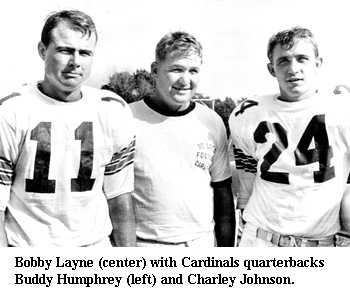
Bobby Layne, who got an assist from the Cardinals in his development as a quarterback, returned the favor two decades later.

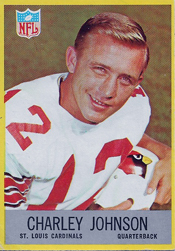
In 1965, Layne joined the St. Louis Cardinals as quarterback coach, helping to refine Charley Johnson.

During the 1950s, Layne was a savvy, swashbuckling quarterback who led the Detroit Lions to NFL championships. Before that, while at University of Texas, he got a crash course in how to play in a modern T formation when he was invited to visit the Chicago Cardinals.

Fast learner

A native of Santa Anna, a Texas town named after a Comanche chief, Layne experienced tragedy in 1935 when he was 8. According to Alcalde, the alumni magazine of the University of Texas, “he was riding in the backseat of the family car when his father coughed and lurched backward from the passenger seat, dying of a heart attack. The experience haunted Layne the rest of his life.”

Layne’s mother sent him to live with an aunt and uncle, and they settled in affluent University Park in suburban Dallas. At Highland Park High School, Layne became a friend and teammate of running back Doak Walker. They later played together with the Detroit Lions and were elected to the Pro Football Hall of Fame.

(Another Highland Park graduate, Matthew Stafford, surpassed Layne as the Detroit Lions’ all-time passing leader.)

Layne went to the University of Texas on a baseball scholarship. Though “he was a pitcher who couldn’t throw a fastball,” according to the Chicago Tribune, Layne was 38-7, including 28-0 against Southwest Conference foes, during his time at Texas. The Cardinals, Giants and Red Sox wanted him to pursue a professional baseball career with them, according to Alcalde magazine.

Football provided him with another option. He became the Texas quarterback and excelled at that, too.

Before Layne’s senior season in 1947, Texas head coach Blair Cherry made plans to convert the offense from a single wing to a T formation, which required deft ballhandling from the quarterback. Because the NFL’s Chicago Cardinals were adept at using the T, Cherry arranged for Layne to visit their summer training camp and learn the techniques.

Layne took his wife Carol on the trip north. “Every time they stopped for gas, Bobby and Carol jumped out of the car and practiced center snaps,” according to the Chicago Tribune.

Cardinals quarterback Paul Christman showed Layne how he operated in the T. Layne also got instruction from head coach Jim Conzelman and assistant Buddy Parker. A fast learner, Layne had a spectacular senior season, leading Texas to a 10-1 record. (The lone loss, 14-13, was to Southern Methodist, whose star player was Doak Walker.)

The Chicago Bears chose Layne in the first round of the 1948 NFL draft and he signed a three-year contract with them because “I could make more money in a hurry than I could have made if I’d started in as a baseball player … but doggone it if I still don’t like that baseball,” Layne told the Detroit Free Press.

Turning pro

With Sid Luckman and Johnny Lujack ahead of him at quarterback, there wasn’t much playing time available for Layne with the 1948 Bears. “I used to shine shoes for (center) Bulldog Turner when I was a Bears rookie,” Layne told the Chicago Tribune, “and … I used to sneak extra food out to Bulldog, too. He was at the fat man’s table and they were holding him down.”

When the Bears traded Layne after the season to the New York Bulldogs, he considered quitting. The 1949 Bulldogs were one of two NFL franchises in New York (the Giants were the other) and were a flop on the field and at the gate. The club was owned by Ted Collins, business manager of singer Kate Smith.

“Every time Kate Smith got a sore throat, we were worried about getting paid,” Layne told the Chicago Tribune. “If she couldn’t sing ‘God Bless America,’ there wouldn’t have been any checks.”

After one season with them, Layne was dealt to Detroit and his career soared. In 1951, when Buddy Parker became head coach, Layne threw 26 touchdown passes in 12 games. In Layne’s eight seasons (1950-58) with the Lions, they won three NFL championships (1952, 1953, 1957). They haven’t won one since.

Layne “couldn’t throw a spiral … but he could produce first downs and touchdowns like magic,” the Chicago Tribune noted.

Lions linebacker Joe Schmidt said to the Detroit Free Press, “Bobby was not a great pro thrower, but he was smart, knew the weaknesses of defenses and did what he had to do to win. He was a tremendous leader, highly competitive.”

His passes may have fluttered, but as Layne told the Chicago Tribune, “The only thing that counts is winning.”

According to United Press International, “Layne was perhaps the first NFL quarterback to make an art of getting a team downfield during the last two minutes of a game. Using plays and pass patterns designed specifically to gain yardage and stop the clock, Layne gave shape and substance to what became known as the two-minute drill.”

Fun and games

Layne was all business on the field and a carouser the rest of the time.

According to the Free Press, he “loved Cutty Sark whiskey, cards, gambling, jazz, a roomful of drinking buddies, picking up the tab and leaving a big tip.”

Lions guard Harley Sewell told the newspaper, “When I was a rookie, I went out with Bobby Layne to get some toothpaste, and we didn’t get back for three days.”

Lions safety Yale Lary added, “When Bobby said block, you blocked, and when Bobby said drink, you drank.”

Running back John Henry Johnson, Layne’s teammate with the Lions and Pittsburgh Steelers, said to The Pittsburgh Press, “He’d drink scotch, start perspiring and you could smell Cutty.”

Joe Schmidt told the Free Press that going to nightclubs with Layne “was like walking into a room with Babe Ruth. Everybody knew him, table down front, drinks for everyone and big tips to the musicians. You’d have a good time but pay for it the next day.”

One night, before playing the Cardinals, Layne was seen partying until 3 a.m., then showed up for the afternoon game and threw for 409 yards.

“No one can ever say I wasn’t 100 percent ready the day of a game,” Layne told the Chicago Tribune.

Dark side

After the second game of the 1958 season, the Lions dealt Layne to the Steelers for quarterback Earl Morrall and two draft choices. Layne was reunited with head coach Buddy Parker, who’d left Detroit for Pittsburgh during training camp in 1957. To Detroiters, the trade was as unimaginable as if the baseball Tigers dumped Al Kaline or the hockey Red Wings got rid of Gordie Howe.

Some speculated Layne was traded because the Lions suspected he was betting on their games.

In investigative journalist Dan Moldea’s 1989 book “Interference: How Organized Crime Influences Professional Football,” convicted gambler Donald “Dice” Dawson said he had placed bets with Layne.

In 1963, the Lions’ Alex Karras and Green Bay Packers halfback Paul Hornung were suspended for the season for betting on league games. In his 2004 autobiography “Golden Boy,” Hornung said Layne told him he bet on the Lions in games he played for them. “Bobby gambled more than anybody who ever played football,” Hornung said.

In his 1962 book “Always on Sunday,” Layne said, “I know I’ve been accused of betting on games … but I would have to be crazy to endanger my livelihood for a few thousand dollars … and to jeopardize my reputation would be ridiculous.”

Cardinals coach

After his final season as a player in 1962, Layne stayed with the Steelers as quarterback coach on Buddy Parker’s staff. When Parker quit just before the start of the 1965 season, Layne was out, too.

That’s when Cardinals head coach Wally Lemm invited Layne to join his staff in St. Louis. Layne accepted and arrived five days before the start of the season opener.

“There’s no doubt he can help us,” Lemm said to the St. Louis Post-Dispatch. “None of the rest of us (on the staff) had the experience of playing quarterback.”

Layne clicked with Cardinals quarterback Charley Johnson.

“A year ago, (Johnson) had an unfortunate habit of trying to force his passes _ throwing to his primary receiver no matter how tight the coverage on him,” Tex Maule of Sports Illustrated observed. “He also had a tendency to give up on his running game if it did not work immediately and to rely entirely on passes. Now he has almost rid himself of these vices. Some of the improvement is the natural result of an additional year’s experience; more of it is due to the intensive coaching of Bobby Layne.”

The concept of the ground game setting up the passing game wasn’t revolutionary, but, coming from Layne, it resonated with Johnson.

“Layne hasn’t told me anything that coach Wally Lemm didn’t,” Johnson explained to Sports Illustrated. “Coach Lemm said the same things to me last year, but I guess I didn’t pay as much attention as I have to Layne _ probably because I know he was a quarterback and a good one.

“For instance, Bobby told me not to quit on a running play because it doesn’t work at first. He told me to run it again now and then just to make the defense aware of it and to set them up for something else, and then, when you get them set up, to wait until the right time to use a particular play. He reminded me not to waste it deep in your own territory _ to save it until you need it.”

According to Sports Illustrated, Johnson was setting up for passes more quickly and was less vulnerable to a rush. “Layne has given me a feeling of security in my calls, and I think I understand tactics better,” he said.

After the 1965 Cardinals won four of their first five games, Layne received much of the credit. “Johnson listens to Layne,” Cardinals receiver Bobby Joe Conrad said to The Pittsburgh Press. “He has a lot of respect for Bobby.”

Running back Willis Crenshaw told the newspaper, “Bobby Layne has made this a different ballclub.”

Layne said to Sports Illustrated’s Edwin Shrake, “My contribution to Charley has been overrated. Charley was a finished quarterback before I came here. I wouldn’t trade him for any quarterback in the league, and I mean that. I’ve helped him with a few little things, but the main thing I’ve done for him is to watch him all the time.

“When I was playing, I didn’t have anybody to watch me constantly and I tended to get sloppy, as anybody will occasionally. One of the most vital things for a quarterback to do is to get back into the pocket and set up quickly, especially with all the blitzes you see now. Charley knows I’m watching and he concentrates on setting up fast. If you keep doing that in practice, it becomes a habit.”

Despite Johnson’s advancement, the Cardinals fizzled and Lemm was fired. His successor, Charley Winner, didn’t retain Layne, who went on to scout for the Dallas Cowboys in 1966 and 1967.

Texas two-step

Layne settled in Lubbock, Texas, and was involved in a variety of businesses. In addition, “Bobby was a big-time gambler, and poker was his best game,” the Lubbock Avalanche-Journal reported. “He often played seven days a week. He reportedly won between $200,000 and $750,000 annually playing poker locally.”

A single-digit handicap, Layne also played in country club golf tournaments. “One year, the tournament committee hired a group of musicians who entertained from a flatbed trailer near the 18th green as the players finished their rounds,” the Lubbock newspaper reported. “As the band played ‘When the Saints Go Marching In,’ Bobby led his somewhat tipsy group in a wiggling, twisting boogie across the fairway _ with Bobby twirling his golf club like a drum major.”

Read Full Post »

Duane Thomas was a valuable running back and non-conformist in a league that valued conformity more than it did talent.

Thomas had two seasons with the Dallas Cowboys and was their leading rusher in both. In his rookie season, they reached the Super Bowl for the first time. In his second season, they won it.

The Cowboys traded Thomas after both title games because he wanted a pay raise. They preferred to get rid of him rather than renegotiate his contract.

Thomas led the NFL in average yards per carry (5.3) as a rookie in 1970 and in total touchdowns (13) and rushing touchdowns (11) in 1971. Against the St. Louis Cardinals, he scored four touchdowns in the 1971 regular-season finale.

On the run

Born and raised in South Dallas, Thomas was a teen when his parents, John and Loretta, died less than a year apart. He moved in with relatives.

Regarding those teen years, Thomas said to Gary Cartwright of Texas Monthly magazine in 1971, “Both of my parents were dead and I traveled a lot. This aunt in Los Angeles … This aunt in Dallas … You travel, you see things. One night, I slept next to a dead man on a railroad track, only I didn’t know he was dead. You see things and you start to relate … I met the Great Cosmos out there.”

(According to Cartwright, “The Great Cosmos was Duane’s attempt to express the inexpressible, and he used the term like a new toy. It was an interchangeable expression of faith and fear, of love and loneliness, of infinite acceptance and eternal rejection, a gussied-up extraterrestrial slang that still hovered painfully near his South Dallas streets.”)

“When I was young, hobos used to come and sleep on our porch,” Thomas told the Boston Globe. “We might not have anything but beans and cornbread but we always shared what we had.”

Thomas played football at Lincoln High School in South Dallas. He reminded observers of Abner Haynes, who played for Lincoln a decade earlier and went on to lead the American Football League (AFL) in rushing touchdowns for three consecutive seasons (1960-62).

Lincoln head coach Floyd Iglehart told Gary Cartwright, “I guess you could call Duane a loner. The only thing that boy liked to do was run. All the time … Running, by himself. Running from home to school, running back home, running over to his girlfriend’s house at night.”

Thomas and his girlfriend married while in high school after she got pregnant. They had a daughter and later a son, according to Texas Monthly.

Happy days

Thomas went to college at West Texas A&M in the panhandle town of Canyon, 375 miles from Dallas. He averaged six yards per carry in four seasons.

The Cowboys chose Thomas in the first round of the 1970 NFL draft. (The Cardinals took the first running back, Texas A&M’s Larry Stegent, who then tore up his knees.)

Cowboys head coach Tom Landry was ecstatic about Thomas being available when Dallas’ turn came with the 23rd pick. “We have unlimited feeling for Thomas,” Landry told the Fort Worth Star-Telegram. “He’s the type running back that doesn’t come along every year … If we’d gone into the draft with only one (player) to come out with, he’s the one we wanted … This guy doesn’t lack anything.”

Asked his reaction to being drafted by Dallas, Thomas said to the newspaper, “There’s nothing like home sweet home. I’m so excited I can hardly think.”

Thomas signed a three-year contract. According to Los Angeles Times columnist Jim Murray, Thomas got base salaries of $18,000 in 1970, $20,000 in 1971 and $22,000 in 1972. Thomas also got a $25,000 signing bonus, plus a bonus for making the team as a rookie.

Robust rookie

Calvin Hill and Walt Garrison opened the 1970 season as the Cowboys’ starting running backs, with Thomas primarily returning kickoffs. (He averaged 22 yards on 19 returns.) In October, Thomas moved into the starting backfield. The rookie led the 1970 Cowboys in rushing (803 yards) and rushing touchdowns (five).

“Thomas is the best we’ve ever had as far as hitting all types of plays and being able to go all the way on them,” Landry told The Sporting News.

Football writer Bob Oates observed, “When daylight appears in a football line, even a crack of light, his acceleration is breathtaking.” Jim Murray wrote, “He didn’t really run; he just sort of flowed, like syrup over a waffle.”

In describing what it was like to carry a football as a NFL running back, Thomas told Gary Cartwright, “It’s like moving in a shadow … in a dream … where everything is real slow and yet so fast you don’t think about it … Then you see some light and you go for it.”

The 1970 Cowboys qualified for the playoffs and Thomas carried them to wins over the Detroit Lions (135 yards rushing) and San Francisco 49ers (143 yards rushing and two touchdowns _ one rushing and the other receiving).

“Thomas is great at cutting back on power sweeps,” columnist Dick Young noted in The Sporting News. “Here’s a guy who picks up the most casual six, eight yards a try I ever saw.”

In the third quarter of the Super Bowl against the Baltimore Colts, the Cowboys were ahead, 13-6, and on the verge of delivering a knockout punch. On first down from the Baltimore 2-yard line, Thomas took a handoff, got inside the 1, twisted and tried to get across the goal line, but linebacker Mike Curtis stripped the ball out of his hands and cornerback Jim Duncan recovered. The Colts rallied and won, 16-13.

Hard feelings

Based on the overall success of his first season, Thomas wanted to be paid more than the $20,000 his contract called for him to receive in 1971. He asked the Cowboys to renegotiate and they refused.

Upset with the response, Thomas held a news conference in July 1971 and criticized Cowboys management. He said Landry was “so plastic, just not a man at all.” He called team president Tex Schramm “sick, demented and completely dishonest” and said player personnel director Gil Brandt was “a liar.”

“I had all the freedom of a Negro slave,” Thomas said to the Boston Globe.

The Cowboys shipped Thomas, lineman Halvor Hagen and defensive back Honor Jackson to the New England Patriots for running back Carl Garrett and a No. 1 draft pick.

At his first training camp practice with the 1971 Patriots, Thomas clashed with head coach John Mazur when asked to set up in a three-point stance. Thomas went into a two-point stance instead. According to The Sporting News, Thomas told Mazur, “This is the way I was taught at Dallas. They said you could see the linebackers better from a two-point stance.”

Mazur insisted a three-point stance was better. Thomas replied, “That may be but I’m doing it my way.”

(Years later, Thomas recalled to the Boston Globe, “I was in a two-point stance because it gives a better view of a handoff. I was behind [fullback] Jim Nance, and I couldn’t see. His ass was the size of a volleyball court.”)

Mazur ordered Thomas to leave the field, then went to general manager Upton Bell and said he wanted Thomas off the team.

When Bell called the Cowboys about rescinding the trade, Tex Schramm said no, but NFL commissioner Pete Rozelle intervened and brokered a compromise, the Boston Globe reported. The Cowboys returned Garrett and the No. 1 draft pick to the Patriots, who sent Thomas and two high draft picks to Dallas. The Patriots kept Hagen and Jackson.

With the Cowboys still unwilling to renegotiate his contract, Thomas refused to report. The Cowboys placed him on their reserve list without pay.

In late September 1971, Thomas agreed to return to the team.

Championship run

The player the Cowboys traded in July and reluctantly relented to take back led them in rushing (793 yards) and total touchdowns scored (13) in 1971, even though he played in just 11 of their 14 games.

One of those games was a 44-21 Cowboys victory against the Patriots. Thomas ignited the rout with a 56-yard touchdown run for the first score of the game. Landry described Thomas as “tremendous,” The Sporting News reported.

Another highlight came Dec. 18, 1971, in the Cowboys’ 31-12 triumph against the Cardinals at Dallas. Thomas scored three touchdowns rushing and another receiving. One of the touchdown runs was of 53 yards. The touchdown catch, on a screen play, went 34 yards. “Thomas zigzagged behind blockers, cut back to the middle and scored easily,” the St. Louis Post-Dispatch reported. Game stats and Video

Throughout the season, Thomas refused to talk with the media because he thought it had taken management’s side in his contract squabble. Years later, he told the Boston Globe, “The NFL controlled the media. That’s how they kept players in line _ through fear, which is an old slave tactic. Pit one against the another … Tom (Landry) would tell you one thing and the media something else.”

Thomas helped the Cowboys repeat as NFC champions, scoring touchdowns in playoff victories versus the Minnesota Vikings and San Francisco 49ers.

In the Super Bowl against the Miami Dolphins, Thomas rushed for 95 yards and a touchdown in Dallas’ 24-3 victory, earning a winner’s share of $15,000.

Moving around

At training camp in July 1972, Thomas again threatened to sit out unless his base pay was raised. Again, the Cowboys traded him _ to the San Diego Chargers for wide receiver Billy Parks and running back Mike Montgomery.

“I’m not going to try and change Duane Thomas,” Chargers head coach Harland Svare said to The Sporting News. “He won’t be expected to stand and salute.”

Thomas never played a regular-season game for the Chargers. He eventually was put on the reserve list in 1972 and traded to the Washington Redskins for two high draft picks in 1973.

Thomas played two seasons (1973-74) with Washington. One of his best performances came on Sept. 22, 1974, when he rushed for 96 yards against the Cardinals, who won, 17-10. Game stats

After playing a few games for Hawaii of the World Football League in 1975, Thomas worked a variety of jobs, including as an avocado farmer in California, before settling in the Village of Oak Creek near Sedona, Arizona.

“I was living in my own little world,” Thomas told Jim Murray. “I was making the world up as I went along.”

Read Full Post »

A hurdler in track, Dave Williams used those skills on the football field to spring above defenders and catch passes in a crowd.

The NFL St. Louis Cardinals projected him to be the deep threat who would replace longtime standout Sonny Randle.

Williams came through for St. Louis in his first three seasons, but couldn’t sustain the success. 

Athletic ability

Though born in Cedar Rapids, Iowa, Williams grew up in Tacoma, Wash., and went to Lincoln High School, where he excelled in football and track. He won a state championship for Lincoln in the hurdles in 1963.

Williams then competed in both sports at the University of Washington. According to Bob Broeg of the St. Louis Post-Dispatch, Washington head football coach Jim Owens said, “He’s the finest natural athlete I ever coached.”

Williams was a collegiate all-America in four different events in track and field _ broad jump, 120-yard hurdles, 440-yard hurdles and 440-yard relay. He qualified to compete in the 1964 Olympic trials in the decathlon.

His football career at Washington was not as consistent. As Tacoma News Tribune sports editor Earl Luebker noted, “Much of his time was spent in frustration.”

In his first varsity season as a sophomore in 1964, Williams made a mere three catches. “He started his sophomore season as one of the most widely heralded pass receivers,” the News Tribune reported, “yet, before the year had progressed too far, he found himself working as a third-stringer in the defensive secondary.”

Williams’ breakout season came as a junior in 1965 when he made 38 catches, including 10 for touchdowns. The 6-foot-2 receiver had 10 catches, including one for a touchdown, against Stanford and another 10 catches, for 257 yards and three touchdowns, versus UCLA.

“We couldn’t cover that fellow Williams,” UCLA head coach Tommy Prothro told the Los Angeles Times. “We tried to play him loose, but it was no go … Williams, who sort of reminds me of (the Green Bay Packers’) Don Hutson, has such deceptive speed. Looks like he’s running slow with that easy gait.”

As a senior in 1966, Williams “was used largely as a decoy,” the Tacoma News Tribune reported, and had no touchdowns among his 21 catches.

Promising rookie

Williams caught the attention of the Cardinals with his play in college all-star games after his senior season. In the East-West Shrine Bowl, he snared a 48-yard touchdown toss from Stanford’s Dave Lewis. Then, in the Hula Bowl, Purdue’s Bob Griese connected with Williams on touchdown throws of 43 and 40 yards.

The Cardinals picked Williams in the first round of the 1967 NFL draft. He was the second wide receiver taken. The first was Michigan State’s Gene Washington by the Minnesota Vikings.

“Williams was the surest bet to help us,” Cardinals head coach Charley Winner said to the Post-Dispatch. “He has ideal size. In addition to speed, he’s big enough to crack back as a blocker and he definitely can catch the ball in a crowd.”

Cardinals receivers coach Fran Polsfoot told the newspaper, “He excels at catching the hard passes. He’ll go up and fight for the ball with a good spring in his legs and intense desire.”

At training camp with the 1967 Cardinals, Williams was accepted by veteran receivers Bobby Joe Conrad and Sonny Randle, and quarterback Charley Johnson.

“I’ve been really surprised by the help I’ve got from the other receivers,” Williams told the Post-Dispatch. “Bobby Joe Conrad showed me how to break on my pass patterns. Sonny Randle helped me in learning to make certain alignments. Charley Johnson has helped in telling me how to read defenses and be in the right place.”

Randle said to the newspaper, “He has all the tools. As soon as he knows the right places to be, he’ll be a good one.”

Williams did so well in exhibition games that the Cardinals traded Randle to the San Francisco 49ers for a draft choice three days before the 1967 season opener.

On Monday night, Oct. 30, 1967, the reigning NFL champion Green Bay Packers played at St. Louis. Matched against Herb Adderley, destined for election to the Pro Football Hall of Fame, Williams caught touchdown passes of 49 and 48 yards from Jim Hart. On a halfback option play, Johnny Roland also completed a pass to Williams in the end zone but it was nullified by an offsides penalty on a lineman. Described by the Green Bay Press-Gazette as “jet-like” and “explosive,” Williams made six catches for 147 yards in the game.

“The kid’s good,” Adderley told the Post-Dispatch. “I predict a great future for him. He’s not like most of these rookies who go out and see how fast they can run. Williams makes moves. I backed off and played him loose the second half. He could have those short ones, but no more bombs.” Game stats and Video

Williams completed his rookie season with 28 catches and five touchdowns.

Hard to cover

Convinced Williams was headed for stardom, the Cardinals traded Billy Gambrell to the Detroit Lions for a draft choice just before the start of the 1968 season, making Williams and Bobby Joe Conrad the starting wide receivers.

Williams had 43 catches, including a team-high six for touchdowns, in 12 starts for the 1968 Cardinals before an injury to his left knee sidelined him for the final two games.

One of his season highlights was a 71-yard touchdown catch on a pass from Hart against the Pittsburgh Steelers. “I was supposed to cut him off short and (safety) Clendon Thomas was supposed to take him long,” Steelers cornerback Marv Woodson told the Post-Dispatch, “but Williams just outran Thomas, and Jim Hart threw a perfect pass. No cornerback can stop a good receiver from catching a perfect pass, no matter how well he covers his man.” Game stats

(Of Williams’ 22 touchdown receptions in his five seasons with St. Louis, 12 were of more than 30 yards.)

In 1969, Williams led the Cardinals in receptions (56). His seven touchdown catches came in two games.

On Nov. 2, 1969, Williams scored four touchdowns on passes from Charley Johnson, but the Saints beat the Cardinals, 51-42. “Here I am with my greatest day statistically, but the luster is taken off,” Williams said to the Post-Dispatch. “You come away with an empty feeling because you lost the ballgame.” Game stats

A month later, Jim Hart connected with Williams on three touchdown passes against the Steelers. Game stats

Unhappy days

Based on his first three seasons, the Cardinals had high hopes for Williams in 1970. At training camp, Bob Broeg of the Post-Dispatch observed that Williams “gives promise of leadership because he’s sharp, articulate and the kind of performer who can inspire.”

Broeg added, “Williams’ forte is the incredible leaping ability and possessiveness that permits him to get higher than backfield defenders and to out-grapple them for the ball.”

The season, though, was a bust. Williams clashed with head coach Charley Winner and told the Post-Dispatch, “Most of the players didn’t respect him.”

Williams had 23 receptions in 1970 (33 fewer than the year before) and, according to the Post-Dispatch, Jim Hart lost confidence in him. “Dave Williams was a dejected, withdrawn football player, dressing quickly and leaving the locker room before his teammates, and intentionally ostracizing himself from the club,” the Post-Dispatch reported.

Charley Winner was fired after the season and became an assistant on the staff of Washington Redskins head coach George Allen. The Cardinals offered to trade Williams to Washington for a second-round draft pick, but Winner recommended to Allen that he decline the proposal, the Post-Dispatch reported.

Bob Hollway was the Cardinals’ head coach in 1971 but Williams regressed, losing his starting job to rookie Mel Gray and finishing with 12 catches.

On Feb. 1, 1972, after the Cardinals made Oregon wide receiver Bobby Moore (who later became Ahmad Rashad) their first pick in the draft, they traded Williams to the San Diego Chargers for wide receiver Walker Gillette. (Like Williams, Moore went to high school in Tacoma.)

“Williams had been a big disappointment to the Cardinals,” the Post-Dispatch exclaimed. “His teammates often accused him of not running correct patterns, and this alienated him from the squad.”

Never a dull moment

After a season and a half with the Chargers (21 total catches, three touchdowns), Williams was placed on waivers and acquired by the Steelers in October 1973. He played in one game for them and joined the Southern California Sun of the World Football League in 1974.

Playing for head coach Tom Fears, Williams spent two seasons with the Sun and revived his career _ 59 catches, 11 touchdowns in 1974, and 21 catches, nine touchdowns in 1975. “Williams runs like a deer, is sure-handed and runs exemplary pass patterns,” the Los Angeles Times noted.

In November 1975, Williams, 30, became the first player to sign with the Seattle Seahawks, an NFL expansion team slated to begin its inaugural season in 1976. Part of his contract required Williams to make promotional appearances to generate interest in the fledgling franchise.

Williams entered a professional indoor track meet in Seattle in the spring of 1976 after receiving approval from the Seahawks. While running an obstacle course, his spikes caught in the boards and he tore cartilage in his left knee.

Meanwhile, in June 1976, Williams filed a damage lawsuit against Dr. Arnold Mandell, a former team psychiatrist for the Chargers, who wrote a book, “The Nightmare Season,” about his experiences with the team. In his lawsuit, Williams said Mandell falsely accused him of “defects of character.”

Two months later, in August 1976, the Seahawks put Williams on waivers because he failed a physical. Williams threatened to sue the Seahawks, claiming they were responsible for the knee injury he suffered in the track meet.

In December 1976, Williams told the Tacoma News Tribune that he and the Seahawks reached an out-of-court settlement. “We sat down and resolved the matter in about 20 minutes,” Williams said to the newspaper.

With his playing career done, Williams eventually became a spokesman for the Pro Football Retired Players Association.

In May 1979, a San Diego County Superior Court jury awarded Williams $300,000 in his libel trial against the former Chargers psychiatrist.

Read Full Post »

When Roman Gabriel was with the Los Angeles Rams, a strong performance versus the St. Louis Cardinals helped him emerge as a No. 1 quarterback. Later, when Gabriel went to the Eagles, he led them to a stirring comeback against the Cardinals for his first win with Philadelphia, then never beat them again.

In 12 games, including 10 starts, versus the Cardinals, Gabriel won four, lost eight. Seven of those defeats came when he was with the Eagles.

Gabriel won a NFL Most Valuable Player Award in 1969 but never played for a NFL champion.

Potent passer

Roman Gabriel’s father came to the United States from the Philippines and settled in Wilmington, N.C., working in a dining car for a railroad.

As a youth, Gabriel had a severe case of asthma. “I remember having to stop to sit on a curb so I could catch my breath on my way to school,” he told the St. Louis Post-Dispatch.

Gabriel attended New Hanover High School, alma mater of NFL quarterback Sonny Jurgensen, and was one of the best prep basketball centers in the state. He joined the football team his senior year. With a strong arm, size and athleticism, he was a natural. “He can throw the pigskin a country mile,” the Greensboro (N.C.) News and Record observed.

Playing college football at North Carolina State, Gabriel became the first Atlantic Coast Conference quarterback to throw for 1,000 yards in a season. At 6-foot-5 and 220 pounds, the Post-Dispatch noted, “He can peer over the tops of defensive linemen. He can stand resolute in the midst of a ferocious rush. He once demonstrated for onlookers that he could toss a football 85 yards in the air.”

Pro scouts were dazzled. The Oakland Raiders made Gabriel the No. 1 overall pick in the 1962 AFL draft. The Rams, with the second and third choices in the first round of the 1962 NFL draft, chose Gabriel and Utah State defensive tackle Merlin Olsen, and signed both.

Tinsel Town

A football player named Roman Gabriel seemed ideal for a team that played its games at the Coliseum in the City of Angels.

The strapping quarterback also had a look tailored for Hollywood. “This is quite a chunk of manhood,” New Yok Times columnist Arthur Daley wrote. “Gabriel is a bronzed giant with high cheek bones.”

Temptations were abundant. Reflecting on his early years with the Rams, Gabriel said to the New York Times, “I came from a small city in North Carolina, Wilmington, and Los Angeles was a lot for me to swallow. For a few years, I was pretty wild, out every night and waking up in a different place every morning. I finally realized that kind of life wasn’t getting me anywhere.”

Gabriel initially did more playing off the field than he did on it. Zeke Bratkowski was the Rams’ quarterback in 1962 and 1963, with Gabriel being given starts in the back ends of those losing seasons. Injured at the beginning of the 1964 season, Gabriel watched as rookie Bill Munson started at quarterback.

The Rams, though, remained intrigued by Gabriel’s potential.

“Gabriel is a cinch to be the next superstar at quarterback,” Rams head coach Harland Svare told the New York Times in 1964. “He’ll be making headlines long after Y.A. Tittle and Johnny Unitas have departed. No quarterback in the history of the league is as strong as Gabriel. One day, Gino Marchetti, the toughest defensive end in the business, had him apparently pinned against the sidelines. Gabriel merely reached out and pushed Marchetti’s face into the dirt. Then he made the throw.”

Nonetheless, when the 1965 season opened, Gabriel was the backup to Munson. As Los Angeles Times columnist Jim Murray noted, “Gabriel has been a Ram for four years. Most of that time he has been just another spectator.”

Job won

On Nov. 21, 1965, Munson tore up his right knee in a game against the San Francisco 49ers and the Rams’ season record fell to 1-9. Gabriel took over and led them to consecutive victories against the Green Bay Packers (their last loss in a NFL title season), St. Louis Cardinals and Cleveland Browns. 

In the Rams’ 27-3 victory over the Cardinals, Gabriel threw two touchdown passes, completed 55 percent of his throws and wasn’t intercepted. One of the scoring passes, 59 yards to tight end Billy Truax, came on third down-and-17 as the Cardinals blitzed two linebackers and a safety.

“Gabriel, unlike any other quarterback, is as strong as the men who were coming at him,” The Sporting News noted. “He strode around in the heavy traffic as Truax ran his pattern. Then, as the Cardinals hacked at him like small boys with a toy hatchet, the tallest quarterback threw a straight dart for the touchdown.”

The Los Angeles Times concluded, “The Rams again benefited from inspired leadership as Gabriel kept the team on the move at all times.” Game stats

The next week, Gabriel threw five touchdown passes against the reigning NFL champion Browns. Game stats

Those performances got the attention of George Allen, who became Rams head coach in 1966. He named Gabriel the starter. “I was determined not to have this Bill Munson-Roman Gabriel wish-wash,” Allen told the Raleigh (N.C.) News and Observer. “I wanted one quarterback. Gabriel was the man.”

Missing link

Before Allen arrived, the Rams hadn’t had a winning season since 1958. With Gabriel as his quarterback, Allen led the Rams to winning records in each of his five seasons with them. In 1967, the Rams were the NFL’s highest-scoring team. Two years later, Gabriel led the league in touchdown tosses (24). “For sheer arm, he is the Sandy Koufax of the NFL,” Jim Murray wrote.

Rams receiver Jack Snow told the Raleigh News and Observer in 1969, “(Gabriel) is the best in the league. I don’t think anyone else could lead the Los Angeles Rams. He is smart, respected and there never has been any questions about his ability. When he steps in the huddle, he’s the boss. The whole team has complete confidence in his ability.”

The hurdle Gabriel couldn’t overcome was the postseason. He got the Rams into two playoff games and lost both. The biggest letdown was in 1969, when the Rams were 11-0, then lost four in a row, including a playoff game against the Minnesota Vikings. “I was crushed, beyond consolation, and I cried,” Gabriel told the Post-Dispatch. “I’d done some good things, but I hadn’t done enough, so I’d let the team down. I felt an awful emptiness.”

Lights, cameras

During timeouts from football, Gabriel tried acting in TV shows and movies. His TV appearances included episodes of “Perry Mason,” “Gilligan’s Island,” “Ironside” and “Wonder Woman.” He showed up in the role of a prison guard in a 1968 movie comedy, “Skidoo,” directed by Otto Preminger and starring Jackie Gleason and Carol Channing.

Gabriel’s biggest movie role was in the 1969 western, “The Undefeated,” starring John Wayne and Rock Hudson. Gabriel’s Rams teammate, Merlin Olsen, also had a part. Gabriel was cast as Blue Boy, an adopted Cherokee Indian son of Wayne’s character. As critic Roger Ebert noted, “Gabriel looks about as Indian as one of the Beach Boys.”

According to Internet Movie Database (IMDb), Rock Hudson said in a 1980 interview he thought the movie was “crap” but he had fond memories of the filming because he became a close friend of John Wayne and Roman Gabriel. Movie trailer

Gabriel said to the Raleigh News and Observer in 1969, “I like acting, and there’s nothing like starting with a winner like John Wayne. I hope some of his winning style rubbed off on me.”

Bad ending

Injuries hampered Gabriel’s playing days with the Rams in 1971 (knee and elbow surgeries) and 1972 (a collapsed lung and tendinitis in his throwing arm). With Tommy Prothro as head coach, the 1972 Rams had a losing season. Disenchanted, Gabriel lashed out, implying the Rams were a selfish group.

“He made some statements that were detrimental to the team,” Rams center Ken Iman said to The Sporting News.

Receiver Jack Snow told columnist Bob Oates that Gabriel didn’t speak to teammates the last two weeks of the season. “Several members of the team, including myself, tolerated him the last half of the season,” Snow said. “I didn’t look up to him. I didn’t respect him.”

In January 1973, after the Rams acquired quarterback John Hadl from the San Diego Chargers, Gabriel demanded a trade. The Rams obliged, sending him to the Eagles in June 1973 for receiver Harold Jackson, running back Tony Baker and three draft choices.

Eagles win

Winless in his first four games with the Eagles, Gabriel faced the Cardinals at St. Louis on Oct. 14, 1973. The Cardinals led, 24-13, in the fourth quarter, but Gabriel threw two touchdown passes in the final two minutes, giving the Eagles a 27-24 victory. The winning touchdown came on a 24-yard pass to receiver Don Zimmerman as time expired.

In the huddle, Gabriel had asked Zimmerman, a rookie making his first NFL start, “Can you get open?” Zimmerman replied, “I think so.” 

“OK,” said Gabriel. “I’m coming to you.”

Gabriel called the play: 93 double arrow. “The pattern called for both wide receivers (Harold Carmichael and Zimmerman) to run deep posts,” the Philadelphia Inquirer reported. “As Gabriel dropped back, he looked toward Carmichael, freezing safety Clarence Duren. Zimmerman loped down the left sideline, then cut sharply toward the goal post.”

Zimmerman caught a strike from Gabriel and was hit by both Duren and safety Jim Tolbert. Then cornerback Roger Wehrli hit Zimmerman from behind, but Zimmerman continued into the end zone. Game stats   Video at 7:46

Gabriel went on to have a spectacular first season with the Eagles, leading the NFL in completions (270), passing yards (3,219) and touchdown throws (23).

Stupid gesture

In 1974, NFL players went on strike, refusing to report to training camps. The NFL ordered teams to keep the camps open, planning to operate with rookies and free agents. Gabriel, 34, decided to defy the union and cross the Eagles’ picket line.

As a busload of rookies, free agents and Gabriel arrived at camp, “Gabriel was jeered by the same players who had held him in reverence the previous season,” the Philadelphia Daily News reported. “Impulsively, Gabriel reacted by closing his hand at the bus window and extending his middle finger.”

Among the players outside Gabriel’s window were the entire Eagles offensive line.

“I believe Roman Gabriel lost the team when he crossed the picket line,” Eagles running back Po James told the Philadelphia Daily News.

In a 13-3 loss to the 1974 Cardinals, Gabriel was sacked nine times. Game stats

“No one ever suggested that the offensive linemen quit on Gabriel in 1974, but the gung-ho streak that used to sustain their blocking against physically superior defenses was no longer in evidence,” Jack McKinney noted in the Philadelphia Daily News.

Two years later, when Dick Vermeil became head coach of the 1976 Eagles, Mike Boryla replaced Gabriel as the starter. Gabriel spent his final season, 1977, as a backup to Ron Jaworski.

After his playing career, Gabriel worked in several jobs, including three years as head football coach at Cal Poly Pomona (8-24 record), a 1980s stint as president of the Charlotte Knights minor-league baseball team, and a stretch as radio broadcaster for the NFL Carolina Panthers (1995-2001).

Gabriel remains the Rams franchise leader in career touchdown passes (154) and most games played at quarterback (130).

Read Full Post »

In high school at suburban St. Louis and in college at the University of Missouri, Andy Russell helped make every football team he played for a winner and was at his best in the most important games.

A hometown standout would seem a natural choice for the St. Louis Cardinals. Instead, Russell played his entire NFL career as an outside linebacker with the Pittsburgh Steelers.

He was named to the Pro Bowl seven times in 12 seasons and was captain of the Steel Curtain defense that transformed the franchise into Super Bowl champions.

In his rookie season in 1963, Russell stung the Cardinals, intercepting a pass in a Steelers win.

Executive’s son

Charles Andrew “Andy” Russell was born in Detroit and lived in Chicago and New York before his family moved to the St. Louis suburb of Ladue. His father’s job as an executive with Monsanto, the chemical company, required the relocations.

According to the Pittsburgh Post-Gazette, Andy Russell said his father William “was an immigrant who came to the United States from Scotland in 1922 at age 11. He was proud of making his way in this new world. It’s a million miles from the tenements of Glasgow to the top ranks of Monsanto.”

Andy Russell became an accomplished fullback on the Ladue Horton Watkins High School football team. Nicknamed “The Horse” because of his power and ability to stiff-arm tacklers, Russell led the team to an 8-0 record his senior season in 1958.

He chose Missouri from among 25 college scholarship offers because, in part, “I was impressed particularly with the members of the faculty whom I met,” Russell told the St. Louis Post-Dispatch.

As Russell entered college, his father got promoted to lead Monsanto’s overseas division. Andy’s parents moved to Brussels, Belgium (and later Geneva, Switzerland), and Monsanto provided Andy with roundtrip airfare each summer during his college years to join them in Europe, according to the Post-Dispatch.

Missouri Tiger

In Russell’s three varsity seasons (1960-62) as a fullback and linebacker for head coach Dan Devine, Missouri was 25-4-3, including victories against Navy in the Orange Bowl and Georgia Tech in the Bluebonnet Bowl.

As a junior in 1961, Russell was Missouri’s leading rusher, but defense was where he excelled the most. At linebacker, he played “aggressively and with intuition, diagnosing running plays and wheeling back to knock down and intercept passes,” columnist Bob Broeg noted in the Post-Dispatch.

Playing before 71,218 spectators, including President-elect John F. Kennedy, in the Orange Bowl, Russell intercepted two passes from Navy quarterback Hal Spooner.

In Missouri’s 10-0 victory versus Oklahoma State in 1961, Russell scored the lone touchdown, intercepting a pass and returning it 47 yards for the score. The next year, he picked off two passes to help Missouri beat Nebraska, 16-7.

In his final game for Missouri at the Bluebonnet Bowl in Houston, Russell made two interceptions and nine tackles. He also threw the key block to spring Bill Tobin on a 77-yard touchdown run.

As the St. Louis Globe-Democrat noted, Russell “always seems to rise to the occasion in important games.”

Join the club

During a visit to St. Louis, William Russell took Andy to a Cardinals football game and was disheartened by the brutality he witnessed on the field. According to Los Angeles Times columnist Jim Murray, the father said, “Son, promise me one thing: You will never play pro football.” Andy replied, “Don’t worry.”

Andy Russell planned to start a business career in St. Louis after he graduated. He also was facing a stint in the Army because he had completed the Reserve Officers Training Corps (ROTC) program at Missouri.

“I never even considered pro football,” Russell said to The Pittsburgh Press. “I can honestly say the thought never occurred to me.”

During his senior year, when NFL teams sent Russell questionnaires that included a query on whether he wanted to play pro football, Russell checked the box marked “no.” According to the Associated Press, the only team that didn’t mail him a survey was the Steelers. So they didn’t know he was uninterested.

The Steelers had traded their top seven spots in the 1963 NFL draft and didn’t have a pick until the eighth round. When their turn came in the 16th round, the Steelers selected Russell, then sent scout Will Walls to meet with him. Walls “gave me a real sales talk on the (team’s) shortage of linebackers,” Russell recalled to the Post-Gazette. “That convinced me that I had a chance.”

After graduating from Missouri in June 1963 with a degree in economics, Russell signed with the Steelers. According to the Associated Press, he got a $12,000 contract and $3,000 signing bonus. Russell planned to play one season for the money, then pursue a graduate degree. At the Steelers’ suggestion, he asked the Army for a delay in fulfilling his ROTC commitment and it was granted.

Making the grade

The 1963 Steelers were loaded with characters. “That was a fun team,” Russell recalled to the Post-Gazette. “They used to drink a lot of ‘fluids’ to ward off colds. I had played for Dan Devine at Missouri and things were so disciplined that you couldn’t even cough in a meeting. At my first meeting with the Steelers, you could barely see the blackboard through all the cigarette smoke. Some guys would snore in the back of the room and others would argue with the coaches on whether or not plays would work.”

Russell said to Jim Murray, “We were a wildly reckless team … We were about as disciplined as a litter of puppies.”

The Steelers accepted Russell because of how well he played in training camp. Defensive coordinator Buster Ramsey told United Press International, “You don’t often see a rookie work into a system that quickly. He has speed and lateral movement and should develop into one of the best linebackers in the league.”

Early in the season, when linebackers John Reger and Bob Schmitz got injured, Russell stepped in and impressed. On Sept. 29, 1963, facing the Cardinals at Pittsburgh, Russell intercepted a Charley Johnson pass, helping the Steelers to a 23-10 victory. Game stats

“The Cardinals had little success with rookie Andy Russell, even though they picked on the St. Louis youngster time and again,” The Pittsburgh Press reported. “His best play was an interception of a pass intended for fullback Joe Childress. The Cardinals tried to play it cute. On the preceding play, they tried the same over-the-middle pass to fullback Mal Hammack, but Russell broke it up at the last instant. Figuring the rookie wouldn’t expect the same play immediately, Childress came in with orders to come right back with the same thing, but Russell wasn’t guessing. He played his man and wound up with the ball.”

Russell was the Steelers’ only rookie regular in 1963. He started in 13 of 14 games, according to pro-football-reference.com.

Rags to riches

In January 1964, Russell was ordered to begin a two-year tour of duty as an Army lieutenant. He spent most of that time at a base in Stuttgart, Germany, where he played football for a service team, and missed the 1964 and 1965 NFL seasons.

Discharged in January 1966, Russell enrolled in graduate school at Missouri before going to Steelers training camp in the summer. He picked up where he left off, returning to the Steelers’ starting unit.

On Nov. 13, 1966, in a game against the Cardinals at Pittsburgh, Russell blocked a Jackie Smith punt, recovered the ball and returned it 14 yards for a touchdown, putting the Steelers ahead to stay. Boxscore

“We normally don’t attempt to block a punt,” Russell told the Post-Dispatch, “but we had seen in films that they left an opening in their line. When they set up the same way on a punt just before the one we blocked, we decided to try it. The punt hit me right in the face, then it was bouncing on the ground. I picked it up, got a good block and ran it in.”

In 1967, Russell was named Steelers defensive captain (a title he held for 10 years) and earned a master’s degree in business administration at Missouri.

Russell played for losing teams from 1966 to 1971 before experiencing a turnaround under head coach Chuck Noll. From 1974-76, the Steelers’ linebacking unit of Jack Ham, Jack Lambert and Russell was considered “the best in football,” Baltimore Colts running back Lydell Mitchell told the Post-Gazette.

The Steelers were NFL champions in 1974 and 1975, beating the Minnesota Vikings and Dallas Cowboys in the Super Bowls those seasons.

Russell played in 168 consecutive regular-season games for the Steelers. Video He was 35 when he stopped playing and opened an investment securities firm in Pittsburgh. Russell also did extensive charitable work there.

Adventure seeker

According to the Post-Gazette, Russell became “the ultimate mountain man,” summiting all 54 14,000-foot peaks in Colorado. He also climbed Mount Kenya and Mount Kilimanjaro in Africa.

Russell and former Steelers center Ray Mansfield completed the Hunter’s Island Route, a 145-mile canoe adventure through the Canadian wilderness.

“I had always been curious about the limits of physical endurance,” Russell told Neil Amdur of the New York Times. “After football games, I was so exhausted that I used to get this tremendous feeling of peace, as if I had used every bone in my body. I always wondered whether it was possible to achieve this same feeling somewhere else.”

Read Full Post »

Golden Richards was a NFL glamour boy with a glittery name and the look to match. A blonde mane flowed from beneath his helmet when he streaked down the field. As columnist Jim Murray noted, “He’s so golden from his hair on down that he glows in the daylight. He’s perfect for the part of Sir Galahad.”

Richards could play, too. Few were faster than he was. A Dallas Cowboys receiver, Richards had sure hands, the strength to catch in a crowd and the ability to haul in long passes over the shoulder.

He got both his first NFL reception and first touchdown catch against the St. Louis Cardinals. Later, as an established starter, Richards made a game-winning touchdown grab at St. Louis. For his career, the foe he had the most catches against (19) were the Cardinals.

In his first five seasons with Dallas, Richards took part in nine playoff games, including two Super Bowls. The glory came at a terrible price. Richards suffered injuries, became addicted to prescription painkillers and struggled with alcohol abuse.

Burnishing bright

John Golden Richards was born on Dec. 31, 1950, in Salt Lake City. According to the Salt Lake Tribune, his parents gave him the distinctive middle name because they thought a baby born on New Year’s Eve must be extra special. Everyone called him Golden.

Richards’ specialness came through in athletics. He participated in five sports _ baseball, basketball, football, tennis and track _ at Granite High School in Salt Lake City. As a senior in 1969, Richards ran the 100-yard dash in 9.4 seconds and cleared 24 feet in the long jump at the Golden West Invitational in Sacramento.

Colleges recruited him for track, but Richards preferred football. The only football offers he got were from Air Force, Brigham Young University (BYU), Utah, Utah State and Westminster College, the Salt Lake Tribune reported.

Richards, a Mormon, planned to bypass BYU and go with Utah because of the football program’s strong passing game. “Next thing, I was called into my bishop’s office, and he told me he wanted me to go to BYU, or else he would call me on (a Latter-day Saints) mission,” Richards said to the Tribune.

Richards did what he was told and found he was right about BYU’s quarterback situation. None could get the ball to him consistently. In his two varsity seasons (1970-71), Richards caught a total of two touchdown passes.

He made up for it with punt and kickoff returns. As a junior in 1971, he was the NCAA’s top punt returner, with 624 yards and four touchdowns.

Richards didn’t put the same kind of effort into his studies. He was declared academically ineligible for his senior season at BYU. “It was my fault,” he told the Deseret News. “The situation arose simply because of my own laziness.”

He transferred to the University of Hawaii for the 1972 season and snared five touchdown passes in five games before he tore ligaments in his right knee.

Seeing stars

Before the injury, Cowboys scout Bob Griffin twice tested Richards in the 40-yard dash and both times he clocked 4.4 seconds. Impressed, the Cowboys took Richards in the second round of the 1973 NFL draft. “We haven’t had anybody this quick on our team since we picked up (two-time Olympic gold medalist) Bobby Hayes,” Cowboys head coach Tom Landry said to the Honolulu Advertiser.

As a teen, the Cowboys were the team Richards dreamed of playing for someday. When he walked into their locker room for the first time at training camp in 1973, “I was standing there next to Bob Lilly, Jethro Pugh and Roger Staubach,” Richards said to the Salt Lake Tribune. “I wanted to get everybody’s autograph.”

(Before a 1975 game against the New York Jets at Shea Stadium, Richards “stuck a pen and paper in his uniform pants and ran over to Joe Namath, begging for his signature right at the 50-yard line. Namath told Richards it was an honor and sent him a signed glossy photo the following the week,” the Tribune reported.)

On Sept. 30, 1973, the Cowboys were routing the Cardinals at Texas Stadium. In the fourth quarter, Landry began putting in his reserves, including the rookie Richards and quarterback Craig Morton. Soon after, Richards caught his first NFL pass, a five-yard toss from Morton. “I just broke out smiling and was just about laughing all the way to the huddle,” Richards said to the Fort Worth Star-Telegram.

Two plays later, Morton called for Richards to go deep. “I thought it might be a touchdown pass when it (the play) was called,” Richards told the Star-Telegram. “That’s what the play was designed for _ six points.”

Sure enough, Richards broke free and Morton connected with him on a 53-yard scoring pass. Game stats

Big playmaker

More good times followed. Richards returned a punt 63 yards for a score in a 1973 playoff game against the Minnesota Vikings and caught touchdown passes in playoff wins against the Los Angeles Rams (1976) and Vikings (1978).

Richards averaged 17.5 yards a catch in the NFL. Of his 17 regular-season touchdown receptions, 11 were of 40 yards or more.

On Oct. 9, 1977, Richards made the play that beat the Cardinals.

With 6:53 remaining and St. Louis ahead, 24-23, the Cowboys were at the Cardinals’ 17-yard line. Quarterback Roger Staubach called an audible but Richards couldn’t hear him above the din at Busch Memorial Stadium.

“I was able to read Roger’s lips and pick it up, though,” Richards told the Fort Worth Star-Telegram.

As Richards dashed to the goal line down the right side, covered by cornerback Lee Nelson, Staubach floated a pass. “It was a little bit underthrown,” Richards said to the Fort Worth newspaper. “So I just kept going like it was coming. Then, at the last second, I stopped and tipped it back to me with one hand. Then I got a hold of it and just went sliding in to score.”

Nelson, filling in for injured Perry Smith, told the Belleville (Ill.) News-Democrat, “The guy made a hell of a catch. He caught it with one hand, one arm. I batted one of his arms away.”

The Cowboys won, 30-24. Game stats They would lose only twice all season (to the Cardinals at Dallas and to the Steelers at Pittsburgh) and rolled to the Super Bowl for a matchup against the Denver Broncos.

Richards was one of the game’s stars, catching a 29-yard touchdown pass from fullback Robert Newhouse to highlight a 27-10 Cowboys victory. Game stats and video

Troubled times

Richards was popular. His first wife, Barbara, said at his peak he got 1,000 pieces of fan mail a week. At the Super Bowl in Miami in 1976, Richards was “chased up and down the streets by the females, some handing him their telephone numbers, others just wanting to touch him,” the Associated Press reported. 

Richards told the wire service, “It’s kind of overwhelming. I mean, they walk right up with my wife standing next to me.”

He hobnobbed with celebrities such as Olivia Newton-John and model Jerry Hall. “It was glamorous,” Richards told the Salt Lake Tribune.

The glamour masked a dark side. Richards was hurting. He took a pounding in the games. A hit from the Steelers’ Mel Blount broke five of Richards’ ribs. His back ached all the time and so did his teeth from getting belted under the face mask.

Seven times, dentists did root canals to repair damage from hits to Richards’ face, the Dallas Morning News reported. He was prescribed Percodan. Codeine was another. Richards became addicted and “depended on painkillers to play,” according to the Dallas newspaper.

“I never took drugs to get high,” he told reporter Barry Horn. “I took drugs because I couldn’t stand the pain.”

His craving for painkillers spun out of control. “In the bleakest moments,” Gordon Monson of the Salt Lake Tribune reported, “he fished through his own vomit in a toilet for unabsorbed painkillers so he could taken them again.”

Richards told Monson, “There were times when I lived through the darkest dark you can imagine. With the painkillers, you fight and struggle to get up to ground zero, but then you discover you’re still 150 miles below the surface of the earth.”

In April 1978, three months after he scored his Super Bowl touchdown, Richards was rushed to a hospital when it was feared he had overdosed. Five months later, the Cowboys traded him to the Chicago Bears for two draft picks.

Richards spent two seasons with Chicago, got released and was done as a player at 29. His third wife, Amy, told the Salt Lake Tribune, “He got hooked on the narcotics in the NFL. When the NFL was taken away, he no longer had football but he still had the narcotics.”

His problems expanded. Richards turned to booze. “I was living in an alcohol fog,” he said to the Tribune.

He was in and out of treatment centers multiple times.

In December 1992, Richards was arrested on charges he forged his father’s signature on nearly $700 in checks to pay for painkillers. He pleaded guilty.

“This has been a horrible, horrible way of life,” Richards told the Dallas Morning News in January 1993. “Like any addict, I have been deceitful, manipulative and cunning. People who suffer from my kind of addiction can lose everything that means everything to you. I know. I have.”

Richards was sober for the last decade of his life, his brother, Doug, told the Deseret News.


Read Full Post »

« Newer Posts - Older Posts »