Feeds:
Posts
Comments

Archive for the ‘Football’ Category

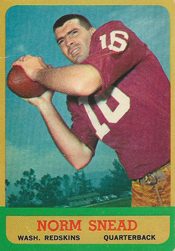
Quarterback Norm Snead lost a lot more often than he won in the NFL. Some of it was his fault. Some of it had to do with his supporting casts.

A classic drop-back passer, Snead was 6-foot-4, smart and had a strong arm. Teams traded quarterbacks Sonny Jurgensen and Fran Tarkenton to acquire him.

He was with the Washington Redskins (1961-63), Philadelphia Eagles (1964-70), Minnesota Vikings (1971), New York Giants (1972-74 and 1976) and San Francisco 49ers (1974-75). Most of those were bad teams.

Snead’s clubs had losing records in 13 of his 16 NFL seasons. The exceptions: 1966 Eagles (9-5), 1971 Vikings (11-3) and 1972 Giants (8-6).

In 178 games played (159 as a starter), Snead was 57-114-7 (52-100-7 as a starter). He was 3-12 versus the Cleveland Browns; 3-14-2 against the Redskins.

The St. Louis Cardinals, with their relentless blitzing, also were a tormentor. Snead was 7-12-1 against them. The Cardinals sacked him more times (53) than any other foe, but he also totaled his most passing yards (3,832) against them.

(Cardinals receiver Sonny Randle was a friend, but more on that later.)

Snead threw 196 career touchdown passes _ more than luminaries such as Ken Stabler (194), Bob Griese (192), Sammy Baugh (187), Otto Graham (174), Joe Namath (173), Norm Van Brocklin (165) and Troy Aikman (165).

Sink or swim

In high school at Newport News, Va., Snead excelled in baseball (he struck out 16 in a game) and basketball (he averaged 21 points a game as a senior) as well as football. He went on to play college football at Wake Forest and set multiple Atlantic Coast Conference passing records.

The Washington Redskins, with the second overall pick in the first round of the 1961 NFL draft, chose Snead ahead of quarterbacks Fran Tarkenton of Georgia and Billy Kilmer of UCLA. Then they traded their starter, Ralph Guglielmi, to the Cardinals and gave the job to Snead.

With no running game (the 1961 Redskins ranked last in the NFL in rushing), Snead was put in a tough spot. Opponents, knowing he was going to pass most of the time, teed off on him.

When Snead faced Guglielmi and the Cardinals on Oct. 22, 1961, at Washington, he was sacked seven times, intercepted once and booed by the home crowd before being replaced in the second half. “I felt sorry for him,” Guglielmi told the Associated Press. “I sure was glad it wasn’t me.”

Led by blitzing linebackers Bill Koman, Dale Meinert and Ted Bates, the Cardinals won, 24-0 _ the franchise’s first shutout win since the Chicago Cardinals beat the Detroit Lions, 7-0, in 1942. Game stats

Snead started all 14 games his rookie season but didn’t get a win until the finale against the Dallas Cowboys. Years later, he told the Philadelphia Daily News, “I should have sat on the bench when I first came up instead of starting right away … I’d just go in and throw. I developed some bad habits, like throwing in a crowd, things like that.”

Helping hand

In 1962, Washington became the last NFL team to integrate. Among the black players acquired was future Pro Football Hall of Famer Bobby Mitchell. He and Snead made an immediate connection. Snead threw 22 touchdown passes in 1962. Eleven of those went to Mitchell.

After the season, Snead volunteered with the Peace Corps as a consultant in recruiting college students.

“I had thought about joining the Peace Corps while I was still at Wake Forest,” he said to the Associated Press. “I think all of us have some sort of idealism or patriotism in us that we want to express. This is a fine chance to do it.”

He also told United Press International, “It’s one way to contribute to a fine cause. I believe in what the Peace Corps is doing throughout the world.”

Snead became the first pro football player to work for the Peace Corps, according to the Associated Press. 

“I don’t think football builds character,” Snead told Joe Donnelly of the Los Angeles Times-Washington Post Service, “but it is the greatest thing I’ve ever participated or come in contact with at revealing character.”

Not so Sonny

Snead’s fortitude got put to the test during his third season with Washington in 1963. He took a step backwards, getting intercepted 27 times, and became “the victim of unmerciful booing and criticism by Washington fans,” the Associated Press reported.

After the season, Snead and defensive back Claude Crabb were traded to the Eagles for quarterback Sonny Jurgensen and defensive back Jimmy Carr. The deal was unpopular in Philadelphia. As Jack McKinney of the Philadelphia Daily News noted, “Jurgensen, gifted with the best arm in pro football, is an established star. Snead, who has a pretty good pump of his own, is still merely promising.”

Then there was the matter of style. Sonny had swagger; Norm didn’t. Jurgensen “is an irrepressible, flamboyant man who moves through the football world laughing and enjoying himself,” the Philadelphia Inquirer reported. Snead “is a soft-spoken and reserved man who has little to say except in the huddle.”

Or, as the Philadelphia Daily News put it, Jurgensen’s antics off the field were “something less than that of a Boy Scout leader.” Snead was “a non-drinking, non-swearing all-American boy type.”

To be sure, there were successes for Snead with the Eagles. Like the time in 1965 that he picked apart a depleted Cardinals secondary (safeties Jerry Stovall and Larry Wilson were sidelined because of injuries) and threw three touchdown passes to his road roommate, Pete Retzlaff, in a win at St. Louis. Game stats

Or, the 1967 season, when Snead in 14 games had 29 touchdown passes (including two to tight end Mike Ditka).

The bad times, though, literally were torture. In a 1966 loss to the Cardinals, Snead was sacked nine times and had five passes intercepted. Two of the picks were returned for touchdowns by Stovall and Wilson. “Snead was being slung around like a string of hot dogs by a pack of mad bulldogs,” the Philadelphia Daily News reported. The Philadelphia Inquirer called it “his darkest hour as a professional quarterback” and noted that the Cardinals “did everything but separate Snead from his right arm.” Game stats

Though the Eagles had many weaknesses, Snead often shouldered the blame. “The criticism has been harsh and steady,” wrote columnist Sandy Padwe.

After the 1970 season, the Eagles traded Snead to the Vikings for offensive tackle Steve Smith and three draft picks.

“The Philadelphia fans never forgave him for the fact the Eagles traded Sonny Jurgensen for him,” United Press International concluded.

Hot and cold

Vikings coach Bud Grant rotated three quarterbacks during the 1971 season. Gary Cuozzo made eight starts and Bob Lee started four times. Snead’s two starts resulted in wins _ one against the Buffalo Bills and the other versus the Eagles at Philadelphia. He also replaced Cuozzo in the fourth quarter of a game against the Giants and threw a game-winning touchdown pass to Bob Grim. Game stats

After the season, the Vikings sent Snead, Grim, running back Vince Clements and two draft choices to the Giants for Fran Tarkenton.

Snead, 33, had a rebirth with the 1972 Giants. He started 13 games (the Giants won eight of those) and led the NFL in completion percentage (60.3). He was the starter in both of the Giants’ wins against the Eagles that season. Eagles owner Leonard Tose, who had guaranteed his team would beat Snead and the Giants at Philadelphia, said to United Press International, “I can’t believe Snead beat this team. I’m sick. I just can’t believe we’re this bad.”

One more highlight: The last time Snead faced the Cardinals was Nov. 18, 1973. He came off the bench near the end of the first quarter to replace Randy Johnson, who suffered a concussion, and completed 14 of 20 passes, leading the Giants to a 24-13 victory. Some of those completions were to Johnny Roland, the former St. Louis running back, who told the St. Louis Post-Dispatch, “It gave me a lot of personal satisfaction to show the Cardinals I can still play football.” Game stats

The Virginians

Like Snead, Sonny Randle, a wide receiver for the 1960s Cardinals, was born and raised in Virginia and played college football in the Atlantic Coast Conference. He and Snead became friends.

When Randle was head football coach at East Carolina and then at his alma mater, the University of Virginia, Snead aided him in developing offenses for those college teams. He also assisted every year at Randle’s summer football camps for youths in Fork Union, Va. “There’s no better offensive man in football,” Randle told the Newport News Daily Press.

After his playing days, Snead became director of admissions and head football coach at Newport News Shipbuilding Apprentice School. Randle became head football coach at Massanutten Military Academy. 

On Nov. 5, 1977, Randle’s team beat Snead’s team, 25-6.

Randle went on to become head football coach at Marshall. Snead stayed with Apprentice School and was credited with “having restored the school’s football program to respectability,” the Newport News Daily Press reported. NFL Films video

Read Full Post »

Frank Ryan, a quarterback who excelled at advanced mathematics and physics, sought the formula for beating the St. Louis Cardinals defense.

In his 13 seasons (1958-70) in the NFL with the Los Angeles Rams, Cleveland Browns and Washington Redskins, Ryan had more ups than downs versus the Cardinals but it wasn’t easy. He started 12 games against them and was intercepted 14 times. No other team picked off more of his passes.

In 1965, the year after he led the Browns to a NFL championship, Ryan was intercepted seven times in two starts versus the Cardinals. The next year, he made the right calculations and had one of the most productive passing games of his career against them.

During a time when the NFL featured Bart Starr, Fran Tarkenton and Johnny Unitas, Ryan twice led the league in touchdown passes _ 25 in 14 games in 1964 and 29 in 14 games in 1966.

Rocket man

As a youngster in Fort Worth, Texas, Ryan took an interest in math and science. By age 6, “he spent a lot of his time drawing sideview cutaway sketches of rockets and figuring out how fast a space missile would have to go to break out of the earth’s gravitational pull,” according to Sports Illustrated.

After high school, he enrolled at Rice, majoring in physics and playing quarterback. As a junior in 1956, Ryan split time with another quality quarterback, King Hill.

Ryan started Rice’s season opener his senior year but got injured. Hill replaced him and remained the starter, breaking the school record for total offense and guiding Rice to a berth in the Cotton Bowl.

In the 1958 NFL draft, the Chicago Cardinals, with the first two picks in the first round, took Hill and Texas A&M running back John David Crow. Ryan was chosen in the fifth round by the Rams. Upon earning his bachelor’s degree in physics, Ryan planned to pursue a master’s in advanced mathematics at Rice. He agreed to sign with the Rams after it was arranged for him to take classes at UCLA during the football season.

Asked about drafting a quarterback who was the backup to King Hill, Rams head coach Sid Gillman replied to the Chicago Tribune, “Ryan is the better bet. He would have been drafted sooner, only no one believes he’ll try pro football.”

California dreaming

While serving as backup to Rams starting quarterback Bill Wade, Ryan took two courses in math logic at UCLA.

Asked whether trying to master the Rams’ playbook was as difficult as graduate studies, Ryan said to the Los Angeles Times, “Both are largely a matter of memory, but with math, you can apply what you’ve memorized to attacking a problem with original thinking. Whereas I doubt if Coach Gillman would appreciate too much original thinking on my part where ‘Split Right, Take 18, Waggle Left, Pass X Comeback” is concerned.

“Let’s put it this way: The difference is that in football, you think quicker, but not as deeply. Science allows you more leisure to think, but you have to think deeper.”

When the Rams went on road trips, Ryan’s wife, Joan, sat in for him at class and took notes. “Give her a week, and she’ll understand it as well as I do,” Ryan told the Times.

(Joan Ryan graduated from Rice with a degree in English literature. When her husband joined the Browns, she became a sports columnist for the Cleveland Plain Dealer. She later was a sports columnist for the Washington Star and Washington Post. She was one of two sports columnists named Joan Ryan. The other worked for San Francisco newspapers and was no relation.)

Ryan backed up Bill Wade in 1958 and 1959, and was in the same role in 1960 when Bob Waterfield replaced Gillman as Rams head coach.

On Sept. 23, 1960, the Cardinals, who had moved from Chicago to St. Louis, opened the season against the Rams. King Hill was the Cardinals’ starting quarterback. He struggled and was replaced at halftime by John Roach, who threw four touchdown passes and carried the Cardinals to a 43-21 victory. Ryan played in the second half for the Rams and threw a 54-yard touchdown pass to rookie Carroll Dale. Game stats

Midway through the 1960 season, the Rams went with Ryan as the starter. On Oct. 30, he threw three touchdown passes, including one to himself, in a 48-35 triumph over the Detroit Lions, snapping the Rams’ streak of 13 consecutive winless games.

Ryan’s touchdown reception happened this way: He threw a short pass to halfback Jon Arnett, who got blanketed by defenders. Arnett turned, saw Ryan and lateraled the ball to him. “I was the most surprised guy on the field,” Ryan said to the Fort Worth Star-Telegram. “I ran about 25 yards. I barely beat Night Train Lane to the end zone.” The play went into the books as a 37-yard touchdown pass from Ryan to Ryan.

Head coach Bob Waterfield said to the Los Angeles Times, “That was a new one on me. I asked Ryan later: Where did we get that play?” Game stats

The next year, much to Ryan’s chagrin, Zeke Bratkowski became the Rams’ starting quarterback. Ryan had one highlight. On Oct. 1, 1961, substituting for an injured Bratkowski, he connected with Ollie Matson on a 96-yard touchdown pass against the Pittsburgh Steelers. Game stats

After making quarterback Roman Gabriel their top pick in the 1962 draft, the Rams saw no need for Ryan. On July 12, 1962, Ryan’s 26th birthday, he and running back Tom Wilson were traded to the Browns for defensive tackle Larry Stephens and two 1963 draft choices.

Dr. Ryan

Jim Ninowski opened the 1962 season as the Browns’ starting quarterback but broke his collarbone in the eighth game and was replaced by Ryan, who held on to the job.

In 1964, the Browns played the Baltimore Colts for the NFL championship. Johnny Unitas was the Colts’ quarterback, but Ryan “completely stole the show,” The Sporting News noted. He threw three touchdown passes to flanker Gary Collins and the Browns won, 27-0. Game stats

Six months later, Ryan got his doctorate in advanced mathematics from Rice. His doctoral dissertation was titled: “A Characterization of the Set of Asymptotic Values of a Function Holomorphic in the Unit Disc.”

“The world outside has no conception of what higher mathematics is about,” Ryan said to Sports Illustrated. “The heart and soul of modern mathematics is very abstract symbolism. People think mathematicians are concerned with numbers, and they’re not at all. Advanced mathematics is unrelated in a casual way to anything else, including football.”

Ryan became a professor of higher mathematics at Case Western Reserve University in Cleveland while playing for the Browns. He taught fulltime in the spring semester and twice a week during football season.

Big Red menace

The defending champion Browns began the 1965 season with a win at Washington and then prepared for their Sept. 26 home opener against the Cardinals. Ryan appeared on the cover of Sports Illustrated that week.

The Cardinals were unimpressed. Ryan “had what must have been his saddest day in the NFL,” according to the Mansfield News-Journal. He was intercepted four times, injured a foot and “left the game with a broken heart” late in the first half, the Akron Beacon Journal noted. The Cardinals won, 49-13.

“The (foot) injury had a good deal to do with Ryan’s performance,” the Akron newspaper reported. “He was unable to set himself properly and throw _ and the results were passes resembling winged ducks.”

Jim Ninowski, who replaced Ryan in the game, was intercepted twice, giving the Cardinals a total of six. Jimmy Burson and Jerry Stovall each had two. Pat Fischer and Larry Wilson had one apiece. Wilson picked of another but it was nullified by a penalty. Game stats

In the rematch at St. Louis three months later, Wilson intercepted three Ryan passes and returned the first 96 yards for a touchdown. Browns running back Jim Brown (ejected for fighting with Cardinals defensive lineman Joe Robb) and flanker Gary Collins (rib injury) departed in the first half, but Ryan overcame the challenges and led the Browns to a 27-24 triumph. Game stats

The next year, with better pass protection, Ryan improved versus the Cardinals. Intercepted seven times by them in 1965, he was picked off just once in two games against the 1966 Cardinals. In the Dec. 17 season finale, a 38-10 Browns victory, Ryan threw for a career-high 367 yards, including four touchdown passes, and was not intercepted. Game stats

Good, bad and ugly

Bill Nelsen replaced Ryan as the the Browns’ starting quarterback in 1968. Ryan spent his final two NFL seasons _ 1969 (when Vince Lombardi was head coach) and 1970 _ with the Redskins as backup to Sonny Jurgensen.

Afterward, Ryan was director of information and computer systems for the United States House of Representatives from 1971-77. In 1977, Yale named him its athletic director and he spent 10 years in that role. He also taught mathematics at Yale and Rice.

Reflecting on his NFL days, Ryan told the Los Angeles Times in 1980, “The greatest lingering malady that goes with playing pro football is the psychological aftereffects. It puts such a hype on your performance. It builds your status as a special person, so you make an assumption about life after football that is fallacious. It leads to a real dislocation between your aspirations and what you are actually capable of.

“There is a harm that comes to a person who get so absorbed in football that the fundamental values that should govern their existence are set aside. There is nothing more special than a great athlete who doesn’t think he’s special.

“I’d be a much better person if I’d spent more of my time not playing football. It’s an intensely selfish sport. I think I succumbed to a lot of that and I’m not as good a man as I could be because of it.” Video highlights

Read Full Post »

In his nine seasons with the Dallas Cowboys, running back Walt Garrison scored three touchdowns in a game just once. He did it against the St. Louis Cardinals.

Though used as the No. 2 running back behind the likes of Calvin Hill, Don Perkins and Duane Thomas during his NFL playing days, Garrison was an important member of the Cowboys’ offense.

As Los Angeles Times columnist Jim Murray noted, “He wasn’t fast. He wasn’t big. He was just dangerous.”

An effective receiver and rugged runner, Garrison played in two Super Bowls and helped the Cowboys win their first NFL championship. He also competed in rodeos, roping and wrestling steers. 

College cowboy

Garrison was born in Denton, Texas, and went to high school in Lewisville, a town 10 miles north of the Dallas/Fort Worth International Airport. He started playing football in seventh grade and first competed in rodeos a year later, according to United Press International.

Though a standout high school fullback, Garrison got no interest from the Texas schools in the Southwest Conference, the Denton Record-Chronicle reported. “He was considered too slow for offense and too small for defense in the Lone Star State,” Jim Murray wrote.

Garrison accepted a scholarship offer to play football for the Oklahoma State Cowboys of the Big Eight Conference and major in veterinary medicine.

A linebacker for the freshman team, Garrison was moved to running back when he joined the varsity as a sophomore in 1963 and had a 48-yard touchdown run against Texas.

Garrison was the Big Eight rushing leader (730 yards) as a junior in 1964, finishing ahead of Oklahoma’s Jim Grisham (725) and Kansas’ Gale Sayers (633).

After Garrison rushed for 121 yards versus Nebraska his senior season, Cornhuskers head coach Bob Devaney called him “the best fullback I’ve ever seen in the Big Eight,” according to the Associated Press.

Garrison finished the 1965 season with 924 yards rushing and was second in the conference to Missouri’s Charlie Brown (937).

Big decisions

In 1966, Garrison was drafted in the fifth round by the Dallas Cowboys of the National Football League and in the 17th round by the Kansas City Chiefs of the American Football League. (The Cardinals bypassed Garrison in the fifth round and took Michigan receiver Jack Clancy, who signed with the AFL Miami Dolphins.)

Regarding the Chiefs, “They made me a real good offer and I gave a lot of thought to signing with them, but figured the NFL was the best place to play,” he told the Denton Record-Chronicle. “Its pension plan and other benefits give it the edge.”

The Cowboys sealed the deal with him when they included a horse trailer as part of his bonus, according to the Denton newspaper.

Garrison spent his first three NFL seasons (1966-68) as a backup to Don Perkins, a six-time Pro Bowl selection in his eight years with Dallas. Don Meredith was the Cowboys’ quarterback. Garrison told the Dallas Morning News, “Don used to say, ‘If you need three yards, give the ball to Walt and he’ll get you three yards. If you need 12 yards, give the ball to Walt and he’ll get you three.’ “

Garrison’s main contribution his first two seasons with Dallas was as a kick returner. As a rookie in 1966, he averaged 22.3 yards on 20 kick returns. He was the Cowboys’ leading kick returner (18.3-yard average) in 1967.

On June 30, 1967, after his rookie season, Garrison signed a two-year contract with the Cowboys in the morning and married Pamela Kay Phillips that night at Lovers Lane Methodist Church in Dallas, the Denton Record-Chronicle reported.

Pamela was the daughter of B.F. Phillips, an independent oilman and “one of the nation’s most prominent quarter horse breeders,” according to the Los Angeles Times. Jim Murray called him “one of Texas’ richest men.”

According to the Corpus Christi Caller-Times, Walt and Pamela “met at a horse sale at the Phillips Ranch in Frisco, Texas” and started dating in November 1966. “Pam has ridden in barrel races in rodeo,” the newspaper noted.

Put me in, coach

After Don Perkins retired, rookie Calvin Hill of Yale and Garrison became the Cowboys’ top rushers in 1969.

When the Cowboys played the San Francisco 49ers for the 1970 NFC championship, Garrison came out of the game because of a severely sprained ankle. He also had back spasms, a twisted right knee and a chipped collarbone, according to the Fort Worth Star-Telegram.

Garrison talked head coach Tom Landry into letting him back in and caught a pass from Craig Morton for the winning touchdown. Landry told the Associated Press, “He came up to me and said he was OK, but I knew he was lying. No other player in football would have gone back into the game.” Game stats

Bob Broeg of the St. Louis Post-Dispatch described Garrison as “tough as a worn saddle.” Jim Murray wrote, “He looks like 190 pounds of trouble just sitting there. He’s coiled.”

Two weeks later, before the Cowboys played in the Super Bowl for the first time, team trainer Larry Gardner told the Associated Press how he got Garrison prepared. “That guy has so much tape on him he’s almost a mummy,” Gardner said. “I wrap him with 36 yards of tape and sometimes I have to get out more during the game.”

With Calvin Hill sidelined because of a knee injury, Garrison was the Cowboys’ leading rusher (65 yards on 12 carries), but the Baltimore Colts prevailed in the Super Bowl, 16-13. Game stats

The next season, Garrison led the 1971 Cowboys in receptions (40), finishing ahead of the likes of Bob Hayes (35), Lance Alworth (34) and Mike Ditka (30). The Cowboys returned to the Super Bowl and won their first NFL title with a 24-3 triumph versus the Dolphins. The rushing leaders were Duane Thomas (95 yards) and Garrison (74). Game stats

Real deal

Garrison competed in professional rodeos after each NFL season. He rode broncos and bulls before the Cowboys asked him to stop, but he continued to rope steer and wrestle steer, United Press International reported.

“Ranching and rodeoing are the great life for me,” Garrison told the Denton Record-Chronicle.

Jim Murray wrote, “He was the genuine spurs-on-the-boots, chaps-on-the-Levis, hammered copper-on-the-belt buckle article, the cowboy on the Dallas Cowboys.”

Asked about his Super Bowl ring, Garrison told John Hall of the Los Angeles Times, “I only wear it when I’m traveling. People want to see it, but I take it off around the rodeo guys. They’re not too impressed.”

Garrison also became a promoter of moist snuff, cut tobacco placed in the mouth. The Los Angeles Times described him as “a tidy chewer. No big lump in the cheek, and he swallows the juice. No spitting.”

Big scorer

On Dec. 3, 1972, the Cowboys faced the Cardinals in a cold drizzle at Busch Memorial Stadium in St. Louis.

In the second quarter, with Dallas ahead, 3-0, Craig Morton passed to Garrison on the right flat. Garrison got past strong safety Larry Wilson and then free safety Roger Werhli and went into the end zone for an 18-yard touchdown reception. “A great individual effort,” the Fort Worth Star-Telegram declared.

Garrison had a three-yard touchdown run in the third quarter. Then, with Dallas on the Cardinals’ 26-yard line and ahead, 17-6, in the fourth quarter, Morton again tossed to Garrison in the right flat. He ran untouched into the end zone for his third touchdown. Larry Wilson “just took a chance, went for the down-and-in and Walt outraced him to the goal,” Tom Landry told the Star-Telegram.

Garrison said to the Associated Press, “They were checking our tight end (Mike Ditka) and that left me open. They weren’t paying attention to me.”

The Cardinals fumbled seven times. Dallas recovered four of those, leading to scores each time, and won, 27-6. Game stats

Time to go

In June 1975, Garrison tore knee ligaments in a steer wrestling exhibition at Bozeman, Mont., and underwent surgery. Two months later, Garrison, 31, told the Cowboys he was done playing football.

“Nine years in the NFL. Just about six too many,” Garrison told John Hall of the Los Angeles Times.

Garrison scored 39 regular-season touchdowns _ 30 rushing and nine receiving _ for the Cowboys. He also had two more receiving touchdowns in playoff games. Video

Read Full Post »

(Updated Dec. 27, 2025)

Even as a NFL rookie, Dick Butkus wreaked havoc on the St. Louis Cardinals. In his first regular-season appearance against them, the Chicago Bears middle linebacker intercepted a pass and got into a fight.

An eight-time Pro Bowl selection in nine seasons (1965-73) with the Bears, Butkus prowled the football field “like a hungry grizzly,” the Dallas Morning News noted. “His vicious hits and ferocious demeanor made the middle linebacker position synonymous with pain.”

The Associated Press called him “the most devastating middle linebacker in pro football” during his time in the NFL.

In his book “Tarkenton,” Minnesota Vikings quarterback Fran Tarkenton said, “Dick Butkus is the greatest football player I have ever seen. Certainly the toughest … He kept his team in a frenzy every game. He was the most dominating single player I’ve ever seen in a football defense … He was a sight. He snorted and cursed and looked like Godzilla’s brother crouching there in front of the center.”

Butkus played in five regular-season games versus the Cardinals, though in one of those he left early because of an injury. He was elected to the Pro Football Hall of Fame in his first year of eligibility.

Humble beginning

Richard Marvin Butkus “was 13 pounds, 6 ounces at birth, the eighth Butkus kid but the first born in a hospital,” according to the Chicago Tribune. He needed to be incubated for a week because his skin turned blue from low oxygen in the blood.

His father, John, an electrician, was a Lithuanian immigrant, according to the Tribune. Mother Emma worked 50 hours a week in a laundry. 

At their four-room home on Chicago’s South Side, Butkus slept in an 8-by-10 room with four brothers, according to the Tribune.

Playing football at Chicago’s Vocational High School, Butkus was a 230-pound fullback and linebacker. He chose the University of Illinois for his college career.

(“Northwestern was … well, they ain’t my kind of people,” Butkus told Sports Illustrated in 1964. “Notre Dame looked too hard.”)

Illini head coach Pete Elliott used him as a linebacker and center. In his junior season, when the Illini were Big Ten Conference champions, Butkus made 145 tackles in 10 games, including 23 versus Ohio State.

The St. Louis Post-Dispatch described him as “a savage tackler whose body slams led to six fumble recoveries for Illinois” in 1963.

On offense, Butkus was an outstanding center, “with his blocks gouging holes in the enemy line for key short yardage plays.”

Staying home

By the end of his senior season in 1964, Butkus was regarded the top defensive player eligible to turn pro. At that time, the National Football League and American Football League were rivals and held separate drafts.

With the first pick in the 1965 NFL draft, the New York Giants said they considered taking Butkus but went instead for Auburn’s Tucker Frederickson “because he is the best all-around fullback in the country,” team executive Wellington Mara told the Chicago Tribune.

The San Francisco 49ers, picking second, selected North Carolina running back Ken Willard.

Counting their lucky stars, the Bears, who had the third and fourth picks in the first round, went with Butkus and Kansas running back Gale Sayers. “We’ve been after Butkus ever since he led Illinois to the Big Ten title,” Bears head coach George Halas told the Tribune. “We’ve got to have him. He’s a great one.”

(With the 12th pick in the first round, the Cardinals took Alabama quarterback Joe Namath. Opting for Broadway rather than Lindbergh Boulevard, Namath signed with the AFL’s New York Jets.)

The Jets had visions of signing both Namath and Butkus. After the Denver Broncos took Butkus in the AFL draft, they gave their rights to him to the Jets.

“Most people think that I am already sewed up for the Bears,” Butkus said to the Tribune. “They can think it if they want to, but it isn’t so. As far as I’m concerned, it’s still wide open.”

Chicago attorney Arthur Morse, who represented Butkus in negotiations, told the Tribune that the Jets made an offer which “I would have to consider more substantial than that of the Bears.”

Butkus signed with the Bears anyway. “I had a big offer from the New York Jets to go to the AFL,” Butkus told the New York Times, “but I accepted less money to play with the Bears just because they were in Chicago where I grew up.”

Seeing Big Red

In the ninth game of his rookie season in 1965, Butkus faced the Cardinals at Wrigley Field in Chicago. He contributed to a defense that harassed quarterback Charley Johnson, who was sacked four times.

In the fourth quarter, Butkus intercepted a Johnson pass and returned the ball 38 yards to the St. Louis 6-yard line. “Butkus was barging over one Cardinal after another until he finally came crashing down in a heap with guard Ken Gray,” the Tribune reported. “Gray and Butkus had been tiffing, mostly with censored language, all afternoon, but on this occasion it went beyond words.”

Butkus and Gray squared off in a fight, the Post-Dispatch reported. The Bears won, 34-13. Game stats

The next year, with the Bears at St. Louis on Halloween night, Butkus got in for only a few plays before he was injured, according to the Post-Dispatch. An understudy, Mike Reilly, replaced him, but, as the Tribune noted, “Nobody backs up the line with Butkus’ violence.” Johnny Roland rushed for two touchdowns and the Cardinals won, 24-17. Game stats

Butkus and the Bears’ defense were at their best on Nov. 19, 1967, against the Cardinals at Wrigley Field. The Bears intercepted seven passes (five on Jim Hart throws and one each on throws from Charley Johnson and Johnny Roland) and recovered two fumbles in a 30-3 victory.

“Hart, pressured by the Bears blitz and often hit hard after he got off his passes, was off target,” the Post-Dispatch reported. “Several times he threw directly to Bears defenders, who could have had a few more interceptions if they had held the ball.”

Years later, recalling the game for Sports Illustrated, Roland said, “I have a bruise under my lip to this day where he (Butkus) shattered my mask.” Game stats

Making of a legend

Stories about Butkus’ bruising antics became part of NFL lore.

A Bears teammate, Doug Buffone, told Dan Pompei of the Tribune, “I used to line up at the outside linebacker position and look inside. I’d see him hulking over the center. He always had a little blood trickling down his face. I don’t know if he would cut himself or what, but I’d always say to myself, ‘Thank you, Lord, he’s on my side.’ “

With about a minute to go in a game the Bears were losing big, the Detroit Lions had first down and were intending to run out the clock. After the first play, Butkus called a timeout.

“We line up,” Buffone recalled. “He is over the top of the center, Ed Flanagan, then takes five steps back. The center snaps it and Dick comes running 100 mph and just smashes the center. Then he jumped up and called timeout again. He just wanted three more cracks at the center before the game ended.”

In a 1969 exhibition game against the Miami Dolphins, Butkus got into a brawl and was ejected by referee Red Morcroft, who accused Butkus of biting his finger during the melee, causing it to bleed. “If I bit his finger,” Butkus said to United Press International, “he wouldn’t have it on his hand now.”

According to the Tribune, during a game versus the Bears, Lions running back Altie Taylor saw Butkus closing in on him and stepped out of bounds to avoid being walloped. Enraged, Butkus kept chasing him around the perimeter of the field. “That man’s crazy,” Taylor told teammate Charlie Sanders.

The image Butkus created helped make him famous, but it wasn’t the full picture. He read Shakespeare after being introduced to the playwright’s work by Robert Billings, a Chicago Daily News reporter. He also got into acting (he spent half his life residing in Malibu, Calif.) and enjoyed watching classic movies. He married his high school sweetheart in 1963 and they remained together.

“Butkus has been caricatured as a monosyllabic creature who communicates only by grunts and groans and savage growls, a half man, half beast,” the Tribune noted. About his persona as a brute, Butkus told the paper, “I was just saying shit to go along with what everybody wanted. It actually was playing a role.”

On the ball

On Sept. 28, 1969, at St. Louis, Butkus blocked a Jim Bakken extra-point attempt (ending the kicker’s streak of converting 97 in a row). Bakken’s left shoulder got battered when Butkus crashed into him. “Sometimes you get mad at that Butkus, but you’ve got to respect him,” Cardinals head coach Charley Winner told the Post-Dispatch. “He makes the big play all the time.”

The Cardinals won the game, 20-17. Game stats

(In an exhibition game between the Bears and Cardinals on Aug. 29, 1970, four 15-yard personal foul penalties were called on Butkus, the Post-Dispatch reported.)

Butkus opposed the Cardinals for the final time on Oct. 29, 1972, at St. Louis. He led a defense that rattled quarterback Tim Van Galder (intercepted three times, sacked twice) in a 27-10 Bears triumph. Game stats

Restricted by a damaged right knee, Butkus, 30, called it quits after the ninth game of the 1973 season.

Butkus had four years remaining on a five-year contract. When he and the Bears were unable to come to terms on a payout, he sued them for breach of contract. In the lawsuit, Butkus said extensive injections of cortisone and other drugs caused irreparable damage to his right knee and that he had not been advised what the long-term effects of the drugs might be, the Associated Press reported.

In 1976, the Bears agreed to pay Butkus $600,000 to settle the suit.

Because of the conflict, Butkus and George Halas didn’t speak for several years. Then, in 1979, Butkus asked Halas, 84, to autograph a copy of the retired coach’s autobiography. According to the Tribune, Halas wrote, “To Dick Butkus, the greatest player in the history of the Bears. You had that old zipperoo.” Video highlights

Read Full Post »

Ed Meador was good at duping the St. Louis football Cardinals. He did that at least a couple of times.

A defensive back for the Los Angeles Rams, Meador successfully pulled off a fake field goal attempt versus the Cardinals. He also tricked their quarterback, Jim Hart, into throwing passes to Jackie Smith that got intercepted.

As the old saying goes, “Fool me once, shame on you; fool me twice, shame on me.”

The Cardinals weren’t alone, though, in getting outmaneuvered by Meador. In his 12 seasons with the Rams (1959-70), Meador totaled 46 interceptions (returning five for touchdowns), 22 fumble recoveries and 10 blocked kicks.

Ram tough

As a college player, Meador was a standout running back and defensive back for the Arkansas Tech Wonder Boys. He was taken by the Rams (whose general manager was Pete Rozelle) in the seventh round of the 1959 NFL draft.

Placed with the defensive unit at Rams training camp in 1959, Meador impressed and won a starting cornerback spot as a rookie. “He has all the essentials to become an outstanding defensive back,” Rams head coach Sid Gillman told the Los Angeles Times. “He has speed and tremendous reactions. He has more poise than any rookie I’ve ever encountered.”

Defensive backs coach Jack Faulkner said to the newspaper, “I’ve never coached any first-year man with greater potential.”

After five seasons (1959-63) as a cornerback, Meador was moved to free safety in 1964 and stayed there the rest of his career. Los Angeles Times columnist Jim Murray noted, “As free safety, he goes where the ball does. With eyesight better than normal, and the speed of a startled doe, he is the surest tackler in the NFL.”

Meador said the toughest player to tackle was Chicago Bears running back Gale Sayers. “I’d much rather tackle a big man who’s trying to run over me. They don’t have the lateral movement,” Meador said to the Los Angeles Times. “Sayers is the best runner in football because when you try to get hold of him, he’s suddenly five yards away from you. The trick is to keep your eye on his belt buckle. His shoes may be going one way and his hat may be going the other, but he can’t get too far away from his belt.”

Right move

Because of his sure hands, Meador also was the holder on field goal and extra point attempts.

On Dec. 5, 1965, the Rams led the Cardinals, 20-3, in the fourth quarter when, on fourth down at the St. Louis 11-yard line, they set up for a Bruce Gossett field goal try. Instead, after the ball was snapped and Gossett went into his kicking motion, Meador got up and “scampered around right end with the ball, beating several Cardinals defenders to the corner of the end zone” for a touchdown, the Los Angeles Times reported.

Rams head coach Harland Svare told the newspaper, “We have had that play for three years, but it didn’t work until today. When you’re ahead, you can afford to do things like this.”

The Rams won, 27-3, marking the first time since 1962 versus the Green Bay Packers that the Cardinals failed to score a touchdown in a game. Game stats

Doing the unexpected

In the 1968 season opener, the Rams harassed Cardinals quarterback Jim Hart and won, 24-13. Hart had six passes knocked down, three by defensive end Lamar Lundy, was sacked five times and intercepted three times.

Meador made two of the interceptions. His 20-yard return with the first set up a Rams touchdown. The second prevented a Cardinals field goal attempt. Both picks came on Hart passes to tight end Jackie Smith, who was running hook patterns. “We had him covered inside and out,” Meador told the Los Angeles Times.

The coverage was not what Hart was expecting. Because Rams strong safety Ron Smith was new to the position, head coach George Allen had Meador, the free safety, help out in covering Jackie Smith.

As the Los Angeles Times explained, “Hart was keying on the tight safety (Ron Smith) on each occasion. He did not see Meador on either play. NFL quarterbacks are not in the habit of watching out for free safeties when they throw to the tight safety’s man. Meador skillfully took advantage of this fact to run for the ball the instant Hart unlimbered.”

George Allen said to the St. Louis Post-Dispatch, “He’s the best free safety in pro football.” Game stats

Meador was one of three safeties selected to the NFL’s all-decade team for the 1960s. The other two, Larry Wilson of the Cardinals and Willie Wood of the Packers, were inducted into the Pro Football Hall of Fame.

Meador also was named to the Pro Bowl six times _ 1960 and each year from 1964 to 1968. He played in 159 consecutive games for the Rams before sitting out one because of an injury.

Columnist Sid Ziff wrote, “Watching Meador, you wonder how anybody can be that good all the time. He never has an off night.” Video highlights

Read Full Post »

One measure of a winner is the ability to come through under pressure. Fullback Ben Wilson passed the test multiple times.

He did it in college for the University of Southern California (USC), helping the Trojans win a national championship with big performances against UCLA and Notre Dame, and then in the Rose Bowl versus Wisconsin.

He did it in the pros, too, winning a job with the Green Bay Packers after being pushed aside by the Los Angeles Rams, helping Vince Lombardi’s team win a third consecutive NFL title.

Wilson also contributed to wins for the Rams and Packers against the St. Louis Cardinals in ways that went beyond the game statistics.

Known as Big Ben long before Pittsburgh Steelers quarterback Ben Roethlisberger got the nickname, Wilson valued education and understood the importance of preparing for a life outside of sports.

Big bruiser

Leaving his hometown of Houston, Wilson became a pre-med student at USC and played three years of varsity football as a fullback for head coach John McKay. Years later, reflecting on his senior season, Wilson told the Los Angeles Times, “Do you know I weighed 250 pounds in 1962? I was bigger than most college linemen and I overpowered them.”

UCLA linebacker Ronnie Hull told the newspaper, “He’s big as a house and as fleet as a deer.”

Wilson got off to a cautious start his senior season. He had undergone surgery in May 1962 to remove a bone chip in his right knee, an operation identical to one he had two years earlier on the other knee, according to the Los Angeles Times. He got better as the season progressed.

On Nov. 24, 1962, USC ran its record to 9-0 with a 14-3 triumph versus UCLA. Wilson scored the Trojans’ first touchdown and he set up the second, rumbling eight yards to UCLA’s 1-yard line before quarterback Pete Beathard carried for the score. Wilson, who averaged 4.6 yards on 10 carries, was awarded the game ball.

The next week, USC faced Notre Dame in the regular-season finale. In Wilson’s sophomore and junior seasons, Notre Dame had held USC scoreless and won handily both times.

It was a different story on Dec. 1, 1962. Playing before 81,676 at the Los Angeles Memorial Coliseum, USC prevailed, 25-0, and finished its regular-season schedule at 10-0. Wilson averaged 4.5 yards on 16 carries, rushed for two touchdowns and received a standing ovation.

Notre Dame’s Frank Budka fractured his right leg trying to bring down Wilson on one of his runs.

“We’ve faced some good fullbacks, but he’s the best by far,” Notre Dame quarterback Daryle Lamonica told the Los Angeles Times.

Wilson said to the newspaper, “This was my best game as a Trojan.”

For the second consecutive week, Wilson was awarded the game ball, but he gave it to tackle and co-captain Marv Marinovich. “I didn’t want to be selfish,” Wilson said to the Los Angeles Times.

On Jan. 1, 1963, with his father, mother, three sisters and a cousin from Houston in attendance, Wilson carried 17 times and scored a touchdown in USC’s 42-37 triumph against Wisconsin in the Rose Bowl at Pasadena, Calif. The Associated Press declared the 11-0 Trojans the national college football champions.

Different drill

Asked his plans for pro football after being drafted by the Rams, Wilson told the Los Angeles Times, “It all depends on whether the deal is enough. I’ve always wanted to be a doctor, but then I got interested in dentistry. The more I think about it, the more I like it. If I am accepted in dental school, and the pro deal isn’t good enough for me to set something aside, it would be useless to play.”

The Rams signed him to a two-year, no-cut contract at $20,000 a year and a $20,000 bonus spread over two years, the Los Angeles Times reported. “This gives me a chance to go to dental school,” Wilson told the newspaper.

As a rookie, Wilson was the Rams’ second-leading rusher in 1963, but after the season he told them he was leaving football and would enroll in the USC school of dentistry in the fall of 1964.

“I couldn’t find any school program where I could play football and continue my dental studies the rest of the year,” Wilson said to the Los Angeles Times. “I eventually want a position where I’m economically secure and at the same time getting personal satisfaction out of doing something for my fellow man. I’ve been accepted at USC and _ who knows? _ if I waited a few more years I might not be able to get in.”

The Rams tried to convince Wilson to stick with them, but when training camp opened he hadn’t changed his mind. “This idea of being a dentist is one I have nurtured for years,” he told the Los Angeles Times. “More than that, I feel like I want to do more for humanity than just entertain it.”

In August 1964, Wilson and Rams owner Dan Reeves found a solution. The University of Tennessee agreed to allow Wilson to play pro football and go to its dentistry school the rest of the year. Dean of admissions Eugene Tragesser told United Press International that Wilson had been accepted as the first black student at the University of Tennessee dental school and was expected to enroll in January 1965.

The Rams offered to pay the $7,500 annual tuition fee, the Los Angeles Evening Citizen News reported.

Wilson rejoined the Rams at training camp in late August 1964. “I’ve never seen a more intense worker,” Rams head coach Harland Svare said to the Los Angeles Times. “He’s got great desire, and he’s a great team man.”

(According to the Los Angeles newspaper, Wilson eventually had second thoughts about dentistry and chose to seek a master’s degree in business at USC.)

No longer wanted

Wilson was the Rams’ leading rusher in 1964. A year later, they went with a backfield by committee. In a 27-3 rout of the Cardinals on Dec. 5, 1965, the Rams used Dick Bass and Willie Brown “to soften up the Cardinals and then polished them off with the bull backs, Ben Wilson and Les Josephson,” the Los Angeles Times reported.

After George Allen replaced Harland Svare as head coach in 1966, Wilson reported to training camp about 15 pounds lighter at 219.

“I carried too much weight to move like an NFL back should,” Wilson said to the Los Angeles Times. “I was like a runaway locomotive once I got up a full head of steam. I was just too heavy to cut effectively. So I just moved in a straight line.”

In an August 1966 exhibition versus the Dallas Cowboys, Wilson rushed for 88 yards on 20 carries, but just before the regular season began he was placed on waivers. “It was quite a shock,” he told The Sporting News.

When Wilson went unclaimed, the Rams put him on their reserve list, or taxi squad, and he spent the entire 1966 season there without appearing in a game.

Wilson told the Green Bay Press-Gazette, “To be put on waivers is a humiliating thing at best _ very humiliating. When you are unable to make a connection with any club, it’s not the most ego-building thing that could happen to you.”

Playing to win

In July 1967, Wilson, 28, got a chance to extend his playing career when the Packers acquired him from the Rams for a draft choice. Jim Taylor, the fullback who led the Packers in rushing for seven consecutive seasons (1960-67), was sent to the New Orleans Saints. A second-year pro, Jim Grabowski, replaced him and the Packers wanted Wilson to be his backup.

Asked at training camp by the Green Bay Press-Gazette what it was like being coached by Vince Lombardi, Wilson replied, “He’s very tough, but he’s fair, and he’s dedicated to winning. I don’t think I’d want it any other way.”

Seeking their third straight NFL championship, the Packers entered the 1967 season with Grabowski and halfback Elijah Pitts as the starters, and Wilson and Donny Anderson as the reserves.

On Oct. 1, in the Packers’ romp over the Atlanta Falcons, Wilson got to play more than usual and did well, rushing for 82 yards and a touchdown.

Mostly, though, he served as a blocker on kickoff returns. In the seventh game of the season, Lombardi inserted rookie Travis Williams as the kick returner and he ran back three for 151 yards, including a touchdown, against the Cardinals. Game stats

Williams went on to return four kickoffs for touchdowns with the 1967 Packers. “They were wedge returns,” Lombardi told The Sporting News.

The blockers forming the wedge for Williams were, from left to right, linebacker Tommy Crutcher, guard Gale Gillingham, tackle Forrest Gregg and Wilson.

Job well done

In the Packers’ eighth game of the 1967 season, against the Baltimore Colts, both Jim Grabowski (knee) and Elijah Pitts (Achilles tendon) were injured. Wilson and Donny Anderson replaced them as the starting running backs.

The next week, facing the Cleveland Browns, Wilson had his first 100-yard rushing game as a pro. He followed that with 110 total yards (80 rushing and 30 receiving) versus the San Francisco 49ers and scored two touchdowns against the Minnesota Vikings.

Soon after, Wilson suffered foot and rib injuries. With Grabowski still sidelined, the Packers turned to a third-string fullback, Chuck Mercein.

Mercein was the fullback in the Packers’ playoff wins against the Rams and Cowboys (in the game dubbed the Ice Bowl).

Next up for the Packers was Super Bowl II in Miami against the Oakland Raiders. (The Raiders quarterback was the same Daryle Lamonica who started for Notre Dame in the game Wilson carried USC to victory.)

About 10 minutes before kickoff at the Super Bowl, Wilson was surprised to learn that he, not Mercein, would be the starting fullback.

He told the Green Bay Press-Gazette, “Coach Lombardi came over and said, ‘How do you feel?’ I said, ‘I feel fine.’ He looked at me kind of funny and walked away. A few minutes later, he came back and again asked me, ‘How do you feel?’ “

When Wilson assured the coach he felt fine, Lombardi said, “If you feel good, then we’ll start you.”

Though he sat out part of the fourth quarter after losing a contact lens, Wilson was the Packers’ leading rusher in the game, with 62 yards on 17 carries, and the Packers prevailed, 33-14.

Moving on

The Super Bowl turned out to be Wilson’s final game.

In March 1968, he had an operation to remove cartilage from his left knee, but there were complications and the knee did not respond.

Wilson reported to training camp (Phil Bengtson had replaced Lombardi as head coach) but told the Green Bay newspaper the knee had undergone “a fantastic amount of atrophy.”

The Packers took him off the roster before the start of the 1968 season.

Wilson went on to own five McDonald’s restaurants in Houston. According to his obituary, he enjoyed singing, fishing, crossword puzzles, card games, was extremely outgoing and never met a stranger.

Read Full Post »

« Newer Posts - Older Posts »