Feeds:
Posts
Comments

Archive for the ‘Football’ Category

Johnny Stuart was a rattled rookie when he made his first start in the majors for the Cardinals and failed to get an out. A year later, on the day he made his second start in the big leagues, he also made his third, and the results were much better.

On July 10, 1923, Stuart started both games of a doubleheader for the Cardinals against the Braves and earned complete-game wins in both.

The iron man feat was a highlight of his four seasons in the majors with the Cardinals, but it wasn’t his only impressive sports accomplishment.

Razzle dazzle

Stuart played baseball and football at Ohio State University. He was a halfback, punt returner and punter for the football team.

In those days, players were taught to just fall on a punted ball that hit the ground rather than risk a fumble. Fleet and sure-handed, Stuart had other ideas. According to a syndicated column in The Cincinnati Post, “He handles a football that is rolling along the ground just as if it was a grounder in baseball. Stuart has thrown tradition to the wind in handling such punts. He races in on them on the bound and is on the way toward the opposition goal at full speed.”

His daring approach sparked Ohio State to victory against Michigan in 1921.

Scoreless in the second quarter, Michigan punted from deep in its territory. It was a lousy kick and the ball wobbled to the Michigan 34-yard line. 

“With the agility of a cat, Stuart pounced on the pigskin,” the Detroit Free Press reported. “With the narrow margin of three yards, Stuart managed to twist through many aspiring Michigan tacklers.”

According to the Cleveland Plain Dealer, Stuart “swept past the entire astonished and dumbfounded Michigan team” and crossed the goal line for a touchdown.

Stuart’s punting was as important as his touchdown because he kept Michigan’s offense from getting good field position. “Time and again Stuart kicked the ball 50 and 60 yards,” the Free Press reported. “His punts were all well-placed and Michigan men found them difficult to gather in.”

Ohio State won, 14-0, putting “Johnny Stuart’s name on the lips of every Ohio State rooter,” the Plain Dealer noted.

The big show

Football was fun but baseball offered Stuart his best chance at a professional career. A right-hander, he excelled as a college pitcher and the Cardinals were impressed. They signed him in July 1922 and brought him directly to the majors.

When he left his home in Huntington, W. Va., and joined the Cardinals in New York, Stuart “was not even city broke,” let alone ready to face batters in the big leagues, the Springfield (Ohio) News-Sun reported.

On July 27, 1922, one day after Stuart joined the team, manager Branch Rickey gave him the start against the reigning World Series champion Giants at the Polo Grounds. The Cardinals (57-38), who trailed the first-place Giants (56-34) by 1.5 games, were in the middle of a stretch of eight games in seven days and Rickey hoped Stuart could give the rotation a lift.

The task, though, was daunting. The Giants, managed by the irascible John McGraw, had a lineup that featured three future Hall of Famers (Dave Bancroft, Frankie Frisch and High Pockets Kelly) and an outfielder, Casey Stengel, who was batting .387 for the season.

Cardinals batters did their best to help the rookie, scoring four in the top of the first against two-time 20-game winner Jesse Barnes, but when it came Stuart’s turn to take the mound the 4-0 lead was no comfort to him.

“Stuart became all fussed before he got started,” the New York Daily News noted.

According to the St. Louis Globe-Democrat, Stuart, 21, was “unnerved by the taunts hurled at him from the Giants’ bench and from the spectators.”

He walked the first batter (Bancroft), then committed a balk, hit the second batter (Johnny Rawlings) with a pitch, and threw a couple of balls out of the strike zone to the third batter (Frisch) before being removed by Rickey.

Two of the runners Stuart put on eventually scored. The Giants won, 12-7. Boxscore

“Several baseball critics over the country are poking fun at manager Branch Rickey in starting Johnny Stuart against the Giants when first place was at stake,” the Springfield (Ohio) News-Sun reported.

The day after his inauspicious big-league debut, Stuart pitched two innings of relief against the Giants and allowed a two-run single to Frisch. Boxscore

Mercifully, the Cardinals shipped him to a farm club, the Syracuse Stars, managed by Shag Shaughnessy, a former baseball and football standout at Notre Dame.

Start me up

Eager to see how Stuart developed after his stint at Syracuse, Rickey included him on a team of prospects he took on a barnstorming tour after the 1922 season. Stuart impressed, pitching a no-hitter against a team of locals in De Soto, Mo., the St. Louis Star-Times reported.

After a good spring training, Stuart earned a spot on the Cardinals’ 1923 Opening Day roster as a reliever. Throughout the season, he “carried with him a tennis ball, which he gripped and squeezed continually to improve the strength of his pitching hand,” the St. Louis Post-Dispatch reported.

Stuart also became a protege of Fred Toney, 34, a two-time 20-game winner who was with the 1923 Cardinals for his 12th and final season in the majors. Toney taught Stuart to throw a fadeaway ball and how to pitch to a batter’s weakness. “He and Toney were constantly talking baseball,” the Post-Dispatch noted.

Stuart made 17 appearances, all in relief, for the 1923 Cardinals before Rickey chose him to start the opener of a July 10 doubleheader against the Braves at Boston. It was Stuart’s first start for the Cardinals since his rough debut versus the Giants a year earlier.

The result this time was much different. Stuart pitched a three-hitter and the Cardinals cruised to an 11-1 victory. Stuart finished strong, getting 12 consecutive outs after Stuffy McInnis led off the sixth with a single. Boxscore

Stuart then asked Rickey to start him in the second game. “There is a dearth of pitchers on the Cardinals club right now,” the Globe-Democrat reported, so Rickey accepted Stuart’s offer.

Stuart retired the first four batters of Game 2 before Tony Boeckel bunted for a single. He held the Braves to a run through seven innings, then gave up two in the eighth, but completed the game, a 6-3 Cardinals triumph.

“It was not until the very end of his second game that he showed the least signs of wear and tear,” the Boston Globe reported.

One of the keys for Stuart was that he induced the Braves to hit into outs. He didn’t strike out a batter in his 18 innings. Boxscore

On Sept. 3, 1923, Stuart pitched a five-hit shutout in the Cardinals’ 1-0 triumph against the Cubs at Chicago. In the fourth inning, two outs came on his pickoffs of runners at first base. Boxscore

Stuart, 22, finished the 1923 season with a 9-5 record. He was 7-2 as a starter.

“His fastball is sweet and he has developed a slow fadeaway which bothers the best hitters in the league,” the Star-Times reported.

Fade away

Stuart was the Cardinals’ 1924 Opening Day starter against the Cubs, but got the flu in late May and didn’t make a start in June. He recovered, pitched a four-hitter against the Pirates on July 1 but finished the season 9-11 with a 4.75 ERA.

Returned to the bullpen in 1925, Stuart struggled. On May 21, he gave up 10 runs against the Braves. A month later, he was shelled for 16 runs versus the Pirates.

Rogers Hornsby replaced Branch Rickey as manager and when the Cardinals, assured of a fourth-place finish, went to Chicago for the final series of the season, he gave Stuart a start against the Cubs. Matched against Grover Cleveland Alexander, Stuart responded with a four-hitter in a 4-3 Cardinals triumph. Boxscore

It turned out to be Stuart’s final big-league game. He was 24 years old. His overall Cardinals record: 20-18, including 5-0 against the Cubs.

In 1927, Stuart was hired to be a college head coach of the baseball and basketball teams at Marshall in the town he resided, Huntington, W. Va. He later became manager of a minor-league team in Huntington and operated a baseball school there.
Read Full Post »

(Updated Dec. 27, 2025)

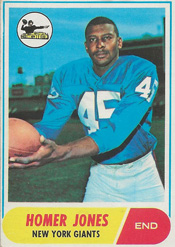
When Homer Jones made a catch, he turned the football field into a dance floor, spinning and shifting with an array of flashy moves.

A receiver with the 1960s New York Giants, Jones was a master at producing long gains. He did it either one of two ways _ hauling in deep passes, or using his deft footwork to add yardage after a grab. His career average of 22.3 yards per catch is a NFL record.

The St. Louis Cardinals faced him often, and then he joined them for a brief time at the tail end of his playing career.

Music man

A high school saxophonist in Pittsburg, Texas, Jones played football his senior year because “I wanted to go to college and they didn’t give scholarships to sax players,” he told the St. Louis Post-Dispatch.

At Texas Southern, Jones excelled in track as well as football. He and Bob Hayes of Florida A&M were two of the fastest sprinters in the United States. Jones and Hayes were on the men’s 400-meter relay team that beat the Russians in an international dual meet at Palo Alto, Calif., in July 1962.

A year later, at the National Association of Intercollegiate Athletics meet at Sioux Falls. S.D., in June 1963, Jones won the 220-yard dash, nipping Hayes at the finish line in 21 seconds.

(Later that month, Hayes won the 100-yard dash in 9.1 seconds, a world record, at the Amateur Athletic Union meet in St. Louis. Described as “the world’s fastest human,” Bullet Bob Hayes won two gold medals, in the 100 meters and as a member of the 4×100-meter relay team, at the 1964 Summer Olympics. Like Jones, Hayes became a NFL receiver, with the Dallas Cowboys.)

Jones was a flanker at Texas Southern and one of his favorite plays was a reverse. It basically called for a ball carrier to hand off to a receiver running in the reverse direction. Jones added a twist. “I reversed the reverses on my own just to see how that would work,” Jones told the Post-Dispatch. “I guess I was the first scrambling flanker in Texas.”

Drafted in 1963 by the Houston Oilers of the American Football League and the New York Giants of the National Football League, Jones opted for the Oilers, but reported to training camp with a twisted knee.

“I couldn’t do any knee bends, and you couldn’t play for the Oilers unless you did knee bends,” Jones said to the Post-Dispatch.

Released, Jones contacted the Giants, who signed him to their practice squad in July 1963. After a doctor repaired the cartilage damage in the knee, Jones and the Giants were relieved to discover he still had speed.

Freestyle football

After spending most of the 1963 and 1964 seasons on the practice squad, Jones, a raw talent, filled in for injured Giants receiver Del Shofner in 1965.

“They used to call him Homer Q, and Jones himself said the Q stood for questionable,” Milton Gross of the North American Newspaper Alliance noted.

“They can never tell what I’m going to do,” Jones said.

He inverted the pass routes designed for him and had trouble holding onto the ball. As the New York Daily News noted, “Homer has a reputation for ad-libbing pass patterns.”

Giants quarterback Earl Morrall told Milton Gross, “You look at the films and at times you’re wondering where he’s wandering to.”

“They used to laugh (head coach Allie Sherman almost cried) when Homer lined up in the wrong place, ran pass patterns in reverse, missed blocks and signals,” The New York Times reported.

Jones explained to Milton Gross, “You’ve got to confuse the defense as much as he confuses you. The one who confuses the most comes out the winner.”

Crowd pleaser

In warmup drills before the Giants played the Philadelphia Eagles on Oct. 17, 1965, at Yankee Stadium, Jones dropped nine passes in a row, the New York Times reported.

Show time was another matter.

In the second quarter, the Giants were on their 11-yard line when Earl Morrall called for Jones to run a fly pattern down the sideline. Morrall backpedaled and was near the goal line when he heaved the ball.

At the Eagles’ 40, Jones turned and looked up. “The sun was pretty strong,” he told the New York Daily News. “I saw a black spot in the sky and I didn’t know whether it was a bird or the ball.”

Jones reached for the object, speared it “and then completed a full pivot around defender Irv Cross, who went sprawling out of bounds,” the Daily News reported. Jones sprinted to the end zone, completing an 89-yard play for his first NFL touchdown.

According to NFL.com, Jones wanted to throw the ball to fans in the stands, but the league would fine a player $500 for doing that, so he flicked it into the ground. He is “believed to be the first player to spike a football after a touchdown,” NFL.com reported. Video and Game stats

Hard to stop

Jones averaged 23 yards per catch each year between 1966 and 1968. His 14 touchdowns (13 receiving and one rushing) in 14 games led the NFL in 1967. He made 49 catches that year, averaging 24.7 yards per reception.

In the 1967 season opener against the Cardinals at St. Louis, Jones had five catches for 175 yards and two touchdowns. On one of the scores, Jones beat cornerback Jimmy Burson, made a jumping catch of a Fran Tarkenton pass at the Cardinals’ 10 and “dragged tackler Larry Wilson the last five yards across the goal line,” the Post-Dispatch reported. Game stats

In the season finale rematch at Yankee Stadium, Jones had five catches for 125 yards and a touchdown. Here’s how the Daily News described his score: “Homer caught a turn-in pass in front of Phil Spiller on the St. Louis 45, foot-shuffled his way past a few defenders and shook off rookie Mike Barnes at the 10 to make it a 69-yard play.” Game stats

“Homer is the top offensive weapon in football today,” Tarkenton said to the Daily News in 1967. “Catching the ball is only part of his value. It’s what he does after the catch that makes him so remarkable. He’s a tough man to bring down.”

(In his autobiography, Tarkenton said, “Homer was the fastest guy I ever saw in a football suit, without question … He didn’t have much refinement as a receiver, and sometimes he missed the easy passes, but if he ever got a step on a defensive back, you couldn’t keep him in the stadium.”)

Giants radio broadcaster Marty Glickman told the Daily News, “There have been receivers who had, or have, Homer’s great speed. There have been receivers who are strong and can break tackles. But I never saw both _ the tremendous speed and the power running _ in one man until I saw Homer Jones.”

Teams regularly double-covered Jones. “We feel that any time they play me one-on-one I have a better than 75 percent chance of beating him,” Jones told Newsday. “I myself feel I have a 99 percent chance of beating him. Only a great play by him can stop me.”

In addition to speed and strength, Jones had huge hands. “He palms watermelons,” the Post-Dispatch declared.

Jones made one-handed catches before those became commonplace. He wore a size 13 glove. (A size 11 is considered XL.) According to the North American Newspaper Alliance, when shaking hands, “his fingers reach up to your forearm.”

Stepping out

In January 1970, the Giants traded Jones to the Cleveland Browns for running back Ron Johnson, defensive tackle Jim Kanicki and linebacker Wayne Meylan. Jones was nearly 29, but “there are some in the Giants family” who suspect he is two or three years older than his listed age, the Daily News reported.

The Browns acquired Jones to replace Paul Warfield, who was dealt to the Miami Dolphins, but a second-year player, Fair Hooker, outperformed Jones at training camp in 1970 and won the starting job.

Jones was used primarily as a kick returner with the 1970 Browns. He returned 29 kickoffs for 739 yards, including one for a touchdown against the New York Jets. Video

On July 13, 1971, the Browns traded Jones to the Cardinals for a draft choice. The Cardinals envisioned Jones rounding out a wide receiver corps that featured John Gilliam, Dave Williams, Fred Hyatt and rookie Mel Gray.

“When a receiver of the caliber of a Homer Jones becomes available, you just have to take a look at him,” St. Louis head coach Bob Hollway explained to the Post-Dispatch. “We felt he could add depth and experience. He’s bound to upgrade the receivers and create hard competition.”

Jones told the newspaper, “I’d say it was a happy day. I’ve always had respect for the Cardinals and I like the idea of playing for them.”

Two weeks later, though, when he was supposed to report to Cardinals training camp, Jones had a change of heart. He informed the club he was finished playing.

“When I broke into pro football, I said I would play for five years,” Jones told the Post-Dispatch. “I played for eight and I’ve thought about quitting for some time.” Video highlights

Read Full Post »

After Don Coryell left the NFL Cardinals, he appeared in St. Louis one time as an opposing head coach. It was an experience he could have done without.

On Nov. 20, 1983, Coryell brought the San Diego Chargers to Busch Stadium to play the Cardinals.

This was no tender homecoming. Too much weird mojo, and too many factors Coryell couldn’t control, not the least of which was an injured quarterback.

Air Coryell

In five seasons with Coryell as their head coach, the Cardinals were 42-27-1 and reached the playoffs twice. “We weren’t the best football team when Don was here,” his quarterback, Jim Hart, said to the St. Louis Post-Dispatch, “but we were the most exciting. We did the unexpected.”

Coryell departed following the 1977 season after a falling out with club owner Bill Bidwill. Subsequently, the Cardinals had four consecutive losing seasons before going 5-4 in strike-shortened 1982.

The Chargers had winning records in Coryell’s first five seasons as their head coach, leading the NFL in passing each of those years. In the words of Sports Illustrated, Coryell masterminded “revolutionary game plans, new formations every week and unrelenting air attacks,” building a resume that earned him election to the Pro Football Hall of Fame.

Chargers challenges

A torn muscle in the right shoulder of Dan Fouts, the quarterback who put the air in Air Coryell, changed the course of the Chargers’ season in October 1983. His replacement, Ed Luther, was in his fourth season with the Chargers but never had started a NFL game.

After Luther took over, the Chargers lost three of his four starts before heading to St. Louis. Fouts remained unavailable, and the Chargers also were without another injured player, James Brooks, a multiple threat as a rusher, receiver and kick returner.

The Chargers still had running back Chuck Muncie, receivers Wes Chandler and Charlie Joiner, and tight end Kellen Winslow, a St. Louis native who was raised in East St. Louis, Ill., and attended the University of Missouri.

With that talent, coached by Coryell, the Chargers were formidable. “He instills pride in all of us,” Muncie told The Sporting News. “We don’t ever think about not winning. He won’t let us.”

Friends and enemies

Jim Hanifan was head coach of the 1983 Cardinals. He and Coryell first met in 1956 at Fort Ord in California. Coryell coached the football team on the Army post and Hanifan was a player.

They became friends and colleagues. Hanifan was an assistant coach for Coryell with San Diego State in 1972 and in all five seasons Coryell was in St. Louis. He also was Coryell’s assistant with the 1979 Chargers before becoming Cardinals head coach in 1980.

Coryell had no desire to coach against him. “Jim Hanifan and I are buddies,” Coryell told the Post-Dispatch. “I’d rather play against somebody I hate.”

On the eve of his return to St. Louis, Coryell said to the Los Angeles Times, “I don’t like this game at all. I am coaching against Jim Hanifan, a good friend, and this is where I started coaching in the pros. I have a lot of emotional ties in St. Louis. Heck, I even love that emblem they have with the little ornery bird on the helmet. He sort of has that mean look in his eye, and I think he’s kind of cute. I would just much rather be playing somebody else.”

Hanifan told the Times, “As a coach you try to go into a ballgame like always. When you know the guy across the field is a dear friend, it does make it difficult. I imagine it will be a weird feeling with him coming back to St. Louis and looking at him across the field.”

Told that Coryell said, “I have nothing but warm, wonderful feelings of St. Louis,” Bidwill replied to the Post-Dispatch, “I guess he doesn’t remember the snowstorms.”

Hostile territory

Most of the 40,644 spectators booed the mention of Coryell’s name in pregame introductions, the Times reported. Then the Chargers imploded. They committed six turnovers, four in the second quarter, and the relentless Cardinals cruised to a 37-0 lead. “A nightmare,” Luther told The Sporting News.

Ahead, 10-0, Hanifan called for an onside kick and the Cardinals recovered, surprising the Chargers and sending them reeling. “It was a great call,” Coryell told the Los Angeles Times.

The Cardinals sacked Luther six times and intercepted three of his passes. David Galloway and Curtis Greer had two sacks each. Bubba Baker had an interception and recovered a fumble.

Cardinals quarterback Neil Lomax threw for two touchdowns and ran for two touchdowns. Ottis Anderson rushed for 113 yards and a score.

The final was 44-14. “San Diego is still a fine team,” Hanifan told the Times, “but it is not the same without Fouts.” Game stats and Video

Coryell “looked as if he were in shock, although it might be argued that is his usual appearance,” Post-Dispatch columnist Kevin Horrigan wrote.

Denver Broncos head coach Dan Reeves told The Sporting News, “Don Coryell must be dying inside. He’s such a competitive person.”

In remarks to the Post-Dispatch, Coryell congratulated the Cardinals, then added, “We should have made a better game of it.”

The Los Angeles Times called the rout “the club’s low point under Coryell.”

The loss dropped the Chargers’ record to 4-8. They finished 6-10, Coryell’s first losing season since his first year with St. Louis in 1973.

The Cardinals improved to 5-6-1 and jump-started their season. They won three of their last four, finishing 8-7-1, their most wins since Coryell’s 1976 team had 10.

Read Full Post »

From his first regular-season game as a head coach in the NFL with the St. Louis Cardinals, Don Coryell showed signs of being special. He got the Cardinals to play with confidence and collective pride.

When he was elected to the Pro Football Hall of Fame on Feb. 9, 2023, Coryell correctly was hailed as an innovator whose offenses with the Cardinals, and later the San Diego Chargers, were thrilling to watch and nerve-wracking to defend.
Those progressive schemes were just part of his skillset. Coryell also was an effective leader who got players to buy into his philosophies and to execute consistently within a framework of selfless collaboration.

Meet the new boss

The season opener between the Cardinals and Eagles on Sept. 16, 1973, at Veterans Stadium in Philadelphia marked the NFL head coaching debuts of Coryell and Mike McCormack.

Coryell came to the Cardinals from the college coaching ranks. In 15 years as a college head coach, Coryell never had a losing season. His record was 127-24-3, including 104-19-2 in 12 seasons at San Diego State.

Like Coryell, McCormack would be elected to the Pro Football Hall of Fame, but, unlike Coryell, he got in as a player, not as a coach. An exceptionally quick and strong right tackle on the Cleveland Browns’ offensive line, McCormack protected quarterback Otto Graham and blocked for running back Jim Brown. In his autobiography, Browns head coach Paul Brown said, “I consider McCormack the finest offensive tackle who ever played pro football.”

(Paul Brown told the story of how another Browns quarterback, Milt Plum, had trouble staying in the pocket before releasing the ball. At practice one day, a frustrated McCormack picked up Plum by the neck, shook him, cursed him and put him back down. After that, “our passing game improved considerably,” Brown told The Sporting News.)

McCormack had been an assistant coach for seven seasons with the Washington Redskins, but never a head coach.

The 1973 opener also was the Eagles debut of quarterback Roman Gabriel, 33, who got traded to Philadelphia after 11 seasons with the Los Angeles Rams.

(Gabriel, a glamour boy in Los Angeles, still was effective. He would lead the NFL in passing yards, completions and touchdown passes as an Eagle in 1973.)

During training camp, Coryell made a favorable impression as a coach of “unquenchable spirit and unflagging energy.” The Sporting News reported. Cardinals director of operations Joe Sullivan told the publication, “He’s one of the best teachers I’ve ever seen.”

On the eve of the season opener, Coryell said to the St. Louis Post-Dispatch, “I think we’ll be pretty darn potent this season. We’ll have the capability of breaking things open.”

Will to win

The fired-up Cardinals charged out to a 21-0 lead in Coryell’s debut. Jim Hart threw touchdown passes to Donny Anderson and Mel Gray, and Anderson also rushed for a score.

“The Eagles came after Hart with a vengeance, and the veteran quarterback proceeded to waste them with draws and screens,” the Philadelphia Inquirer reported.

Cardinals turnovers (two fumbles and an intercepted pass) helped the Eagles rally. They got within a point, 24-23, in the fourth quarter.

Recent Cardinals clubs might have panicked, but the Coryell Cardinals kept their poise. Hart moved them into position for a Jim Bakken 20-yard field goal, extending the lead to 27-23 with 1:10 to play. When the Eagles’ Tom Sullivan fumbled the ensuing kickoff, the Cardinals recovered. Anderson capped a 34-23 victory with another scoring run, his third touchdown of the game.

Though describing the Eagles as “a poor team,” the Post-Dispatch noted that the Cardinals “showed the ability to move under pressure, to capitalize on opposition mistakes and to make the big offensive play, three areas sadly lacking for them in recent years.”

Anderson, the former Green Bay Packer acquired in a trade for MacArthur Lane, had 66 yards receiving, 58 yards rushing and also was praised by Coryell for his blocking. “He has such a great understanding and concept of our offense,” Coryell told the Post-Dispatch.

Terry Metcalf, a third-round draft choice making his NFL debut, rushed for 133 yards and added another 25 yards with a catch. Plus, “he was blocking on me all afternoon,” Eagles linebacker Dick Cunningham told the Inquirer. “He will stick his head into you.” Video

Coryell said to the Philadelphia Daily News that Metcalf “is quick, tough, agile and has a heart as big as a lion.” Game stats and Game video

In a “rah-rah-sis-boom-bah” locker room celebration after the victory, the Inquirer reported, tight end Jackie Smith presented Coryell with the game ball and said, “This is for the man with the most enthusiasm.”

High praise

After the Cardinals scored 34 points again in winning their home opener against the Redskins, defensive tackle Bob Rowe said to the Post-Dispatch, “We have a confidence in ourselves, a confidence that Coach Coryell built. He has made us believe we’re football players. He has made us respect one another.”

Recalling his days playing for Packers head coach Vince Lombardi, Donny Anderson told Rich Koster of The Sporting News, Lombardi “was more than a coach. He was a man who taught you to become a man. You seemed to grow up faster and accept the responsibilities that you have as a player. In Coach Coryell, I think we have a man who in many respects is like Lombardi. Both loved people, and that’s the biggest thing in relating to players.”

Though the Cardinals faded, finishing 4-9-1 in Coryell’s first season, the players recognized he had changed the clubhouse culture for the better.

“We’ve got great life on our team, as opposed to what it used to be,” linebacker Jamie Rivers said to The Sporting News.

Jim Hart told the publication, Coryell “is a great man. He won’t pull any punches with you privately, but he’ll defend you to the letter publicly.”

In five seasons with Coryell, the Cardinals posted a 42-27-1 record and twice qualified for the playoffs. Those were the Cardinals’ first playoff berths since 1948 and their first division titles since moving from Chicago to St. Louis in 1960.

Coryell continued to have success with the Chargers in San Diego. His overall record as a NFL head coach is 115-89-1. According to the College Football Hall of Fame, Coryell was the first head coach to win 100 games at both the college and pro levels.

Read Full Post »

(Updated June 12, 2022)

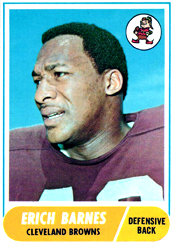
Erich Barnes was a formidable foe of the St. Louis football Cardinals. He was an intimidating, savvy defensive back who played 14 seasons in the NFL. In seven games against the Cardinals, he intercepted six passes.

Two of Barnes’ most significant clashes with the Cardinals occurred in consecutive seasons (1966 and 1967) at St. Louis. The first illustrated his fiery intensity. The second showed his smarts.
An all-pro, Barnes totaled 45 interceptions with the Chicago Bears (1958-60), New York Giants (1961-64) and Cleveland Browns (1965-71).

Rough stuff

Barnes played college football at Purdue and earned a bachelor’s degree. The Bears selected him in the fourth round of the 1958 NFL draft.

In January 1961, the Bears sent Barnes to the Los Angeles Rams for quarterback Bill Wade. The Rams then flipped Barnes to the Giants for defensive back Lindon Crow, who had threatened to retire unless the Giants traded him to a team near his California home.

“We gave up a class A player in Barnes,” Bears head coach George Halas told the Chicago Tribune, “but you must give up a class A player to get one in return.”

“Often matched against the league’s best wide receivers,” the New York Times noted, Barnes helped the Giants reach the NFL title game in three consecutive seasons (1961-63).

Bobby Mitchell of the Washington Redskins said of Barnes, “When a man can hold me down playing man-to-man defense, he’s doing a tremendous job.”

Barnes developed a reputation for making hard hits “with an exuberance that drew penalties or warnings,” the Associated Press reported. In a 1963 game against the Bears, he was assessed a penalty for roughing another tough guy, tight end Mike Ditka.

“Throughout Barnes’ career, his method of operation was simple: You come across the middle, you get busted in your chops,” the Akron Beacon Journal observed.

Barnes displayed an uncanny knack for arriving at the same time a pass reached a receiver, and then whacking the ball from the recipient’s arms with a motion similar to a butcher wielding a cleaver.

“He was very intense on the field,” Barnes’ teammate, Giants offensive lineman Roosevelt Brown, told the Akron newspaper. “Off the field, he was very laid back. That’s when you wanted to meet him. You didn’t want to meet up with him on the football field.”

Barnes had 18 interceptions in four seasons with the Giants. 

Like the Bears four years earlier, the Giants were in desperate need of an experienced quarterback in August 1965, and Barnes had trade value. The Giants sent Barnes to the Browns for linebacker Mike Lucci, then swapped Lucci and guard Darrell Dess to the Detroit Lions for quarterback Earl Morrall.

Danger zone

On Dec. 17, 1966, the Browns and Cardinals played at Busch Memorial Stadium. Late in the fourth quarter, with the Browns ahead by 28, backup quarterback Jim Ninowski threw a sideline pass to pint-sized Walter “The Flea” Roberts. The pass was incomplete, but Cardinals rookie defensive back Bobby Williams followed Roberts out of bounds and knocked him toward the Browns’ bench.

Roberts got up and “wanted to fight,” Williams said to the Associated Press. “He jumped on me. Then Barnes came over. Then it seemed like the whole Browns team was around me.”

Barnes told the St. Louis Post-Dispatch, “I guess I was the first one to reach Williams, and I gave him a shove.”

Barnes then kicked, or attempted to kick, Williams while he was down, witnesses told United Press International.

“I swung my foot, but I’m not even sure I touched him,” Barnes said to the Cleveland Plain Dealer. “It was more of a chastising gesture. I had no intention of hurting him.” Video courtesy of Cardinals football historian Bob Underwood

Emotions were raw. Some spectators left their seats, gathered on top of a dugout and shouted at the Browns players on the sidelines.

“Ushers were unable to control the unruly bunch,” the Jacksonville (Ill.) Daily Journal reported, “and policemen with nightsticks were rushed to the scene.”

Bruce Alford, a line judge on the officiating crew, feared the mob would storm the field. “I thought there might not be enough policemen when the trouble started,” Alford told the Fort Worth Star-Telegram.

During a timeout, a spectator broke loose, approached Barnes from behind and struck him in the back of the head, knocking him to the ground.

“The first thing I know, I’m flat on my back,” Barnes recalled to the Post-Dispatch, “and I see our other players pushing some fan away from me.”

The assailant was handcuffed by police and taken away. Game stats

Two plainclothes police officers were assigned to escort Barnes from the locker room to the team bus, according to the Post-Dispatch.

After reviewing film, NFL commissioner Pete Rozelle fined Barnes $250 for making “a major contribution to an inflammatory sideline incident.”

Experience matters

A year later, when the Browns returned to Busch Memorial Stadium on Dec. 10, 1967, “Barnes was booed vociferously when he was introduced” before the game, the Dayton Daily News reported.

Unfazed, Barnes responded with an outstanding performance. “Can’t play this game to win popularity contests,” Barnes told the Dayton newspaper.

In the third quarter, with the Browns ahead, 10-9, Cardinals tight end Jackie Smith took a handoff from Jim Hart on an end-around play.

“We’d studied films of that play all week,” Barnes told the Post-Dispatch.

When Barnes saw Smith take the ball, it was his responsibility to leave the receiver he was covering, Bobby Joe Conrad, and advance toward Smith, but Barnes’ instincts told him something was amiss.

“I say to myself, ‘Why is Bobby Joe Conrad running by me so hard?’ ” Barnes told the Post-Dispatch. “Most pass receivers don’t really run unless they think they’re going to get the ball.

“I say, ‘Erich, ain’t no pass receiver going to run that hard on a fake.’ That’s how I guessed Jackie Smith might plan to throw on that end-around. So I stay with Conrad.”

Sure enough, Smith stopped, looked downfield and tossed a pass toward Conrad. It was the first pass Smith attempted in a NFL game. Barnes intercepted it and ran 40 yards to the Cardinals’ 21. A few minutes later, Lou Groza kicked a field goal for a 13-9 Browns lead. Video courtesy of Cardinals football historian Bob Underwood

Barnes’ pickoff and return “put the Cardinals in a hole for the entire third quarter,” the Post-Dispatch reported. “The play served to turn the game in Cleveland’s direction.”

Barnes came up big again on the last play of the game.

With the Browns ahead, 20-16, Hart connected with Smith on a pass to the Cleveland 18. Six seconds remained when Smith caught the ball. Barnes blocked Smith’s path to the sideline so that he couldn’t get out of bounds and stop the clock. Forced to run down the field, Smith was tackled by middle linebacker Dale Lindsey as time expired. Game stats

Read Full Post »

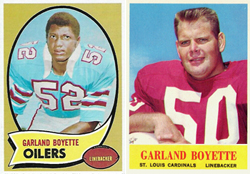
Undrafted, Garland Boyette overcame the odds, earning a roster spot at a position he’d never played and becoming a starting linebacker for the NFL St. Louis Cardinals in 1962.

Two years later, the Cardinals cut him, but that wasn’t the only insult he endured. Philadelphia Chewing Gum Corporation produced a football card of Boyette that year, but fumbled the assignment. The name on the card was Garland Boyette, but the photo was of Don Gillis, a former Cardinals center who no longer was in the league. Boyette was black and Gillis was white.

Boyette went to Canada, revived his career and returned to the United States, launching a successful stint as a two-time Pro Bowl selection at linebacker with the Houston Oilers.

Awesome athlete

Boyette played college football at Grambling and primarily was a defensive lineman. His teammates included other future NFL players such as Buck Buchanan, Willie Brown, Ernie Ladd and Roosevelt Taylor. Ladd, 6 feet 9 and about 320 pounds, was Boyette’s nephew. Ladd’s mother was Boyette’s sister.

Boyette, 6 feet 1 and about 220 pounds, also was a standout track and field athlete who excelled in the decathlon.

After his senior football season at Grambling in 1961, Boyette wasn’t selected in either the AFL or NFL draft. The Cardinals signed him in February 1962 and invited him to training camp.

Ernie Ladd, who made his pro football debut with the San Diego Chargers in 1961, and a friend, Len Burnett, a defensive back for the 1961 Pittsburgh Steelers, worked out with Boyette and offered him advice before he joined the Cardinals.

“They suggested that with my speed and agility I ought to be able to play cornerback in pro football, or with more weight, maybe linebacker,” Boyette told the St. Louis Post-Dispatch. “Ernie told me to get on the weights and get my weight up, so I did.”

Boyette firmed up to about 235 pounds, and, though he never had played linebacker in college, he “landed in an outside linebacker spot, playing behind the Cardinals’ ace outside linebacker, Bill Koman,” the Post-Dispatch reported.

On-the-job training

With the Cardinals loaded with veteran linebackers, Boyette, 22, didn’t play much early in the 1962 season. “I found it discouraging,” Boyette told the Post-Dispatch. “I’d always played first string in college, but it gave me time to learn.”

When several linebackers, including Ted Bates, Ed Henke, Dale Meinert and Marion Rushing _ “All of whom figured to give the Cardinals a tremendous ground defense and a big rush,” The Pittsburgh Press noted _ got sidelined because of injuries, Boyette got his chance.

Against the San Francisco 49ers on Nov. 25, Boyette played at left linebacker, with Koman moving to the right side, and “did a commendable job,” Cardinals head coach Wally Lemm told the St. Louis Globe-Democrat.

Boyette started at left side linebacker in the Dec. 7 game against the Steelers and played well, sacking Ed Brown for a 15-yard loss.

“I told Bill Koman I’d learned more in that one game at Pittsburgh than I’d learned in five years of football earlier,” Boyette said to the Post-Dispatch. “I’m learning more by getting to play. I’ve found nobody ever relaxes in this game.”

After the Cardinals completed the 1962 season, the Globe-Democrat declared, “Boyette came along so well.”

On the move

The Cardinals went into their 1963 exhibition game opener with Boyette, Koman and Meinert as the starting linebackers, but, a couple of weeks later, rookie Larry Stallings was named a starter, replacing Boyette, according to the Post-Dispatch.

In October, Boyette tore ligaments in a knee. He came back in late November and made a key play in a game against the New York Giants, setting up the winning touchdown by recovering Eddie Dove’s fumble on the New York 20-yard line.

As for that football card snafu, Don Gillis wore No. 50 when he played for the Cardinals from 1958-61, and Boyette wore the same uniform number for the Cardinals in 1962 and 1963.

“The card companies would ask the team who wears what numbers,” Boyette told the Monroe (La.) News-Star, “but how the hell do you get that screwed up?”

With Koman, Meinert and Stallings returning in 1964, and Dave Meggyesy pushing for playing time as well, the Cardinals deemed Boyette expendable and placed him on waivers on Sept. 2, according to the Post-Dispatch.

A few days later, Boyette was signed by the Montreal Alouettes of the Canadian Football League. Montreal’s head coach was Jim Trimble. Cardinals defensive coordinator Chuck Drulis had been an assistant on Trimble’s staff when Trimble was head coach of the Philadelphia Eagles in 1954 and 1955.

Boyette played two seasons (1964-65) with the Alouettes and made a favorable impression. “He is the best athlete on my team,” Trimble told the Montreal Star. “Garland is one of the finest athletes I’ve ever known.”

After Trimble departed, Boyette signed with the AFL’s Houston Oilers, who’d hired Wally Lemm to be their head coach in 1966.

“The only reason he was cut by the Cardinals was he made too many mistakes,” Lemm told The Sporting News. “We are hoping now that he is older, and with two years of Canadian ball behind him, he will have matured.”

In 1967, Boyette became the Oilers’ middle linebacker. That same season, rookie Willie Lanier started at middle linebacker for the Kansas City Chiefs. According to the Houston Chronicle, Boyette and Lanier were the first black starting middle linebackers in pro football in the U.S.

A year later, Sports Illustrated described Boyette as “an exceptional athlete who can be one of the great middle linebackers.”

Boyette was named to the Pro Bowl in 1968 and 1969, and played with the Oilers until 1972.

Read Full Post »

« Newer Posts - Older Posts »