Feeds:
Posts
Comments

Archive for the ‘Football’ Category

Wide receiver Charley Taylor and quarterback Sonny Jurgensen were in sync, able to connect in a city often associated with disconnection. So when they botched a play in a key game against the St. Louis Cardinals, it was unusual and costly.

With the Washington Redskins, Taylor was “the man who had given more headaches to cornerbacks than any pass catcher to play the game,” according to the Washington Post.

His ability to consistently rack up receptions made him one of the franchise’s most popular players. As Sports Illustrated noted, “It would have surprised hardly anyone at a Georgetown dinner party to hear Henry Kissinger, with his mouth full of caviar canapes, discoursing about the grace of Charley Taylor.”

A player who held the NFL record for career receptions (649) when he retired after the 1977 season, Taylor competed in 22 games versus the Cardinals. He caught 78 passes against them, but it was one he didn’t catch that became perhaps the most noteworthy.

Multiple skills

Charley Taylor was born and raised in Grand Prairie, Texas, an aircraft manufacturing hub located 14 miles west of Dallas. His mother, Myrtle, was a chef, butcher and restaurant owner and his stepfather, James, built airplane parts, according to the New York Times.

A local grocer, R.B. Clarke, who had connections to Arizona State University, arranged for Taylor to meet the school’s football coach, Frank Kush, who offered a scholarship.

Taylor excelled as a running back at Arizona State and hoped to be drafted by the NFL’s Dallas Cowboys so he could play near home. When a college roommate informed him he was taken by Washington with the third overall pick in the first round of the 1964 draft, “I actually rolled over in bed and started crying because I wanted to go to Dallas so bad,” Taylor told the Associated Press.

Swift and sure-handed, Taylor excelled at running back for Washington his rookie season in 1964, rushing for 755 yards, catching 53 passes and scoring 10 touchdowns in 14 games.

About midway through the season in 1966, coach Otto Graham moved Taylor from running back to wide receiver. Taylor initially resisted the move but discovered the position change “gives me the opportunity to do what I do best _ catch the ball and run with it,” Taylor told the Associated Press.

Taylor and Bobby Mitchell gave Washington a pair of elite receivers as targets for quarterback Sonny Jurgensen. All three were destined for election to the Pro Football Hall of Fame

Taylor said Mitchell and assistant coach Ray Renfro, a Browns receiver when Graham quarterbacked them, were influential in his transformation.

“They knew I had the knack for catching the ball,” Taylor said to the Associated Press. “What they had to teach me was to run patterns. That’s the difficult thing _ reading defenses and running good patterns.”

Taylor led the NFL in receptions in 1966 (72) and 1967 (70).

Mitchell, who also had started his NFL career as a running back before shifting to receiver, told Sports Illustrated, “Charley would always get the double coverage. I had some big days because people said Charley Taylor wasn’t going to beat them.”

All mixed up

Taylor, 33, and Jurgensen, 40, were in their 11th season together when Washington (4-2) faced the Cardinals (6-0) on Oct. 27, 1974, at Busch Memorial Stadium in St. Louis.

Though the Cardinals defeated Washington in the second week of the season and were atop the NFC East Division, Taylor said, “We still feel Dallas is the team we have to beat.”

Pinned to a bulletin board in the Cardinals’ locker room, Taylor’s quote was viewed as “an affront to our pride,” Cardinals defensive tackle Bob Rowe told the St. Louis Post-Dispatch.

Taylor was matched in the game against cornerback Roger Wehrli, another future Pro Football Hall of Famer. When the Cardinals drafted Wehrli out of Missouri in the first round in 1969, it was partly because it was thought he had the speed to cover receivers such as Taylor.

On the game’s opening drive, Washington advanced to the Cardinals’ 48-yard line before Jurgensen attempted a pass. On first-and-10, he called for Taylor to run an out pattern to the sideline.

Taylor ran the route correctly, but Wehrli had him covered. Taylor adjusted, turning up field, but Jurgensen didn’t adjust his pass. He threw before Taylor broke free of Wehrli.

“I was throwing the ball away,” Jurgensen told the Post-Dispatch.

Instead, he threw it into the hands of Wehrli, who moved forward, rather than follow Taylor, when he saw Jurgensen release the ball. “I just kept coming and there was no one there but me,” Wehrli told the Post-Dispatch.

Wehrli streaked 53 yards down the sideline, converting an interception into a touchdown for the first time in his NFL career. His only other interception return for a touchdown was in 1979 against Tommy Kramer of the Minnesota Vikings. Wehrli totaled 40 interceptions, all for the Cardinals.

St. Louis won the game, 23-20, improving to 7-0 and moving three games ahead of Washington in the division standings. Video and Game Stats

“The Cardinals made the big plays,” Jurgensen said to the Post-Dispatch. “Now they’re in the driver’s seat. It was a key game. We had to have it, and they got it.”

St. Louis and Washington each finished 10-4 in the regular season and each lost in the first round of the playoffs.

Taylor remains the Washington franchise leader in career touchdowns scored (90) _ 11 rushing and 79 receiving.

Of his 79 touchdown catches, 53 came on throws from Jurgensen, 21 from Billy Kilmer, two each from Randy Johnson and Jim Ninowski and one from Joe Theismann. The touchdown pass to Taylor was the first of Theismann’s NFL career.
Read Full Post »

(Updated May 1, 2022)

The punishing rushes of Green Bay Packers fullback Jim Taylor shredded a daring defense of the St. Louis football Cardinals.

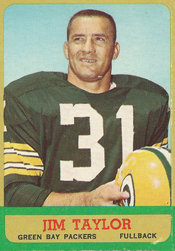
Taylor was a bruising rusher for the championship Packers teams of the 1960s. Paired in a backfield with “Golden Boy” halfback Paul Hornung, Taylor was a powerful force who twice led the NFL in rushing touchdowns and was elected to the Pro Football Hall of Fame.
In 1962, Taylor topped the NFL in rushing yards with 1,474 in 14 games. He faced the St. Louis Cardinals for the first time that season and his rushing and pass-catching skills were key to enabling the Packers to overcome a challenging defensive scheme.

Game plan

The Cardinals and Packers each had 1-0 records entering their game on Sept. 23, 1962, at Milwaukee County Stadium. The Packers were the reigning NFL champions and the Cardinals were looking to establish themselves as contenders.

Cardinals head coach Wally Lemm and his staff devised a plan to apply pressure on Packers quarterback Bart Starr by having St. Louis defensive players use stunting maneuvers and blitzing schemes.

The stunting meant two or more Cardinals defenders would alter their usual paths to the quarterback in an effort to confuse the Packers’ offensive linemen.

The blitzing freed a defensive back or linebacker to leave his usual post and become an extra pass rusher. New York Giants linebacker Donald “Red Dog” Ettinger is credited with being the first to use the technique from 1948-50 and blitzes came to be known as “red dogging.” In 1960, Cardinals assistant coach Chuck Drulis designed a blitz using safety Larry Wilson and named it “wildcat.”

Pressuring Pack

The blitzing and stunting of Cardinals defenders confused the Packers in the first half of their 1962 game. Starr “was under considerable pressure from the Cardinals’ determined rush, including red-dogging defensive halfbacks,” the Green Bay Press-Gazette reported.

Packers offensive tackle Forrest Gregg said the Cardinals “were doing a lot of jumping around in there and we weren’t picking them up.”

Said Packers coach Vince Lombardi: “Their defense upset us in the beginning. We had a hell of a time trying to find them. They did a lot of stunting in there … It was new to us. We hadn’t seen it before this year.”

Lombardi and his staff tried to make adjustments during the first half, but were unsuccessful in communicating effectively during the helter-skelter pace of the game. The best the Packers could do was hold on until they could regroup in the locker room at halftime. “We had to put it on the (chalk) board,” Lombardi said.

The Packers’ defense, led by linemen Willie Davis and Henry Jordan, stopped the Cardinals, and Green Bay led, 3-0, at halftime on Hornung’s field goal.

Fast learners

Using the chalkboard to illustrate what needed to be done to counter the Cardinals’ aggressive blitzing and stunting, Lombardi and his staff instructed their offensive linemen to block in assigned areas rather than man against man, and they told Starr to turn Taylor loose to rumble and mix in short passes to Taylor and tight end Ron Kramer.

The adjustments worked. Taylor, 6 feet and 215 pounds, pounded the Cardinals with runs up the middle and put the Packers in position to score a pair of touchdowns.

“In three years, nobody has run through our middle as the Packers did,” defensive tackle Frank Fuller, who played for the Cardinals from 1960-62, told the St. Louis Post-Dispatch.

Taylor “turned the tide with his powerful smashes in the second half,” the Green Bay Press-Gazette reported. Taylor “punished the Cardinals’ defense with his hard hitting … His thrusts up the middle helped the (Packers) loosen up the Cardinals’ defense and thus make their passing work.”

Taylor finished with 122 yards rushing on 23 carries and also had four catches for 40 yards. Hornung had a three-yard touchdown run in the third quarter, Starr connected with Max McGee on a 19-yard scoring strike in the fourth quarter and the Packers won, 17-0. Boxscore

“We adjusted between halves,” Lombardi said. “In the second half, we zone blocked and area blocked. The boys picked them up real well.”

Said Taylor: “We just got to zone blocking in the second half and they changed their defense. They weren’t red-dogging so much and the red dogs were not real hard to pick up.”

One of a kind

Lemm praised the Packers as “the best-balanced team in football. Father Time is the only thing that’s going to beat the Packers.”

Regarding Taylor, Lemm said to the Post-Dispatch, “He has a great ability to slide out and get moving. He takes a pitchout quick with that sliding ability.”

Lemm added, “The blocks Hornung throws for Taylor are really something.”

The Cardinals totaled 16 yards rushing and their top receiver, Sonny Randle, had one catch for five yards. Halfback John David Crow had nine yards on nine carries.

“We don’t have a Taylor,” Lemm lamented.

The 1962 Packers repeated as NFL champions and Taylor also played for league champions in 1965 and 1966. The Cardinals finished 4-9-1 in 1962.

Taylor played two more regular-season games against the Cardinals in his career. On Oct. 20, 1963, he rushed for 67 yards and two touchdowns in a 30-7 Packers victory. On Dec. 12, 1967, in his final NFL season with the Saints, the former Louisiana State standout had 34 yards rushing in a game the Cardinals won, 31-20.

Read Full Post »

In a game featuring an inordinate number of big plays, Philadelphia Eagles flanker Tommy McDonald produced one nearly every time he touched the football.

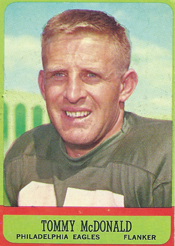
On Dec. 16, 1962, McDonald made four catches, three for touchdowns, in a game versus the St. Louis Cardinals at Busch Stadium. In a NFL career filled with achievements, it was McDonald’s best performance against the Cardinals.

McDonald was one of the NFL’s most amazing players. At 5 feet 9, 175 pounds, he was a prolific pass catcher who regularly produced touchdowns.

Walking tall

McDonald was born in Roy, New Mexico, and his father was a farmer and electrician who set up a spotlight outside the barn “so his sons could play basketball after milking the cows each night,” according to The Daily Oklahoman.

A multi-sport athlete in high school, McDonald was recruited by the University of Oklahoma and was a running back for coach Bud Wilkinson on three consecutive unbeaten teams from 1954-56. McDonald scored 17 touchdowns, 16 rushing and one receiving, for the 1955 national champions. McDonald’s success at Oklahoma earned him election to the College Football Hall of Fame.

“There are worlds of people with potential physical abilities greater than McDonald’s,” Wilkinson said to Sports Illustrated. “About his only real advantages are quickness and extraordinary determination.”

The Eagles selected McDonald in the third round of the 1957 NFL draft and converted him to a receiver.

McDonald was undersized but tough. On Oct. 4, 1959, a week after he broke his jaw and had it wired shut, McDonald played against the New York Giants and scored four touchdowns _ three on receptions and the other on a punt return.

As a teen, McDonald lost the tip of his left thumb in a motorbike accident, the New York Times reported, but he was as sure-handed as any receiver in the NFL.

McDonald also benefitted from learning the proper way to go down after being tackled by much larger defensive players. “I fall like 175 pounds of spaghetti,” McDonald said.

“He has the balance of a gymnast,” Sports Illustrated observed, and as teammate Tom Brookshier said, “The little rat is strong as a bull.”

Good chemistry

Quarterback Norm Van Brocklin, traded by the Rams to the Eagles in 1958, mentored McDonald “in the art of running pass patterns,” the Times reported, and McDonald became Van Brocklin’s favorite receiver.

McDonald led the NFL in touchdown receptions (nine) in 1958.

In the 1960 NFL championship game against the Packers, McDonald caught three passes from Van Brocklin for 90 yards and a touchdown in a 17-13 Eagles victory.

“If I had to pick one guy to throw the ball to with the game on the line, I’d pick McDonald,” Van Brocklin told Ray Didinger, author of “The Eagles Encyclopedia.”

Van Brocklin retired after the 1960 season and his protege, Sonny Jurgensen, took over as Eagles quarterback. Jurgensen and McDonald were friends and clicked on the field. McDonald led the NFL in receiving yards (1,144) in 1961.

Jurgensen, McDonald and Van Brocklin all would be elected to the Pro Football Hall of Fame. “I wound up with two great quarterbacks _ Van Brocklin and Jurgensen,” McDonald told The Daily Oklahoman. “You couldn’t go in a chemistry lab and mix up two better arms.”

Thrill ride

The Eagles and Cardinals each entered the 1962 season finale with a 3-9-1 record. Played on a sunny St. Louis Sunday with a temperature of 40 degrees and before a crowd of 14,989, the game quickly became what the Philadelphia Daily News described as “a spectator’s dream but a coach’s nightmare.”

Among the highlights:

_ McDonald made four catches for 162 yards. Three of those grabs were for touchdowns of 56, 60 and 40 yards, the latter “a remarkable diving catch,” the Philadelphia Inquirer reported.

_ Jurgensen threw for 419 yards and five touchdowns. He did most of that damage from a shotgun formation designed to buy time against the Cardinals’ blitzes, according to the Inquirer.

_ Timmy Brown, the Eagles’ halfback, rushed for 50 yards and caught five passes for 199 yards, including touchdown receptions of 60 and 82 yards.

_ John David Crow, the Cardinals’ running back, rushed for three touchdowns and snared a 16-yard touchdown toss from quarterback Charley Johnson.

_ Johnson threw for 386 yards and two touchdowns and also ran for a score.

_ Sonny Randle, a Cardinals split end, made three catches for 134 yards and a touchdown.

_ Taz Anderson, a Cardinals flanker, totaled 175 yards on eight receptions.

The Cardinals led, 31-28, at halftime and won, 45-35. Game summary and Video

“I’ve never seen a shoddier defensive show by two teams,” said Eagles head coach Nick Skorich.

Cardinals head coach Wally Lemm said, “It seemed both teams wanted to give the game away, didn’t it?”

The teams combined for 1,087 yards _ 589 for the Cardinals; 498 for the Eagles.

“The defensive indolence gave the illusion of offensive excellence,” the Philadelphia Daily News concluded.

Finding the end zone

McDonald six times made three touchdown catches in a game _ five times for the Eagles and the other for the Rams.

He played 12 years in the NFL for the Eagles (1957-63), Cowboys (1964), Rams (1965-66), Falcons (1967) and Browns (1968). His last regular-season game was for the Browns against the Cardinals on Dec. 14, 1968.

McDonald finished his NFL career with 495 catches for 8,410 yards and 84 touchdowns. When he retired, his 84 touchdown receptions were the second-most in NFL history, behind the 99 for the Packers’ Don Hutson. McDonald was inducted into the Pro Football Hall of Fame in 1998.

“I think catching passes is judgment, mostly,” McDonald said. “I’ve got good vision, good peripheral vision. I think sometimes I can see things the defensive back doesn’t see.”


Read Full Post »

(Updated Jan. 18, 2020)

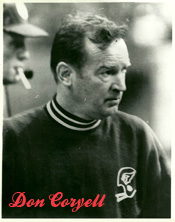
Don Coryell was the best coaching hire in St. Louis Cardinals football history.

don_coryellOn Jan. 18, 1973, the football Cardinals, responding to an unsolicited letter, hired Coryell to be their head coach.

An innovator known for producing winning college teams and high-powered offenses, Coryell overcame his lack of NFL experience and transformed the Cardinals into a championship-caliber club.

In five seasons (1973-77) under Coryell, the Cardinals posted a 42-27-1 record and twice qualified for the playoffs. Those were the Cardinals’ first playoff berths since 1948 and their first division titles since moving from Chicago to St. Louis in 1960.

Few predicted such success in January 1973. The Cardinals had finished the 1972 season with their second consecutive 4-9-1 record under head coach Bob Hollway. They ranked 23rd in scoring in the 26-team NFL.

Coryell, 48, had a 104-19-2 record in 12 years at San Diego State. He had developed future NFL players such as quarterbacks Dennis Shaw of the Bills, Don Horn of the Broncos and Brian Sipe of the Browns, and receivers Isaac Curtis of the Bengals and Gary Garrison of the Chargers.

Outside of the San Diego area, Coryell was “an unfamiliar name to most,” according to The Sporting News.

In the book “Big Red: The Story of the Football Cardinals,” author Bob Burnes said reporters at the St. Louis press conference announcing Coryell’s hiring asked, “Don who?”

Seeking a challenge, Coryell had written a letter to Cardinals owner Bill Bidwill, inquiring about the job after Hollway was fired. “People told me that, if I wanted a college coach, there was this guy at San Diego State,” Bidwill said.

Coryell received a three-year contract from the Cardinals. The only other candidate considered for the position was former Packers quarterback Bart Starr, United Press International reported.

“I wanted someone who could put the offense back into the Cardinals,” Bidwill said. “(Coryell) has always had this. He comes to us very highly recommended from many sources. He has a consistent record of winning seasons.”

Said Coryell: “I believe in a wide-open style of play. I like to throw the ball. I believe in attacking the defense.”

One reason Coryell was confident he could succeed was the presence of quarterback Jim Hart on the Cardinals’ roster. Hollway had soured on Hart and had tried Gary Cuozzo and Tim Van Galder at quarterback in 1972.

“(Hart) can throw long and he can throw the deep sideline pattern,” Coryell said. “If he can do that, I know he can throw the short stuff. I want a quarterback who can explode the ball, particularly against the zone defense.”

Years later, Hart told the St. Louis Post-Dispatch, “After the first meeting we had with him, and he started talking about how he liked to throw the ball … It was like, ‘Whoa, you got us, pal.’ ”

“I believe in the passing game,” Coryell said. “I’m not a coach who builds on defense. If you’re playing a team with more talent, the only way to win is by throwing the ball well.”

After a 4-9-1 record in 1973, St. Louis was 10-4 and won a division championship in Coryell’s second season, 1974. Hart thrived in an offense with running backs Jim Otis and Terry Metcalf; receivers Mel Gray, Earl Thomas, Jackie Smith and J.V. Cain (Ike Harris and Pat Tilley later contributed significantly); and linemen Dan Dierdorf, Conrad Dobler and Tom Banks.

The Cardinals were 11-3 and won a second consecutive division title in 1975. They won seven times in the last minute of a game that season, earning the nickname “Cardiac Cardinals.”

Winning championships with flair, the football Cardinals began to rank in popularity with the baseball Cardinals, who went without a championship in the 1970s, and Coryell began to emerge as an iconic coach.

A 10-4 finish in 1976 was followed by a 7-7 record in 1977. Coryell and Bidwill feuded over control of the draft and personnel decisions. Disenchanted, Coryell went back to San Diego to coach the Chargers and led them to the NFL playoffs in four consecutive seasons.

Previously: 1987: year of the Smiths, Ozzie and J.T., for Cardinals

Read Full Post »

« Newer Posts