Feeds:
Posts
Comments

Archive for the ‘Games’ Category

(Updated Feb. 21, 2021)

The 1943 Cardinals figured they had plenty of quality left-handed pitching. What they needed most was cash.
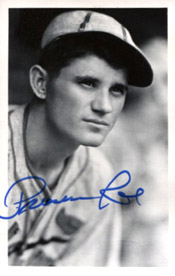
In September 1943, the Cardinals traded a top left-handed pitching prospect, Preacher Roe, to the Pirates for pitcher Johnny Podgajny, outfielder Johnny Wyrostek and “a big bundle of cash,” The Sporting News reported.

The Cardinals received “in the neighborhood of $25,000,” according to the Pittsburgh Press. They needed the money to offset financial losses in their minor-league system, The Sporting News reported.

Roe was well-regarded, but the Cardinals were stocked with left-handed pitchers such as Al Brazle, Harry Brecheen, Max Lanier and Ernie White and had another, Howie Pollet, in military service.

Several clubs made bids for Roe, but the Pirates won out because they offered the Cardinals the best combination of cash and players.

Name game

Elwin Roe was born in Ash Flat, Ark., and his father, Charles Roe, was a physician who played and coached semipro baseball.

When Elwin was 3 years old, he told an uncle he thought he should have a new name.

“What do you think it should be?” the uncle asked.

“Preacher,” replied the boy, who admired a local minister and his wife who took Roe for rides in their horse-driven buggy.

From then on, he was known as Preacher Roe, United Press reported.

Roe showed skill as a ballplayer and his father initially steered him toward being an outfielder. “I wanted to pitch,” Roe said, “but Dad wouldn’t let me until I was 16. I think that saved my arm and gave me the strength to throw my fast one.”

Roe eventually enrolled at Harding College in Searcy, Ark., and became a pitcher, posting a 24-4 career record there. In 1938, he struck out 27 in a 13-inning game for Harding. “It shows he has grasped the general idea of the fundamentals of pitching,” the St. Louis Post-Dispatch proclaimed.

Speedy trial

Roe attracted the attention of the Yankees, Tigers, Red Sox, Indians and Cardinals, according to the St. Louis Star-Times.

Columnist Red Smith described him as “an angular, drawling splinter of gristle.” In his book “The Era,” Roger Kahn called Roe “a left-handed stringbean, all bones and angles and Adam’s apple.”

On July 25, 1938, Cardinals scout Frank Rickey, brother of club executive Branch Rickey, convinced Roe to sign with the Cardinals for $5,000. “It’s understood he rejected offers from the Yankees and Tigers,” the Post-Dispatch reported.

Roe, 22, was placed on the big-league roster, joined the Cardinals in New York and spent the next few weeks watching and learning.

On Aug. 19, 1938, Cardinals manager Frankie Frisch gave Roe the start in an exhibition game against the semipro Belleville Stags at Athletic Park in Belleville, Ill. Roe pitched a three-hitter, striking out 11 and issuing no walks, in a 4-1 Cardinals victory.

Three days later, on Aug. 22, 1938, Roe made his major-league debut, pitching 2.2 innings of relief and yielding four runs to the Reds at St. Louis. Boxscore

That was Roe’s lone major-league appearance for the Cardinals.

Pirates prize

After the 1938 season, the Cardinals sent Roe to the minor leagues and he spent the next five years (1939-43) pitching for their farm clubs without getting another chance to return to the big leagues.

In 1943, Roe, 27, had his best minor-league season, posting a 15-7 record and 2.37 ERA for the Columbus (Ohio) Redbirds.

“The Preacher has speed, a fine curveball that he can operate on more than one speed and he flanks these orthodox offerings with a dandy screwball,” The Sporting News reported.

On Sept. 15, 1943, the Pirates obtained Roe from the Cardinals. Frisch, fired by the Cardinals in September 1938, was the Pirates’ manager and recommended they acquire Roe.

The Pirates got “one of the gems of the year,” the Pittsburgh Press reported. “Scouts believe he can’t miss in the majors this time.”

“In getting one of the real prize packages of the minors, Preacher Roe, the Pirates strengthened their pitching staff for next season,” the Pittsburgh Post-Gazette declared.

Big chance

Roe reported to spring training in 1944 at Muncie, Ind., where the Pirates were based because of wartime travel restrictions, and fulfilled expectations. Frisch gave the rookie the Opening Day start against the Cardinals in St. Louis on April 18, 1944.

“Frisch knows nothing would give the Preacher more pleasure than to show the Cardinals they made a mistake by letting him get away,” the Pittsburgh Press reported.

Roe limited the two-time defending National League champions to one hit in the first five innings. He also got the Pirates’ first hit, a single in the third. According to the Post-Dispatch, Roe “happened to meet a pitch with a feeble swing very much on the push side and the ball looped to center field.”

The Cardinals scored in the sixth and eighth innings and won, 2-0, behind Max Lanier’s two-hitter. Roe pitched a complete game, yielding seven hits, walking three and striking out two.

Roe’s father attended the game and Frisch told the physician, “Your boy certainly did a fine job this afternoon, but the breaks did not go his way.” Boxscore

Down, not out

Roe was 13-11 with a 3.11 ERA for the Pirates, who finished second to the champion Cardinals in 1944. He followed that with a 14-13 mark in 1945.

In February 1946, Roe was coaching a team in a high school basketball game in Arkansas when he was slugged by a referee during an argument. Roe’s head hit the floor and he fractured his skull. When he was able to pitch again, he no longer could throw a fastball with consistent effectiveness.

After posting records of 3-8 in 1946 and 4-15 in 1947, the Pirates soured on Roe. Again, the Rickeys played a pivotal role in Roe’s career. Branch Rickey, who’d left the Cardinals to join the Dodgers, acquired Roe after the 1947 season.

Determined to revive his career with the Dodgers, Roe began throwing a spitball and the illegal pitch worked wonders for him. He’d use ruses while on the mound to make batters think he was wetting the ball even when he wasn’t.

“I had a wet one and three fake wet ones,” Roe said, according to the Los Angeles Times. “You don’t have to throw it … Just make them think you’re going to throw it.”

Roe threw the best spitball of any pitcher he’d seen, the Cardinals’ Stan Musial told the Post-Dispatch.

“I’d never let the Preacher get two strikes on me because that’s when he liked to throw the spitter,” Musial said. “So I’d swing at the first good pitch and I did all right against him.”

Roe achieved a 28-20 career mark against the Cardinals, even though he couldn’t fool Musial, who hit .387 with 12 home runs against him. Asked about his strategy for pitching to Musial, Roe said, “I throw him four wide ones, then try to pick him off first base.”

Among Roe’s best seasons with the Dodgers: 1951 (22-3), 1952 (11-2) and 1953 (11-3). He earned World Series wins for the Dodgers against the Yankees in 1949 and 1952.

Roe finished his 12-year major-league career with a 127-84 record and 3.43 ERA.
Read Full Post »

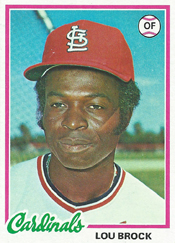
As Lou Brock neared the finish to his worst season with the Cardinals, he and the club could have decided to part ways. Instead, they agreed to stay together, with the Cardinals acknowledging Brock still had the skills to play regularly and Brock acknowledging he would do whatever the team needed.

On Sept. 21, 1978, Brock signed a contract to return to the Cardinals in 1979, ending speculation he would become a free agent.

Brock, 39, was unproductive for most of the 1978 season and rarely played in September, sparking suggestions the Cardinals no longer wanted him.

With less than two weeks left in the 1978 season, Brock and manager Ken Boyer met and reached an understanding on what each expected from the other, clearing the way for Brock to come back.

Unproductive reunion

Brock had a splendid start to the 1978 season, batting .320 in April even though he was among the players who had a strained relationship with manager Vern Rapp.

On April 25, 1978, Rapp was fired and replaced by Boyer. Brock and Boyer were quite familiar with one another. They’d been Cardinals teammates as players in 1964 and 1965 and were together again in 1971 and 1972 when Boyer was a Cardinals coach.

When Boyer became manager, he kept Brock in the lineup as the leadoff man and left fielder, but Brock went into a prolonged slump, batting .189 in May and .130 in June. Brock was hitless for two weeks in the middle of June.

Boyer benched Brock in late June and experimented with moving catcher Ted Simmons to left field before giving backup outfielder Jerry Mumphrey a try.

Sending messages

After Brock was held out of the starting lineup for the 16th time in the Cardinals’ last 19 games, Rick Hummel of the St. Louis Post-Dispatch reported “there is a ticklish alliance between player and manager.”

In an article appearing in the July 6, 1978, Post-Dispatch, Boyer said Brock was trying to pull too many pitches instead of attempting to hit to the opposite field. “He’s had his chances … If Brock gets his stroke back, he’s going to get his hits,” Boyer said. “It’s a matter of concentration.”

Boyer also said Brock “may somehow be too relaxed.”

“Mentally, you can’t afford to relax,” Boyer said.

Told of Boyer’s theories, Brock replied, “Do you realize how many theories I’ve heard this season?”

Regarding his relationship with Brock, Boyer said, “I’d like to think we’re all friends. He knows he’s not hitting the ball.”

When asked about his future as a player, Brock said, “I’m going to play next year.”

Plea to play

A week later, in an interview with Bob Broeg of the Post-Dispatch, Orioles scout Jim Russo said, “Lou Brock, I fear, is a star passed by the parade.”

On July 21, Brock’s batting average for the season dropped to .198.

Brock went without a RBI from June 5 through July 25. He broke the skid on July 26 when he drove in the winning run with a single in a 2-1 Cardinals triumph over the Giants. “I’ve been hitting the ball well all year, but I was hitting in tough luck,” Brock said. “I’ve felt that my problem as a hitter has been due more to lack of playing time than anything else. When you don’t play for a long time, your timing is bound to be off.” Boxscore

Brock’s playing time increased in August and he responded with a .301 batting mark for the month, but in September he was back on the bench. With the Cardinals out of contention, Boyer returned Simmons to left field and put Terry Kennedy at catcher to see what the rookie could do. Brock was limited to four starts from Sept. 1 to Oct. 1.

Brock’s benching fueled talk he might become a free agent after the season and sign with another club. Brock was nearing 3,000 career hits but was unlikely to get the 100 or so he needed if he didn’t receive substantial playing time in 1979.

On same page

On Sept. 18, 1978, the Cardinals revealed Brock had agreed during spring training to a contract extension for 1979. “The contract has been there waiting for Lou to sign,” general manager Bing Devine said.

Initially, Brock was waiting for his agent, Richie Bry, and the Cardinals to alter some contract language before he signed, but when his playing time started to decrease, Brock held off making a commitment for 1979.

Brock “wants to think about it a little longer,” Devine said.

Bry added, “Lou has not given me any indication he would play for another club. I’m sure he wants to finish his career in St. Louis.”

On Sept. 20, Boyer and Brock met and agreed on a plan for 1979. The next day, Brock signed the contract extension to return to the Cardinals in 1979 for an estimated $250,000, the Post-Dispatch reported.

“Sure, he’s capable of being a regular,” Boyer said. “He’s strong both physically and mentally. Lou Brock probably could go out and play 130 games.”

Brock told Boyer, “I’m not signing to get 3,000 hits. I’m signing to be part of the total picture. I want to play. I want to pinch-hit. I want to pinch-run.”

Brock finished his 1978 season with a .221 batting average, no triples, no home runs, 12 RBI and 17 stolen bases.

He came back strong in 1979, got his 3,000th hit on Aug. 13 and finished the season with a batting mark of .304 in 120 games.

Read Full Post »

In establishing a franchise home run record, George Harper helped the pennant chances of the Cardinals and hampered the hopes of the team that traded him to St. Louis.

On Sept. 20, 1928, Harper became the first Cardinals player to hit three home runs in a game, carrying them to an 8-5 victory over the Giants in the first game of a doubleheader at the Polo Grounds in New York.
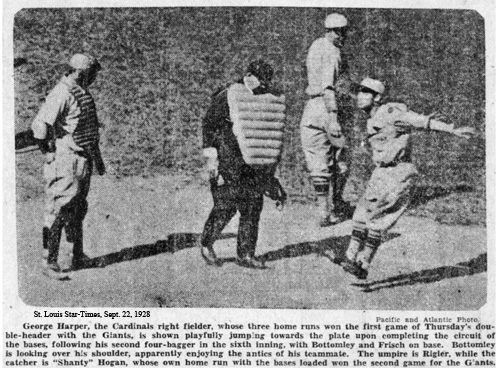
Though the Giants won the second game, 7-4, the split enabled the first-place Cardinals (89-56) to maintain a two-game lead over the Giants (87-58) with nine to play.

Harper delighted in excelling against his former club and he displayed his feelings with a bit of showmanship.

Good wood

George Washington Harper was born in Kentucky and grew up on a tobacco farm. He began his professional baseball career with a minor-league team in Paris, Texas, when he was 21, according to the Society for American Baseball Research.

An outfielder who batted left-handed, Harper debuted in the major leagues with the Tigers in 1916 and played three seasons for them. When the Tigers sent him back to the minors, Harper quit baseball and bought a sawmill near Stephens, Ark.

While operating the sawmill, Harper learned about wood and he decided a persimmon baseball bat would be stronger and more durable than one made of ash. Using his persimmon bats, Harper launched a baseball comeback in the minor leagues in 1920 and returned to the majors in 1922 with the Reds.

A good hitter with a strong throwing arm, Harper played for the Reds (1922-24), Phillies (1924-26) and Giants (1927-28). Standing 5 feet 8 and weighing 167 pounds, he packed power in his frame, hitting 18 home runs for the 1925 Phillies.

In 1928, Giants manager John McGraw was looking to create an outfield spot for teenage slugger Mel Ott and Harper was the player the club decided to move. On May 10, 1928, a month before he turned 36, Harper was traded by the Giants to the Cardinals for catcher Bob O’Farrell, who won the National League Most Valuable Player Award in 1926 and was player-manager in 1927.

New York Daily News columnist Paul Gallico said McGraw sent Harper “down the river to St. Louis” and “if you have ever been to St. Louis in July or August, you can appreciate just how sore George would be at John.”

The Cardinals were keenly aware of Harper’s hitting ability because he batted .455 with five home runs and 18 RBI against them in 1927.

Harper became the primary right fielder for the 1928 Cardinals and joined an outfield of Chick Hafey in left and Taylor Douthit in center.

Playful mood

The Giants trailed the Cardinals by two games entering the Thursday afternoon doubleheader and were seeking a sweep to move into a first-place tie. Game 1 matched two aces, left-hander Bill Sherdel (18-9, 3.07 ERA) for the Cardinals and right-hander Larry Benton (24-7, 2.51) for the Giants, and 50,000 packed the Polo Grounds to see them.

In the second inning, Harper hit “a cheap homer into the lower right-field stands” for a 1-0 Cardinals lead, the Daily News reported.

Harper faced Benton with two on in the sixth and worked the count to 3-and-2. According to the Daily News, Benton, a St. Louis native, “grooved the next one” and Harper hit “a legitimate homer” into the upper deck in right, giving the Cardinals a 5-0 lead.

As Harper completed his trot around the bases, “he leaped onto home plate with both feet, looked over into the Giants’ dugout straight at John McGraw, pursed up his lips and blew,” Gallico reported.

McGraw, a tough, feisty character, didn’t react to Harper’s antics. “In his younger days,” Gallico wrote,” I am afraid John would have emerged from his hutch and punched George in the nose.”

Encore effort

The Giants battled back, scoring three runs in the bottom of the sixth. The Cardinals added a run in the seventh and the Giants countered with two in their half of the inning, cutting the St. Louis lead to 6-5.

In the eighth, Hafey led off with a home run against reliever Jack Scott, stretching the Cardinals’ lead to 7-5. Harper came up next and hit his third home run of the game “just inside the line in the upper stands” in right, according to the Daily News.

As he completed his trip around the bases, “I blush to relate that George repeated the act as he dug his cleats once more into the (plate)” and blew toward McGraw, Gallico reported.

According to the St. Louis Star-Times, Harper gave McGraw “an ironical smile” as he crossed the plate.

“I like a guy like that,” Gallico wrote. “I’m not so hot on those repressed heroes who pretend they don’t enjoy putting it over on the other fellow. George may never have a moment like that again and I am not one to blame him for enjoying it to the fullest.”

Seeking a fourth

According to The Sporting News, Harper also “saved his team with two sensational running catches that prevented three New York runs.”

In the ninth, the Cardinals loaded the bases, bringing Harper to the plate against Dutch Henry with a chance for a fourth home run to tie the major-league record held by Bobby Lowe (1894 Boston) and Ed Delahanty (1896 Philadelphia).

The fans in the Polo Grounds “were cheering for him to do this,” the St. Louis Post-Dispatch reported, but Harper struck out looking.

The crowd jeered Cy Rigler’s “questionable third strike” call, the Post-Dispatch reported, and Harper argued so vigorously with the umpire that teammate Rabbit Maranville “had to drag him away from trouble and toward the bench,” according to the Associated Press. Boxscore

The Cardinals (95-59) went on to win the 1928 pennant, finishing with two more wins than the Giants (93-61). Harper played a big role, batting .388 with six home runs against the Giants and .305 with 17 home runs overall in 99 games for the Cardinals.

On Dec. 8, 1928, two months after the Yankees swept the Cardinals in the World Series, Harper’s contract was sold to the Braves and he finished his big-league career with them in 1929.

Read Full Post »

(Updated March 5, 2026)

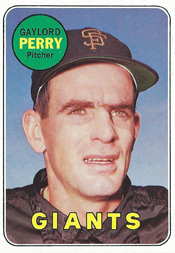
On a night when Juan Marichal was supposed to start for the Giants, Gaylord Perry got the call instead and outdueled the most dominant pitcher in baseball.

On Sept. 17, 1968, Perry pitched a no-hitter against the Cardinals at Candlestick Park in San Francisco. The Giants won, 1-0, overcoming a typically stellar performance by Bob Gibson.
Perry, pitching on three days’ rest because Marichal was sidelined by a sore right knee, tired in the eighth, prompting Giants pitching coach Larry Jansen to ask manager Herman Franks whether a reliever should get ready. Franks stuck with Perry, who delivered the only no-hitter of his Hall of Fame career.

One and done

The Tuesday night game against the Giants was the Cardinals’ first since they clinched the National League pennant two days earlier on Sept. 15, 1968, at Houston.

Manager Red Schoendienst started most of his regulars against Perry. The exceptions were Bobby Tolan, who substituted for Lou Brock in left field, and Phil Gagliano, who replaced Julian Javier at second base.

Gibson, on his way to securing NL Most Valuable Player and Cy Young awards, entered the game with a 21-7 record and 1.13 ERA. Perry was 14-14 and 2.55.

In the bottom of the first inning, Giants second baseman Ron Hunt, a St. Louis native, hit Gibson’s third pitch of the game over the left-field fence for a home run, his second and last of the season.

Hunt told the San Francisco Examiner the pitch “was about waist high and I think Gibson was just trying to throw me a strike.”

“Hunt hit a fastball that I threw a little inside,” Gibson said to United Press International.

Getting wet

In the second, the Cardinals got their first base runner when Mike Shannon walked with two outs, but Perry retired the next batter, Gagliano.

With two outs in the fourth, Perry made what he described as a “fat pitch,” a high slider, to Orlando Cepeda, but it was popped up to first baseman Willie McCovey, who caught it in foul territory for an out.

“The most important thing was my control,” Perry said to the Associated Press. “I was hitting the spots, keeping the ball low and my slider was really working.

“I knew after the fifth inning that I had a chance for a no-hitter and I tried to hit the corners all the way.”

Perry threw three types of pitches _ “a fastball, a sinking slider and a slider that was breaking real sharp on the outside,” catcher Dick Dietz told the Examiner.

“Most of the Cardinals charged that Perry threw about 75 percent spitballs or Vaseline balls,” the St. Louis Post-Dispatch reported.

“Perry was throwing his same old sinker, but it was wet and it sure dropped,” Schoendienst said.

Wetting the ball with saliva or any substance such as Vaseline was against the rules, and the Cardinals were adamant Perry was in violation. Cepeda told the Post-Dispatch that Perry threw him six spitballs or Vaseline balls in his last at-bat, and pinch-hitter Johnny Edwards said all but one pitch to him were spitters.

Giants reliever Frank Linzy told the Tulsa World, “Gaylord threw about 90 percent spitters that night.” Linzy said Vaseline usually was hidden behind the right ear and underside of the left wrist.

In his 1974 book “Me and the Spitter,” Perry admitted, “I was greasing that night, but only a few times.”

“I had a great slider that day. Honest,” Perry said.

Fine fielding

Cardinals center fielder Curt Flood said, “We were trying to do anything to get a base hit.”

The Cardinals came close to getting a hit in the sixth.

Dal Maxvill led off and smacked a sharp grounder to Perry’s left. A right-hander, Perry wore his glove on his left hand and he was able to field the ball and throw out Maxvill. “The ball just fell right into my glove,” Perry said to the Post-Dispatch. “If the ball had been hit to my right, I couldn’t have got it.”

With two outs, Tolan cracked a hard grounder between first and second, but McCovey snared it and made a perfect toss to Perry, who was covering first. Perry credited McCovey with making a “tremendous play to his right.”

The Cardinals hit two balls to the outfield the entire game and both were caught by Bobby Bonds in center.

Finish the job

In the eighth, Gagliano walked with two outs and Jansen, the pitching coach, didn’t like what he was seeing. “When a pitcher’s ball starts to come up from the (batter’s) knees and gets around the waist or higher, then you have to feel he is beginning to tire,” Jansen said. “That’s the way it looked in the eighth.”

Jansen told Franks, “I think he is beginning to lose his stuff. Do you want to get somebody warm?”

Franks replied, “Not until they get a hit off him.”

After the walk to Gagliano, Perry struck out Edwards, who was batting for Maxvill.

In the ninth, Brock, batting for Gibson, led off and grounded out to short. Tolan followed with a groundout to second and Flood, who led the club in hits, came up next. “I was really worried about Flood,” Perry said. “Flood hits to all fields and I thought he might hit a ball between the infielders.”

Instead, Flood took three called strikes. Boxscore

Good calls

In his book “Stranger to the Game,” Gibson praised home plate umpire Harry Wendelstedt, “who distinguished himself with what I consider to be the best job of calling balls and strikes that I ever witnessed.”

“Harry didn’t miss a pitch all night,” said Gibson, “and I told him so afterwards. That wasn’t an easy thing for me to do, not only because I was reluctant to compliment an umpire, as a rule, but mostly because I was not in a sociable mood when the game ended.”

Gibson’s line: 8 innings, 4 hits, 1 run, 2 walks, 10 strikeouts. “That may have been one of the best games I ever pitched,” Gibson told Stan McNeal of Cardinals Yearbook in 2018.

Perry’s line: 9 innings, 0 hits, 0 runs, 2 walks, 9 strikeouts.

The no-hitter was the first against the Cardinals since Don Cardwell of the Cubs did it on May 15, 1960. Perry also became the first Giant to toss a no-hitter since Marichal achieved one against Houston on June 15, 1963.

Perry’s gem was completed in one hour, 40 minutes and played before 9,546 spectators. He threw 101 pitches.

After celebrating with a dish of ice cream, Perry signed autographs for about 100 fans who were waiting for him outside the clubhouse.

Less than 24 hours later, on Wednesday afternoon, Sept. 18, 1968, Ray Washburn pitched a no-hitter against the Giants in the Cardinals’ 2-0 victory at Candlestick Park. Boxscore

Perry and Washburn became the first big-league pitchers to toss no-hitters in consecutive games.

Read Full Post »

(Updated April 6, 2026)

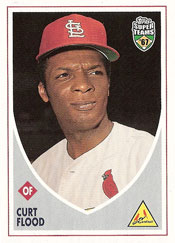
Curt Flood, the most consistent hitter on the 1968 Cardinals, helped the team and himself with a perfect performance at the plate in the pennant clincher.

On Sept. 15, 1968, Flood produced five hits in five at-bats, sparking the Cardinals to a 7-4 victory over the Astros at Houston. The win combined with the Giants’ loss to the Reds assured the Cardinals their second consecutive National League pennant and their third in five years.

Flood’s 5-for-5 game also elevated his batting average for the year to .302 and positioned him to become one of the few players to finish the 1968 season with a mark of .300 or better.

Key player

The 1968 Cardinals were a club with four future Hall of Fame players _ Lou Brock, Steve Carlton, Orlando Cepeda and Bob Gibson _ and the reigning single-season home run record holder, Roger Maris, but Flood was an essential part of the team’s success.

Flood in 1968 led all National League center fielders in putouts (384) and assists (11) and he won the sixth of his seven Gold Glove awards. Flood also led the 1968 Cardinals in hits (186), batting average (.301) and on-base percentage (.339) and he ranked No. 1 in the league in singles (160).

Flood was one of six major-league players to achieve a batting mark of .300 or better in 1968. Pete Rose (.335), Matty Alou (.332), Felipe Alou (.317), Alex Johnson (.312) and Flood (.301) did it in the National League and Carl Yastrzemski (.301) was the lone achiever in the American League.

Manager Red Schoendienst usually batted Flood second in the order behind Lou Brock because Flood was able to hit consistently well even though he often took strikes to enable Brock to attempt steals of second base.

In the book “Redbirds Revisited,” Flood said, “Brock made me a better hitter. His ability to rattle the opposition gave me the opportunity to wait on good pitches … I became a more patient hitter up there. I’d take one strike, I’d take two strikes, as I gained confidence at the plate.”

Run generator

Flood went into the three-game series with the Astros determined to cut down on his stride at the plate and the strategy worked. Flood had nine hits in 13 at-bats for the series.

In the Sunday finale, Flood was the ignitor of the Cardinals’ offense.

Flood singled against Don Wilson in the first inning and Brock scored from second on the play. In the third, Flood singled and scored on Maris’ two-run home run, the last of his career, giving the Cardinals a 3-2 lead.

Flood singled and scored on Cepeda’s two-run hit in the fifth, singled and drove in Dal Maxvill from third in the sixth and capped his performance with a fifth single in the eighth.

Brock had three hits, a walk, two runs and a steal, Maris produced three RBI, and Cepeda contributed two hits and two RBI. Carlton struck out nine, went the distance and got the win, though he yielded 11 hits and four walks. Boxscore

Waiting game

With the win, the Cardinals were guaranteed of finishing the regular season in at least a tie for first place atop the 10-team league. The second-place Giants were playing the Reds in San Francisco that afternoon and needed a win to keep their pennant hopes alive.

After beating the Astros, the Cardinals gathered in the visiting team clubhouse, ate fried chicken and baked beans, played cards and monitored radio reports from the Reds-Giants game.

An hour later, when the final out was made in the Reds’ 4-0 triumph over the Giants, the Cardinals were outright champions, holding a 12.5-game lead over the Giants, who had 12 games remaining.

As the Cardinals celebrated with champagne, Cepeda got on top of a table and led the cheers.

“The Cardinals players baptized their newest teammate, 19-year-old catcher Ted Simmons, with champagne and beer after tearing off his undershirt,” the St. Louis Post-Dispatch reported.

Simmons, who joined the Cardinals for weekend games in September while attending college classes at Michigan on weekdays, “shook his head and said, ‘I’ve got to catch a plane to Michigan at 7 o’clock,’ ” the Post-Dispatch reported.

Winning combination

The 1968 pennant was the Cardinals’ 12th. The Sept. 15 date was the earliest they’d clinched a National League championship. “This is the game you wait for from March 1st on,” Flood said to the Associated Press.

Flood credited Gibson, who won 15 consecutive decisions, as the biggest factor in the Cardinals’ successful run to the 1968 pennant. “Gibson having that fantastic streak of his is the most important thing that happened to us this year,” Flood said. “He was winning consistently and pitching complete games, which helped our bullpen.”

The Cardinals finished the season at 97-65, nine wins better than the runner-up Giants at 88-74.

“They’re not selfish as a ballclub,” Schoendienst said. “They’ll give themselves up at bat, move up the runner, or do whatever it takes. It’s just like Flood. He’ll take a strike and give Lou a chance to steal a base. Anytime you get Brock on base, he’s got a chance to score. He’s tough _ and you got Flood hitting behind him.”

Nearly 50 years later, in a 2015 interview with Fox Sports Midwest, Flood’s 1960s Cardinals teammate, catcher Tim McCarver, said Flood was “as good a teammate as any of us had … He was about as conscientious a guy as I ever played with.”

Read Full Post »

(Updated July 26, 2025)

Mark Whiten remains the only Cardinals player to hit four home runs in a game.

On Sept. 7, 1993, in the second game of a doubleheader at Cincinnati, Whiten hit a grand slam, a pair of three-run home runs and a two-run home run, leading the Cardinals to a 15-2 victory over the Reds. Boxscore

“This is the No. 1 achievement I’ve ever witnessed,” Cardinals manager Joe Torre said to the St. Louis Post-Dispatch.

Whiten’s 12 RBI tied the big-league single-game record established by Jim Bottomley of the Cardinals on Sept. 16, 1924, against the Dodgers at Brooklyn. In that game, Bottomley produced six hits _ three singles, a double and two home runs. The home runs were a grand slam and a two-run shot. Boxscore

Whiten was the 12th big-league player to hit four home runs in a game and the first since Bob Horner of the Braves did it on July 6, 1986, against the Expos at Atlanta. Boxscore

Eight major-league players have hit four home runs in a game since Whiten did it, bringing the total number of those who have achieved the feat to 20.

Whiten, Gil Hodges and Josh Hamilton are the only major-league players to hit four home runs in a game and have at least one runner on base for each of the four.

Whiten, a switch-hitter, hit each of his four home runs while batting left-handed against Reds right-handers. Whiten said he hit a fastball on each home run.

“Even though they were fastballs down the middle, you still have to know what to do with them,” Cardinals third baseman Todd Zeile said. “You can’t even do what he did in batting practice.”

Here is a look at each of Whiten’s four home runs, including the calls by KMOX broadcasters Jack Buck and Mike Shannon as published by the Post-Dispatch:

Home run No. 1

In the first inning, Whiten hit a 2-and-0 pitch from rookie starter Larry Luebbers 408 feet to left-center for a grand slam.

Jack Buck on KMOX: “Swing and a long one to left-center. That one won’t be caught. At the wall and goodbye.”

Home run No. 2

In the sixth, Mike Anderson, making his major-league debut, relieved Luebbers and walked the first two batters he faced, Zeile and Gerald Perry. Whiten was the next batter and he drilled the first pitch from Anderson 397 feet to right-center for a three-run home run.

Mike Shannon on KMOX: “Swing and a long one into right field. On the move the right fielder (Tim) Costo can’t get it. Over the wall and seven RBI in the second game for Whiten … Have a big evening and Whiten said, ‘I don’t mind if I do.’ ”

Home run No. 3

In the seventh, Whiten hit a 2-and-1 pitch from Anderson 388 feet to right for another three-run home run.

Jack Buck on KMOX: “Here’s another pitch and another home run by Whiten. He walks down to first base as it is over the fence for a three-run homer.”

Home run No. 4

When Whiten came up in the ninth to face the original Nasty Boy closer, Rob Dibble, the Cardinals had a 13-2 lead, a runner on first and one out.

“Do you think Dibble will come after him?” Jack Buck asked on the air, building the drama for his listeners. “Do you think Dibble will let him swing the bat?”

Dibble’s first two pitches to Whiten were outside the strike zone.

Said Whiten: “I felt he was going to try to pitch around me.”

“”I’m not going to walk him,” Dibble told the Cincinnati Enquirer. “That’s not my style. Put it in play, fine.”

With the count at 2-and-0, Whiten swung at Dibble’s next offering and crushed it 441 feet off the facing of the second-deck seats in right-center for a two-run home run.

Jack Buck on KMOX: “Swing and a long one. Looks like he did it. Four home runs for Mark Whiten. He powdered one over the center field fence … Man, what a blast that was! What a blast this is! … Excuse me while I applaud.”

On Cardinals’ television, Jack’s son, Joe Buck, was doing the play-by-play and his call of Whiten’s fourth home run was: “Into center field. Did he? Yes!”

Said Whiten: “It’s like when Michael Jordan gets in the zone. He’s going to score 50 points. That’s kind of the way I felt.”

Here is a video of all four home runs: Video

Ten years later, Whiten told Gabriel Kiley of Cardinals Gameday Magazine, “I was more excited about the third one because I had never hit more than two in a game in my life. The fourth dinger was icing on the cake.”

Whiten didn’t use his bat model to hit any of the four home runs, Rick Hummel of the Post-Dispatch reported, and “word is he has been using Jose Oquendo’s bat.”

Oquendo hit no home runs for the 1993 Cardinals. “There are plenty of home runs left in that bat,” Torre said.

The next night, in his first at-bat of the game leading off the second against the Reds’ Bobby Ayala, Whiten singled.

“What a bum,” Jack Buck said to listeners in his most endearing wise guy tone. “That’s the best he can do?”

Read Full Post »

« Newer Posts - Older Posts »