(Updated March 26, 2024)
Celebrated throughout the day and night, the unveiling of the Stan Musial statue outside Busch Memorial Stadium was the St. Louis version of a royal wedding.
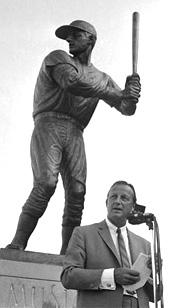 On Aug. 4, 1968, the public got its first glimpse of the statue honoring the Cardinals ballplayer.
From the moment Stan’s mother, Mary, and his wife, Lillian, pulled the cords to remove its coverings, the statue became as prominent a part of the St. Louis community as the Gateway Arch.
Writers initiative
The bronze statue of Musial in his batting stance came about through the efforts of the St. Louis chapter of the Baseball Writers Association of America. Much of the $35,000 cost of the statue was raised from the proceeds of a 1963 retirement dinner for Musial sponsored by the baseball writers. The dinner at the Chase Park Plaza hotel drew 1,400 people, according to the St. Louis Post-Dispatch.
In addition to the funds raised from the dinner, private contributions were made by Cardinals flagship radio station KMOX, the board of directors of the Cardinals and the St. Louis chapter of the baseball writers association.
Carl Mose, a sculptor based in Alexandria, Va., was hired to create the statue and he spent three years on the project.
The statue initially was planned to show Musial signing a scorecard for a youth, an image Musial preferred, “but costs and freedom of artistic expression prevailed,” Post-Dispatch sports editor Bob Broeg reported.
To get the image for the statue, Musial posed in his batting stance while Mose sketched, but the sculptor “had to rework the original plaster design after Musial thought it depicted him in too upright of a stance and found other things not quite right about it, including the configuration of his head,” according to author James N. Giglio in his book “Musial: From Stash to Stan the Man.”
Redbirds reunion
The statue, 10 feet, 8 inches high atop an 8.5-foot marble pedestal, was placed outside the stadium near Broadway and Walnut streets.
The dedication was scheduled to be held after the Cubs and Cardinals played on a Sunday afternoon.
 Before the game, the club hosted a brunch for Musial, his family and friends in team owner Gussie Busch’s stadium dining room. Officials also invited members of the 1941 Cardinals because Musial made his major-league debut with them. Busch presented each former player with a commemorative Cardinals wristwatch.
After the meal, Musial and the group went onto the field for a pregame ceremony and were introduced to the crowd of 47,445 by broadcaster Harry Caray.
Nineteen of Musial’s teammates from the 1941 Cardinals were on hand: Johnny Beazley, Walker Cooper, Frank Crespi, Erv Dusak, Harry Gumbert, Ira Hutchinson, Howie Krist, Whitey Kurowski, Eddie Lake, Gus Mancuso, Marty Marion, Steve Mesner, Johnny Mize, Terry Moore, Don Padgett, Howie Pollet, Enos Slaughter, Lon Warneke and Ernie White.
Also in the group were Ollie Vanek, the scout who signed Musial for the Cardinals in 1938; two of the umpires from Musial’s first game, Jocko Conlon and Beans Reardon; and two of Musial’s youth sports coaches from his hometown of Donora, Pa., Michael Duda and Frank Pizzica.
When Musial, dressed in uniform, was introduced to the crowd by Caray, fans responded with “deafening” applause, the Post-Dispatch reported. Musial ran to right field, did a pantomime of a fielder pursuing a fly ball, and waved.
Stan’s 4-year-old grandson, Jeffrey, turned to his grandmother Lil and asked, “Is Stan Musial going to play today?”
The game matched aces Ferguson Jenkins of the Cubs against Bob Gibson of the Cardinals. Gibson took a 4-3 lead into the ninth, but Al Spangler led off the inning with a home run, his first in three years, and tied the score at 4-4. The Cubs won, 6-5, on Lee Elia’s RBI-single against Joe Hoerner in the 13th. Boxscore
Symbol of sportsmanship
About 20,000 people gathered for the statue dedication after the game, according to the Post-Dispatch. Among the guests on the dais were Gov. Warren Hearnes of Missouri, U.S. Senator Stuart Symington of Missouri, St. Louis Mayor Alfonso Cervantes, baseball commissioner William Eckert, National League president Warren Giles and retired baseball commissioner Ford Frick.
In a 1963 ceremony before Musial’s final game, Frick said of Musial, “Here stands baseball’s happy warrior; here stands baseball’s perfect knight.”
The words inscribed on the base of the Musial statue say: “Here stands baseball’s perfect warrior; here stands baseball’s perfect knight.”
At the dedication, Frick told the crowd, “Fortunately, behind the bronze and the stone is a man of heart and great integrity. If the time comes when people are so blasé that they don’t look for a Musial glove under a boy’s pillow, or a Musial bat at the side of the bed, then something will be lost from life.”
Broadcaster Jack Buck, master of ceremonies for the dedication, said, “Stan indicated he never forgets the fans. This statue will assure we’ll never forget him.”
When it came time for Musial to speak, he said, “I like to think of the statue as a symbol of sportsmanship and great freedom of opportunity.”
Displaying emotion, Musial told the audience, “I want to thank everyone, for my mother and the Musial family, for making me a Cardinal forever.”
With tears welling, Mary Musial gave her son a kiss.
After the dedication, Musial hosted a party at his restaurant, and delighted guests with his dancing. When the party ended, Musial invited a small group to his house, where he played the harmonica late into the night.
Some close to Musial thought the statue wasn’t an accurate likeness. In subsequent banquet speeches, the Post-Dispatch noted, Jack Buck often used the line, “The statue may be bronze, but the sculptor must have been stoned.”
In 2006, when the Cardinals opened a new Busch Stadium in downtown St. Louis, the statue was relocated to a prominent place outside the entrance on the west side of the ballpark, and remained a popular gathering place for residents and visitors alike.
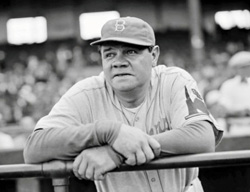 On Aug. 2, 1938, in the first game of a doubleheader between the Cardinals and Dodgers at Ebbets Field in Brooklyn, yellow baseballs were used in a major-league game for the first time.
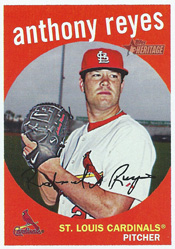 On July 26, 2008, the Cardinals traded Reyes to the Indians for minor-league reliever Luis Perdomo and cash.
 On July 21, 1978, the Cardinals purchased Garrett’s contract in a waiver deal with the Expos. The Cardinals envisioned Garrett, a left-handed batter, for a pinch-hitting role, but he performed well when given the chance to substitute for slumping third baseman Ken Reitz and ended up being used in a platoon with Reitz the remainder of the season.
 On July 20, 2008, Miles stunned the Padres with a walkoff grand slam in the ninth inning, carrying the Cardinals to a 9-5 victory at St. Louis.
 Smoke poured through the press box and into the concourses, burning debris fell onto field-level seats and five suites were destroyed, according to multiple published reports.
 RetroSimba