A closer for a rotation that often completed what it started, Joe Hoerner still served a valuable role for the 1968 National League champion Cardinals and supported the staff with a stellar season.
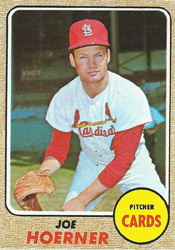 On June 1, 1968, Hoerner struck out six Mets in a row, tying the National League record for consecutive strikeouts by a reliever.
Hoerner went on to post an 8-2 record with 17 saves and a 1.47 ERA for the 1968 Cardinals. The left-hander ranked second in the National League in saves to the 25 by Phil Regan of the Cubs and his ERA was second on the club to the 1.12 achieved by Bob Gibson.
Led by Gibson’s 28, Cardinals starters pitched 63 complete games in 1968. Hoerner only was needed for 49 innings and he usually was effective, allowing no earned runs in 40 of his 47 appearances.
“Joe is almost as much of a machine out there as Bob Gibson,” Cardinals reliever Wayne Granger said to the St. Louis Post-Dispatch. “He just goes out there and does the job time after time.”
Overcoming adversity
Hoerner, son of an Iowa farmer, made his professional baseball debut in the White Sox minor-league system in 1957. A year later, Hoerner was diagnosed with muscle weakness near his heart. Because any strain on the muscle impaired Hoerner’s circulation, doctors advised him to change his pitching delivery from overhand to sidearm.
“I took four pills a day for a long time to strengthen the muscle, but I haven’t been bothered since then,” Hoerner told the Post-Dispatch in 1968.
Hoerner, 26, made his major-league debut in September 1963 with the Houston Colt .45s. The Cardinals acquired him in November 1965 and he pitched for them in 1966 (5-1 record, 13 saves,1.54 ERA) and 1967 (4-4, 14 saves, 2.59 ERA).
After the Cardinals won Game 7 of the 1967 World Series against the Red Sox, Hoerner was celebrating with his teammates in the locker room at Boston’s Fenway Park when a champagne bottle he was holding exploded, severing a tendon in the middle finger of his pitching hand.
“If we win many more pennants, my fingers won’t stand it,” Hoerner said.
Tough to hit
Hoerner recovered from the injury and yielded no runs in his first nine appearances in 1968.
On June 1, the Cardinals played the Mets at Shea Stadium in New York. The Mets led, 4-1, before the Cardinals rallied for three runs in the seventh against Nolan Ryan, tying the score at 4-4.
Hoerner, the third Cardinals pitcher of the game, was brought in to pitch the seventh and retired the Mets in order. The Cardinals took the lead, 5-4, with a run in the eighth, but the Mets tied the score on Ed Charles’ pinch-hit home run in the bottom half of the inning.
In the ninth, Hoerner struck out Al Weis, Ron Swoboda and Don Bosch. After Mike Shannon hit a home run against Cal Koonce in the 10th, putting the Cardinals ahead, 6-5, Hoerner struck out Greg Goossen, Jerry Buchek and Jerry Grote, sealing the win. Boxscore
Hoerner’s six consecutive strikeouts came against right-handed batters.
Hoerner was effectively consistent during the 1968 season. He was 4-1 with a 1.05 ERA in home games and 4-1 with a 1.93 ERA in away games. Left-handed batters hit .189 against him and right-handed batters hit .194.
In the 1968 World Series against the Tigers, Hoerner earned a save in Game 3 with 3.2 scoreless innings in relief of Ray Washburn boxscore and was the losing pitcher in Game 5 when he faced four batters, retired none and was charged with two runs. Boxscore
Hoerner and Cardinals teammate Dal Maxvill owned a successful travel agency in St. Louis for several years.
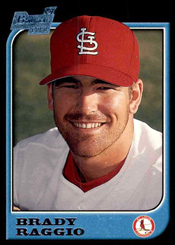 On May 15, 1998, Raggio started for the Cardinals against the Marlins and allowed 11 consecutive batters to reach base before he was lifted in the first inning.
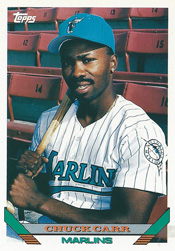 On May 14, 1993, the Cardinals played the Marlins in a regular-season game for the first time. The first batter they faced was Carr, whom the Marlins selected from the Cardinals in the Nov. 17, 1992, National League expansion draft.
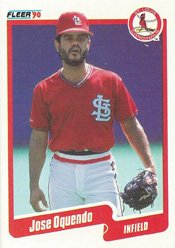 On May 14, 1988, at St. Louis, Oquendo was asked by manager Whitey Herzog to relieve in the 16th inning because no one on the pitching staff was available. Oquendo shifted from first base to the mound and shut out the Braves for three innings before yielding two runs in the 19th. Though he lost, Oquendo surprised most by doing as well as he did for as long as he did.
 On May 13, 1958, Musial got his 3,000th career hit, a double against Drabowsky at Wrigley Field in Chicago. The feat forever linked Drabowsky with Musial.
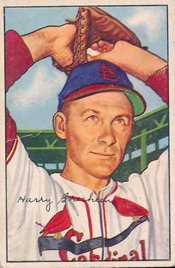 Brecheen began the 1948 season with three consecutive shutouts, including a one-hitter.
 RetroSimba