Feeds:
Posts
Comments

Archive for the ‘Games’ Category

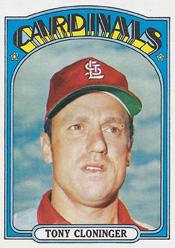
Tony Cloninger, a prominent National League starting pitcher in the 1960s, was given an opportunity by the Cardinals to extend his major-league career as a reliever in the 1970s, but it didn’t work out.

Cloninger was acquired by the Cardinals from the Reds for second baseman Julian Javier on March 24, 1972.

A right-hander, Cloninger pitched well for the Reds in 1971, posting a 3.33 ERA in 20 relief appearances and a 3.88 ERA overall, but he didn’t fit into their plans in 1972.

The Reds showcased Cloninger, 31, in a spring training start against the Cardinals on March 23, 1972, and he delivered, yielding one hit in six innings. The next day, the Cardinals, seeking relief help, made the deal for him.

Reliable starter

The trade reunited Cloninger with his friend, Cardinals third baseman Joe Torre. They were teammates with the Braves from 1961-68 and Torre was Cloninger’s catcher during the pitcher’s heyday. Torre caught more of Cloninger’s games, 141, than any other catcher.

Cloninger signed with the Braves as an amateur free agent in May 1958 and, when he made his major-league debut with them at age 20 on June 15, 1961, in a start against the Giants at Candlestick Park, Torre was his catcher. Boxscore

A month later, on July 13, 1961, at St. Louis, Cloninger faced the Cardinals for the first time and catcher Tim McCarver, 19, hit his first big-league home run against him. Boxscore

The next year, on Sept. 5, 1962, Cloninger pitched his first major-league shutout in a 1-0 Braves victory over the Cardinals at St. Louis. Bill White, with a single and double, had two of the Cardinals’ five hits against Cloninger. Boxscore

On Aug. 11, 1963, at Milwaukee, Cloninger pitched another gem against the Cardinals, striking out 11 in a four-hitter won by the Braves, 9-1. Boxscore

From 1964-66, Cloninger was a productive, durable ace for the Braves. He was 19-14 with 242.2 innings pitched in 1964, 24-11 in 279 innings in 1965 and 14-11 in 257.2 innings in 1966. Cloninger was 3-0 against the Cardinals in 1965.

Cloninger also could hit. On July 3, 1966, he produced nine RBI, with two grand slams and a run-scoring single, in a game against the Giants at Candlestick Park. He hit the first grand slam against Bob Priddy and the second against Ray Sadecki, the former Cardinal, and pitched a complete game in a 17-3 Braves victory. Boxscore

In June 1968, the Braves traded Cloninger to the Reds and, though he no longer was an ace, he contributed, earning nine wins for the pennant-winning 1970 Reds. Cloninger also started and lost Game 3 of the 1970 World Series against the Orioles. Boxscore

Taking a chance

The 1972 Cardinals looked at another former Reds starter, Jim Maloney, in spring training, but didn’t like what they saw, released him and acquired Cloninger.

“Even though I like Cloninger personally and admire his perseverance, I can’t get excited over the addition of a struggling pitching veteran who has been beset by arm, eye and back troubles,” Bob Broeg wrote in the St. Louis Post-Dispatch.

Reds manager Sparky Anderson said if the Cardinals “pitch him enough so that he can keep his control, he’ll deliver for them.”

“He still throws hard and his attitude is the best,” Anderson added.

Cardinals manager Red Schoendienst said Cloninger told him he was “ready to start, to relieve or hit fungoes” to help.

“I’ve never talked to a ballplayer yet who played for the Cardinals organization who didn’t think it was fantastic,” Cloninger said to the Dayton Journal Herald.

In his first spring training appearance for the Cardinals, Cloninger yielded two hits in five innings against the Mets and ensured himself a spot on the Opening Day pitching staff.

The Cardinals opened the 1972 season with seven relievers: right-handers Moe Drabowsky, Dennis Higgins, Al Santorini and Cloninger, and left-handers Joe Grzenda, Don Shaw and Lance Clemons.

Gopher balls

Cloninger had a good outing on May 24, 1972, against the Pirates, pitching 3.2 scoreless relief innings, but five days later he took a big step backwards.

On May 29, 1972, the Cardinals carried a 6-3 lead into the ninth inning against the Mets at St. Louis and Schoendienst called on Cloninger to be the closer. After Jerry Grote singled and Bud Harrelson walked, Ken Bowell, batting with one out, hit a three-run home run, tying the score at 6-6. Tommie Agee followed with a single before Schoendienst lifted Cloninger. Agee eventually scored from third on a passed ball by Ted Simmons, the Mets won, 7-6, and Cloninger took the loss.

The home run was the first of the season for Boswell, who entered the game batting .177. Boxscore

Cloninger unveiled a knuckleball and experienced some good outings, including a three-inning scoreless stint against the Braves on July 11, 1972, at St. Louis.

His Cardinals career, however, came to a sudden close with one bad pitch.

On July 22, 1972, against the Braves at Atlanta, Cloninger entered in the 10th inning with the score tied at 7-7. His first pitch to the first batter, Dusty Baker, was belted for a walkoff home run and an 8-7 Braves victory.

Before going to the plate, Baker told teammate Oscar Brown, “I think I’ll take a pitch and see what he’s got.” Brown replied, “No, man, go up there swinging,” and Baker did.

Denny McLain, who pitched a scoreless top of the 10th, got his first National League win and the loss went to Cloninger. Boxscore

Four days later, on July 26, the Cardinals released Cloninger, who was 0-2 with a 5.19 ERA in 17 relief appearances. On Aug. 1, Cloninger signed with the Braves, who sent him to their minor-league club at Richmond, Va., where he became a teammate of second baseman Tony La Russa.

Cloninger was 1-1 in seven appearances for Richmond, ending his playing days. He had a 113-97 record in 12 big-league seasons.

Twenty years later, in 1992, Cloninger was hired to be a coach on the staff of Yankees manager Buck Showalter. In 1996, Showalter departed and Cloninger’s old friend, Torre, became Yankees manager. Cloninger was a coach for five pennant-winning teams and four World Series championship clubs with the Yankees under Torre.

In 2002 and 2003, Cloninger was a Red Sox coach for manager Grady Little.

Read Full Post »

Looking to boost his sagging career, Felipe Lopez joined the Cardinals and benefitted from being tutored by Jose Oquendo.

On Aug. 5, 2008, Lopez signed with the Cardinals a week after being released by the Nationals.
Lopez, 28, was best suited for shortstop and second base, but he also possessed the skills to play all infield and outfield positions, much like Oquendo did for the Cardinals before becoming a coach.

Also, Lopez was a switch hitter, like Oquendo had been, and both were natives of Puerto Rico. Oquendo saw Lopez as a protege, and Lopez responded favorably to the special attention Oquendo gave him.

Traveling man

Lopez was 21 when he made his major-league debut with the Blue Jays in August 2001. He played two seasons (2001-02) with the Blue Jays before serving stints with the Reds (2003-06) and Nationals (2006-08).

His best season was 2005 when he hit .291 with 23 home runs and 85 RBI as the Reds shortstop and was named to the National League all-star team.

In July 2006, the Reds swapped Lopez to the Nationals for shortstop Royce Clayton, the former Cardinal. By 2008, Lopez had shifted to second base, but his production declined and he was batting .234 when the Nationals released him.

The 2008 Cardinals had Aaron Miles and Adam Kennedy at second base and Cesar Izturis and Brendan Ryan at shortstop, but decided to add Lopez.

Lopez said signing with the Cardinals was a “no-brainer,” the St. Louis Post-Dispatch reported, and he marveled at the clubhouse atmosphere. “As soon as I walked in, I felt the energy,” Lopez said. “That inspires you … to play well.”

Mentoring program

Oquendo urged Lopez “to be more aggressive in his play defensively” and get to the ball quicker.

“He probably needs to widen his (defensive) stance a little more when he’s taking ground balls,” Oquendo said.

Oquendo also worked with Lopez on his mental approach and told him his departures from the Blue Jays, Reds and Nationals were a sign he was doing something wrong.

“For him to be bouncing from place to place in the major leagues …. Why?” Oquendo asked. “Maybe he has to change the way he approaches the game, or the way he goes about the game. There’s a key somewhere for him and hopefully we’re the key.”

Lopez got off to a fast start, batting .357 in his first nine games for the Cardinals. “Lopez was a heck of a pickup by Cardinals general manager John Mozeliak,” columnist Bernie Miklasz wrote in the Post-Dispatch. “Lopez is playing hard for the Cardinals, something he hadn’t done for a long time.”

Back for more

Lopez batted .333 for the Cardinals in August and .414 in September.

In a three-game, season-ending series versus the Reds at St. Louis. Lopez was 8-for-12 with two walks, seven runs scored and four RBI. He went 3-for-4 with a walk and three runs scored in the Cardinals’ 7-6 victory on Sept. 26 Boxscore and he was 4-for-5 with three RBI and two runs scored in their 11-4 triumph on Sept. 28. Boxscore

Lopez made starts at second base (20), third base (eight), left field (seven) and shortstop (three) for the 2008 Cardinals. He also played in right field and at first base.

Lopez batted .385 for the 2008 Cardinals and his on-base percentage was .426.

Granted free agency after the season, Lopez was approached by the Cardinals about returning, the Post-Dispatch reported, but they couldn’t assure him he’d be an everyday player in 2009.

Lopez instead accepted a one-year, $3.5 million contract from the 2009 Diamondbacks. Playing primarily at second base, Lopez batted .301 for the Diamondbacks before he was acquired by the Brewers in July 2009. Lopez hit .320 for the Brewers, became a free agent after the 2009 season and signed again with the Cardinals.

The encore with St. Louis wasn’t as good for Lopez as the first time around. He hit .231 in 109 games as a Cardinals utility player in 2010 before he was released in September.

Lopez’s most memorable feat for the 2010 Cardinals may have been the scoreless inning he pitched on April 17 in a game won by the Mets, 2-1, in 20 innings at St. Louis. Boxscore

Read Full Post »

(Updated March 26, 2024)

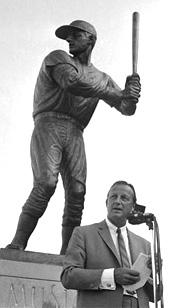
Celebrated throughout the day and night, the unveiling of the Stan Musial statue outside Busch Memorial Stadium was the St. Louis version of a royal wedding.

On Aug. 4, 1968, the public got its first glimpse of the statue honoring the Cardinals ballplayer.

From the moment Stan’s mother, Mary, and his wife, Lillian, pulled the cords to remove its coverings, the statue became as prominent a part of the St. Louis community as the Gateway Arch.

Writers initiative

The bronze statue of Musial in his batting stance came about through the efforts of the St. Louis chapter of the Baseball Writers Association of America. Much of the $35,000 cost of the statue was raised from the proceeds of a 1963 retirement dinner for Musial sponsored by the baseball writers. The dinner at the Chase Park Plaza hotel drew 1,400 people, according to the St. Louis Post-Dispatch.

In addition to the funds raised from the dinner, private contributions were made by Cardinals flagship radio station KMOX, the board of directors of the Cardinals and the St. Louis chapter of the baseball writers association.

Carl Mose, a sculptor based in Alexandria, Va., was hired to create the statue and he spent three years on the project.

The statue initially was planned to show Musial signing a scorecard for a youth, an image Musial preferred, “but costs and freedom of artistic expression prevailed,” Post-Dispatch sports editor Bob Broeg reported.

To get the image for the statue, Musial posed in his batting stance while Mose sketched, but the sculptor “had to rework the original plaster design after Musial thought it depicted him in too upright of a stance and found other things not quite right about it, including the configuration of his head,” according to author James N. Giglio in his book “Musial: From Stash to Stan the Man.”

Redbirds reunion

The statue, 10 feet, 8 inches high atop an 8.5-foot marble pedestal, was placed outside the stadium near Broadway and Walnut streets.

The dedication was scheduled to be held after the Cubs and Cardinals played on a Sunday afternoon.

Before the game, the club hosted a brunch for Musial, his family and friends in team owner Gussie Busch’s stadium dining room. Officials also invited members of the 1941 Cardinals because Musial made his major-league debut with them. Busch presented each former player with a commemorative Cardinals wristwatch.
After the meal, Musial and the group went onto the field for a pregame ceremony and were introduced to the crowd of 47,445 by broadcaster Harry Caray.

Nineteen of Musial’s teammates from the 1941 Cardinals were on hand: Johnny Beazley, Walker Cooper, Frank Crespi, Erv Dusak, Harry Gumbert, Ira Hutchinson, Howie Krist, Whitey Kurowski, Eddie Lake, Gus Mancuso, Marty Marion, Steve Mesner, Johnny Mize, Terry Moore, Don Padgett, Howie Pollet, Enos Slaughter, Lon Warneke and Ernie White.

Also in the group were Ollie Vanek, the scout who signed Musial for the Cardinals in 1938; two of the umpires from Musial’s first game, Jocko Conlon and Beans Reardon; and two of Musial’s youth sports coaches from his hometown of Donora, Pa., Michael Duda and Frank Pizzica.

When Musial, dressed in uniform, was introduced to the crowd by Caray, fans responded with “deafening” applause, the Post-Dispatch reported. Musial ran to right field, did a pantomime of a fielder pursuing a fly ball, and waved.

Stan’s 4-year-old grandson, Jeffrey, turned to his grandmother Lil and asked, “Is Stan Musial going to play today?”

The game matched aces Ferguson Jenkins of the Cubs against Bob Gibson of the Cardinals. Gibson took a 4-3 lead into the ninth, but Al Spangler led off the inning with a home run, his first in three years, and tied the score at 4-4. The Cubs won, 6-5, on Lee Elia’s RBI-single against Joe Hoerner in the 13th. Boxscore

Symbol of sportsmanship

About 20,000 people gathered for the statue dedication after the game, according to the Post-Dispatch. Among the guests on the dais were Gov. Warren Hearnes of Missouri, U.S. Senator Stuart Symington of Missouri, St. Louis Mayor Alfonso Cervantes, baseball commissioner William Eckert, National League president Warren Giles and retired baseball commissioner Ford Frick.

In a 1963 ceremony before Musial’s final game, Frick said of Musial, “Here stands baseball’s happy warrior; here stands baseball’s perfect knight.”

The words inscribed on the base of the Musial statue say: “Here stands baseball’s perfect warrior; here stands baseball’s perfect knight.”

At the dedication, Frick told the crowd, “Fortunately, behind the bronze and the stone is a man of heart and great integrity. If the time comes when people are so blasé that they don’t look for a Musial glove under a boy’s pillow, or a Musial bat at the side of the bed, then something will be lost from life.”

Broadcaster Jack Buck, master of ceremonies for the dedication, said, “Stan indicated he never forgets the fans. This statue will assure we’ll never forget him.”

When it came time for Musial to speak, he said, “I like to think of the statue as a symbol of sportsmanship and great freedom of opportunity.”

Displaying emotion, Musial told the audience, “I want to thank everyone, for my mother and the Musial family, for making me a Cardinal forever.”

With tears welling, Mary Musial gave her son a kiss.

After the dedication, Musial hosted a party at his restaurant, and delighted guests with his dancing. When the party ended, Musial invited a small group to his house, where he played the harmonica late into the night.

Some close to Musial thought the statue wasn’t an accurate likeness. In subsequent banquet speeches, the Post-Dispatch noted, Jack Buck often used the line, “The statue may be bronze, but the sculptor must have been stoned.”

In 2006, when the Cardinals opened a new Busch Stadium in downtown St. Louis, the statue was relocated to a prominent place outside the entrance on the west side of the ballpark, and remained a popular gathering place for residents and visitors alike.

Read Full Post »

Yellow baseballs couldn’t help a Cardinals club from feeling blue about a season coming apart at the seams.

On Aug. 2, 1938, in the first game of a doubleheader between the Cardinals and Dodgers at Ebbets Field in Brooklyn, yellow baseballs were used in a major-league game for the first time.
To the Cardinals, the color of the baseball didn’t make any difference in helping their hitting or pitching. The Dodgers beat the Cardinals, 6-2, using yellow baseballs in the opener, and in the second game, when standard white baseballs were brought back into play, the Dodgers won again, 9-3.

Afterward, Cardinals manager Frankie Frisch suggested his players should try using red baseballs. “Maybe it would make them mad,” seeing red, Frisch said to the St. Louis Post-Dispatch.

The losses dropped the Cardinals’ record to 38-54 and intensified speculation about Frisch’s job security. Two months later, Frisch was fired and the Cardinals went on to finish with a 71-80 mark, their fewest wins in a season since 1924.

Higher visibility

Frederick H. Rahr, a color engineer from New York, developed the yellow baseball after he witnessed Tigers catcher Mickey Cochrane get beaned by a pitch at Yankees Stadium in 1937. Rahr determined a yellow baseball would make the game safer to play because it would be easier to see than a white baseball.

“It is intended primarily to stop beanball accidents,” Rahr told The Sporting News.

Rahr convinced the baseball coaches at Columbia University and Fordham to use his yellow baseball in a game in April 1938. Dodgers executive Larry MacPhail took notice and got permission from National League president Ford Frick to try the yellow baseball in a regular-season game.

The yellow ball with red stitches was a delight for sportswriters, who described it in their game reports as a “stitched lemon,” a “golden globe,” “canary yellow” and having “a dandelion hue.”

Play ball

Played on a bright Tuesday afternoon, the game with the yellow baseball seemed like any other game.

“I didn’t see much difference,” plate umpire George Barr said to The Sporting News.

Said Cardinals outfielder Joe Medwick, the reigning National League batting champion: “When you’re hitting, the ball rides, no matter if it’s red, white or blue.”

The majority of spectators liked the yellow baseball and said they could follow it well, the New York Times reported. Most of the Cardinals and Dodgers were OK with it, too.

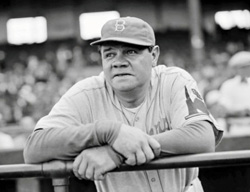
“I saw it all right,” Dodgers coach Babe Ruth told the Brooklyn Daily Eagle. “I hit three of them out of the park in batting practice.”

Other positive reviews:

_ Don Gutteridge, Cardinals third baseman: “I’d like to hit against it all the time.”

_ Leo Durocher, Dodgers shortstop; “It suited me all right. I couldn’t find any fault with it.”

_ Merv Shea, Dodgers catcher: “It’s much easier to follow on a low pitch because the cover of the ball doesn’t reflect the glare of the sun.”

The biggest complaint concerned the dye used to make the baseballs yellow.

“The dye came off on my fingers and the ball was a bit too slippery for my knuckleball,” said Dodgers starter Freddie Fitzsimmons.

Fitzsimmons kept wiping the dye from his hand onto his jersey and pants and “the entire side of his uniform was stained” yellow, according to United Press.

Among the other criticisms:

_ Turk Stainback, Dodgers outfielder: “I noticed the dye came off the ball and onto the bat after it was hit.”

_ Frenchy Bordagaray, Cardinals outfielder: “The yellow ball is too hard to autograph.”

“The yellow cover soiled easily and the umpires were kept busy tossing in new spheres,” the St. Louis Star-Times noted.

Johnny Mize of the Cardinals socked one of the yellow baseballs over the fence in the seventh for the only home run of the game. Boxscore

In the second game, the Cardinals’ frustrations poured out when umpire Bill Stewart started to signal Durocher out at the plate, changed his mind and called him safe. Cardinals catcher Mickey Owen shoved Stewart, threw the white baseball high into the air and was ejected, the Post-Dispatch reported. Frisch came onto the field and “took to kicking dirt over home plate as often as Stewart would brush the plate off” and also was ejected. Boxscore

Keeping with tradition

In an editorial, The Sporting News, urged more use of the yellow baseballs.

“Though the ball cannot be regarded as a complete success at present … enough favorable evidence was adduced to warrant a continuation of the experiment,” The Sporting News wrote. “Anything that contributes to greater safety in the game merits a thorough trial.”

After the 1938 season, baseball officials approved teams using yellow baseballs in games as long as both teams were in agreement, but the experiments were done only a couple of more times in 1939.

In 1973, at the request of Athletics owner Charlie Finley, major-league officials allowed the use of orange baseballs in an exhibition game between the Athletics and Indians in Arizona, but the idea didn’t catch on.

Read Full Post »

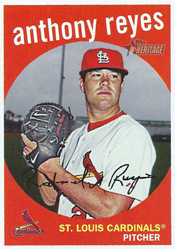
Two years after he established the tone for the 2006 World Series, pitching a Game 1 gem and propelling the club toward a championship, Anthony Reyes and the Cardinals were eager for a divorce.

On July 26, 2008, the Cardinals traded Reyes to the Indians for minor-league reliever Luis Perdomo and cash.

Reyes, 26, was with the Cardinals’ farm club at Memphis when the deal was made. He began the 2008 season with the Cardinals, clashed with pitching coach Dave Duncan, sprained his right elbow and got demoted to the minor leagues.

Disillusioned, Reyes was ready to be traded and the Cardinals were prepared to accommodate him.

“He needs a change of scenery,” Cardinals outfielder Skip Schumaker said to the St. Louis Post-Dispatch.

Said Reyes: “When you get overlooked and you feel you’re pitching well, you want to go to a place that’s a better fit.”

Hot prospect

Reyes pitched at the University of Southern California and was selected by the Cardinals in the 15th round of the 2003 amateur draft. In 2004, Reyes pitched for two clubs in the Cardinals’ system and had an overall record of 9-2 with 140 strikeouts in 111 innings.

Before the 2005 and 2006 seasons, Reyes was named the top pitching prospect in the Cardinals’ organization by Baseball America magazine.

He made his major-league debut on Aug. 9, 2005, in a start against the Brewers at Milwaukee and got the win, yielding two runs in 6.1 innings of a 5-2 Cardinals victory. Boxscore On June 22, 2006, Reyes pitched a one-hitter for the Cardinals against the White Sox, but lost, 1-0, on a Jim Thome home run. Boxscore

Though he was 5-8 with a 5.06 ERA in 17 starts for the 2006 Cardinals, Reyes was the Game 1 starter in the World Series because veterans Chris Carpenter, Jeff Suppan and Jeff Weaver were unavailable after pitching in a seven-game National League Championship Series against the Mets.

Matched against Tigers ace Justin Verlander in Detroit, the odds didn’t favor Reyes, but he delivered a masterpiece, limiting the Tigers to two runs in eight innings and earning the win in a 7-2 St. Louis victory. Reyes retired 17 consecutive Tigers batters. Boxscore The Cardinals went on to win four times in five games and clinch their first World Series title in 24 years.

Steps backward

After the postseason, the Cardinals allowed Suppan, Weaver and another starter, Jason Marquis, to leave as free agents, figuring Reyes would help fill the void, but Reyes lost his first 10 regular-season decisions with the 2007 Cardinals and finished the season at 2-14 with a 6.04 ERA.

The Cardinals and Phillies discussed a trade of Reyes for outfielder Michael Bourne, but the proposed deal unraveled, the Post-Dispatch reported.

Reyes was prone to using high fastballs to entice batters to swing and miss. Duncan wanted him to pitch to contact rather than try for strikeouts. Reyes didn’t embrace the concept and “became a point of frustration” for Duncan, the Post-Dispatch reported.

Cardinals manager Tony La Russa said reports of a disconnect between Duncan and Reyes were “nonsense” and caused a distraction. “I regret the fact people mentioned he was not a Dave Duncan style of pitcher,” La Russa told the Post-Dispatch.

The Cardinals moved Reyes to a reliever role in 2008 and he was 2-1 with a save and a 4.91 ERA before spraining his right elbow. After a stint on the disabled list, Reyes was sent by the Cardinals to their Class AAA farm club at Memphis.

“Reyes came to represent the risks of holding on to a young player too long,” the Post-Dispatch reported. “Aware of Duncan’s frustrations with Reyes, some within the organization advocated trading the pitcher after his celebrated win in the first game of the 2006 World Series.”

Fresh start

After the Indians acquired Reyes from the Cardinals, they sent him to their Class AAA affiliate at Buffalo. Working with pitching coach Scott Radinsky, a former Cardinals reliever, Reyes was 2-0 with a 2.77 ERA in two starts for Buffalo before getting called up to the Indians.

Reyes made his Indians debut in a start on Aug. 8, 2008, against the Blue Jays at Toronto and got a win, yielding a run in 6.1 innings of a 5-2 Cleveland victory. Boxscore

“He had a good heartbeat, made pitches when he needed to and was very efficient,” Indians manager Eric Wedge said to the Akron Beacon Journal.

Reyes used the media attention his win attracted to express his frustrations with Duncan and the Cardinals.

“When I’d get sent down in St. Louis, no one ever told me what I was supposed to work on,” Reyes said to the Cleveland Plain Dealer. “It wasn’t like it was anything mean, but I was going crazy trying to figure out if I did something wrong. Did I step on someone’s toes?”

In comments to the Beacon Journal, Reyes said, “I felt like I didn’t fit in over there. They didn’t like anything I was doing. It made for some long years.”

After Reyes earned a win in a start at Cleveland against the Royals on Aug, 19, he told the Beacon Journal, “I think I’m getting there. I got in a lot of bad habits the last couple of years, so coming here gives me a chance to get rid of them.”

Elbowed out

Reyes continued pitching well for the 2008 Indians, but on Sept. 5 he was pulled from a start at Kansas City because of elbow pain. Sidelined for the remainder of the season, Reyes was 2-1 with a 1.83 ERA in six starts for the 2008 Indians.

In 2009, Reyes made eight starts for the Indians and was 1-1 with a 6.57 ERA before his right elbow gave out. On June 12, 2009, Reyes underwent reconstructive elbow surgery and never again pitched in the major leagues.

Reyes pitched in the Indians’ farm system in 2010 and 2011. At 30, his final professional season was in 2012 when he pitched for the Padres’ Class AAA Tucson club managed by former Cardinals catcher Terry Kennedy.

In 67 big-league games, Reyes was 13-26 with a 5.12 ERA.

Reyes became a firefighter for the Los Angeles County Fire Department in California in 2017, following in the footsteps of his father, also a firefighter.

Read Full Post »

(Updated Nov. 14, 2021)

Wayne Garrett, who had some of his best games against the Cardinals, finished his major-league playing days with them, producing a sustained stretch of solid hitting for St. Louis and positioning himself to earn an opportunity to extend his career in Japan.

On July 21, 1978, the Cardinals purchased Garrett’s contract in a waiver deal with the Expos. The Cardinals envisioned Garrett, a left-handed batter, for a pinch-hitting role, but he performed well when given the chance to substitute for slumping third baseman Ken Reitz and ended up being used in a platoon with Reitz the remainder of the season.

Playing almost exclusively against right-handed pitchers, Garrett batted .333 for the 1978 Cardinals, generating 21 hits in 63 at-bats. He hit .389 (7-for-18) with runners in scoring position.

The Cardinals were impressed and wanted Garrett, 30, to return in 1979 as a utility player, but when he and the club couldn’t agree on contract terms, Garrett departed as a free agent.

Cards connections

In 1965, Garrett was selected by the Braves in the sixth round of major-league baseball’s first amateur draft. During his stint in the Braves’ system, Garrett caught the attention of Mets scout Bob Scheffing, who recommended him to management. In December 1968, the Mets took Garrett in the Rule 5 draft and he opened the 1969 season with the major-league club.

Garrett made his big-league debut for the Mets on April 12, 1969, against the Cardinals at New York. Batting third and playing second base, Garrett had a single and walk against Dave Giusti, who pitched a shutout in a 1-0 Cardinals victory. Boxscore

The next day, April 13, Garrett again got the start at second base and had a double and walk against Bob Gibson, who pitched the Cardinals to a 3-1 triumph. Boxscore

Garrett eventually was shifted to third base and platooned there with Ed Charles.

On July 2, 1969, Garrett had his first four-hit game in the majors. He was 4-for-6 with four RBI, a walk and a run scored in the Mets’ 6-4 victory over the Cardinals in 14 innings at St. Louis. Garrett drove in two runs against Giusti with a double and a single, added a RBI-single against Chuck Taylor in the eighth and drew a bases-loaded walk from Ron Willis in the 14th. Boxscore

Garrett started 63 games at third and 34 games at second for the 1969 Mets, who supplanted the Cardinals as National League champions, and batted .218. The rookie got into two games in the 1969 World Series against the Orioles.

Big hits

In the book “After the Mircale,” Garrett told teammate Art Shamsky that at spring training in 1970, Mets manager Gil Hodges wanted to know who taught him to swing down on the ball. Garrett told him it was Charlie Lau, a manager in the Braves’ farm system who later became a respected hitting coach in the majors.

“So Gil said, ‘I don’t want you hitting down anymore. I want you swinging on a little upward plane,’ ” Garrett recalled.

Garrett made the change and began hitting more consistently.

On Sept. 1, 1970, Garrett had another four-hit game for the Mets against the Cardinals. He was 4-for-5 with a walk against Gibson and scored twice in a 4-3 Mets victory in 12 innings at St. Louis.

In the 12th, with the score tied at 3-3, Garrett led off with a single against Gibson. With Cleon Jones up next, the Mets signaled for a hit-and-run, but Jones swung and missed at a high fastball. Garrett swiped second and continued on to third when catcher Ted Simmons’ throw clanked off the glove of Milt Ramirez for an error on the shortstop. Jones followed with a sacrifice fly, driving in Garrett with the go-ahead run. Boxscore

Garrett hit .333 versus Gibson in his career, with 22 hits in 66 at-bats and 10 walks, and had a .421 on-base percentage against the Cardinals ace.

In 1973, Garrett had his best big-league season, batting .256 with 16 home runs and 58 RBI as the third baseman for the Mets, who won their second National League pennant. Facing the Athletics in the World Series, Garrett hit solo home runs against Vida Blue in Game 2 and Catfish Hunter in Game 3. Batting leadoff in all seven games of the World Series, Garrett produced five hits, five walks and was hit by a pitch, but he struck out 11 times and batted .167.

The Mets traded Garrett to the Expos in July 1976 and he platooned at second base with Pete Mackanin the remainder of the season. In 1977, Garrett was plagued by shoulder and leg injuries and was a backup to Larry Parrish at third and Dave Cash at second.

Packing a wallop

By July 1978, Garrett seldom played for the Expos. He was batting .174 for the season when the Cardinals acquired him in a transaction that attracted little attention.

Soon, Cardinals manager Ken Boyer decided to start Garrett against right-handed pitching because Reitz batted .183 overall in June and .226 in July.

On Aug. 13, 1978, Garrett was 3-for-4 with a walk, RBI and run scored in a 6-1 Cardinals triumph over the Mets at New York. Boxscore

A couple of weeks later, on Aug. 31 at St. Louis, Garrett batted for pitcher Aurelio Lopez and hit a ninth-inning grand slam against Reds reliever Doug Bair, though Cincinnati won, 11-6. The ball Garrett hit landed 20 rows deep in the bleacher seats beyond the right-field wall, the St. Louis Post-Dispatch reported. Boxscore

It was Garrett’s second major-league grand slam. The first occurred on Sept. 29, 1976, against former Mets teammate Tom Seaver in a 7-2 Expos victory at New York.

Overseas adventure

Garrett played his final big-league game on Sept. 26, 1978, going 2-for-4 in a 3-1 Cardinals win over the Mets at New York. Boxscore

“We got to make some decisions on him,” Boyer said. “He’s looking for a long-term contract, like three years, and we want to see whether we should enter into that kind of deal with him.”

The Cardinals decided to pursue free-agent Pete Rose rather than invest in a multi-year deal for a utility player. Garrett became a free agent and drew interest from the Brewers, but his best offer came from Japan.

Adrian Garrett, Wayne’s brother, went to Japan in 1977 after eight seasons as a utility player in the major leagues with the Braves, Cubs, Athletics and Angels. Adrian hit 35 home runs for the Hiroshima Toyo Carp in 1977 and 40 home runs for them in 1978.

Wayne Garrett followed his brother’s career path, signed with the Chunichi Dragons in the Japan Central League and played for them in 1979 and 1980.

Read Full Post »

« Newer Posts - Older Posts »