Feeds:
Posts
Comments

Archive for the ‘Games’ Category

By any definition, Jose Oquendo was a giant killer.
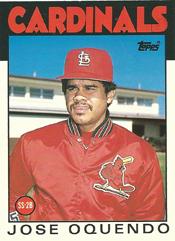
In his first four years in the major leagues, Oquendo hit three home runs. All came against the Giants. The first two occurred in the regular season. The third happened on Oct. 14, 1987, and carried the Cardinals to a National League pennant.

In the decisive Game 7 of the 1987 NL Championship Series at St. Louis, Oquendo hit a three-run home run in the second inning, giving the Cardinals a 4-0 lead. The blast stunned the Giants and inspired the Cardinals, who went on to a 6-0 victory and a berth in the World Series against the Twins.

“You’ve heard of a home run giving somebody a lift,” Cardinals slugger Jack Clark said to the San Francisco Chronicle. “This one lifted us right out of the stadium.”

Asking for trouble

Oquendo was 20 years old and a rookie with the Mets when he hit his first big-league home run. It occurred on Aug. 21, 1983, against Giants left-hander Gary Lavelle at San Francisco.

In 1987, Oquendo was a Cardinals utility player. He produced 71 hits _ 61 for singles. On July 25 that season, Oquendo hit his second big-league home run. It came against Giants left-hander Craig Lefferts at San Francisco.

With another Giants left-hander, Atlee Hammaker, starting Game 7 of the NL Championship Series, Cardinals manager Whitey Herzog sought to stack his lineup with players who batted from the right side. Needing a first baseman to replace Clark, who was injured, Herzog moved right fielder Jim Lindeman to first and chose Oquendo, a switch hitter, to start in right.

In the second inning, the Cardinals led, 1-0, and had Willie McGee on second, Tony Pena on third and one out. Oquendo, the eighth-place batter, was at the plate and pitcher Danny Cox was on deck.

With first base open, Giants manager Roger Craig had the option of walking Oquendo intentionally, setting up a potential force out at every base with Cox at the plate.

Instead, the Giants decided to take their chances with Oquendo.

“I didn’t think Roger Craig would want to pitch to me,” Oquendo said.

Countered Craig: “Hammaker has got out a lot better hitters than Oquendo. With one out, I wouldn’t put Oquendo on … You can second-guess me. I don’t care.”

It’s a gift

With the count even at 2-and-2, Hammaker threw Oquendo a slider that barely missed the strike zone. “Real close,” Oquendo admitted.

The full-count payoff pitch was a cut fastball over the plate. “It hung about as high as the bird on Oquendo’s uniform,” wrote San Francisco columnist Ray Ratto.

“Hung it big as day,” said Giants third baseman Kevin Mitchell.

“I thought they’d try to throw me breaking balls outside,” Oquendo said to the St. Louis Post-Dispatch. “I was surprised he came in.”

“Even then,” said Hammaker to the Santa Rosa Press Democrat, “Oquendo needs luck.”

Taking a confident cut, Oquendo connected with the pitch and drove the ball over the left-field wall at Busch Stadium. Video

“If you’re talking improbable, implausible and almost impossible, how about Jose Oquendo hitting a home run?” wrote Rick Hummel of the Post-Dispatch.

“Was I stunned?” asked Cardinals third baseman Terry Pendleton. “Weren’t you?”

Said Herzog: “It was a goddamn Christmas present.” Boxscore

Hard work pays

Oquendo’s home run occurred on the birthday of his daughter, 3-year-old Adianez. “I feel proud,” Oquendo said.

During the series with the Giants, Doug DiCences, an infielder acquired by the Cardinals from the Angels, had suggested to Oquendo that he watch an instructional hitting video by future Hall of Famer Rod Carew. Oquendo, who admired Carew, studied the video before Game 7, according to the Post-Dispatch.

“He’s probably the hardest worker we have on the ball club,” Cardinals hitting coach Johnny Lewis said of Oquendo. “He was out here today (before Game 7) at 2:30 taking batting practice … He was ready.”

Oquendo would finish his 12-year career in the major leagues with 15 home runs _ 14 in the regular season and one in the postseason.

Only one was hit against a right-hander, Doug Bair of the Pirates.

Previously: How Ozzie Smith motivated Cards to get Jose Oquendo

Previously: Tom Lawless and his role in Cardinals World Series lore
Read Full Post »

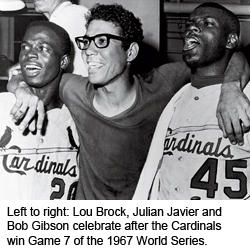
For overall excellence with bat and glove, second baseman Julian Javier earned a place alongside future Hall of Famers Bob Gibson and Lou Brock as a standout for the Cardinals in the 1967 World Series.

The trio capped their consistently strong postseason with clutch performances in the decisive Game 7 against the Red Sox at Boston on Oct. 12, 1967.
After the Cardinals and Red Sox split the first six games, St. Louis prevailed in the finale, 7-2, at Fenway Park. In that game:

_ Gibson pitched a three-hitter, struck out 10 and contributed a home run. He won all three of his starts against the Red Sox and was named recipient of the World Series Most Valuable Player Award.

_ Brock produced two hits, a walk, three stolen bases and scored a run. For the Series, he hit .414 (12-for-29) with seven steals and eight runs scored.

_ Javier delivered the key hit _ a three-run home run. For the Series, he hit .360 (9-for-25) and fielded splendidly. Javier made 12 putouts, helped turn four double plays and made 20 assists. His lone error occurred on a hurried relay throw in the finale.

Brock told United Press International he believed the World Series MVP trophy “has to go to Javier. He made some of the greatest plays I’ve ever seen in addition to his nine hits.”

Strategy session

Through five innings of Game 7, the Cardinals led, 4-1. With Gibson at peak form, the Red Sox realized they likely would need to keep the Cardinals from scoring again in order to have a chance to rally.

In the sixth, Tim McCarver, hitless in his previous 10 at-bats, led off for the Cardinals and stroked a low liner to right against Red Sox ace Jim Lonborg. Ken Harrelson charged in and attempted a diving catch, but the ball glanced off his glove. McCarver hustled to second base with a double.

Mike Shannon followed with a one-hop smash that clanked off third baseman Joe Foy. With McCarver holding at second, Shannon reached first base safely and Foy was charged with an error.

Red Sox manager Dick Williams visited Lonborg on the mound. “I went out there to take him out,” Williams told The Sporting News.

Lonborg asked to stay in. He explained to Williams that the next batter, Javier, likely would try to advance the runners with a sacrifice bunt. Williams agreed.

After Javier, the Cardinals’ eighth- and ninth-place batters, Dal Maxvill and Gibson, were due to bat. If Javier sacrificed, Lonborg figured, he liked his chances of escaping the inning unscathed.

“Jim said he still felt good,” Williams told the St. Louis Post-Dispatch, “and we thought Javier would be bunting.”

Instead, Cardinals manager Red Schoendienst, sensing a chance to drive a dagger into Boston’s hopes, allowed Javier to swing away.

Game changer

Looking to make contact, “I wasn’t trying to hit the ball hard,” Javier said to the Associated Press.

Relying on breaking pitches, Lonborg got ahead in the count, 1-and-2.

The next pitch, a slider, lacked a sharp break and hung in the strike zone.

Javier connected _ “It went up there,” he said of the ball_ and the high drive carried over the Green Monster wall in left field for a home run, giving St. Louis a 7-1 lead.

“This one is a crusher,” Cardinals broadcaster Harry Caray said. Video

As McCarver, Shannon and Javier rounded the bases and reached home plate _ “A joyous parade,” Caray crowed _ many in the Boston crowd fell silent.

The Red Sox managed to score a run in the eighth before Gibson sealed the win in the ninth. Boxscore

Noting that two of the Cardinals’ top hitters had struggled throughout the World Series _ Orlando Cepeda batted .103 and McCarver hit .125 _ Javier said “we could have beat them in five games” if the middle-of-the-order duo had produced better.

A few days after the championship celebration, Javier returned to his home in the Dominican Republic. Arriving at the airport in Santo Domingo, Javier was “given a hero’s welcome,” according to the Post-Dispatch. In a public ceremony, President Joaquin Balaguer presented Javier with the Order of the Fathers of the Country, the Dominican Republic’s highest decoration.

Previously: George Scott: Bob Gibson ‘won’t survive 5’ in Game 7

Previously: World Series duels: Norm Siebern vs. Bob Gibson

Read Full Post »

(Updated Sept. 12, 2025)

Only once has a Cardinals player hit a ninth-inning home run that provided the winning run in the deciding game of a World Series.

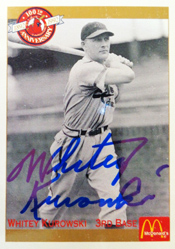
Whitey Kurowski, a rookie third baseman, accomplished the feat.
On Oct. 5, 1942, in Game 5 of the World Series at Yankee Stadium, Kurowski hit a two-run home run in the ninth inning, breaking a 2-2 tie and carrying the Cardinals to a 4-2 victory. The win was the fourth in a row for the Cardinals over the Yankees in the best-of-seven World Series.

Kurowski’s home run rates with those by players such as Ken Boyer (1964), Tim McCarver (1964), Willie McGee (1982), Tom Lawless (1987), Albert Pujols (2011) and David Freese (2011) as being among the most prominent and most important in Cardinals World Series lore.

Beating the odds

George “Whitey” Kurowski, a Reading, Pa., native, debuted with the Cardinals on Sept. 23, 1941 _ six days after another Polish-American from Pennsylvania, Stan Musial, played his first game for St. Louis.

“Kurowski’s right arm, which flaps in the breeze like a seal’s flipper, is the result of a bone operation, in which a large piece was removed from the forearm,” wrote Tom Meany, a New York-based syndicated columnist. “As a kid, he fell off a fence and landed on some broken glass. Osteomyelitis was the result and osteomyelitis is no fun for an 8-year-old who can’t even pronounce it.”

Determined to earn a spot with the 1942 Cardinals, Kurowski was at spring training when he learned his father had died of a heart attack.

Jimmy Brown opened the 1942 season as the Cardinals’ third baseman, with Kurowski in reserve. In May, manager Billy Southworth shifted Brown to second base, replacing Frank “Creepy” Crespi, and made Kurowski the starter at third.

In the book “Few and Chosen,” Cardinals shortstop Marty Marion said Kurowski had “good hands, but he didn’t have much range to his left, so I would cheat toward third. If I went far to my right for a ball, (Kurowski) would hold his glove over his mouth and say, ‘Thank you, Marty, thank you.’ ”

Kurowski, 24, batted .254 with nine home runs and 42 RBI in 115 games for the 1942 National League champions.

Decision time

In Game 1 of the 1942 World Series, Kurowski struck out three times against Yankees starter and future Hall of Famer Red Ruffing.

Kurowski produced a hit in each of the next three games, all Cardinals victories.

Needing one more win to clinch the championship, the Cardinals started rookie Johnny Beazley, winner of Game 2, against Ruffing in Game 5. Ruffing, 37, had seven World Series wins in his career.

In the ninth, with the score tied at 2-2, Walker Cooper led off for the Cardinals with a single to center. Johnny Hopp’s sacrifice bunt moved Cooper to second.

Kurowski batted next. With first base open, Ruffing looked to the dugout to see whether Yankees manager Joe McCarthy wanted him to give an intentional walk to Kurowski. On deck was the eighth-place batter, Marty Marion, who had no home runs during the regular season. After Marion came the pitcher, Beazley.

McCarthy ordered Ruffing to pitch to Kurowski.

Dramatic ninth

Kurowski connected on a high, inside pitch and drove the ball through a fog toward the left-field corner. “Not one-tenth of the spectators saw the ball,” wrote Tom Meany.

The ball _ fair by about five feet _ cleared the fence for a two-run home run, giving the Cardinals a 4-2 lead.

Cooper and Kurowski “received a few pats on the back when they arrived at the bench,” the St. Louis Star-Times reported. “The Cards were not going to celebrate before the final verdict had been sealed.”

The Yankees threatened in their half of the ninth. Joe Gordon led off with a single. Bill Dickey rolled a grounder to second, but Jimmy Brown booted the ball for an error. With runners on first and second, no outs, Jerry Priddy bluffed a bunt. The Cardinals’ catcher, Walker Cooper, fired the ball _ “a lightning peg,” The Sporting News called it _ to Marion, who was covering second. Gordon, caught off guard, was tagged out.

The pickoff took the steam out of the Yankees’ comeback hopes. Priddy popped out (Brown made a sprawling catch on the play) and George Selkirk, batting for Ruffing, grounded out, ending the game and clinching the championship for the Cardinals. Boxscore

Team player

In the victorious clubhouse, Cardinals players “hugged and pounded Kurowski on the back and then hoisted him on their shoulders,” the Associated Press reported. Teammates tore pieces off the back of Kurowski’s uniform pants and kept the shreds as souvenirs.

As the Star-Times noted, “The team spirit that carried the Cardinals to the top of the heap can be best illustrated by Kurowski, blonde-haired Polish boy from the hills of Pennsylvania who sidesteps all personal glory, even after that epic smash.”

Each member of the Cardinals earned a World Series championship share of $6,192.50.

Upon arriving in St. Louis by train from New York, the Cardinals were greeted by a crowd so thick on the station platform “it was hard to see who was coming out of the train,” the St. Louis Post-Dispatch reported.

Then 13 of the Cardinals, including Kurowski, went to the Red Cross headquarters in St. Louis and donated blood for use in treating U.S. military members.


Read Full Post »

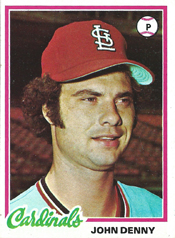
In a season that started spectacularly before shattering into shambles, the low point for Cardinals pitcher John Denny occurred when he was ejected from a game before it began.

On Sept. 27, 1977, Denny was tossed because he ignored an umpire’s directive to stop talking with people in or near the stands.

It was that kind of season for Denny. He won his first seven decisions for the 1977 Cardinals before losing his next eight in a row. During the skid, he was injured and sat out for more than a month.

A year after leading the National League in earned run average, Denny was an underachiever for the 1977 Cardinals.

Up and down

Denny debuted in the big leagues with the Cardinals in September 1974. He earned 10 wins for St. Louis in 1975 and followed that with 11 wins and a league-leading 2.52 ERA in 1976. Denny was especially strong in the second half of the 1976 season, posting ERAs of 1.93 in July, 1.88 in August and 1.15 in September.

His effectiveness carried over into the start of the 1977 season. Denny was 5-0 with a 2.94 ERA in April and his record stood at 7-0 after a shutout victory over the Cubs on May 31.

After that, his season began to unravel. In June, Denny was 0-2 with a 4.91 ERA. He was ejected on June 6 for bumping an umpire and he got tossed again on June 11 for fighting with Reggie Smith of the Dodgers.

On June 21, Denny suffered a hamstring injury and didn’t pitch from June 22 until July 30. After he came back, Denny lost six decisions in a row, dropping his record to 7-8 with a 4.67 ERA.

“That was the worst stretch I’ve ever been through,” Denny said to the St. Louis Post-Dispatch. “It really bothered me.”

Social hour

In their final homestand of the 1977 season, the Cardinals had games with the Expos and Mets.

On Sept. 27, the night before he was scheduled to make a start against the Expos, Denny was talking with people in or near the Busch Stadium stands before the game.

The St. Louis Post-Dispatch and Edwardsville (Ill.) Intelligencer offered slightly different versions of what transpired between Denny and umpire Paul Runge.

_ Post-Dispatch: “Before the game, Runge noticed Denny leaning across the rail, talking to fans in violation of a league rule. When the umpire ordered Denny to return to the dugout, the pitcher got testy and was ejected.”

_ Intelligencer: “Runge objected to Denny talking to photographers in their booth by the dugout after he had asked that players move away from the stands.”

Cardinals management said Runge had overstepped his authority because the game hadn’t started, the Intelligencer reported.

Happy ending

Because Runge was scheduled to work home plate in the Expos-Cardinals game on Sept. 28, Denny was scratched from his start that night by manager Vern Rapp, who wanted to avoid a potential conflict between pitcher and umpire. Rapp moved Denny’s start to Sept. 30 in Game 1 of a doubleheader against the Mets.

Denny, 25, ended the tumultuous season on a high note. He pitched a complete game in a 7-2 Cardinals victory against the Mets. The win was his first since May and evened his record at 8-8.

Denny, who yielded eight hits and issued three walks, was helped by a defense that turned three double plays.

“That was one of the hardest games for me because I had to wait so long to win one,” Denny said. Boxscore

Denny credited pitching coach Claude Osteen with finding and fixing a flaw. “Claude noticed in some films that I had been hurrying too much with my pitches,” said Denny. “That made me erratic with my curve and with my changeup.”

Previously: Larry Dierker and his unsatisfying stint with Cardinals

Read Full Post »

Delivering pitches with a motion that resembled someone cracking a whip, Jim Donohue was a top prospect in the Cardinals’ system.

In 1960, Donohue, a St. Louis native and graduate of Christian Brothers College High School, made a strong bid for a spot on the Cardinals’ Opening Day roster, but fell short of achieving the goal.
Instead, two months later, the Cardinals traded him.

Though he never pitched for the Cardinals in the regular season, Donohue did play two years in the major leagues with three American League teams.

Career choice

Donohue, son of a policeman, was a teammate of Mike Shannon, future Cardinals player and broadcaster, at Christian Brothers.

In June 1956, Donohue graduated from high school and signed with the Cardinals for $4,000.

Asked years later by reporter Jack Herman about the decision to pursue a baseball career rather than follow his father into law enforcement, Donohue replied, “I’d rather pitch than get shot at.”

Donohue, 17, made his professional debut with the 1960 Gainesville (Fla.) G-Men, a Class D club in the Cardinals’ system.

His breakout season _ the one that put him in the top tier of prospects _ occurred two years later, 1958, with the York (Pa.) White Roses, a Class A club managed by Joe Schultz.

Donohue was 7-0 with a 1.48 ERA for York.

Moving up

Impressed, the Cardinals promoted Donohue to their Class AA team, the Houston Buffaloes, in June 1958. In his Houston debut, Donohue pitched a two-hitter in a 4-0 shutout win over the Dallas Rangers. He struck out 11.

In October 1958, Donohue was invited to join other top Cardinals prospects in the Florida Instructional League. Donohue and Gordon Richardson were cited by The Sporting News as “fledgling Cards pitchers from whom much is expected.”

Donohue opened the 1959 season with the Rochester Red Wings, but soon after was sent to St. Louis’ other Class AAA club, the Omaha Cardinals, where he was reunited with manager Joe Schultz. Donohue joined a staff that included other elite pitching prospects such as Bob Gibson and Ray Sadecki.

In July 1959, Donohue pitched a two-hitter for Omaha in a 4-0 triumph over the Minneapolis Millers. Donohue retired 18 consecutive batters until Chuck Tanner singled.

“Manager Joe Schultz’s faith in young Jim Donohue is reaping rich rewards for Omaha,” The Sporting News wrote.

Said Schultz: “He’s got quite a future.”

Donohue had a 2.39 ERA in 28 appearances for Omaha. After the season, St. Louis placed Donohue on its big-league winter roster.

The Whip

During that off-season, Donohue participated in workouts at the St. Louis University gym with fellow area residents Stan Musial, Ken Boyer and Joe Cunningham of the Cardinals.

Donohue reported to 1960 spring training at St. Petersburg, Fla., determined to earn a spot on the big-league pitching staff.

At 6 feet 4 and 175 pounds, Donohue had a “buggy whip” delivery that reminded many of another right-hander, Ewell Blackwell, who had been an all-star with the Reds in the 1940s.

“Jim is rough on right-handed swingers,” Sadecki said. “He throws everything downstairs. They call him The Whip and I guess he is the closest thing to Blackwell in both physique and delivery to come along in several years.”

Sal Maglie, who ended his pitching career with the 1958 Cardinals and stayed with the organization as a scout and instructor in 1959, worked with Donohue to develop a slider to use against left-handed batters.

After Donohue had several effective outings early in 1960 spring training, Cardinals general manager Bing Devine called him the “sleeper” of training camp.

However, in April, just before the Cardinals opened the season, Donohue was sent to Rochester.

“I thought I was going to make it with the Cardinals,” Donohue said.

Big time

Donohue was 4-2 with a 4.03 ERA for Rochester. On June 15, 1960, 30 minutes before the trade deadline, the Cardinals dealt Donohue and outfielder Duke Carmel to the Dodgers for outfielder John Glenn.

In reporting the trade, the Post-Dispatch described Donohue as a “highly regarded pitching prospect who almost stuck with the varsity in the spring” and “rated among the top Cardinals farmhands.”

The Dodgers assigned Donohue to their Class AAA club, the St. Paul Saints, and he spent the rest of the 1960 season there.

In December 1960, the Tigers took Donohue in the minor-league draft. He pitched well at training camp and opened the 1961 season on the Tigers’ Opening Day roster.

Donohue made his big-league debut in the Tigers’ season opener on April 11, 1961. He pitched two scoreless innings of relief against the Indians. Boxscore

On April 23, the Tigers and Angels played a doubleheader at Detroit. Donohue got his first big-league save in the opener and his first big-league win in the second game.

In the ninth inning of the first game, the Angels had the bases loaded, one out, when Tigers manager Bob Scheffing turned to Donohue to protect a 3-1 lead. Donohue retired pinch-hitters Ken Hunt and Leo Burke on pop-outs. Boxscore

In Game 2, Donohue relieved Jim Bunning in the 11th, pitched a scoreless inning and got the win when the Tigers scored in the bottom half of the inning. Boxscore

“Donohue looked good in Florida near the end (of camp),” Scheffing said. “We had a feeling he would be a big help.”

Baseball man

Donohue was 1-1 with one save and a 3.54 ERA when the Tigers traded him to the Angels in June 1961. He got into 38 games with the 1961 Angels and was 4-6 with five saves and a 4.31 ERA.

In 1962, his last season in the majors, Donohue pitched for the Angels and Twins. His combined record for those teams was 1-1 with one save and a 4.67 ERA in 18 appearances.

Fifty-five years later, Donohue’s obituary in the Post-Dispatch noted, “His love for baseball continued throughout his lifetime.”

Previously: Clyde King mentored young Cardinals of 1960s

Read Full Post »

Consistently confrontational, Al Hrabosky was involved in controversy right down to his very last homestand as a Cardinals pitcher.

In 1977, Hrabosky, the so-called “Mad Hungarian,” was involved in a series of incidents, including feuding publicly with manager Vern Rapp, getting suspended by the club for refusing to meet with the manager and incurring the wrath of team owner Gussie Busch by defying a ban on facial hair.

Hrabosky also sparked an on-field brawl in May that year when he hit Cesar Cedeno of the Astros with a pitch.

On Sept. 26, 1977, Hrabosky capped his tumultuous season by throwing a pitch at the head of Warren Cromartie of the Expos in the opening game of the Cardinals’ final homestand.

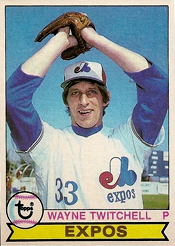
An Expos pitcher, Wayne Twitchell, peeved by what he perceived to be an intentional assault of his teammate, waited outside the Cardinals’ clubhouse to confront Hrabosky after the game.

Tough ninth

The Expos and Cardinals entered the ninth inning of the Monday night game at St. Louis with the score tied at 5-5. Among the highlights to that point were Garry Templeton’s two-run inside-the-park home run against Twitchell in the sixth and Gary Carter’s three-run home run for the Expos in the seventh against Eric Rasmussen.

Rawly Eastwick yielded singles to the first four Expos batters in the ninth. The last of those consecutive hits, by Ellis Valentine, drove in a run and put the Expos ahead, 6-5.

With the bases loaded and none out, Hrabosky relieved Eastwick.

The first batter he faced, Carter, pulled a curveball to left for a single, scoring two and giving the Expos an 8-5 lead.

“The count was 2-and-2 and he had just blown one by me,” Carter said to the Associated Press. “I consider myself a fastball hitter and I was surprised to get the curve. He got it up some and I waited for it.”

Danger zone

Next up was Cromartie. Hrabosky threw a fastball that sailed directly toward Cromartie’s head. Cromartie raised his arm to protect his face and the ball struck his right wrist.

“If he hadn’t got his hand up, it would have hit him right here,” Expos manager Dick Williams, pointing to his temple, said to the St. Louis Post-Dispatch.

Valentine tried to charge from the dugout to the mound to get at Hrabosky, but he was restrained by teammates. Players from both clubs gathered on the field but no fights erupted and no one was ejected.

“He threw at him,” Valentine said. “Everybody on the ball club knew it.”

Hrabosky stayed in the game and completed the inning. The Expos added a run on a sacrifice fly by pitcher Don Stanhouse. The Cardinals failed to score in their half of the ninth and the Expos won, 9-5. Boxscore

Face to face

Hrabosky exited the dugout through a hallway to the clubhouse. As he approached the clubhouse door, he was surprised to see Twitchell there.

Twitchell, 6 feet 6, 215 pounds, pointedly told Hrabosky, 5 feet 11, 185 pounds, that hitting Cromartie with a pitch right after yielding a two-run single to Carter “was very poor timing.”

“I asked what the hell he thought he was doing,” Twitchell said. “He said it was unintentional.”

Several Cardinals had gathered in the hallway on their way to the clubhouse. “I was drastically outnumbered,” Twitchell said.

Asked whether he was seeking a fight, Twitchell said, “If that’s what it came to, but he wouldn’t swing.”

Twitchell departed and went to the Expos clubhouse.

“He hung a pitch and Carter gets a hit,” Twitchell said of Hrabosky. “Now he’s going to take it out on the next hitter? If you are going to brush back a hitter, there’s no worse place you can put the ball.”

Hrabosky declined to comment to reporters.

Said Cardinals manager Vern Rapp: “There was no intent. What does a guy want to hit him for with two men on and nobody out?”

Hrabosky pitched in three more games for the Cardinals. After the season, he was traded to the Royals.

Previously: Bake McBride was a menace against Wayne Twitchell

Previously: Gary Carter and his two 5-RBI games against Cardinals

Read Full Post »

« Newer Posts - Older Posts »