Feeds:
Posts
Comments

Archive for the ‘Games’ Category

In the last game the Cardinals played against the Giants at the Polo Grounds in New York, Stan Musial delivered a performance worthy of Broadway.
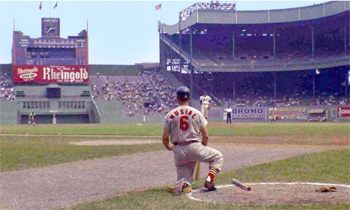
On Aug. 21, 1957, Musial bid a dramatic farewell to the Giants at one of his favorite ballparks, hitting a home run in the first inning against former teammate Stu Miller at the Polo Grounds.

In two subsequent plate appearances that Wednesday afternoon, Musial also produced an infield single and a sacrifice fly before being removed from the game by Cardinals manager Fred Hutchinson.

Though Musial and the Cardinals never would play the Giants again at the Polo Grounds, they would return to the ballpark five years later, in 1962, when the Mets joined the National League as an expansion club.

Musial and the Cardinals would face the Mets at the Polo Grounds in 1962 and 1963. After the 1963 season, Musial retired, the Mets moved to Shea Stadium and the Polo Grounds was demolished.

In August 1957, however, there was no inkling that major-league baseball would be played at the Polo Grounds after that season.

Go west

In May 1957, National League club owners gave permission to the Giants to move from New York to San Francisco and for the Dodgers to transfer from Brooklyn to Los Angeles.

Three months later, on Aug. 19, the Giants’ board of directors, by an 8-to-1 vote, approved the proposal to relocate the franchise to San Francisco for the 1958 season. The Giants had been in New York for 74 years.

On Aug. 20, the day after the board made its decision, the Cardinals played a doubleheader against the Giants at the Polo Grounds. The Cardinals won both games before a crowd of 13,198.

The next day, Aug. 21, the Cardinals and Giants played for the final time at the Polo Grounds. The game drew 5,296 spectators to the ballpark along Eighth Avenue and West 159th Street between Coogan’s Bluff and the Harlem River in upper Manhattan.

NL’s best

The starting pitchers were Lindy McDaniel for St. Louis and Stu Miller, a former Cardinal, for the Giants.

Batting third in the orders were two of the all-time best _ Musial for the Cardinals and Willie Mays for the Giants.

The Polo Grounds had unusual dimensions. The distance from home plate to the deepest part of center field was about 480 feet. Down the lines, it was 258 feet from the plate to the right field foul pole and 279 feet from the plate to the left field foul pole.

In the first inning, Musial hit a home run into the upper deck in right.

In the Giants’ half of the first, Mays hit a home run over the left-field roof.

Facing 18-year-old rookie reliever Mike McCormick, Musial got an infield single in the third and a sacrifice fly in the fifth.

With the Giants ahead, 11-3, Hutchinson opted to give Musial a rest and removed him from the game in the sixth.

Musial, 36, was leading the National League in batting average (.342) and RBI (97) and had 29 home runs.

“As far as I’m concerned, he’s the most valuable player in the National League this year and it couldn’t happen to a nicer guy,” Cardinals general manager Frank Lane said to the St. Louis Post-Dispatch. Boxscore

Big Apple fan

In 11 games at the Polo Grounds in 1957, Musial batted .439 (18-for-41) with six home runs and 14 RBI.

Asked by New York writers whether he would miss the Polo Grounds, Musial replied, “Yes. The Polo Grounds makes a hero or a bum out of you. It can throw you into a terrible batting slump if you try to pull too much. It can give you the toughest out on the longest drives anywhere and the cheapest home runs. I’ve had my good years here and others not so good, but overall I’ve been fortunate. I’ll miss the park and the fans and the city’s legitimate theater, too.”

Musial and the Cardinals returned to the Polo Grounds to play the Mets on April 18, 1962. Musial had two hits and two RBI.

Three months later, on July 8, 1962, Musial, 41, hit three home runs against the Mets at the Polo Grounds. He’s the oldest player to hit three home runs in a big-league game.

Musial, 42, appeared at the Polo Grounds for the final time on Aug. 8, 1963, against the Mets. Pinch-hitting in the ninth, he drew a walk.

In 171 games at the Polo Grounds against the Giants and Mets, Musial batted .343 with 216 hits, including 49 home runs. He hit more home runs at the Polo Grounds than he did at any other ballpark outside St. Louis.

Previously: How Stan Musial made me a Cardinals fan

Previously: Stan Musial still oldest to belt 3 home runs in game
Read Full Post »

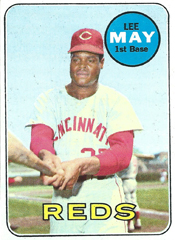
Lee May, one of the National League’s most consistent sluggers in the late 1960s and early 1970s, hit for both average and power against the Cardinals.

A first baseman known as “Big Bopper,” he played for the Reds (1965-71) and Astros (1972-74) in the National League before going to the American League with the Orioles and Royals.
In 103 games versus the Cardinals, May had 128 hits, 26 doubles, 16 home runs and 63 RBI. His career .327 batting average against the Cardinals is 60 points higher than his career major-league mark of .267.

A standout high school athlete in Birmingham, Ala., May was offered a football scholarship to play fullback at the University of Nebraska, but he elected to sign a baseball contract with the Reds. He modeled his swing after his boyhood idol, American League slugger Harmon Killebrew.

“May was a husky bear of a man with the disposition of a newborn cub, a guy with a wondrous sense of humor, a guy loved by everybody who came into contact with him,” wrote Hal McCoy in the Dayton Daily News.

From 1969-74, May ranked among the top 10 in the NL in home runs each year. In 1970, when he hit 34 home runs for the pennant-winning Reds, May delivered one of his most memorable long balls _ a grand slam against the Cardinals.

Keep swinging

On July 20, 1970, the Reds and Cardinals had a Monday twi-night doubleheader at Busch Stadium in St. Louis.

May was in a slump. He had batted .304 in May but .220 in June. Hitless in his three previous games, he entered the doubleheader with a .246 batting average.

“I’ve been pressing a little,” May said to the Associated Press. “It’s always natural for a guy in a slump to press. When you’re in a slump, you look at it like the other team has about 20 infielders and 20 outfielders. So it really doesn’t make any difference who is pitching.”

In the opener, May was 1-for-4. His two-out double in the eighth against Jerry Reuss drove in Tony Perez from second base. When left fielder Lou Brock bobbled the ball, Johnny Bench raced from first to home, tying the score at 3-3. A run-scoring single by Bobby Tolan in the ninth lifted the Reds to a 4-3 victory. Boxscore

Reds manager Sparky Anderson intended to rest May in the second game. “He’s been in a little slump,” Anderson said. “I was going to get him away from the field and give him a chance to relax. Then he said, ‘I don’t need mental help. I just need my swings.’ ”

Winning wallop

May started Game 2 and was in his usual fifth spot in the batting order.

The starting pitchers, Tony Cloninger of the Reds and Chuck Taylor of the Cardinals, engaged in a scoreless duel. Cloninger shut out the Cardinals for eight innings before being relieved by Wayne Granger. Taylor shut out the Reds through nine.

Taylor faced the minimum 27 batters before he was lifted for a pinch hitter. He yielded three singles, but two of the runners were erased on double play grounders and the other was caught by catcher Joe Torre attempting to steal second.

With the score at 0-0, a rookie, Bob Chlupsa, was chosen by Cardinals manager Red Schoendienst to pitch the 10th.

The Reds loaded the bases with one out on singles by Pete Rose and Bernie Carbo and a walk to Perez.

May stepped to plate and drove a pitch 400 feet over the wall in left-center for a grand slam.

“It was a fat pitch _ fastball, high _ and that’s what he gets paid to hit,” Chlupsa said to the St. Louis Post-Dispatch.

Said May: “I feel a little confidence coming back. I feel like I’m going to shake this thing.”

Granger retired the Cardinals in order in the bottom half of the 10th, giving the Reds a 4-0 victory and a sweep of the doubleheader. Boxscore

The Reds set a NL record in the game by playing 10 innings without leaving a runner on base.

Fast learner

Three months later, May hit .389 (7-for-18) with two doubles and two home runs against the Orioles in the 1970 World Series.

“He might get fooled on a pitch, but on that same pitch, the next time he sees it, he’ll knock it out of the park,” said Reds hitting coach Ted Kluszewski.

After the 1971 season, May was sent to the Astros in the trade that brought future Hall of Fame second baseman Joe Morgan to the Reds.

May played 18 seasons in the big leagues and produced 354 home runs and 1,244 RBI.

His brother, Carlos May, played 10 seasons (1968-77) in the big leagues as an outfielder for the White Sox, Yankees and Angels.

Previously: Johnny Bench was nemesis of Steve Carlton

Read Full Post »

Expected to supply power and run production, Mark McGwire was a dud in his first 10 games with the Cardinals.

Slow to adjust to National League pitching, McGwire batted .088 in 10 games after being acquired by the Cardinals from the Athletics on July 31, 1997.
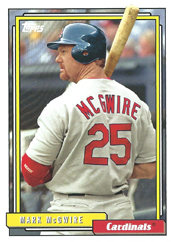
McGwire had three hits and one RBI in his first 34 at-bats for the Cardinals. He produced two singles in seven games before hitting a home run in his eighth. He was hitless in the next two.

The Cardinals lost eight of those 10 games.

After that, McGwire recovered from his slump and delivered the offense most expected. In light of subsequent revelations, the question of whether performance-enhancing drugs aided his breakout cannot be dismissed.

In 2010, McGwire told the Associated Press he used steroids on and off for nearly a decade, beginning after the 1989 season.

“I remember trying steroids very briefly in the 1989-1990 offseason and then after I was injured in 1993, I used steroids again,” McGwire said. “I used them on occasion throughout the 1990s, including during the 1998 season.”

McGwire told Bob Costas of MLB Network that studying pitchers and making his swing shorter _ not performance-enhancing drugs _ led to his increase in home runs, but skeptics weren’t convinced.

“I think that’s a lot of horse muffins,” Hall of Fame pitcher Bob Feller said. “If it didn’t help him any, what the hell was he taking them for? Of course it helped him.”

Singles hitter

McGwire, acquired for pitchers T.J. Mathews, Eric Ludwick and Blake Stein, went hitless with a walk in his first Cardinals game on Aug. 1, 1997, at Philadelphia.

The next day, Aug. 2, he got his first Cardinals hit, an infield single against the Phillies’ Matt Beech.

McGwire was hitless over the next three games _ one at Philadelphia and two at New York versus the Mets.

On Aug. 6, he got his second Cardinals hit, a bloop single to center against the Braves’ Greg Maddux.

McGwire was hitless the next night, Aug. 7, versus the Braves. His batting average after seven road games versus the Phillies, Mets and Braves was .080.

“I’m big into visualization,” McGwire told the St. Louis Post-Dispatch. “You have to visualize how the pitch is going to come and what kind of pitch he has. When I’m facing a guy for the first time … they’re getting me out before I really see what they have.”

Cardinals manager Tony La Russa noted that Ray Lankford had been sidelined because of a hamstring injury since McGwire joined the team. La Russa had planned to bat Lankford third in the order. Without Lankford, McGwire, in the cleanup spot, batted behind a rotation of No. 3 hitters _ Phil Plantier, John Mabry, Willie McGee and Ron Gant.

Still, it was surprising, if not concerning, that McGwire, acquired to provide instant offense, was without an extra-base hit after seven games.

“All I can say is this is very humbling,” McGwire said.

Welcome home

McGwire’s eighth Cardinals game, on Aug. 8, was his first home game. He hadn’t been in St. Louis since playing there in an exhibition game for Team USA in 1983.

Lankford returned to the lineup for that night’s game against the Phillies at Busch Stadium. La Russa batted Lankford third and McGwire fourth in the order.

When McGwire came to the plate in the first inning, with runners on first and second, one out, most among the crowd of 38,300 gave him a standing ovation. McGwire popped out to the second baseman.

In the third, with the Cardinals ahead, 2-0, Lankford hit a solo home run against Mark Leiter. Two pitches later, McGwire followed with his first Cardinals home run. The ball, which barely avoided hooking into foul territory, traveled 441 feet before slamming into the glass exterior of the Stadium Club dining area above the left field bleachers.

The crowd roared its approval. After returning to the dugout, McGwire emerged onto the top step and waved to the fans. Video

“I don’t think I’ve ever heard a crowd so loud in a regular-season game,” McGwire said.

In his last two at-bats of the game, McGwire flied out to right and walked. The Cardinals won, 6-1. Boxscore

Many homers, no pennants

After the feel-good home debut, McGwire went hitless against the Phillies in the remaining two games of the series. The Cardinals lost both.

In the Aug. 10 game, the Busch Stadium scoreboard, at La Russa’s request, displayed McGwire’s combined 1997 batting average with the Athletics and Cardinals (.267) rather than just his St. Louis mark.

After 10 games with the Cardinals, McGwire had an .088 batting average, two singles, one home run, one RBI and 12 strikeouts in 34 at-bats. It also didn’t go unnoticed that Mathews had three wins for the Athletics since being dealt for McGwire.

On Aug. 12, McGwire hit a double and a home run against the Mets’ Dave Mlicki. From then on, he improved his production.

In 25 games in August, McGwire hit nine home runs with 18 RBI and had an on-base percentage of .408.

In 26 games in September, McGwire hit 15 home runs with 24 RBI and had an on-base percentage of .413.

Overall for the 1997 Cardinals, McGwire hit 24 home runs with 42 RBI in 51 games. The Cardinals finished 73-89.

He had two epic seasons for the Cardinals in 1998 and 1999. McGwire hit 70 home runs with 147 RBI in 1998 and 65 home runs with 147 RBI in 1999, but the Cardinals failed to qualify for the postseason both years.

Previously: How Cardinals were able to acquire Mark McGwire

Read Full Post »

(Updated Jan. 9, 2019)

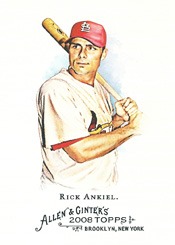
Early in the 2007 season, the Cardinals had a plan to call up Rick Ankiel from the minor leagues in September to see what he could do. By mid-summer, when Ankiel continued to clout home runs at a consistent clip for Memphis, the plan changed and the Cardinals moved up their timetable.

On Aug. 9, 2007, Ankiel returned to the big leagues with the Cardinals after a three-year absence.
When he had left, he was a pitcher.

He came back as an outfielder.

Arriving in St. Louis from Memphis late that Thursday afternoon, Ankiel was inserted in the starting lineup for that night’s game against the Padres.

It was a memorable return. Ankiel hit a three-run home run, signaling that his transformation from pitcher to slugger was no stunt.

Something to consider

In 2000, his first full season with the Cardinals, Ankiel was a starting pitcher. The left-hander earned 11 wins and struck out 194 in 175 innings. His career quickly unraveled during the 2000 postseason when he suddenly lost the ability to pitch in the strike zone.

Frustrated by injuries and unhappy with his career path, Ankiel decided during spring training in 2005 to give up pitching and become an outfielder.

Assigned to the minor leagues, Ankiel played for two Cardinals farm clubs _ Quad Cities and Springfield, Mo., _ in 2005. His combined statistics that season included 21 home runs and a .275 batting average.

Injured, Ankiel sat out the 2006 season.

In 2007, the Cardinals assigned him to their top farm team, Memphis, where he produced 104 hits in 102 games, with 32 home runs and 89 RBI.

Lineup upgrade

On Aug. 8, when asked by the St. Louis Post-Dispatch about Ankiel, Cardinals manager Tony La Russa said, “We’re talking about when is the right time” for a call-up.

Later that day, as the Memphis team was in Tacoma, awaiting a flight back home, Memphis manager Chris Maloney informed Ankiel the Cardinals wanted him to report to St. Louis the next day because a roster spot opened when Scott Spiezio went on leave to address a substance abuse problem, Ankiel said in his 2017 book “The Phenom.”

Ankiel arrived at Busch Stadium at 4 p.m. on Aug. 9, 2007.

“I pulled open the door to a major-league clubhouse I’d sometimes wondered if I’d ever see again,” Ankiel said in his book.

La Russa put Ankiel in the lineup as the right fielder and batted him second in the order, behind David Eckstein and ahead of Albert Pujols.

“It’s very overwhelming,” Ankiel admitted.

Ankiel, 28, hadn’t appeared in a major-league game since Oct. 1, 2004.

“If I didn’t think having him in the lineup gives us a better chance to win, he wouldn’t be here,” La Russa said.

Home sweet home

Ankiel received a standing ovation when he stepped to the plate in the first inning. Facing Chris Young, the Padres’ 6-foot-10 pitcher, Ankiel popped out to shortstop.

Young struck out Ankiel in the second and again in the fifth.

In the seventh, the Cardinals led, 2-0, and had runners on second and third, two outs, when Ankiel came to bat against Doug Brocail.

“I just hope people have patience and realize he’s still not a polished major-league hitter,” Cardinals television broadcaster Al Hrabosky said to viewers.

Broadcast partner Dan McLaughlin replied, “Chance here to make an impression, though.”

Ankiel pulled a 2-and-1 slider over the right-field wall, thrilling the crowd and his teammates.

In the dugout, La Russa beamed and applauded. Ankiel raised his right fist in triumph as he reached first base. Video

“Almost seven years after it had happened the first time, I felt as though I’d left my body again,” Ankiel said in his book. “This time, however, there was no panic. My breaths were short _ not out of fear but in celebration, in joy. I could feel the game in my heart, in my soul.”

Ankiel got a curtain call from the crowd of 42,848. Boxscore

“I’m happy to be home,” Ankiel said.

Power supply

Declaring Ankiel’s home run the “best single moment in St. Louis sports in 2007,” Post-Dispatch columnist Bernie Miklasz also wrote, “It was great theater and it moved anyone who witnessed it. Most of all, the homer gave us another indication of Ankiel’s strong, competitive character. He didn’t give up on himself after a barrage of misfortune that would have ruined many athletes. Ankiel deserved the joy and happiness that came his way.”

Jim Riggleman, the Cardinals’ minor-league field coordinator, said, “The moment he stopped pitching is the same moment he became the No. 1 power bat in the system.”

Ankiel had hit two home runs as a Cardinals pitcher in 2000. He became the first big-league player since Clint Hartung to hit his first big-league home run as a pitcher, return to the majors as a position player and hit a home run again. Hartung pitched for the Giants from 1947-50 and he was an outfielder for them in 1951 and 1952.

Before Hartung, the last major-league player to hit his first home run as a pitcher, change positions and hit a home run again was Babe Ruth.

On Aug. 11, two days after his dramatic return to the big leagues, Ankiel again dazzled. He hit two home runs _ a two-run shot off starter Derek Lowe and a solo blast off Roberto Hernandez _ in a 6-1 Cardinals triumph over the Dodgers at St. Louis.

In 47 games for the 2007 Cardinals, Ankiel produced 49 hits, with 11 home runs and 39 RBI.

The next year, Ankiel had his best season as a hitter, with 25 home runs and 71 RBI in 120 games for the 2008 Cardinals.

Previously: Pitching or hitting, Rick Ankiel was marvel and mystery

Read Full Post »

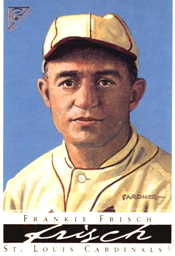
The last hit of the Hall of Fame career of Frankie Frisch completed a ninth-inning comeback that carried the Cardinals to a walkoff victory and inspired his teammates to carry Frisch off the field.

In 1937, Frisch, 40, was manager of the Cardinals. He also was in his last season as a player.

Frisch had been a standout second baseman for the Giants from 1919 to 1926. After he was dealt for Rogers Hornsby, Frisch continued his success with the Cardinals, helping them to four National League pennants and two World Series titles. He became their player-manager in 1933.

As late as 1936, Frisch played 59 games at second base and 22 at third base for the Cardinals, batting .274 with an on-base percentage of .353.

In 1937, however, Frisch seldom appeared in the lineup.

His last game at second base was on May 29, 1937. Over the next two months, he had five at-bats as a pinch hitter. Frisch failed to reach base in any of those plate appearances.

So it was a bit of a surprise when, with the outcome on the line in the Cardinals’ game against the Braves on Aug. 4 at St. Louis, Frisch put himself at the plate as a pinch hitter.

Keep the line moving

The Braves led, 6-2, entering the bottom of the ninth inning of the Wednesday afternoon game before 2,303 spectators at Sportsman’s Park.

Braves starter Lou Fette, who had a 13-3 record, appeared to be in control. The rookie from Alma, Mo., retired two of the first three batters in the ninth. Terry Moore, who had walked, was on first base when Johnny Mize came to the plate, representing the Cardinals’ last hope.

With a four-run lead, the Braves weren’t holding Moore at first. So, he went to second base uncontested while Fette focused on Mize.

Mize singled to right, scoring Moore and cutting the Braves’ lead to 6-3.

Joe Medwick followed with a double to left-center, driving home Mize and making the score 6-4.

Braves manager Bill McKechnie, the former Cardinals skipper, brought in Guy Bush to relief Fette. Bush had a 2.76 ERA.

Don Padgett greeted him with a single to right, scoring Medwick and reducing the Braves’ lead to 6-5.

Don Gutteridge got the Cardinals’ fourth consecutive hit _ a single to left. When Padgett advanced from first to third on the play, drawing the throw from the outfield, Gutteridge alertly took second.

With runners on second and third, Pepper Martin, sent to pinch-hit for Leo Durocher, received an intentional walk, loading the bases.

Stout heart

Mickey Owen was due up next for the Cardinals. A rookie catcher, Owen was the Cardinals’ eighth-place batter. He was 1-for-4 in the game, giving him a .214 batting mark for the season.

Frisch, who was batting .194 and hadn’t produced a hit since May 28, grabbed a bat and stood in at the plate for Owen.

“I felt I was the right man in this spot,” Frisch said to the St. Louis Star-Times. “I believed I could deliver the much-needed hit in the pinch … Why should I put some other man in that spot when I figured I could get a hit myself?”

Frisch, a switch hitter, batted from the left side against Bush, a right-hander. Swinging at the first pitch, Frisch “slashed it down the first-base line like a shot out of a howitzer,” the Star-Times reported.

The ball eluded first baseman Elbie Fletcher and bounded into right field. Padgett scored from third with the tying run and Gutteridge raced from second to the plate with the winning run for a 7-6 Cardinals victory. Boxscore

Frisch’s teammates rushed toward him, lifted him onto their shoulders and carried him triumphantly to the dugout.

“The best pinch-hit I’ve ever seen,” Medwick said.

Frisch, the Star-Times observed, “still packs a pretty stout heart beneath those red birds on his Cardinals uniform shirt.”

The hit gave Frisch 2,880 for his big-league career.

The next day, Frisch batted for the final time. Pinch-hitting in the ninth for Moore, Frisch grounded into a double play in a game the Cardinals lost 4-1 to the Braves.

Frisch finished with a career batting mark of .316 and 1,244 RBI. He was inducted into the National Baseball Hall of Fame in 1947.

Previously: Kolten Wong, Frankie Frisch gave Cards pop at 2nd

Read Full Post »

(Updated Oct. 17, 2024)

With a drive to the outfield depths of Sportsman’s Park, Enos Slaughter altered the course of a National League pennant race in favor of the Cardinals.

Slaughter hit a walkoff inside-the-park home run that lifted the Cardinals to an extra-inning victory over the Dodgers and completed a doubleheader sweep of the NL leaders on July 19, 1942.

The Dodgers’ top player, center fielder and NL batting leader Pete Reiser, suffered a concussion when he crashed into a concrete outfield wall while pursuing Slaughter’s smash.

The sweep moved the second-place Cardinals to within six games of the Dodgers.

Reiser, who rushed back to the lineup too soon, struggled to hit over the last two months of the season. That was a factor in enabling the rejuvenated Cardinals to overtake the Dodgers at the end of the season and win the pennant.

Musial gets mad

The Dodgers entered the July 19 doubleheader at St. Louis with an eight-game lead over the Cardinals. A Dodgers sweep threatened to demoralize the Cardinals.

In Game 1, the Cardinals led, 7-0, in the fourth inning when Stan Musial batted against rookie Les Webber. A month earlier, Musial had hit a home run off him.

Webber threw an inside pitch that moved Musial off the plate. Musial yelled out to Webber. The next pitch “came dangerously close to Stan’s head,” according to the St. Louis Star-Times.

Angered, Musial uncharacteristically moved toward Webber with his bat in hand. Webber started toward Musial. (“I didn’t know what I was going to do once I got there,” Musial told Cardinals Yearbook in 1991.)

Players from both dugouts poured onto the field, but umpires stepped between Musial and Webber. No punches were thrown and the showdown quickly dissolved. Musial continued his at-bat and grounded out.

Two innings later, Webber batted and was hit by a pitch from Mort Cooper. Led by four RBI from Johnny Hopp, the Cardinals went on to an 8-5 victory. Boxscore

Going all-out

In Game 2, the Cardinals led, 6-2, after three, but the Dodgers scored four in the fifth, tying the score at 6-6. The game went into extra innings.

It was 7:37 p.m. and dusk was arriving when Slaughter led off the bottom of the 11th against Johnny Allen and launched an 0-and-2 pitch deep into center field.

“It’s a line drive directly over my head, and my first thought was that it can be caught,” Reiser told author Donald Honig in the book “Baseball When the Grass Was Real.”

Reiser raced back _ “He was traveling like a bullet,” Dodgers left fielder Joe Medwick told The Brooklyn Daily Eagle _ turned and caught the ball. A split second later, Reiser crashed into the wall, his head banging against the concrete. The ball squirted out of his glove and bounced toward the flagpole.

“It was like a hand grenade had gone off inside my head,” Reiser told Donald Honig.

As Slaughter sped around the bases, Reiser got to his feet, “staggered dizzily after the ball” and threw to the cutoff man, shortstop Pee Wee Reese, according to accounts in both the Star-Times and Daily Eagle. “How I did that I’ll never know,” Reiser told Honig.

In a rare double relay, Reese flipped the ball to second baseman Billy Herman, who was better positioned to make a strong peg to catcher Mickey Owen.

As Slaughter rounded second, he looked up and saw Cardinals manager Billy Southworth, coaching at third, “waving his arms like mad,” Slaughter said.

“I really gave that sprint around the base paths everything I had,” Slaughter told the Star-Times.

Slaughter “slid under the throw in a cloud of dust” for a home run that gave the Cardinals a 7-6 triumph. Boxscore

Eager to return

Dodgers players rushed to Reiser, who was leaning against the outfield wall. Reiser, a St. Louis native, walked off the field, went to the clubhouse, showered and dressed, according to the Star-Times.

Still wobbly, Reiser was taken to a hospital. Dr. Robert Hyland said X-rays revealed Reiser had a concussion, but no fractures.

The next day, July 20, Reiser, against the advice of doctors, left the hospital and went to his parents’ home in St. Louis. After spending the night there, Reiser boarded a noon train on July 21 and went to rejoin his teammates in Brooklyn.

Four days later, on July 25, Reiser was back in the Dodgers’ lineup.

Reiser, who was batting .350 at the time of his injury, was a diminished player afterward. He hit .206 in August and .233 in September.

The Cardinals surged to records of 25-8 in August and 21-4 in September and finished in first place at 106-48, two games ahead of the Dodgers.

Read Full Post »

« Newer Posts - Older Posts »