Feeds:
Posts
Comments

Archive for the ‘Games’ Category

(Updated Nov. 21, 2024)

In their many duels from 1959-72, Bob Gibson threw brushback pitches to Roberto Clemente to keep him from taking ownership of the plate. The tactic was rooted in a machismo kind of respect, not dislike, and Gibson never hit Clemente with a pitch.
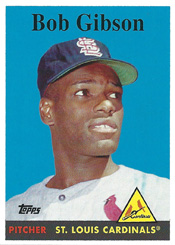
One time, though, Clemente hit Gibson.

The incident became a prominent part of Cardinals lore.

On July 15, 1967, Clemente hit a ball that struck Gibson and fractured a bone in his right leg.

Unaware of the severity of the injury, Gibson remained in the game and pitched to three more batters before collapsing.

Many predicted the injury, which would sideline Gibson for almost two months, would ruin the Cardinals’ championship hopes.

Instead, the Cardinals pulled together and went on to win the 1967 National League pennant and World Series title.

Back off

Clemente, a career .317 hitter, batted .208 (26-for-125) with 32 strikeouts against Gibson.

In his book “Stranger to the Game,” Gibson said of Clemente, “I always threw at him. He swung way too hard against me, flinging himself at the ball and spinning around in the batter’s box like he was on the playground. I had to demonstrate to him I was no playground pitcher. To that end, I made a point of throwing at least one fastball in his direction nearly every time he came to the plate.”

(In the book “Voices From Cooperstown,” pitcher Robin Roberts said of Clemente, “He was the most unorthodox good ballplayer I ever saw … When he swung, he’d lunge and hit bad balls … He really looked less like a ballplayer than anyone I’ve ever seen … The only thing that made him look sensational was the results … but everything he did was an effort. Nothing was graceful or smooth.”

Gibson said he liked Clemente and learned to laugh at his antics.

“It was virtually impossible to ignore him because he was always talking,” Gibson said. “Usually, it was to complain about how much his back or his shoulder or some other thing was hurting him. Then he would step in the batter’s box and swing so hard that the flagsticks on top of the stadium would bend.”

Just tape it

The Pirates went hitless in the first three innings against Gibson on July 15, 1967, in St. Louis. Clemente, leading off the fourth, hit a ball that rocketed straight toward Gibson and struck him on the shin.

“All my weight is on my right foot on my follow through,” Gibson said to the St. Louis Post-Dispatch. “That’s why I couldn’t get out of the way of the ball. I couldn’t even lift my foot because the weight was on it.”

The force of the blow knocked down Gibson. Trainer Bob Bauman rushed to the mound and sprayed ethyl chloride on Gibson’s leg. “He advised me to take a look,” Gibson said. “I saw what he saw _ a dent in the skin the shape of a baseball.”

Clemente’s smash cracked Gibson’s fibula, a bone in the lower part of the leg.

Gibson, though, didn’t feel much pain. “In this type of injury, there is shock immediately and no pain,” said Cardinals team physician Dr. I.C. Middleman.

Said Gibson: “It was odd that I couldn’t feel where I had been struck, but because I couldn’t feel it I wasn’t particularly worried. I told Doc (Bauman) to put a little tape on it and let me get back to work.”

Now it’s broke

Gibson threw some practice pitches and declared himself fit to continue. “While it was true I didn’t surrender easily to pain or injury, at the time I didn’t fully realize what I was doing,” Gibson said. “I assumed I had picked up a hell of a contusion.”

Pirates slugger Willie Stargell told the Atlanta Constitution, “You could hear the leg pop. I knew something was wrong, but Gibson stayed in.”

When play resumed, Gibson walked Stargell and got Bill Mazeroski to fly out to center. The next batter, Donn Clendenon, worked the count to 3-and-2.

“I tried to put a little extra on the payoff pitch,” Gibson said.

As the pitch sailed outside the strike zone for ball four, Gibson collapsed.

“Initially, the bone had been fractured, but not separated,” Gibson said. “It was only when I came down on it so hard (on the last pitch) _ my motion concentrated a lot of weight and spinning momentum on my right leg _ that it broke cleanly in two. If that hadn’t happened, I might have continued the season uninterrupted.”

Said Middleman: “He has a high threshold for pain. You or I would have been writhing from the pain.”

Setting an example

Gibson was taken to a hospital and his leg placed in a cast. “At the hospital, he didn’t even want a shot,” Middleman told The Sporting News. “All we gave him was a little codeine.”

The Pirates won the game, 6-4, cutting the Cardinals’ lead over the second-place Cubs and Reds to four. Boxscore

After witnessing Gibson’s will and determination, Cardinals pitchers who might have complained about minor ailments or tiredness felt inspired to push forward.

The Cardinals were 36-19 during the time Gibson was sidelined. Nelson Briles and Dick Hughes each won seven of nine decisions during Gibson’s absence; Steve Carlton won five of seven.

When Gibson returned to action on Sept. 7, the Cardinals were 87-53, 11.5 games ahead of the second-place Cubs and Giants.

“I felt a little awkward with all the gushy rhetoric that accompanied the incident,” Gibson said, “but if it provided a constructive example for the ballclub, so be it.”

Gibson, 10-6 when injured, won three of four decisions after his return and finished 13-7. The Cardinals completed the season at 101-60, 10.5 ahead of the runner-up Giants.

In the ensuing World Series against the Red Sox, Gibson made three starts and earned wins in all.
Read Full Post »

In the home of the Big Red Machine, it was a Cardinal, Ray Lankford, who put on an unprecedented display of jaw-dropping power.

Cincinnati’s Riverfront Stadium was the venue for Reds teams that won four National League pennants and two World Series championships from 1970 to 1976. Those teams had sluggers such as Johnny Bench, Tony Perez and George Foster.
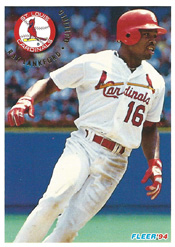
Yet, it was Lankford who became the first to hit two home runs in one game into the upper-level red seats in the fourth deck of the Cincinnati stadium.

Lankford achieved the feat on July 15, 1997. By then, the stadium had been renamed Cinergy Field.

Sonic boom

Lankford was in the cleanup spot in the St. Louis batting order against Reds starter Brett Tomko, a rookie right-hander.

In the first inning, with Danny Sheaffer on base, Lankford got a fastball on a 2-and-1 count and drove it 448 feet into the empty red seats in right field, becoming the first Cardinals batter to reach the upper deck since the stadium opened in 1970.

“When you hit a ball like that, it’s just a different feel and a different sound,” Lankford said to The Cincinnati Post. “The ball just jumps, like you’re hitting a golf ball with a bat.”

Reds catcher Joe Oliver told the St. Louis Post-Dispatch, “The crack of the bat was deafening.”

When Lankford came up again in the third inning, three fans scurried into the red seats in right. Batting with the bases empty, Lankford again got a fastball on a 2-and-1 count and propelled it 439 feet into the upper deck.

“Fastballs. Both belt-high. Right down the middle,” Tomko said to the Cincinnati Enquirer.

Said Cardinals manager Tony La Russa: “You’ve got a pitcher with good stuff and a hitter with full extension. That makes for some serious distance.”

Exclusive group

Until Lankford, only one player, Foster, had hit two upper-deck home runs at the stadium in one year, but no one, not even the Cardinals’ Mark Whiten, had hit two in one game. Whiten hit four home runs in a game at Riverfront Stadium on Sept. 7, 1993, but none reached the red seats.

Foster hit the most career upper-deck home runs (six) at the stadium.

Lankford became the sixth visiting player to hit a home run into the red seats. The others: the Expos’ Bob Bailey, the Pirates’ Dave Parker, the Phillies’ Greg Luzinski, the Mets’ Darryl Strawberry and the Rockies’ Dante Bichette.

“I don’t know how to pitch to Lankford,” Reds manager Ray Knight said. “I know one thing, you don’t pitch him anywhere he can get the fat part of the bat on it.”

When Lankford came to bat for the third time, in the fifth inning, Oliver turned to him and said, “I knew you were strong, but this is ridiculous.”

About 30 fans went into the red seats in right, hoping Lankford would launch another up there, but reliever Felix Rodriguez issued an intentional walk to him.

In his last two plate appearances that night, Lankford struck out and walked. Boxscore

At the time of Lankford’s feat, bopper Mark McGwire still was with the Athletics. (McGwire would be traded to the Cardinals two weeks later, on July 31, 1997.)

Asked by the Post-Dispatch whether Lankford’s clouts reminded him of McGwire, whom he had managed in Oakland, La Russa replied, “He reminds me of Ray Lankford.”

Previously: Mark Whiten, Josh Hamilton: Same feat, different path

Read Full Post »

Initially, most thought Lou Gehrig, not Earl Averill, delivered the most damaging shot against Dizzy Dean in the 1937 All-Star Game. It wasn’t until later in the summer that the impact of Averill’s low liner off the big toe of the Cardinals ace began to be understood.

On July 7, 1937, Dean was one out away from completing his starting stint for the National League all-stars at Washington when he yielded a single to Joe DiMaggio and a home run to Gehrig.
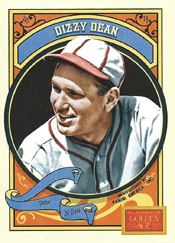
Averill followed with a smash up the middle. The ball hit Dean’s left toe and caromed to second baseman Billy Herman, who threw to first in time for the final out of the third inning.

Dean went to the clubhouse and listened to the remainder of the game on the radio. His toe was throbbing but he didn’t bring attention to the injury when meeting with reporters.

Instead, the media focus was on the hits Dean allowed to DiMaggio and Gehrig. Dean admitted to the Associated Press he ignored catcher Gabby Hartnett’s calls for curveballs to the Yankees sluggers. Dean, looking for strikeouts, threw fastballs to them.

DiMaggio singled hard to center on a 1-and-2 count and Gehrig hit his towering home run to right on a 3-and-2 count. “Those guys were lucky stiffs,” Dean said.

Averill, looking for a fastball, got it on the first pitch and drove it right back toward Dean. Boxscore

Just a bruise

Dean returned to St. Louis and had the aching toe examined by Dr. Robert F. Hyland, the club physician. Hyland said the toe was bruised, not broken, and prescribed rest for Dean, according to the St. Louis Post-Dispatch.

Dean, who had a 12-7 record and 2.41 ERA, was scratched from his scheduled start July 11 versus the Reds.

During his recuperation, Dean clipped a newspaper photo showing his bandaged foot, autographed it, inscribed “Thanks, Earl” and mailed it to Averill.

Though Dean still was limping, Cardinals management instructed him to join the team in Boston. When he arrived, manager Frankie Frisch asked Dean whether he could pitch. Dean said he could.

On July 21, two weeks after he was injured, Dean started against the Braves in Boston. He pitched eight innings and yielded two runs, but he altered his delivery to compensate for the pain in his toe. By throwing with an unnatural motion, Dean damaged his arm.

“I was unable to pivot my left foot because my toe hurt too much,” Dean said according to the biography “Diz” by Robert Gregory. “I was pitching entirely with my arm and putting all the pressure on it. I felt a soreness … I shouldn’t have been out there.”

Said catcher Mickey Owen: “His fastball had nothing on it, nothing at all.” Boxscore

Keep going

Four days later, on July 25, Dean started against the Dodgers in Brooklyn and pitched into the 11th inning of a game halted because of darkness with the score tied at 7-7. Boxscore

“It was evident early that there was something wrong with Dizzy’s arm,” the Post-Dispatch reported. Dean “was merely lobbing the ball over the plate.”

Asked about his toe, Dean said, “I’d forgotten about the toe. My arm hurts me so bad I didn’t know I had a toe.”

The next day, Dean, grimacing in pain, went to Cardinals trainer Harrison Weaver and told him, “This toe of mine is broke.”

Still, the Cardinals started Dean on Aug. 1 at home against the Dodgers. “I couldn’t follow through with my pitches and my shoulder hurt every time I threw,” Dean said after pitching 6.1 innings.

Dean started and pitched six innings on Aug. 8 at home against the Phillies.

“Frisch never pitched him against his will,” Cardinals outfielder Terry Moore said. “He relied on Diz to tell him how he felt.”

Nothing serious

After sitting out for two weeks, Dean earned a complete-game win in a start on Aug. 22 against the Pirates at Pittsburgh.

“It took much talking by his comrades to get Dizzy through the nine innings,” the Post-Dispatch reported. “He wanted to quit after seven and complained bitterly about misery in his right arm.”

Dean contributed three hits _ two singles and a home run _ and three RBI. Boxscore

Four days later, on Aug. 26, Dean started against the Phillies at Philadelphia, gave up a double to the leadoff batter and was lifted. Frisch told him to return to St. Louis and get examined by Hyland.

Hyland diagnosed Dean with bursitis of the right shoulder and prescribed rest. “In the opinion of Dr. Hyland, the pitcher’s arm ailment is not serious,” the Post-Dispatch reported.

About two weeks later, on Sept. 8, Dean started against the Cubs at Chicago and pitched a complete game, “though he threw without his usual graceful follow through and with little of his usual burning speed,” according to the Post-Dispatch. Boxscore

“I don’t think I did bad for a fellow whose arm hurt him on every pitch,” Dean said.

Cardinals executive Branch Rickey suggested Dean sit out a full year but said the decision was up to him. Dean rejected that idea, but he was done pitching for the season. His record after the all-star break was 1-3. Without an effective ace, the 1937 Cardinals finished in fourth place, 15 games behind the champion Giants.

Just before the start of the 1938 season, on April 16, the Cardinals traded Dean to the Cubs. After posting a 134-75 record in his Cardinals career, Dean was 16-8 in four seasons with the Cubs.


Read Full Post »

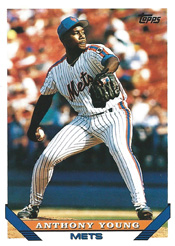
To avoid setting a major-league record for futility, Anthony Young needed to beat the Cardinals, but he couldn’t do it.

On June 27, 1993, Young was the losing pitcher for the 24th time in a row in a 5-3 Cardinals victory over the Mets at New York.
Young’s 24 consecutive losses over two seasons surpassed the big-league mark of 23 straight defeats by Cliff Curtis of the 1910-11 Braves.

Young would lose 27 decisions in a row before earning a win.

On the skids

Young was a defensive back and University of Houston football teammate of Heisman Trophy winner Andre Ware, but baseball was Young’s preferred sport and he believed it offered him his best chance for a professional career.

A right-hander, Young made his big-league debut with the 1991 Mets and finished the season at 2-5 with a 3.10 ERA.

In 1992, Young won his first two decisions, including an April 9 start against the Cardinals, before losing 14 in a row, including two to the Cardinals, and finishing with a 2-14 record and 4.17 ERA.

Young was 0-9 in 1993 _ giving him a record-tying 23 consecutive losses over two seasons _ when he entered the June 27 game against the Cardinals at Shea Stadium

Playing with fire

The Mets scored twice in the first, but the Cardinals rallied against Young with three runs in the fourth and two in the sixth. Rod Brewer contributed a two-run double for St. Louis and Brian Jordan, Tom Pagnozzi and starting pitcher Joe Magrane each had a RBI-single.

Each starter pitched seven innings: Magrane allowed 10 hits, no walks and three runs. Young yielded eight hits, two walks and five runs.

Magrane, who earned his fifth consecutive win, was relieved Young didn’t break the losing streak against him.

“I would have rather faced Doc Gooden or Bret Saberhagen,” Magrane said to the St. Louis Post-Dispatch. “I certainly didn’t want to be the answer to a trivia question. I was really scared of the game. It was like dancing on the rim of Vesuvius, waiting for it to explode. I was hoping that I wasn’t going to be the one to be torched.” Boxscore

Said Young: “It was the same old thing. I thought I pitched a pretty good game except for a couple of hits.”

Dallas Green, who was evaluating all the Mets after replacing Jeff Torborg as manager a month earlier, said Young “has a great arm … but the important things to scout are the head and the heart.”

Cardinals closer Lee Smith, expressing empathy for Young, said to the Associated Press, “I’d tell him to hang in there. I know what he’s going through. I was with the Cubs.”

Season to forget

After his loss to the Cardinals, Young lost three more in a row, stretching the streak to 27, before he earned a win on July 28 against the Marlins.

Young finished the 1993 season with a 1-16 record and a 3.77 ERA.

He spent the 1994 and 1995 seasons with the Cubs, posting an overall mark of 7-10, before completing his major-league career with a 3-3 record for the 1996 Astros.

His overall record in the majors: 15-48 with a 3.89 ERA.

Young’s career record against the Cardinals is 1-6 with a 2.86 ERA in 16 appearances, including six starts. Three of his losses during his streak of 27 were to the Cardinals.

Previously: Why 22-game loser Roger Craig appealed to Cardinals

Read Full Post »

Taking advantage of a pitching staff with the worst earned run average in the National League, the 1937 Cardinals capped a doubleheader sweep of the Phillies by scoring their most runs in an extra inning.

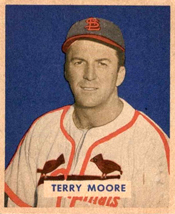
On July 16, 1937, Terry Moore hit a three-run home run to highlight an eight-run 10th inning in an 18-10 Cardinals victory. Boxscore

No Cardinals club has scored more in an extra inning, though the 2017 team came close to matching the feat.

On June 20, 2017, Yadier Molina and Tommy Pham each hit a two-run home run to highlight a seven-run 11th in an 8-1 Cardinals victory over the Phillies. Boxscore

Hitter’s haven

The 1937 Phillies had one of the worst pitching staffs all-time. The Phillies finished the season with a 5.05 team ERA, yielding 868 total runs. Only three of their pitchers posted an ERA better than 5.00: Claude Passeau (4.34), Orville Jorgens (4.41) and Bucky Walters (4.75).

Just before the 1937 Cardinals arrived in Philadelphia, the Phillies blew a 10-4 lead at home, giving up six runs in the ninth, and losing 11-10 to the Giants in 10 innings.

The Friday afternoon doubleheader between the Cardinals and Phillies drew a Ladies Day crowd of about 9,000 in sweltering conditions.

“It was a hot, muggy day,” wrote J. Roy Stockton of the St. Louis Post-Dispatch. “It is funny to hear people in Philadelphia talk about the St. Louis heat. You can breathe in St. Louis. In Philadelphia, when it is hot, the humidity creeps up and stifles you. It was that kind of a day.”

Walters started Game 1 for the Phillies and allowed a solo home run to Moore, a two-run home run to Joe Medwick and a double to Johnny Mize before he was relieved by Jorgens after retiring one batter.

The Cardinals scored five in the first _ four of the runs charged to Walters _ and five in the fifth off Jorgens, cruising to a 10-3 victory. Si Johnson pitched a complete game and earned the win for the Cardinals. Boxscore

It’s raining runs

Moore led off Game 2 by lofting a pop fly to George Scharein, a rookie shortstop. As Scharein made the catch, his cap fell off. When he reached for it, the ball slipped out of his glove. Moore, who hustled into second base, was ruled safe by umpire Bill Stewart.

Phillies fans, who thought Scharein had held onto the ball long enough for the play to be ruled an out, “threw pop bottles from the stands in the direction of Stewart,” the Post-Dispatch reported.

Trailing 6-5, the Cardinals scored five in the eighth _ two off Wayne LaMaster and three against Walters _ for a 10-6 lead, but the Phillies responded with four off Lon Warneke in the bottom half of the inning, tying the score at 10-10.

After Walters held the Cardinals scoreless in the ninth, St. Louis manager Frankie Frisch brought in the Game 1 winner, Si Johnson, to pitch the bottom half of the inning. The Phillies didn’t score and the game went to an extra inning.

In the 10th, the Cardinals scored three off Walters and five against Jorgens for an 18-10 lead.

“Singles, doubles and home runs blossomed quicker than worms on a concrete walk after a rainstorm,” wrote Stan Baumgartner of the Philadelphia Inquirer.

When Johnson sealed the victory with a scoreless 10th, he earned his second win of the day. Walters was the losing pitcher in both games, even though he had “more stuff than he ever showed before,” Stewart, the umpire, told The Sporting News.

Previously: How Cardinals, Reds kept their heads above water

Read Full Post »

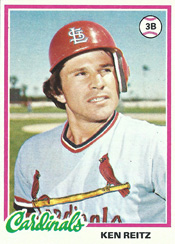
In his most productive game for the Cardinals, Ken Reitz redefined the meaning of the Mendoza Line.

On June 28, 1977, Reitz had a career-high eight RBI against the Pirates in the second game of a Tuesday night doubleheader at St. Louis.

Reitz, the Cardinals’ third baseman, generated those RBI on three hits: a single and two home runs.

The first home run was a grand slam off starter Grant Jackson.

The second was a three-run shot off Mario Mendoza.

Pace setter

An infielder, Mendoza was making his first and only big-league pitching appearance.

As a hitter, Mendoza often had a season batting average of about .200. He eventually became the symbol of the minimum expected of a big-league batter. Today, a .200 batting average commonly is referred to as the Mendoza Line.

As a pitcher, the Mendoza Line is a 13.50 earned run average. That’s what he posted after facing Reitz and the Cardinals.

Let’s play two

In the first game of the June 28 doubleheader, Reitz had a single in four at-bats and the Cardinals won, 6-1.

Cardinals manager Vern Rapp offered to let Reitz sit out the second game _ “He’d been going so hard all season and it was hot,” Rapp explained to the St. Louis Post-Dispatch _ but Reitz wanted to play because the Pirates were starting Jackson, a left-hander. Reitz hit .282 against left-handers in his big-league career and .247 versus right-handers.

Rapp put Reitz in the No. 5 spot in the batting order.

After grounding out in the first inning, Reitz got a RBI-single off Jackson in the third, extending the Cardinals’ lead to 4-2. “The first RBI was the most exciting because it helped us get rolling,” Reitz said.

In the fourth, Reitz, batting with two outs, hit a high, inside pitch off Jackson _ “It was not in the strike zone,” Reitz said _ for the grand slam, putting the Cardinals ahead, 10-2.

“I didn’t even know how many guys were on base when I hit the grand slam because I was concentrating so much at-bat,” Reitz said.

Tough job

With the score 10-3, Pirates manager Chuck Tanner lifted Jackson after six innings. Wanting to rest an overworked bullpen staff, Tanner turned to Mendoza.

“We’ve had him throw batting practice,” Tanner said to United Press International. “We had five games in three days and figured this was a good time to use him.”

Mendoza told the Pittsburgh Press, “My dad used to be a pitcher in the semipros … He said pitching is a tougher life than to be a shortstop.”

Mendoza, a right-hander, pitched a scoreless seventh, getting Keith Hernandez to line out into an inning-ending double play.

In the eighth, Reitz faced Mendoza with runners on first and second, two outs. Mendoza threw a wild pitch, advancing the runners, Roger Freed and Tony Scott, to second and third.

Reitz pulled the next pitch, a breaking ball, down the line. The ball struck the corner of the foul pole for a home run, giving the Cardinals a 13-3 lead. Boxscore

“He’s got a surprisingly good curveball,” Reitz said. “He just threw one too many to me and I happened to hit it down the line. I usually just get doubles off those pitches.”

Reitz was the first Cardinals batter with eight RBI in a game since Augie Bergamo did it in Game 2 of a doubleheader against the Giants on July 4, 1945, at New York.

Reitz would finish the 1977 season with single-season career highs in home runs (17) and RBI (79).


Read Full Post »

« Newer Posts - Older Posts »